

Every training cycle and nutrition tweak changes your body in ways you can’t always feel or see, but beneath the surface, a network of biological signals is constantly at work. For athletes and biohackers, understanding these signals means moving beyond guesswork into the world of objective measurement with biomarkers. Biomarkers provide real-time snapshots of your internal health, connecting your choices to cellular changes that influence performance, recovery, and long-term vitality. By unlocking the story hidden in your own numbers, you gain the power to personalize your path toward stronger, healthier living.
Table of Contents
- What Biomarkers Reveal About Your Body
- Types of Biomarkers and Their Functions
- Interpreting Biomarker Results Accurately
- Applying Data to Optimize Health and Performance
- Common Pitfalls and Misunderstandings
Key Takeaways
| Point | Details |
|---|---|
| Biomarkers Provide Insight | Biomarkers offer real-time data about your health, revealing underlying biological states and helping tailor personalized health interventions. |
| Context is Crucial | Proper interpretation of biomarker results requires considering individual lifestyle, training history, and other contextual factors. |
| Focus on Priority Markers | Identify and prioritize specific biomarkers directly related to your health goals for targeted improvement and better outcomes. |
| Avoid Common Pitfalls | Ensure biomarkers are validated, account for measurement errors, and interpret results in the context of personal health rather than population averages. |
What Biomarkers Reveal About Your Body
Your body is constantly communicating with itself, sending chemical messages and biological signals that tell a complete story about your health. A biomarker is an objective measure that captures biological states or processes within your body at any given moment. Think of biomarkers as your internal health dashboard: they range from simple measurements like blood pressure and body weight to molecular and cellular changes detectable in genes, proteins, or metabolic compounds. This means biomarkers function as early warning systems that reveal relationships between your current lifestyle, environmental exposures, and potential health risks before symptoms even appear.
What makes biomarkers particularly powerful for athletes and biohackers is their ability to provide real-time snapshots of what’s happening beneath the surface. Most people understand that running faster or lifting heavier weights indicates fitness improvements, but biomarkers show you why these changes are happening at the cellular level. Are your amino acid profiles optimized for muscle synthesis? Is your inflammatory status spiking after training, or recovering properly? Are your micronutrient levels supporting your performance goals? Characteristics that can be objectively measured help evaluate your current health state and how your body responds to the stressors you’re imposing on it, whether that’s intense training, dietary changes, or supplements. This is where precision health becomes actionable rather than generic.
Consider how different biomarkers reveal distinct aspects of your physiology:
- Metabolic markers (glucose, insulin, lipids) show how efficiently your body processes fuel and whether you’re heading toward metabolic dysfunction
- Amino acid profiles reveal whether your dietary protein intake is actually being utilized for muscle recovery and synthesis
- Micronutrient status (vitamin D, B vitamins, iron, magnesium, zinc) exposes hidden deficiencies that silently undermine performance and recovery
- Hormone levels (cortisol, testosterone, estrogen, thyroid function) indicate whether training load, sleep quality, and stress management are balanced
- Inflammatory markers show whether your training is creating productive adaptation or chronic overtraining stress
- Cardiovascular markers measure not just cholesterol but specific lipid particle types that predict actual risk rather than population averages
The insight here is that biomarkers eliminate guesswork. Instead of following generic nutrition advice or training protocols designed for the average person, you get data specific to your unique biology. Someone might have “normal” total cholesterol but carry the particle types most associated with cardiovascular risk. Another person might show adequate B12 on conventional testing but demonstrate metabolic insufficiency when measured at a deeper level. Your baseline might look completely different from someone with identical training goals, which is exactly why personalized interpretation matters.
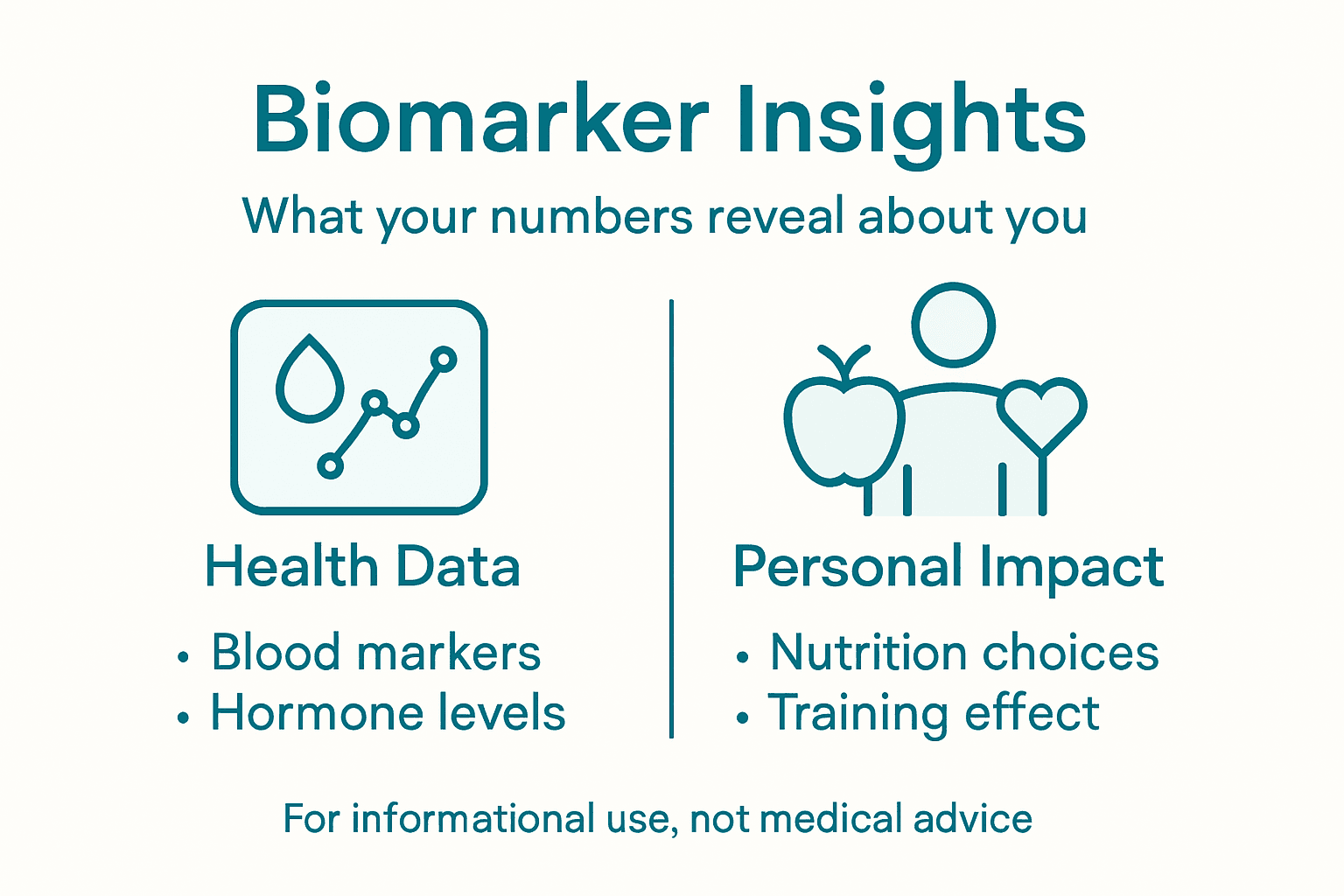
Pro tip: When reviewing your biomarker results, focus first on the markers that directly connect to your specific goals: athletes concerned with recovery should prioritize amino acid profiles and inflammatory markers, while those focused on longevity might emphasize cardiovascular and metabolic markers. This targeted approach helps you identify the highest-impact interventions rather than trying to optimize everything simultaneously.
Types of Biomarkers and Their Functions
Not all biomarkers work the same way or serve the same purpose. Understanding which type of biomarker you’re looking at is critical because it changes how you interpret the data and what actions you should take. Biomarkers are classified according to what they measure and their specific applications in monitoring health. Think of them as different instruments in a diagnostic toolkit, each one designed to answer a different question about your body. Some biomarkers tell you about exposures you’ve experienced, others reveal how your body is currently responding to those exposures, and still others predict your future risk based on your genetics or current physiology. This means a single blood test can contain multiple types of biomarkers, each providing different intelligence about your health status.
Exposure biomarkers measure the levels of chemicals or substances currently in your body, whether from your environment, diet, or supplements. If you’ve been taking a specific mineral supplement, exposure biomarkers show exactly how much is circulating in your bloodstream and whether you’re actually absorbing it. Response biomarkers are biological indicators of health effects that reveal how your body is reacting to stressors. For example, elevated inflammatory markers are response biomarkers showing that your training load, diet, or stress level is triggering inflammation at the cellular level. Susceptibility biomarkers include genetic variations that affect your disease risk or how you respond to interventions. Someone might carry a genetic variation that makes them more sensitive to caffeine, more prone to high cholesterol, or better at recovering from intense exercise. These three categories form the foundation of how we think about what’s happening inside your body.
Beyond these broad categories, there are distinct biomarker roles that deserve specific attention depending on your goals:
- Diagnostic biomarkers confirm whether you actually have a specific condition right now. A positive test for a particular pathogen or metabolic disorder falls into this category.
- Prognostic biomarkers predict your future risk of developing a disease. High lipoprotein(a) levels, for instance, predict cardiovascular risk years before symptoms appear.
- Monitoring biomarkers track disease progression or response to treatment over time. Athletes use monitoring biomarkers to measure training adaptations, recovery status, and whether their current protocol is working.
- Predictive biomarkers identify who will benefit most from a specific intervention. Your genetic profile might predict whether you’ll respond better to a certain nutrient protocol or training approach.
- Pharmacodynamic biomarkers show how your body is responding to a specific treatment or supplement at the molecular level, revealing the actual mechanism of action happening inside you.
- Safety biomarkers detect early signs of harm or adverse effects before they become serious health problems.
The practical implication for athletes and biohackers is that you need context for every number. A single cholesterol reading without particle size analysis is a diagnostic snapshot but doesn’t tell you about your cardiovascular risk. Amino acid ratios are monitoring biomarkers that show whether your current diet and training protocol are working in synergy. Vitamin D levels are prognostic because they predict bone health, immune function, and recovery capacity months into the future. Some biomarkers matter more at certain life stages too. A 28-year-old focused on building muscle should weight amino acid profiles and testosterone levels more heavily than someone at 45 focused on cardiovascular health and metabolic stability. The key is understanding not just what a biomarker measures, but what type it is and what it actually tells you about your biology.
Pro tip: When you receive your biomarker panel, organize results by type and function rather than treating every number with equal importance; diagnostic and monitoring biomarkers demand immediate attention and action, while prognostic biomarkers should inform your long-term prevention strategy.
Here’s a quick reference comparing major biomarker categories and their impact on health decisions:
| Biomarker Type | What It Measures | Clinical Value | Action Implications |
|---|---|---|---|
| Exposure | Environmental/dietary | Reveals current status | Guides avoidance or intake |
| Response | Biological adaptation | Assesses resilience | Adjusts training or recovery |
| Susceptibility | Genetic predisposition | Predicts risk | Enables targeted prevention |
| Diagnostic | Current diseases | Confirms condition | Triggers immediate intervention |
| Prognostic | Future risk prediction | Guides strategy | Drives long-term prevention |
| Monitoring | Ongoing changes | Tracks interventions | Fine-tunes ongoing protocols |
| Predictive | Likely responders | Identifies responders | Tailors choice of intervention |
| Safety | Early harm detection | Prevents complications | Prompts stopping interventions |
Interpreting Biomarker Results Accurately
Getting your biomarker results back is only half the battle. A stack of numbers without context is like having a car’s dashboard lit up with warning lights but no manual to tell you what each one means. Accurate interpretation requires understanding the context surrounding your results, including your lifestyle, training history, dietary patterns, and individual susceptibility factors. Interpreting biomarker results requires understanding environmental exposures and individual susceptibility alongside biological responses your body is mounting. This is where precision health becomes personal: your vitamin D level of 35 ng/mL might be adequate for someone living in a sunny climate with minimal sun exposure needs, but critically low for an athlete training intensely at altitude or someone with genetic variations affecting vitamin D metabolism. The same testosterone reading means something completely different for a 25-year-old athlete versus a 50-year-old managing age-related decline. Context transforms data into actionable intelligence.

One of the biggest mistakes people make is comparing their results directly to reference ranges without accounting for individual variation and testing methodology. Reference ranges represent population averages, not optimization targets. Standard lab ranges for cholesterol, for example, are designed to identify disease risk at a population level, not to support athletic performance or longevity goals. Your amino acid profile needs interpretation through the lens of your specific training protocol, recovery capacity, and dietary intake. If your branched-chain amino acid ratio is lower than the reference range suggests, that matters tremendously if you’re training hard with insufficient protein intake, but might be completely normal if you’re in a planned recovery phase or eating adequately. Accurate interpretation requires rigorous analysis methods and understanding study design to avoid drawing false conclusions from your data. This is why working with qualified professionals who understand biomarker science is valuable. They ask the critical questions: When was this tested relative to your training cycle? What’s your current diet composition? Are you experiencing symptoms that correlate with these findings? What was your baseline before any lifestyle interventions?
Here’s how to interpret your results responsibly:
- Look for patterns, not isolated numbers. A single high inflammatory marker might be noise from a hard training session. Consistently elevated markers across multiple tests suggest a real issue requiring intervention.
- Compare to your own baseline. Your personal trend matters more than population averages. If your vitamin B12 dropped 30 percent in three months, that’s significant even if it’s still technically “normal.”
- Consider timing and context. Blood drawn the morning after an intense training session looks different from blood drawn after a recovery day. Micronutrient levels fluctuate seasonally. Hormone levels vary by time of day and menstrual cycle phase.
- Understand confidence intervals. Biomarker tests have measurement error. A result of 42 with a confidence interval of 38 to 46 is actually different from a result of exactly 42 with no variability.
- Cross-reference multiple markers. High cholesterol paired with excellent triglycerides, low inflammatory markers, and healthy particle size tells a different story than high cholesterol with elevated triglycerides and inflammatory dysfunction.
- Account for supplement and medication interactions. Many biomarkers shift when you change your supplement protocol, and pharmaceutical medications influence dozens of markers simultaneously.
The most dangerous interpretation error is assuming your results tell you the complete story. A comprehensive metabolic panel showing normal glucose and insulin doesn’t mean you’re metabolically optimized if your fasting insulin is 8 mU/L, which falls within “normal” ranges but suggests emerging insulin resistance for someone focused on performance. Conversely, a prognostic marker like lipoprotein(a) showing elevated cardiovascular risk doesn’t mean you’re destined for heart disease if you understand your genetic predisposition and implement appropriate preventive strategies. Biomarkers are snapshots and predictions, not destiny. They show you where you are and where you’re headed if you maintain your current trajectory, which means they’re useful precisely because they’re actionable.
Pro tip: Request the actual reference ranges and methodology used when you receive results, then assess whether you’re comparing yourself to healthy population averages or optimization targets aligned with your specific goals; this single step prevents misinterpretation and guides you toward meaningful changes rather than chasing irrelevant numbers.
Applying Data to Optimize Health and Performance
Having data is only valuable if you actually use it. The real power of biomarkers emerges when you translate numbers into specific actions designed to move those numbers in the direction that matters for your goals. This is where most people fall short. They get a comprehensive biomarker panel, look at the results, maybe feel worried about a few values outside normal ranges, and then do nothing different because they don’t have a clear optimization framework. Biomarker data supports optimized health and performance by enabling personalized approaches that tailor interventions specifically to your biology rather than following generic protocols. The athlete with chronically elevated cortisol needs a completely different recovery strategy than the athlete with adequate cortisol but insufficient sleep quality markers. The person with depleted magnesium needs targeted supplementation, while someone with adequate magnesium levels might need micronutrient balance adjustments elsewhere. Precision means specificity. Your biomarker results are essentially a personalized diagnostic report that tells you exactly where your biology is breaking down and what specific levers you can pull to fix it.
Applying biomarker data starts with establishing a baseline and then creating a hypothesis about what specific intervention will improve specific markers. This is where the scientific method becomes practical. You measure amino acid ratios and find them suboptimal for muscle synthesis. Your hypothesis: increasing protein intake from 1.4 grams per kilogram of body weight to 1.8 grams per kilogram combined with better distribution across meals will improve amino acid profiles at your next test in three months. You measure inflammatory markers and find persistent elevation despite adequate training recovery. Your hypothesis: reducing processed carbohydrate intake and adding targeted antioxidant support will reduce inflammatory burden. Applying biomarker data involves assessing changes and making informed decisions about continuing or adjusting your interventions based on response patterns. You implement the protocol, track adherence carefully, and retest. Did the markers move? If yes, you continue and potentially optimize further. If no, you adjust the hypothesis and try something different. This is data-driven optimization rather than guesswork.
Here’s a practical framework for applying biomarker data effectively:
Identify Your Priority Markers
Not all biomarkers deserve equal attention. Your comprehensive panel might contain 50 different measurements, but only a handful are actually driving your health limitations or performance ceiling. Start by identifying which markers directly correlate with your specific goals and constraints. If you’re training hard but recovering poorly, priority markers include amino acid ratios, sleep quality indicators, cortisol patterns, and inflammatory markers. If longevity is your focus, cardiovascular markers, metabolic indicators, and cellular aging biomarkers become priorities. If you’re managing a chronic condition, diagnostic and monitoring markers related to that condition take precedence.
Create Specific, Measurable Interventions
Vague goals fail. “Improve my amino acid profile” is too abstract. Specific goals work: “Increase leucine by 15 percent and improve leucine to isoleucine ratio from 2.1 to 2.4 by consuming 35 grams of leucine-rich protein within two hours post-training five times weekly.” You’ve identified the specific marker change desired, the specific dietary intervention, the frequency, and the timing. This specificity is what allows you to know whether your intervention actually worked.
Test Comprehensively but Strategically
Retesting everything every month wastes money and creates noise. Instead, retest your priority markers on a schedule that makes sense for your intervention timeline. Dietary changes typically show biomarker responses within 6 to 12 weeks. Training adaptations appear in performance markers within 4 to 8 weeks. Genetic markers don’t change at all. Create a testing timeline that matches the expected response period of your interventions.
Adjust Based on Response
Your first hypothesis might be correct, or it might be completely wrong. If your amino acid profile improved dramatically with higher protein intake, that validates your hypothesis and you continue refining that approach. If it didn’t change despite perfect adherence, your hypothesis was incorrect and you need a different intervention. Perhaps your absorption is limited, or your training stimulus isn’t sufficient to drive adaptation, or another factor is constraining that particular marker. This is where working with qualified professionals accelerates your learning because they help distinguish between interventions that need more time, interventions that need optimization, and interventions that need replacement.
Pro tip: Focus your first biomarker optimization on a single system (metabolic, recovery, or cardiovascular), implement your intervention for the full expected adaptation window without changing multiple variables simultaneously, then retest to confirm response before moving to optimize your next priority; this systematic approach prevents wasted effort and provides clear feedback about what actually works for your individual biology.
Common Pitfalls and Misunderstandings
Biomarker testing has democratized access to health data, but this accessibility comes with a cost: widespread misinterpretation. The most dangerous pitfall is treating biomarkers as if they directly predict health outcomes without understanding their limitations. You might see a headline claiming that a specific biomarker indicates disease risk, assume that your elevated level means you’re destined for that disease, and then panic without cause. Common pitfalls in biomarker interpretation include using non-validated biomarkers and misapplying them outside their intended context, which leads to inaccurate conclusions. A biomarker might be scientifically valid for predicting disease risk in a specific population under specific conditions but completely unreliable when applied to you. Lipoprotein(a) is a genuinely predictive cardiovascular risk factor, but knowing your level tells you nothing definitive about your personal risk without considering your family history, actual cardiovascular function, inflammatory status, and dietary and lifestyle factors. This is where the complexity of biological systems creates confusion. Biomarkers provide information, not answers. They’re signals worth investigating, not definitive diagnoses.
Another critical mistake is confusing surrogate markers with actual outcomes. A surrogate marker is a biomarker you assume will predict a real health outcome, but the assumption might be wrong. LDL cholesterol became a classic example: for decades, lowering LDL was assumed to prevent heart disease universally, so drugs were developed to lower it aggressively. But some people with very low LDL still had heart attacks, while others with high LDL never did. The surrogate marker didn’t perfectly predict the actual outcome. This taught us that inconsistent terminology and misunderstanding of biomarker context can lead to misguided interventions and wasted resources. When you’re interpreting your biomarker results, ask yourself: Is this a direct measure of my health status, or is it a proxy I’m assuming will predict something else? Is that assumption validated for my specific situation? Has anyone proven this particular biomarker actually predicts outcomes in people like me? These questions prevent you from over-correcting based on a signal that might be meaningless for your personal health.
Here are the specific pitfalls that appear again and again:
- Using untested biomarkers as if they were validated. A biomarker might be biologically interesting and theoretically predictive, but if it hasn’t been rigorously validated in clinical studies, you’re essentially guessing about what it means. Always ask whether your biomarker has been validated specifically for your use case.
- Ignoring biological variability and measurement error. Your biomarker result has an inherent margin of error. A result showing 28 ng/mL might actually be anywhere from 26 to 30 ng/mL depending on testing methodology, time of day, and individual variation. Chasing small changes within that error margin is pointless.
- Comparing yourself to someone else’s optimal range. What’s optimal for an elite endurance athlete differs completely from optimal for a powerlifter or someone managing autoimmune disease. Population averages are useful context, but your personal optimization targets need to account for your specific physiology and goals.
- Treating a single test as definitive. One elevated inflammatory marker after a hard training session is noise. Three tests across three months showing consistently elevated inflammation is a signal. Build patterns before drawing conclusions.
- Implementing too many interventions simultaneously. If you retest after changing your protein intake, sleep schedule, supplement protocol, and training volume all at once, you have no idea which change actually moved your markers. You’ve created uncontrolled chaos.
- Overestimating your ability to self-diagnose. You can track data and notice patterns, but biomarker interpretation in the context of actual health outcomes requires expertise. A qualified professional asks questions you won’t think to ask and recognizes relationships between markers that individual data points hide.
The most subtle pitfall might be confirmation bias. You get your biomarker results expecting a certain story (“I’m healthier than I’ve ever been” or “my training is ruining my health”), and you interpret all your biomarkers through that lens. You ignore inconvenient numbers that don’t fit your narrative and emphasize ones that do. Real biomarker interpretation requires intellectual honesty about what your data actually shows, even when it contradicts what you wanted to believe.
Pro tip: Before implementing any intervention based on biomarker results, verify that the biomarker is scientifically validated for your specific use case, understand whether you’re acting on a surrogate marker or direct outcome measure, and always test whether the intervention actually changes the biomarker in the direction you expected before assuming it’s working.
Below is a summary of common biomarker pitfalls and how to avoid them for reliable results:
| Pitfall | Why It’s Problematic | How to Avoid |
|---|---|---|
| Using unvalidated biomarkers | Results may be misleading | Check for clinical validation |
| Ignoring measurement error | Small changes may be meaningless | Consider confidence intervals |
| Comparing to population averages | Ignores personal context | Use personal baselines |
| Acting on single test | May reflect temporary changes | Look for consistent trends |
| Over-optimizing multiple markers | Causes confusion | Focus on one system at a time |
| Confirmation bias | Skews objective decision-making | Seek external expert input |
Unlock Your Personalized Health Insights with Advanced Biomarker Interpretation
Understanding your unique biomarker data is essential to optimize health, performance, and longevity. The challenge many face is making sense of complex results like amino acid profiles, inflammatory markers, and metabolic indicators without confusion or guesswork. You want clarity and actionable guidance that fits your exact biology rather than generic advice. This is where precision meets empowerment.
Explore our Biostarks | Collection to access comprehensive at-home biomarker testing using cutting-edge Swiss mass spectrometry. 
Take control of your health journey by leveraging precise, reliable biomarkers tailored to your goals. Visit Biostarks now to start measuring the markers that matter and receive clear, personalized reports that transform data into meaningful action. Don’t wait for symptoms to appear. Act now to optimize your biology with confidence and science-driven insights.
Frequently Asked Questions
What are biomarkers and how do they relate to my health?
Biomarkers are objective measures that capture biological states or processes in your body, acting like an internal health dashboard. They help indicate your current health status and potential risks before symptoms appear.
How should I interpret my biomarker results accurately?
It’s important to consider the context of your results, including your lifestyle, training history, and dietary patterns. Comparing your results to population averages may not provide the best insight for your specific health and performance goals.
What types of biomarkers should I focus on for optimizing athletic performance?
For athletes, key biomarkers to prioritize include amino acid profiles, inflammatory markers, hormone levels, and recovery indicators, as these provide insight into training adaptations and recovery status.
Why is it essential to work with qualified professionals when interpreting biomarker results?
Working with qualified professionals ensures accurate interpretation by providing context for your results, identifying patterns, and helping to design specific interventions tailored to your unique biology and health goals.


