

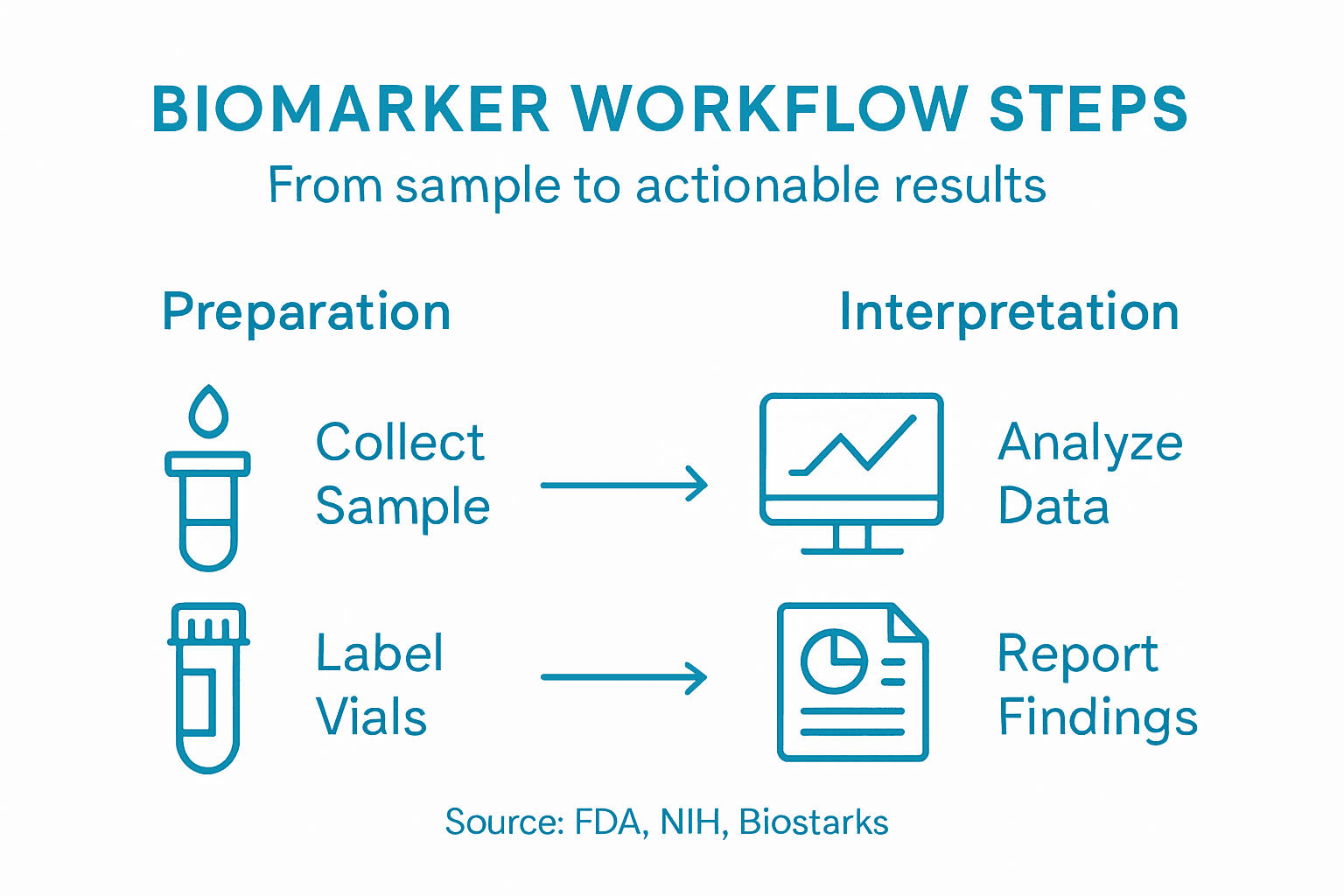
Every fitness coach and nutritionist knows that reliable health data starts long before results are analyzed. Staying on top of sample integrity from the very first step means the difference between trustworthy biomarker insights and lost opportunities for client progress. By following proven protocols from respected sources like the FDA and the National Institute of Environmental Health Sciences, you set the stage for interpreting data that actually drives real-world wellness and performance improvements.
Table of Contents
- Step 1: Prepare Biomarker Sample Collection Protocols
- Step 2: Acquire and Validate Mass Spectrometry Data
- Step 3: Identify and Categorize Biomarker Profiles
- Step 4: Analyze Biomarker Results For Health Insights
- Step 5: Verify Interpretation Accuracy and Report Outcomes
Quick Summary
| Key Message | Explanation |
|---|---|
| 1. Standardize sample collection protocols | Establish clear protocols to ensure sample integrity and reduce pre-analytical variability in biomarker collection. |
| 2. Validate mass spectrometry data rigorously | Follow strict validation guidelines to guarantee the accuracy and reliability of mass spectrometry data used in biomarker analysis. |
| 3. Categorize biomarkers for better insights | Use established frameworks to classify biomarkers, allowing for more effective interpretation and understanding of health implications. |
| 4. Analyze results within health frameworks | Contextualize biomarker results by comparing them to reference ranges and evaluating overall health trends for actionable insights. |
| 5. Document verification processes comprehensively | Maintain detailed records of data verification to enhance the reliability and transparency of biomarker interpretations. |
Step 1: Prepare biomarker sample collection protocols
Preparing precise biomarker sample collection protocols is crucial for obtaining reliable diagnostic insights. Your goal is to establish a standardized approach that maintains sample integrity and minimizes pre-analytical variability.
The process begins with understanding essential preparation requirements. The FDA guidelines for bioanalytical method validation emphasize creating a systematic protocol that ensures consistent sample quality across all collection stages. Key preparation steps include:
- Select appropriate collection tubes based on specific biomarker requirements
- Confirm proper patient fasting conditions
- Document precise collection time and environmental conditions
- Use sterile, validated collection equipment
Consider the specific biomarker type when designing your collection protocol. For instance, plasma and serum samples require different handling techniques. Your protocol should detail:
- Exact blood draw procedure
- Immediate sample processing steps
- Temperature and storage conditions
- Maximum allowable time between collection and processing
Professional protocols transform raw biological samples into precise diagnostic data points.
The Alzheimer’s Disease Neuroimaging Initiative protocols recommend meticulous labeling and tracking to maintain sample traceability. Each sample should have unique identifiers and comprehensive documentation.
Below is a reference table highlighting sample integrity factors and their impact:
| Factor | Impact on Integrity | Recommended Best Practice |
|---|---|---|
| Collection tube choice | Prevents contamination | Match tube to biomarker type |
| Temperature control | Preserves sample stability | Store at specified temperature |
| Labeling accuracy | Maintains traceability | Use barcoded IDs and records |
| Time to processing | Reduces degradation risk | Minimize delay post-collection |
Pro tip: Keep a standardized log documenting every sample’s collection conditions, processing time, and storage details to ensure maximum scientific reproducibility.
Step 2: Acquire and validate mass spectrometry data
Mass spectrometry data acquisition and validation represent critical steps in transforming raw biomarker measurements into reliable scientific insights. Your primary objective is to generate precise, reproducible analytical data that meets rigorous scientific standards.
FDA bioanalytical method validation guidelines outline comprehensive procedures for ensuring data quality. Key validation components include:
- Evaluate analytical accuracy across different concentration ranges
- Confirm instrument sensitivity and specificity
- Establish robust calibration curves
- Perform incurred sample reanalysis
To effectively acquire mass spectrometry data, follow these systematic steps:
- Prepare and calibrate mass spectrometry instrument
- Configure optimal ionization parameters
- Generate reference standard curves
- Process biological samples sequentially
- Apply quality control checks
Precise data validation transforms raw measurements into meaningful biological insights.
The biomarker quantification standards require meticulous documentation of every analytical procedure. Each data point must be traceable, reproducible, and meet stringent quality metrics.
Pro tip: Always maintain a comprehensive log of instrument performance, calibration details, and sample processing conditions to ensure maximum data reproducibility and scientific transparency.
Step 3: Identify and categorize biomarker profiles
Identifying and categorizing biomarker profiles is a critical process for understanding your unique biological landscape. Your goal is to transform complex biological data into meaningful insights that reveal specific health characteristics and potential risk factors.

The National Institute of Environmental Health Sciences biomarker classification provides a comprehensive framework for understanding different biomarker types. Key categories include:
Here’s a summary comparing the main biomarker profile categories:
| Category | Key Focus | Example Use Cases | Data Source |
|---|---|---|---|
| Exposure biomarkers | Environmental influence | Chemical exposure assessment | Blood, urine, environmental sampling |
| Susceptibility markers | Genetic predisposition | Disease risk stratification | Genomic analysis, family history |
| Response biomarkers | Biological reaction | Treatment monitoring | Blood tests, imaging data |
| Diagnostic biomarkers | Health condition status | Disease detection/diagnosis | Clinical testing, laboratory measurements |
- Exposure biomarkers indicating environmental interactions
- Susceptibility biomarkers revealing genetic predispositions
- Response biomarkers measuring biological system reactions
- Diagnostic biomarkers identifying specific health conditions
To effectively categorize biomarker profiles, follow these systematic steps:
- Analyze biological source and origin
- Determine specific biomarker type
- Assess measurement characteristics
- Evaluate potential clinical implications
- Map biomarker to relevant health domain
Precise biomarker categorization transforms raw data into actionable health intelligence.
The FDA and NIH biomarker terminology resource recommends a structured approach to classification, including detailed documentation of each biomarker’s measurable characteristics and intended application. This ensures consistent interpretation across research and clinical settings.
Pro tip: Develop a standardized tracking system for biomarker profiles that captures nuanced details about each measurement, enabling more comprehensive long-term health insights.
Step 4: Analyze biomarker results for health insights
Analyzing biomarker results is a transformative process that translates complex biological data into actionable health intelligence. Your objective is to uncover nuanced insights that reveal your body’s unique physiological landscape and potential health trajectories.
NIEHS biomarker analysis approaches demonstrate how comprehensive data interpretation can illuminate critical health connections. Key analytical strategies include:
- Compare results against established reference ranges
- Identify subtle pattern variations
- Track longitudinal changes in biomarker levels
- Contextualize individual markers within broader health frameworks
To systematically analyze your biomarker results, follow these strategic steps:
- Review individual biomarker values
- Assess relative positioning within reference ranges
- Examine interrelationships between different biomarkers
- Consider potential environmental and lifestyle influences
- Develop preliminary health insights and intervention strategies
Precise biomarker analysis transforms raw numerical data into meaningful health narratives.
The National Cancer Institute’s biomarker data analysis framework emphasizes a holistic approach that integrates multiple measurement perspectives, enabling a comprehensive understanding of your physiological status and potential health risks.
Pro tip: Create a standardized tracking system that allows you to visualize biomarker trends over time, enabling more proactive and personalized health management.
Step 5: Verify interpretation accuracy and report outcomes
Verifying biomarker interpretation accuracy is the critical final stage in transforming complex biological data into meaningful health insights. Your goal is to validate results, ensure scientific rigor, and create comprehensive reports that communicate your findings effectively.
FDA bioanalytical validation guidelines recommend comprehensive verification processes. Key accuracy verification strategies include:
- Cross-reference multiple data sources
- Validate statistical significance
- Check calibration and precision
- Assess potential measurement variability
To systematically verify your biomarker interpretation, follow these detailed steps:
- Review statistical confidence intervals
- Confirm measurement precision
- Evaluate potential systematic errors
- Compare results with historical data
- Document verification methodology
Rigorous verification transforms data from potentially unreliable to scientifically credible.
The FDA’s comprehensive validation guidance emphasizes meticulous documentation and quality control protocols, ensuring your interpretation meets the highest scientific standards.
Pro tip: Always maintain an audit trail of your verification process, including detailed notes on statistical methods and potential limitations, to enhance the transparency and reproducibility of your findings.
Unlock Precision in Biomarker Data Interpretation with Biostarks
Mastering the workflow of biomarker data interpretation requires more than understanding complex protocols it demands reliable tools that deliver accurate results and actionable insights. If you face challenges like maintaining sample integrity, validating mass spectrometry data, or translating biomarkers into meaningful health intelligence Biostarks is your solution. Our platform specializes in at-home testing powered by advanced Swiss mass spectrometry that covers vitamin, hormone, amino acid, lipid, mineral, and metabolic markers.
Whether you are navigating the intricacies of sample collection or seeking to categorize and analyze your biomarker profiles with confidence Biostarks offers user-friendly kits and comprehensive reporting designed for clarity and precision. Experience the difference with our Public Collection or elevate your testing through the Pro Collection to access premium analytical rigor.
Take control of your health data with Biostarks and transform complex laboratory results into personalized strategies for optimizing your longevity and metabolic performance. Visit Biostarks now and start your journey toward empowered health management with high-resolution biomarker testing.
Frequently Asked Questions
What are the key steps in the biomarker data interpretation workflow?
The key steps include preparing biomarker sample collection protocols, acquiring and validating mass spectrometry data, identifying and categorizing biomarker profiles, analyzing biomarker results, and verifying interpretation accuracy. Follow these steps systematically to ensure data reliability and produce meaningful health insights.
How can I ensure the integrity of biomarker samples during collection?
To maintain sample integrity, select appropriate collection tubes based on biomarker requirements, confirm proper patient fasting conditions, and document collection time and environmental conditions. Implement a standardized log to record every detail, which enhances scientific reproducibility and minimizes pre-analytical variability.
What are effective methods for analyzing biomarker results?
Effective methods include comparing results against established reference ranges, identifying subtle pattern variations, and tracking longitudinal changes in biomarker levels. By contextualizing individual markers within broader health frameworks, you can develop insightful health narratives based on the data.
How do I verify the accuracy of biomarker interpretations?
To verify accuracy, cross-reference multiple data sources and validate statistical significance. Document your verification methodology and maintain an audit trail to enhance transparency and reproducibility in your findings.
Why is it important to categorize biomarker profiles?
Categorizing biomarker profiles is essential because it transforms complex biological data into actionable health intelligence. By analyzing the type and origin of each biomarker, you can uncover specific health characteristics and potential risk factors, leading to more informed health decisions.


