

TL;DR:
- Mastering diagnostic terminology is essential, as misreading values or applying incorrect reference ranges can negatively impact patient care and research. Clear understanding of core terms, performance metrics, and regulatory language enhances clinical accuracy and workflow efficiency. Precise communication across disciplines prevents delays, errors, and patient harm by ensuring shared understanding of diagnostic concepts.
Mastering industry terminology in diagnostics is not simply an academic exercise. Misread a sensitivity value, confuse analytical validation with clinical validation, or apply a reference range from the wrong population, and the downstream consequences reach patient outcomes, regulatory submissions, and research integrity. Even experienced clinicians and laboratory scientists encounter genuine ambiguity in diagnostic language, particularly where clinical, regulatory, and research contexts overlap and use the same words with different meanings. This guide cuts through that ambiguity by covering the core vocabulary, performance metrics, regulatory language, and reference range concepts that form the practical backbone of diagnostic medicine.
Key Takeaways
| Point | Details |
|---|---|
| Core terms have precise definitions | Terms like POCT, immunoassay, and antigen carry specific technical meanings that directly affect clinical decisions. |
| Sensitivity and specificity work together | A highly sensitive test rules out disease; a highly specific test rules it in. Neither metric works in isolation. |
| Validation is context-dependent | The word “validation” means different things under FDA, EU IVDR, and CLIA frameworks. Specify the level every time. |
| Reference ranges are lab-specific | Applying published ranges to a different lab’s results introduces error. Always use the issuing lab’s reference interval. |
| Terminology drives workflow clarity | Consistent diagnostic language in records, reports, and team communication reduces error across every stage of care. |
Industry Terminology in Diagnostics: Core Terms Explained
Diagnostic medicine runs on precise vocabulary. When that vocabulary slips, clinical decisions follow. The foundational terms below represent the building blocks of the diagnostic language used across laboratory medicine, clinical chemistry, pathology, and point-of-care settings.
Antigen and antibody sit at the center of serological testing. An antigen is any substance that triggers an immune response; an antibody is the protein produced by the immune system in response. Tests that detect either are broadly classified as immunoassays, a category covering enzyme-linked immunosorbent assays (ELISA), lateral flow assays, and chemiluminescence methods.
Point-of-care testing (POCT) refers to clinical testing near the patient that delivers rapid results capable of improving both clinical and economic outcomes compared to centralized laboratory processing. POCT devices range from urine dipsticks and glucometers to more sophisticated benchtop analyzers running multiple simultaneous assays. The defining characteristic is not the device itself but the operational intent: rapid turnaround and immediate implementation of treatment decisions.
Here is a breakdown of the major diagnostic test categories you will encounter across clinical and research settings:
- Molecular diagnostics: Tests that detect nucleic acids (DNA or RNA), including PCR, RT-PCR, and next-generation sequencing (NGS). Used for infectious disease, oncology, and genetic screening.
- Serological tests: Detect antibodies or antigens in blood or serum. Common in infectious disease workups and autoimmune panels.
- Biochemical / clinical chemistry tests: Measure metabolites, enzymes, electrolytes, and proteins. Examples include comprehensive metabolic panels (CMP), lipid panels, and thyroid function tests (TFTs).
- Hematological tests: Assess blood cell counts and morphology. The complete blood count (CBC) is the most ordered test in clinical medicine.
- Microbiological culture: Grows organisms from patient samples to identify pathogens and determine antimicrobial susceptibility. Turnaround is hours to days, contrasting sharply with POCT.
- Histopathology and cytopathology: Examine tissue and cell morphology under microscopy. Terminology in pathology here includes terms like dysplasia, neoplasia, and metaplasia, each carrying distinct prognostic weight.
Pro Tip: When a test report lists an acronym you do not recognize, check whether it refers to the assay method (e.g., ECLIA for electrochemiluminescence immunoassay) or the analyte category (e.g., AFP for alpha-fetoprotein). Confusing method acronyms with analyte acronyms is one of the most common documentation errors in clinical reporting.
Key regulatory and operational acronyms you will also encounter include: IVD (in vitro diagnostic), LDT (laboratory-developed test), QC (quality control), TAT (turnaround time), and LoD (limit of detection). Each has specific technical meaning that differs by regulatory region.
Diagnostic test performance metrics and their interpretation
Understanding what makes a test perform well requires more than knowing that a high number is good. The four core metrics: sensitivity, specificity, positive predictive value (PPV), and negative predictive value (NPV), interact with each other and with clinical context in ways that frequently produce misinterpretation.
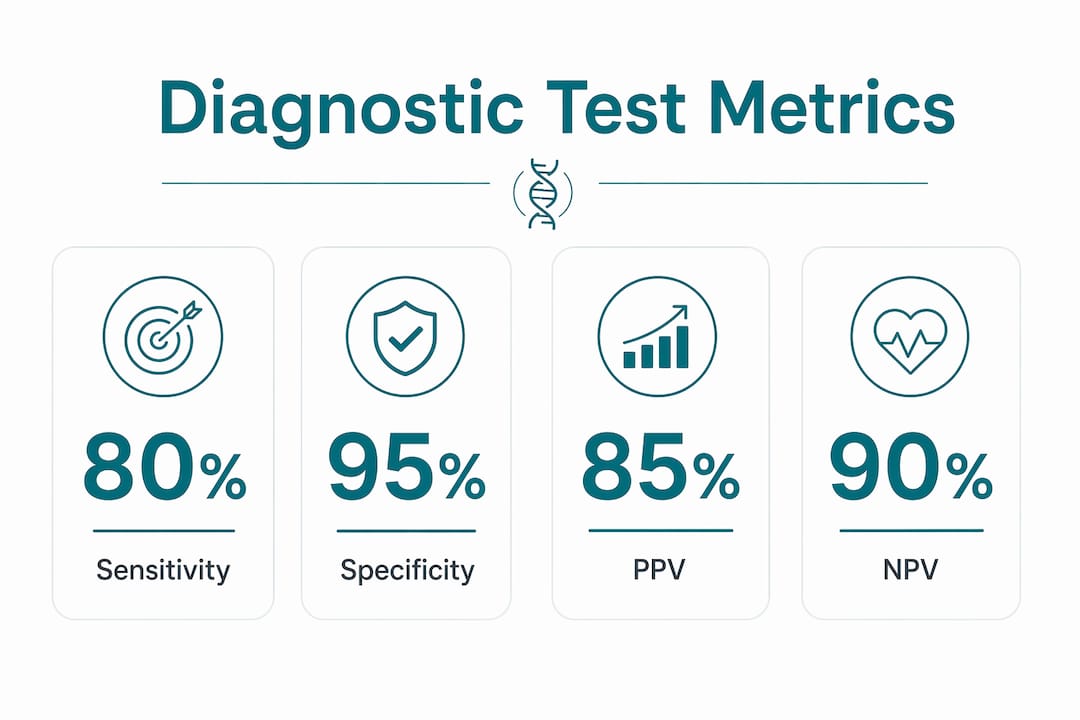
Sensitivity is the true positive rate. An 80% sensitivity means 8 of 10 diseased patients test positive. The remaining 20% are false negatives. Specificity is the true negative rate: a 90% specificity means 9 of 10 non-diseased individuals test negative, and 1 is a false positive.

The clinical mnemonic SnNOut/SpPIn captures the practical rule: a highly sensitive test rules out disease when the result is negative; a highly specific test rules in disease when the result is positive.
The table below illustrates how these metrics behave in practice:
| Metric | Definition | Clinical Use |
|---|---|---|
| Sensitivity | True positive rate | Screening; ruling out disease |
| Specificity | True negative rate | Confirmation; ruling in disease |
| PPV | Probability disease present when positive | Depends on prevalence; higher in high-prevalence settings |
| NPV | Probability disease absent when negative | Depends on prevalence; higher in low-prevalence settings |
| Likelihood Ratio+ | How much a positive result raises disease odds | Values above 10 provide strong confirmation |
| Likelihood Ratio- | How much a negative result lowers disease odds | Values below 0.1 provide strong exclusion |
The point most often missed in practice: PPV and NPV are not fixed. They shift with disease prevalence in the tested population. A test with 95% sensitivity and 95% specificity applied to a population where only 1% has the disease will still generate more false positives than true positives. This is why the same test can perform very differently in a primary care screening context versus a specialist referral clinic.
Pro Tip: Before quoting a test’s PPV in a clinical report or research paper, state the prevalence assumption. A PPV without a stated prevalence figure is incomplete information.
Cutoff points also shape performance. Moving a cutoff threshold changes the sensitivity and specificity in opposite directions. Lowering a cutoff increases sensitivity at the cost of specificity. This trade-off is visualized in receiver operating characteristic (ROC) curves, where the area under the curve (AUC) summarizes overall test discriminative ability.
Regulatory and validation terminology in diagnostics
No area of diagnostic language causes more interdisciplinary friction than the word “validation.” It appears in FDA submissions, EU IVDR dossiers, CLIA compliance documents, and academic publications, and it does not mean the same thing in each.
Under FDA and EU regulatory frameworks, validation terminology diverges significantly. The FDA focuses on intended use and functional performance. The EU IVDR framework, which governs in vitro diagnostics across European markets, requires a broader evidence package: analytical performance, clinical evidence, and risk management documentation as separate deliverables.
| Validation Type | Definition | Regulatory Context |
|---|---|---|
| Analytical validation | Confirms assay meets technical performance specs (LoD, precision, accuracy) | FDA, EU IVDR, CLIA |
| Clinical validation | Confirms meaningful association with clinical outcome or disease state | EU IVDR (Clinical Evidence); FDA (clinical studies) |
| Performance evaluation | Broader assessment across real-world conditions | EU IVDR specifically |
| Software/AI validation | Validates algorithm outputs at dataset, model, and device levels | FDA AI/ML guidance; EU MDR |
The distinction between these levels is not merely semantic. Validation terminology misuse causes regulatory delays, incomplete submissions, and breakdowns in cross-functional team communication when a biostatistician, a regulatory affairs specialist, and a clinical scientist each assume a shared definition that does not actually exist.
CLIA regulations, which govern US clinical laboratories, require laboratories to establish performance specifications for non-waived tests. Notably, CLIA requirements do not use the word “validation” explicitly in their regulations, which creates additional confusion when labs describe their processes in submissions or audits.
Pro Tip: In any document crossing regulatory jurisdictions or disciplines, define your use of “validation” on first use and specify whether you mean analytical, clinical, or device-level validation. One sentence of clarification prevents weeks of back-and-forth review.
For those working in advanced lab testing, the discipline of specifying regulatory context is particularly relevant when comparing biomarker assays across different country markets or preparing multi-site research data.
Importance and interpretation of laboratory reference ranges
Reference ranges, sometimes called reference intervals, define the expected values in a healthy reference population. They are not normal ranges in a moral or evaluative sense. They are statistical constructs, typically representing the central 95% of values from at least 120 healthy individuals in the lab’s reference population.
Several factors shape what those ranges look like:
- Demographics: Age, sex, and sometimes ethnicity affect many analytes. Creatinine ranges differ between adult males and females. Thyroid-stimulating hormone (TSH) shifts with age.
- Assay method: Two labs measuring the same analyte with different reagents and analyzers may produce systematically different results. Their reference ranges will reflect those differences.
- Geography and diet: Vitamin D reference ranges, for example, show meaningful variation across regions with different sun exposure and dietary fortification practices.
- Accreditation standards: CAP (College of American Pathologists) and CLIA both require labs to validate or establish reference ranges. Labs cannot simply adopt published ranges without verification in their own patient population.
The clinical risk here is direct: reference intervals must be lab- and method-specific. Applying a range from a published textbook or a different laboratory to your result is statistically unjustified and clinically risky. Demographic factors in range determination are especially relevant for pediatric, geriatric, and pregnant populations, where standard adult ranges routinely mislead interpretation.
For a deeper look at how precision tests account for these population-specific considerations in biomarker analysis, Biostarks covers this in detail across its educational resources.
Applying diagnostic terminology to clinical and research practice
Terminology knowledge becomes valuable only when it changes behavior. In clinical practice, reading a lab report accurately requires understanding not just what each value means but what the method, the reference range source, and the assay limitations imply about the result.
When interpreting test reports, notice whether sensitivity and specificity data are provided for the specific assay version used, not just the general test category. Assay generations within the same test family can have meaningfully different performance characteristics, and the diagnostic language in pathology reports often assumes a familiarity with version-specific data that clinicians are not always given.
In electronic health records (EHR) and scientific reporting, consistent use of standardized terminology prevents downstream data errors. SNOMED CT and LOINC are the dominant coding systems for clinical terms and laboratory observations respectively. When a lab result is coded incorrectly at the terminology level, it can disappear from population health queries or trigger inappropriate clinical decision support alerts.
Linking diagnostic terminology to workflow outcomes is also one of the most effective teaching strategies in healthcare education. Students and residents who understand why POCT was designed around turnaround time, not just proximity, retain the distinction between POCT and conventional lab testing far more reliably than those who memorize definitions in isolation.
Staying current means tracking guidance updates from bodies like the CLSI (Clinical and Laboratory Standards Institute), the AACC (Association for Diagnostic and Laboratory Medicine), and regulatory agencies. Terminology does evolve. “Liquid biopsy,” for instance, has moved from research jargon to a recognized regulatory category with specific validation requirements in less than a decade. The professionals who track that shift stay ahead of documentation and communication problems before they occur. Reading resources like the advanced diagnostics overview from Biostarks can help close those knowledge gaps efficiently.
My perspective on mastering diagnostic language
I have watched terminology confusion cause real professional friction, and in some cases, real patient harm. Not because anyone was careless, but because two experts in adjacent fields used the same word to mean different things and never stopped to confirm alignment.
The most common version I see: a regulatory affairs team submits a dossier using “validation” to mean analytical validation, while the clinical reviewers assume clinical validation is covered. The submission stalls. Weeks are lost. And when you trace it back, the entire problem was one word without a defined scope.
What I have learned is that the professionals who communicate best across disciplines are not those who know the most terminology. They are the ones who define their terms explicitly and invite others to do the same. In team meetings, in written documentation, and in peer review. “When I say validation here, I mean analytical performance per CLSI EP15. What do you mean?” That single question has prevented more project derailments than I can count.
For students and early-career researchers, my advice is this: do not wait until you encounter a confusing report to learn these terms. Understand the performance metrics, the regulatory frameworks, and the reference range logic before you are in a clinical or regulatory setting where confusion costs something. Biomarker interpretation is a skill built over time, and the terminology is the foundation.
— Romain
How Biostarks supports precision in diagnostic science

Biostarks, an AMR Labs SA company, applies the same rigor you have read about here to its at-home biomarker testing platform. Using advanced Swiss mass spectrometry, Biostarks analyzes vitamins, hormones, amino acids, lipids, minerals, and metabolic markers with the analytical precision that clinical professionals and researchers expect. The reports are built around lab-specific reference ranges, validated methods, and clear diagnostic language that reflects current standards in laboratory medicine. Whether you are a clinician looking to extend personalized health data to your patients or a researcher exploring biomarker applications, Biostarks offers the scientific depth and methodological transparency you need. Explore the full testing portfolio and educational resources at Biostarks.
FAQ
What is the difference between sensitivity and specificity?
Sensitivity measures how well a test identifies true positives (diseased patients), while specificity measures how well it identifies true negatives (non-diseased individuals). A sensitive test is best for ruling out disease; a specific test is best for ruling it in.
Why do reference ranges differ between laboratories?
Reference ranges reflect the specific method, reagents, and population used by each laboratory to establish its interval. Applying one lab’s reference range to another lab’s result is statistically unreliable and should be avoided.
What does “validation” mean in diagnostics?
Validation covers several distinct processes: analytical validation (technical performance), clinical validation (association with health outcomes), and regulatory validation (meeting framework requirements). The term must always be defined in context, as it means different things under FDA, EU IVDR, and CLIA frameworks.
How does disease prevalence affect test interpretation?
Positive and negative predictive values change with the prevalence of disease in the tested population. The same test produces more false positives in a low-prevalence screening population than in a high-prevalence specialist referral population.
What is point-of-care testing (POCT)?
POCT is clinical laboratory testing performed near the patient rather than in a central lab, designed specifically for rapid turnaround and immediate treatment decisions. Devices include glucometers, dipsticks, and portable analyzers capable of running multiple tests simultaneously.
This content is for educational purposes only and does not constitute medical advice. Always consult with a healthcare professional before making changes to your health regimen.


