

TL;DR:
- Personalized nutrition starts with comprehensive biomarker data, including lab results, genetics, and microbiome analysis. A structured workflow involving elimination, reintroduction, and ongoing optimization ensures dietary plans align with individual biology and lifestyle, improving long-term compliance and outcomes. Regular follow-up assessments and integration of subjective and objective feedback refine the approach, making it more effective and sustainable.
If you’ve followed a “healthy” diet and still felt exhausted, inflamed, or stuck at a plateau, the problem almost certainly wasn’t your willpower. Generic dietary guidelines are built on population averages, which means they’re optimized for nobody in particular. A personalized nutrition workflow flips that equation. Instead of starting with a food pyramid, it starts with you: your biomarkers, your metabolism, your lifestyle, and your goals. This guide walks through every phase of that process, from data collection to ongoing optimization, so you can build a plan that actually works for your biology.
Table of Contents
- Key Takeaways
- Building your personalized nutrition workflow foundation
- Executing a step-by-step nutrition workflow
- Common challenges and how to fix them
- Verifying progress and refining your plan
- My perspective on what personalized nutrition actually demands
- How Biostarks powers your nutrition workflow
- FAQ
Key Takeaways
| Point | Details |
|---|---|
| Start with biomarker data | Lab results like lipid panels, A1C, and hormone levels are the foundation of any effective, customized diet plan. |
| Use a phased dietary protocol | A structured elimination, reintroduction, and stabilization sequence improves both adherence and measurable outcomes. |
| AI tools accelerate personalization | Machine learning can synthesize genomic, metabolic, and lifestyle data to generate precise meal timing and macro targets. |
| Follow-ups drive results | Scheduling assessments every 4 to 6 weeks allows you to adjust your plan based on real feedback, not assumptions. |
| Cultural fit determines sustainability | Plans that reflect your food preferences and daily routines are far more likely to stick long-term. |
Building your personalized nutrition workflow foundation
Before any meal plan gets written, the nutrition assessment process needs to generate enough signal to be useful. The single most common reason customized diet plans underperform is that they were built on incomplete or outdated data. Recent lab work matters enormously here. Without lipid panels, fasting glucose, A1C, thyroid markers, and key nutrient levels, practitioners are forced to fall back on population-level guidelines rather than your actual physiology.
The data categories worth collecting fall into four distinct layers:
- Biometric and metabolic markers: Lipids, blood glucose, thyroid hormones, sex hormones, inflammatory markers like hsCRP, and nutrient levels including vitamin D, B12, ferritin, and amino acids
- Genetic and epigenetic factors: Variants that affect folate metabolism, caffeine sensitivity, fat metabolism, and carbohydrate tolerance
- Microbiome composition: Gut bacteria diversity and the presence of keystone species that influence nutrient absorption and immune regulation
- Lifestyle and behavioral patterns: Sleep quality, stress levels, physical activity load, and food preferences
A structured food diary adds a layer that lab work alone cannot capture. Food diaries that log meal timing alongside portion sizes and post-meal symptoms, specifically energy levels, mood, and digestion within 30 to 60 minutes of eating, generate richer diagnostic data than calorie counting ever could. Think of it as a continuous bioassay you run on yourself.
| Data Type | Examples | Collection Method |
|---|---|---|
| Metabolic biomarkers | Glucose, insulin, lipids, thyroid | At-home or clinical blood test |
| Micronutrient levels | Vitamin D, B12, zinc, ferritin | Mass spectrometry blood panel |
| Genetic markers | MTHFR, APOE, FTO variants | DNA saliva test |
| Gut microbiome | Diversity score, pathogen presence | Stool analysis |
| Food and symptom log | Timing, mood, digestion, energy | Food diary app or journal |
| Health goals | Weight, performance, longevity | Intake form with practitioner |
Pro Tip: Don’t wait for a practitioner to order your labs. At-home biomarker testing, such as what Biostarks provides, lets you collect a complete metabolic and micronutrient baseline before your first nutrition consultation, which means your first session focuses on strategy rather than paperwork.
Nutrition assessment tools go beyond mere data collection. They provide the interpretive structure that turns raw numbers into nutritional risk classifications and clinically meaningful patterns. Understanding which tools your practitioner uses, and why, helps you ask better questions and stay active in your own care.
Executing a step-by-step nutrition workflow
Once your data is assembled, the real work of individualized meal planning begins. Personalization must integrate genetic, microbiome, hormone profiles, and lifestyle patterns to address root causes rather than just symptoms. That level of integration requires a clear sequence.
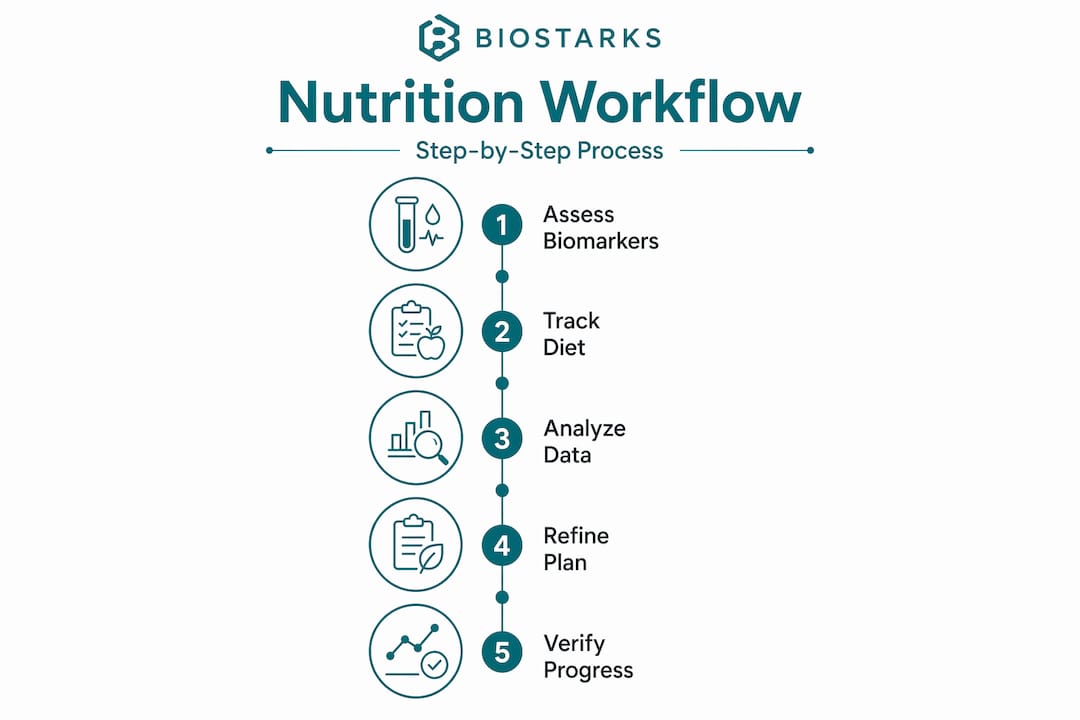
Here is the core workflow:
- Synthesize all data streams into a single profile that maps your metabolic strengths, deficiencies, inflammation drivers, and hormonal patterns
- Define your primary health goal with measurable outcomes, such as fasting glucose below 90 mg/dL, ferritin above 50 ng/mL, or body composition changes tracked by DEXA
- Begin the elimination phase by removing the most probable dietary triggers, typically refined sugars, gluten, industrial seed oils, and alcohol, for a structured period of 4 to 6 weeks before any reintroduction
- Reintroduce foods one at a time over two-week windows while tracking biomarker responses and symptom changes in your food diary
- Enter the stabilization phase where tolerated foods are organized into a sustainable meal structure built around your metabolic profile and macro targets
- Integrate meal timing based on your circadian biology and activity patterns, whether that means early time-restricted eating, carbohydrate periodization around training, or larger protein loads at specific meals
- Review and recalibrate every 4 to 6 weeks using follow-up labs and symptom tracking data
AI and machine learning tools are genuinely changing what is possible in this workflow. Algorithms trained on genomic, metabolomic, and lifestyle data can generate individualized recommendations for macro ratios and meal timing with a precision that no manual calculation matches. The key is selecting platforms that augment clinical judgment rather than replace it. AI-powered platforms should automate multi-omic data synthesis without adding administrative complexity or generating outputs that practitioners cannot interpret and apply.
| Phase | Duration | Primary Goal | Success Marker |
|---|---|---|---|
| Elimination | 4 to 6 weeks | Remove triggers, reduce inflammation | Improved energy, reduced bloating |
| Reintroduction | 2 weeks per food group | Identify tolerances and sensitivities | Symptom tracking data, stable mood |
| Stabilization | Ongoing | Build a sustainable, personalized baseline | Improved lab markers, consistent adherence |
| Optimization | Reviewed every 4 to 6 weeks | Refine macros, timing, and food choices | Follow-up biomarker improvements |
Cultural and practical lifestyle factors are non-negotiable for any plan that needs to last beyond three weeks. A protocol that ignores local food availability, cooking habits, social eating norms, or budget constraints will fail regardless of how scientifically precise it is. The best dietary workflow solutions are the ones your actual life can accommodate.
Pro Tip: When evaluating AI nutrition tools, ask specifically whether the platform integrates lab data directly or relies solely on self-reported intake. Tools that ingest biomarker data produce significantly more precise recommendations than those working only from food logs.
Common challenges and how to fix them
Even well-designed plans run into friction. Knowing where things typically break down lets you address problems before they become reasons to quit.
-
Attempting too many changes simultaneously. This is the most reliable way to create unsustainable stress and lose the ability to isolate what is and is not working. Phased protocols exist for this reason. One variable at a time generates actionable data.
-
Using food diaries only for calorie tracking. Combining dietary intake data with symptom tracking and lab results is what captures comprehensive nutritional status. If your diary only records what you ate, you are leaving the most diagnostic information off the page.
-
Ignoring compliance barriers early. Lifestyle barriers like shift work, frequent travel, limited cooking time, or tight food budgets need to be built into the plan from day one, not treated as exceptions to manage later.
-
Expecting linear progress. Biomarker responses to dietary changes often lag by several weeks. An absence of visible change in the first two weeks does not mean the protocol is failing. Premature adjustments are one of the leading reasons personalized plans never reach the stabilization phase.
-
Relying on generic nutrition advice alongside a personalized protocol. Generic nutrition fails when it ignores personal biology and lifestyle. If your personalized protocol is based on your specific biomarker profile, adding in generic supplement advice or trendy dietary rules can actively undermine the data-driven logic of your plan.
Understanding how biomarker data transforms wellness outcomes is what separates people who troubleshoot effectively from those who cycle through protocols indefinitely.
Verifying progress and refining your plan
The nutrition assessment process does not end when your first meal plan is written. Initial assessments typically set a 4 to 6 week follow-up cycle for good reason. Metabolic and inflammatory markers respond to dietary changes at different rates, and your plan needs to reflect what your body is actually doing, not what the original model predicted.

At each follow-up, the focus should be on three things. First, rerun the most relevant biomarkers. If you started with elevated fasting glucose and low vitamin D, those are your primary indicators of progress. Second, review your food diary for patterns that emerged during the previous cycle, especially correlations between specific foods or meal timing and energy or sleep quality. Third, adjust macro ratios and meal timing based on what the combined data shows, not what you feel like should be working.
Behavior change is the limiting factor more often than the science. Flexibility in how you hit your targets matters as much as the targets themselves. A person who hits 130 grams of protein daily with foods they enjoy is generating better long-term outcomes than someone who hits 150 grams with a protocol they resent.
Pro Tip: Track at least one subjective metric alongside your lab markers, such as sleep quality score, afternoon energy levels, or workout recovery. These are often the first indicators that a dietary change is working, weeks before biomarkers shift.
Nutritionists who incorporate biomarker-driven tracking consistently report stronger client outcomes because they can verify progress objectively and course-correct before small drifts become full regressions.
My perspective on what personalized nutrition actually demands
I’ve spent years looking at how people approach dietary change, and the pattern I see repeatedly is this: the people who get the most from personalized nutrition are the ones who treat it as an ongoing relationship with their own data rather than a one-time plan to follow. What I’ve learned from watching this process up close is that the workflow matters as much as the science behind it.
The technology is genuinely impressive now. Machine learning can synthesize data streams that would take a clinical team weeks to manually interpret. But I’ve also seen AI-generated recommendations fail people who were technically impressive on paper because the cultural fit was never considered. A meal plan that ignores how someone actually lives their life is not personalized. It is just precise in the wrong direction.
My honest take: the phased approach is not optional. People push back on it because it feels slow. The first six weeks of elimination feel restrictive and the results are not dramatic enough to feel rewarding. But that phase is doing critical diagnostic work. Every reintroduction after it is a controlled experiment. Skip it and you never know which variable actually drove your improvement.
The other thing I would say plainly: get your baseline labs done before you start. Not after the first month. Before. You cannot optimize what you have not measured. Everything else in this workflow is downstream of that first data pull.
— Romain
How Biostarks powers your nutrition workflow

Biostarks, an AMR Labs SA company, is built specifically for this kind of work. The platform’s at-home biomarker testing analyzes vitamins, hormones, amino acids, lipids, minerals, and metabolic markers using advanced Swiss mass spectrometry. Every report is designed to feed directly into a personalized nutrition guide built around your actual biology rather than population averages.
For individuals managing their own wellness or working with a nutritionist, Biostarks provides the objective baseline that makes every stage of the workflow more precise. The platform integrates with existing healthcare providers and clinical workflows, so your data moves cleanly between your at-home test and your practitioner’s recommendations. If you are ready to build a plan grounded in real biomarker data, start with Biostarks and give your nutrition workflow the foundation it needs.
FAQ
What is the first step in a personalized nutrition workflow?
The first step is gathering objective baseline data, specifically recent lab work including metabolic markers, nutrient levels, and hormones. Without this data, any customized diet plan defaults to generic guidelines rather than your individual biology.
How long does a personalized nutrition plan take to show results?
Most metabolic and inflammatory biomarkers respond to dietary changes within 4 to 6 weeks, which is why follow-up assessments are scheduled at that interval. Subjective markers like energy and sleep quality often improve earlier.
What role do food diaries play in individualized meal planning?
Food diaries that capture meal timing, portion sizes, and post-meal symptoms generate far more diagnostic value than simple calorie logs. They reveal correlations between specific foods and physical responses that lab work alone cannot identify.
Why do most generic diets fail for performance and wellness goals?
Generic diets are based on population averages and ignore individual variation in metabolism, genetics, microbiome composition, and lifestyle. Functional medicine experts consistently find that plans failing to integrate multiple personal data streams miss the root causes driving poor outcomes.
How often should I update my personalized nutrition plan?
Plan reviews every 4 to 6 weeks are the standard recommended cycle. Each review should include updated biomarker data and a symptom or performance log so adjustments are based on objective evidence rather than subjective feeling alone.
This content is for educational purposes only and does not constitute medical advice. Always consult with a healthcare professional before making changes to your health regimen.


