

TL;DR:
- At-home biomarker testing provides objective insights into cellular and biochemical health, guiding targeted interventions.
- Tracking longitudinal trends beyond standard reference ranges enables more effective wellness optimization for longevity and performance.
You commit to optimizing your health, you clean up your diet, adjust your sleep, add targeted supplements, and then wait. But how do you actually know if any of it is working? The frustration is real: without measurable data, progress feels invisible, and it is easy to make changes based on guesswork rather than evidence. At-home biomarker testing changes that equation entirely. This guide walks you through exactly how to design a wellness monitoring plan that generates real insight, tracks meaningful trends, and helps you make decisions your body will actually respond to.
Table of Contents
- Why measure wellness: From goals to outcomes
- What you need: Tools and baseline for effective monitoring
- Step-by-step: Creating your personalized wellness monitoring plan
- Making sense of your results and adjusting your plan
- The real value (and limits) of wellness monitoring
- Take the first step: Start your at-home wellness monitoring plan
- Frequently asked questions
Key Takeaways
| Point | Details |
|---|---|
| Data empowers progress | Tracking biomarkers helps you personalize and optimize your wellness journey. |
| Combine methods | Use both at-home lab tests and wearables for a more complete health picture. |
| Go beyond normal | For maximal longevity and performance, aim for optimal—not just normal—ranges. |
| Plan for consistency | Schedule regular testing at logical intervals for meaningful, actionable insights. |
Why measure wellness: From goals to outcomes
Most people track wellness the old-fashioned way: by how they feel. Energy levels seem good, the scale moved a bit, sleep felt decent. But subjective signals are unreliable. They lag behind actual physiological changes, and they miss silent shifts in metabolic function, hormonal balance, or inflammatory load that build quietly over months or years.
Personalized wellness data gives you something subjective tracking never can: a direct window into what your body is actually doing at the cellular and biochemical level. When you see a rising hs-CRP (high-sensitivity C-reactive protein, a marker of systemic inflammation) three months before you feel any different, you have an opportunity to intervene early rather than react late.
The type of goal you are working toward shapes which biomarkers matter most:
- Longevity: Focus on ApoB (a carrier protein linked to cardiovascular risk), insulin sensitivity, fasting glucose, and inflammatory markers
- Metabolic health: Track HbA1c (a three-month average of blood sugar), triglycerides, HDL cholesterol, and liver enzymes
- Athletic performance: Prioritize testosterone, cortisol, ferritin (stored iron), amino acid profiles, and vitamin D
- General optimization: Monitor the full panel including thyroid function, key vitamins, and hormonal baselines
What separates a well-designed monitoring plan from random testing is intentionality. Wellness optimization strategies work best when they start with a clearly defined goal, a specific set of markers to watch, and a realistic retesting schedule.
“Periodic biomarker testing is a best practice for ongoing health optimization.” Setting targets that go beyond a doctor’s standard reference range, toward what longevity researchers call longevity-oriented optimal ranges, is increasingly recognized as the smarter approach for people who want to perform and live well, not just avoid disease.
The key insight here is that “normal” on a lab report is not the same as optimal. Standard reference ranges are derived from population averages, which include many people who are already metabolically compromised. If your goal is to perform and feel your best for decades, you need to target a better standard than average.
What you need: Tools and baseline for effective monitoring
Before you can track progress, you need a starting point and the right instruments. Think of it like calibrating a piece of equipment before you use it. Your baseline blood sample is your calibration point. Everything measured afterward becomes meaningful because it is compared against that starting reference.
Here is a practical overview of the tools you will want to combine:
| Tool | What it tracks | Best used for |
|---|---|---|
| At-home lab test kit | Blood biomarkers (vitamins, hormones, lipids, metabolic markers) | Deep biochemical insight |
| Wearable device | Heart rate, HRV, sleep stages, activity | Daily trend monitoring |
| Digital health log | Symptoms, energy, mood, diet patterns | Contextualizing lab data |
| Secure health platform | Storing and comparing results over time | Trend analysis |
What to prepare before your first test:
- A quiet morning with at least 8 hours of fasting completed (water is fine)
- Access to a secure digital platform for storing results
- A clear list of your primary wellness goals written down
- Recurring calendar reminders set for future retesting windows
- A short symptom and lifestyle log for the week leading up to each test
Understanding the at-home testing process removes most of the friction. Finger-prick collections are fast and low-stress when you know what to expect.
Most structured wellness programs recommend retesting every 3 to 4 months for actively tracked markers, with a broader annual review of less volatile biomarkers. Subscription-style multi-month biomarker testing is used by leading wellness programs precisely because physiological change takes time to register in lab values, and one data point tells you almost nothing.
One important caution: wearables are remarkable for tracking activity and sleep, but they have real limits. Wearable and continuous monitoring has significant limitations, especially for trace biomarkers like hormones, heavy metals, fat-soluble vitamins, and inflammatory cytokines. A smartwatch cannot tell you your testosterone is declining or your vitamin D has dropped below the threshold needed for immune function. That is what lab testing is for. Applying biomarker analysis best practices means knowing which tool answers which question.
Pro Tip: Use your wearable data to contextualize your lab results, not replace them. If your HRV (heart rate variability) has been trending down for six weeks and your cortisol comes back elevated on your lab test, those two signals together tell a much clearer story than either one alone.
Step-by-step: Creating your personalized wellness monitoring plan
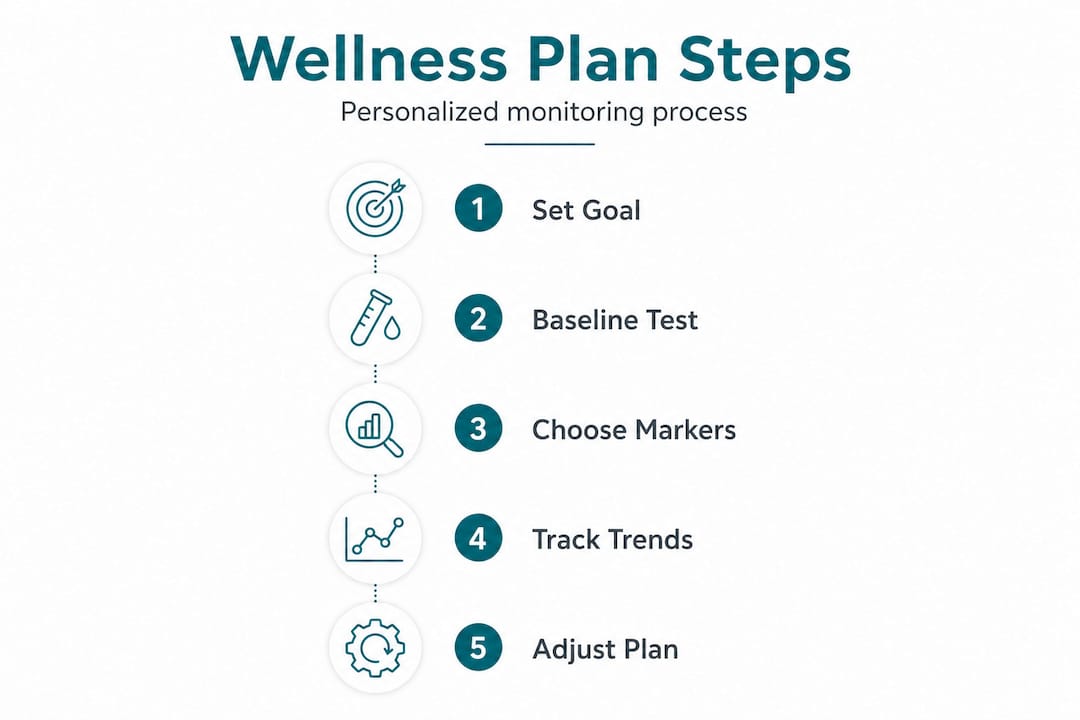
A plan that works is a plan you can actually follow, not a perfect system you abandon after two months. Here is a straightforward sequence that builds sustainable momentum:
- Define your primary goal in one specific sentence. “Improve metabolic health over the next 12 months” is workable. “Get healthier” is not.
- Select your marker panel based on that goal. Work with a health professional or use a validated panel designed for your objective (metabolic, longevity, performance, etc.).
- Order your baseline test and collect your sample at home using the collection kit. Morning, fasted samples yield the most accurate lipid and glucose readings.
- Upload or submit your sample to the lab and wait for your results report. Precision labs using advanced mass spectrometry typically return results within a few days.
- Interpret your results against both standard reference ranges and longevity-optimized targets. Programs like Sperity and AliveLongevity stress structured timelines and target tracking well beyond what a standard clinical report highlights.
- Set your personal targets for each key marker. Use the longevity-optimal column, not just the “in range” column, as your performance benchmark.
- Design your intervention based on gaps: dietary adjustment, supplementation, exercise type, sleep hygiene, or stress management.
- Schedule your retest at 3 to 4 months out and set a reminder the week before so you can replicate your fasting protocol.
- Review, compare, and adjust your strategy based on what changed, what improved, and what needs more attention.
The comparison between reference ranges and functional targets matters more than most people realize:
| Marker | Standard reference range | Longevity-optimal target |
|---|---|---|
| Fasting glucose | 70 to 99 mg/dL | 72 to 85 mg/dL |
| ApoB | Below 130 mg/dL | Below 70 mg/dL |
| Vitamin D (25-OH) | 20 to 50 ng/mL | 50 to 80 ng/mL |
| hs-CRP | Below 3.0 mg/L | Below 0.5 mg/L |
| Testosterone (men) | 264 to 916 ng/dL | 600 to 900 ng/dL |
The benefits of biomarker testing become most visible when you track longitudinal trends rather than treating each test as a standalone event. A single result is a snapshot. A series of results is a story. Holistic health platforms increasingly recognize this distinction as central to meaningful wellness management.
The wellness testing process guide covers the practical mechanics of each stage so the logistics never become a barrier.
Pro Tip: Create a simple spreadsheet or use your health platform’s tracking feature to log each result with the date, your lifestyle context (travel, illness, stress level), and any interventions you made since the previous test. This creates an invaluable reference for understanding why numbers shift.
Making sense of your results and adjusting your plan
Getting your results back is genuinely exciting. But the interpretation step is where many people either overreact or underreact, and both errors are costly.

The first rule is to look for trends, not isolated values. A single elevated triglyceride reading after a stressful month of travel and poor eating is very different from four consecutive readings trending upward despite lifestyle changes. The former is noise. The latter is a signal worth acting on.
Here are the most common misinterpretations to watch for:
- Treating “in range” as “optimal”: A ferritin of 15 ng/mL is technically within the standard female reference range but is often associated with fatigue, hair loss, and poor exercise recovery at that level
- Ignoring context: A high cortisol reading after three nights of disrupted sleep is expected. If it stays elevated after sleep normalizes, that is a different issue
- Over-adjusting too fast: Changing multiple variables at once makes it impossible to know which intervention drove a change
- Discounting subjective data: If your markers look great but you feel exhausted, that tension is worth investigating rather than dismissing
- Comparing to others: Your trend matters more than someone else’s absolute number
“Results within standard reference ranges can still mask risk or suboptimal physiology for longevity and performance goals.” This is one of the most important things to understand about modern wellness monitoring.
Your wellness optimization checklist can serve as a practical reference when results come back mixed or ambiguous. Pairing your data interpretation with wellness routines for lasting well-being creates a grounded framework for sustainable change over years, not weeks.
When should you consult a health professional? Any time a marker deviates sharply from its previous value, when multiple markers shift together in a concerning direction, or when your subjective experience contradicts what your data suggests. Biomarker data is a tool for better conversations with your practitioner, not a replacement for clinical judgment.
The real value (and limits) of wellness monitoring
Here is an uncomfortable truth the wellness industry does not say loudly enough: data is only as useful as the framework you use to interpret it. We have seen people obsess over a single biomarker, supplement aggressively to move it, and ignore three others that were clearly more relevant to how they actually felt and performed.
The trap is seductively easy to fall into. A number changes. You feel validated or alarmed. You adjust something. You wait for the next number. The whole process becomes circular and disconnected from what you actually care about, which is feeling and functioning better across years and decades.
The best results consistently come from people who treat their biomarker data as one input among several. Your lab results, your wearable trends, your subjective energy and performance, your sleep quality, your stress load, your training response. These inputs need to be integrated, not ranked. A rising ferritin reading means more when your training load has also increased and your HRV has dropped. In isolation, it is just a number.
Continuous and sweat-based monitoring should be treated as complementary rather than definitive for most biomarkers. This peer-reviewed finding matters practically: it means that no wearable, no sweat patch, and no continuous glucose monitor replaces the depth of information you get from a comprehensive blood panel analyzed with precision instrumentation. Technology fills gaps. It does not replace ground truth.
Understanding the role of biomarkers in health at a systems level helps you avoid false confidence in any single reading. The real power of monitoring is pattern recognition over time, and that requires patience and consistency more than it requires obsessing over any individual value.
Take the first step: Start your at-home wellness monitoring plan
You now have a clear framework: set a goal, establish your baseline, choose the right markers, track trends, and adjust over time. The single most effective move you can make right now is ordering your first comprehensive at-home test and collecting that baseline data.
At Biostarks, we built our testing platform specifically for people who take their health seriously enough to want real data. Our Swiss mass spectrometry analysis covers vitamins, hormones, amino acids, lipids, minerals, and metabolic markers with a level of precision you simply cannot get from a standard clinical blood draw. The sample collection process is straightforward, the reports are clear and actionable, and the data is yours to track over time. If you are ready to move from guessing to knowing, your monitoring journey starts with a single test.
Frequently asked questions
What biomarkers should I monitor for overall wellness?
Start with blood sugar markers, cholesterol fractions, inflammatory markers like hs-CRP, vitamin D, and key hormones for a genuinely useful overview. Programs like IQ Healthspan recommend tracking ApoB, insulin, and hs-CRP as core longevity markers alongside standard metabolic panels.
How often should I repeat at-home biomarker tests?
For most actively tracked markers, retesting every 3 to 4 months gives you enough time for interventions to register while keeping your data current. Popular biomarker platforms use subscription-style testing at similar intervals to maintain consistent trend data.
Are wearables a substitute for at-home lab testing?
No. Wearables track surface-level biometrics well, but they cannot measure hormones, inflammatory proteins, or nutritional status with clinical accuracy. Wearable biosensing lags blood-level detection and is particularly unreliable for trace biomarkers that require lab analysis.
If my results are in the normal range, am I healthy?
Not necessarily. Standard reference ranges reflect population averages, which include many metabolically compromised individuals. Longevity programs routinely prioritize targets that are stricter than standard ranges to achieve genuine performance and longevity outcomes rather than just avoiding clinical disease.


