

TL;DR:
- Functional biomarker assessment measures markers reflecting optimal body function rather than disease presence, enabling proactive health optimization. It uses evidence-based, tighter ranges and trend analysis over time to identify subclinical imbalances and support personalized interventions. Advances in AI and multi-omics are further enhancing precision in monitoring and managing individual health trajectories.
Functional biomarker assessment is the process of measuring specific biological markers that reflect optimal physiological function, not merely the presence or absence of disease. This distinction matters enormously for anyone serious about performance, longevity, or metabolic health. Standard clinical labs tell you whether you are sick. Functional biomarker analysis tells you how well your body is actually working. Platforms like Biostarks, Function Health, and Protocol have built entire services around this principle, using validated panels to generate personalized biomarker insights that standard annual checkups simply cannot provide.
What is functional biomarker assessment and how does it differ from standard tests?

Functional biomarker assessment defines health as optimal function rather than the absence of overt disease, which is why a person can receive a clean bill of health from a conventional physician and still feel chronically fatigued, inflamed, or metabolically sluggish. Standard clinical labs use broad population reference ranges built to flag pathology. Functional labs use tighter, evidence-based ranges built to identify suboptimal physiology before it becomes diagnosable disease.
The practical difference shows up immediately when you compare specific markers:
- Traditional markers: fasting glucose, total cholesterol, TSH, CBC. These detect disease states.
- Functional markers: fasting insulin, HOMA-IR, ApoB, hsCRP, diurnal cortisol, RBC magnesium, 25-OH vitamin D. These reveal how well your metabolism, inflammation pathways, and hormonal systems are performing right now.
- Reference range logic: A fasting glucose of 99 mg/dL is “normal” by clinical standards. A functional assessment flags it as a warning sign for insulin resistance when paired with a fasting insulin above 7 µIU/mL.
- Cortisol patterns: Standard labs measure a single morning cortisol. Functional assessment maps the full diurnal curve, revealing dysregulation that a single draw misses entirely and that correlates directly with sleep quality, stress resilience, and adrenal function.
The conceptual shift is significant. Functional biomarker evaluation treats the body as a system operating on a spectrum from suboptimal to optimal, not as a binary healthy-or-sick machine. For health-conscious individuals, athletes, and anyone focused on longevity, this framing changes what you test, how you interpret results, and what you do next.
How to evaluate biomarkers: the four pillars of valid assessment
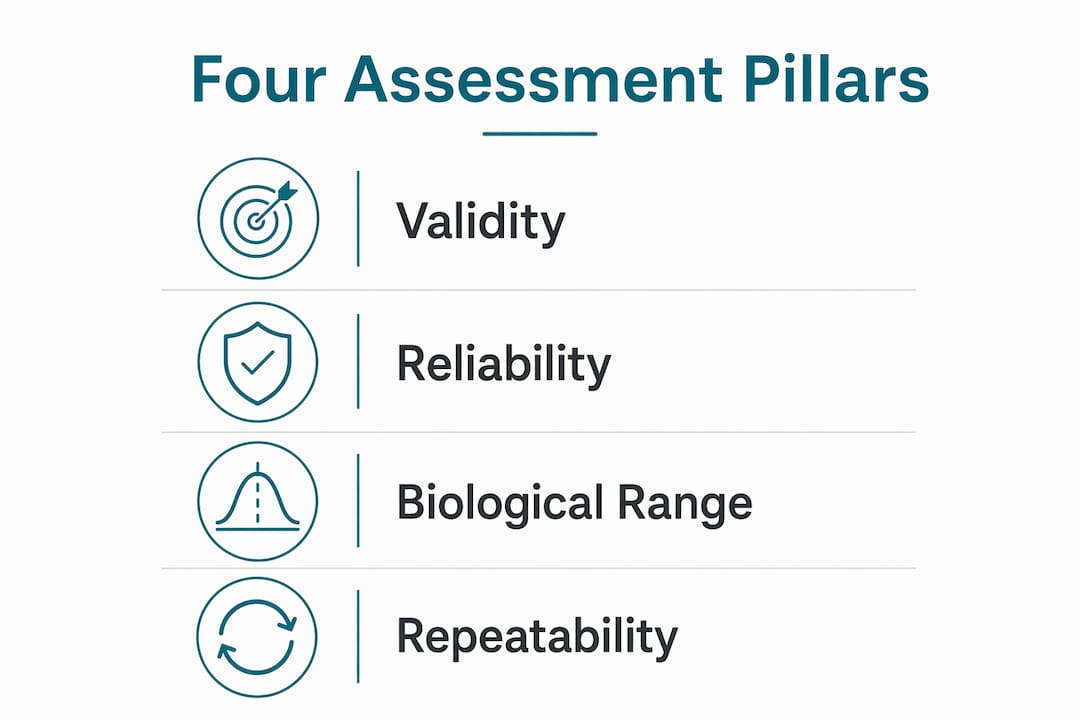
Not every biomarker that can be measured should drive clinical decisions. Valid biomarker assessment depends on four specific criteria, and understanding them protects you from wasting money on tests that generate noise rather than signal.
-
Analytic reliability. The measurement must be consistent and repeatable across labs and time points. Swiss mass spectrometry, the method used by Biostarks, sets a high bar here because it quantifies molecules with precision that immunoassay-based methods often cannot match. If a lab cannot demonstrate inter-assay reproducibility, the result is not trustworthy.
-
Clinical meaningfulness. The marker must connect to a real health outcome or disease risk. ApoB, for example, predicts cardiovascular events more accurately than LDL cholesterol because it counts the actual number of atherogenic particles. A biomarker that correlates with nothing actionable adds complexity without value.
-
Actionability. There must be evidence-based interventions available when the marker is out of range. HOMA-IR responds to time-restricted eating, resistance training, and metformin. A marker with no known intervention pathway is interesting scientifically but practically useless for personal health optimization.
-
Proven efficacy. Evidence must show that correcting the biomarker actually improves health or longevity outcomes. Lowering ApoB reduces cardiovascular risk. Normalizing 25-OH vitamin D improves immune function and bone density. The intervention must move the needle on the outcome, not just on the number.
Pro Tip: Before ordering any panel, ask your clinician or testing platform whether each marker meets all four criteria. If a test cannot answer “what do I do differently if this is abnormal,” it probably does not belong in your panel.
Common pitfalls include interpreting a single measurement as definitive, ignoring biological variability caused by sleep, hydration, or recent exercise, and treating every out-of-range result as equally urgent. Biomarker results are conversation starters, not verdicts.
Why repeated testing and trend analysis define meaningful results
A single biomarker result is a photograph. A series of results over time is a film. The difference between the two determines whether you are making decisions based on real physiology or random biological noise.
Effective functional biomarker tracking requires setting specific targets with defined timelines. A concrete example: reduce HOMA-IR below 1.5 within 8 weeks through a combination of reduced refined carbohydrate intake and three weekly resistance training sessions, then retest to confirm the trend. Targets without timelines produce no accountability and no learning.
The table below outlines a practical retesting framework based on intervention type:
| Intervention type | Retest interval | What to look for |
|---|---|---|
| Dietary change (e.g., low-carb) | 8 weeks | HOMA-IR, fasting insulin, triglycerides |
| Micronutrient supplementation | 12 weeks | 25-OH vitamin D, RBC magnesium, ferritin |
| Stress management protocol | 8 to 12 weeks | Diurnal cortisol, hsCRP |
| Pharmacological intervention | 4 to 6 weeks | Target marker plus safety markers |
Retesting at appropriate intervals serves two functions. First, it confirms whether an intervention is working. Second, it distinguishes a genuine physiological shift from a transient fluctuation caused by illness, poor sleep, or a single bad dietary week. Trends across two or three data points carry far more weight than any single result.
- Escalation pathways matter. If lifestyle changes do not move a marker within two retest cycles, the next step might be targeted supplementation. If supplementation fails, pharmacological options enter the conversation. This structured escalation prevents both under-treatment and over-treatment.
- Overtesting is a real risk. Testing cortisol every two weeks, for example, creates anxiety without generating new information. Most functional markers stabilize over weeks to months, not days.
Pro Tip: Track your biomarker trends in a simple spreadsheet alongside your intervention log. Seeing a HOMA-IR drop from 2.8 to 1.4 over 16 weeks is far more motivating and informative than any single result in isolation.
How AI and multi-omics are reshaping functional biomarker analysis
The next frontier in understanding functional biomarkers is not a better blood draw. It is the integration of multi-omics data, meaning genomics, proteomics, metabolomics, and microbiome analysis, with AI-driven interpretation engines that can identify patterns no single clinician could detect manually.
Multi-omics data combined with AI supports tailored health optimization rather than generic population-based recommendations. This is the difference between telling everyone with low vitamin D to take 2,000 IU daily and identifying that a specific individual has a VDR gene variant requiring 5,000 IU to achieve the same serum response.
Key developments driving this shift include:
- Proteomics panels that measure hundreds of circulating proteins simultaneously, revealing inflammatory, metabolic, and hormonal signals invisible to standard chemistry panels.
- AI pattern recognition that cross-references an individual’s full biomarker profile against large datasets to flag risk patterns years before symptoms appear.
- Person-specific reference ranges replacing population norms. Your optimal ferritin level may differ from the population median based on your genetics, training load, and dietary iron absorption efficiency.
- Longitudinal data integration where AI tracks how your biomarkers shift in response to seasons, stress events, and interventions, building a dynamic model of your physiology rather than a static snapshot.
Platforms advancing this work include precision health companies integrating omics data with clinical interpretation to move beyond one-size-fits-all recommendations. The practical benefit for individuals is early detection of metabolic drift, more precise supplement and medication dosing, and a health strategy built around your actual biochemistry rather than average population data. For a deeper look at how this data transforms outcomes, the analysis of 28 biomarker insights from Biostarks illustrates the real-world impact.
Practical guidance on using functional biomarker results for personal wellness
Knowing what to test is only half the equation. Knowing how to act on results without falling into common interpretation traps is where most people lose the benefit of functional biomarker evaluation.
Start with the right panel. Many standard labs do not include ApoB, HOMA-IR, diurnal cortisol, RBC magnesium, or advanced lipid fractionation. If your panel does not include these markers, you are missing the most clinically meaningful functional signals. A functional health biomarkers list built for 2026 wellness standards covers these gaps explicitly.
- Work with a clinician who prioritizes actionable markers. A physician who dismisses fasting insulin as unnecessary because your glucose is normal is not equipped to guide functional optimization.
- Understand analytic values in clinical context. A ferritin of 18 ng/mL is technically within the normal range but functionally suboptimal for an endurance athlete with high iron turnover. Context transforms numbers into decisions.
- Avoid single-biomarker fixation. Focusing exclusively on testosterone, cortisol, or vitamin D in isolation misses the interaction effects that drive real outcomes. Functional assessment is a systems exercise.
- Out of 100+ markers in comprehensive panels, only 5 to 8 typically warrant immediate clinical attention based on your individual risk profile. Prioritization prevents data overwhelm and keeps your intervention plan focused.
Pro Tip: Ask your testing platform to rank your out-of-range markers by clinical priority, not just by how far they deviate from the reference range. A mildly elevated ApoB matters more than a mildly low zinc for most people.
Nutrition, sleep, and exercise remain the primary levers for most functional biomarkers. Testing without a willingness to modify these behaviors produces data without outcomes. The goal is a continuous feedback loop: test, intervene, retest, refine.
Key takeaways
Functional biomarker assessment is the most precise tool available for moving from reactive disease management to proactive, personalized health optimization.
| Point | Details |
|---|---|
| Functional vs. clinical testing | Functional biomarkers assess optimal physiology; standard labs only flag overt disease. |
| Four pillars of valid assessment | Every biomarker must meet reliability, clinical meaningfulness, actionability, and proven efficacy criteria. |
| Trend analysis over single results | Retesting at 8 to 12 week intervals separates real physiological change from biological noise. |
| Prioritize 5 to 8 key markers | Out of large panels, focus intervention energy on the markers with the highest clinical priority for your profile. |
| AI and multi-omics are the future | Person-specific reference ranges and AI-driven pattern recognition will replace population-based norms. |
Why function-focused testing changed how I read lab results
I have reviewed hundreds of biomarker panels over the years, and the pattern that surprises people most consistently is this: their standard labs look fine, but their functional markers tell a completely different story. A fasting insulin of 14 µIU/mL alongside a normal fasting glucose is the most common example. Clinically invisible. Functionally alarming.
The challenge I see most often is not ignorance. It is data overload without prioritization. Someone receives a 90-marker panel, sees 12 out-of-range values, and either panics or shuts down. The skill is not in measuring everything. It is in knowing which three or four numbers to act on first and in what order.
What I find genuinely exciting about where this field is heading is the shift from population norms to individual baselines. Your optimal cortisol curve is not the same as the population average. Your ideal ferritin is not the same as the reference range midpoint. When AI can build a dynamic model of your specific physiology and flag deviations from your personal baseline rather than a statistical average, the precision of functional assessment will improve by an order of magnitude.
My honest advice: do not wait for symptoms to justify testing. The value of functional biomarker evaluation is precisely that it catches suboptimal trends before they become clinical problems. Engage with a qualified clinician, prioritize your most actionable markers, and commit to the retest cycle. The data is only as useful as the decisions it drives.
— Romain
Start your functional biomarker journey with Biostarks

Biostarks, an AMR Labs SA company based in Vevey, Switzerland, offers at-home biomarker testing powered by advanced Swiss mass spectrometry. The platform analyzes vitamins, hormones, amino acids, lipids, minerals, and metabolic markers with the analytical precision that functional assessment demands. Reports are designed to translate complex laboratory data into clear, prioritized health insights you can act on immediately. Whether you are an athlete optimizing performance, a professional managing metabolic health, or someone committed to longevity, Biostarks delivers the precision health data your wellness strategy requires. Explore the full testing catalog and start building your personalized health baseline today.
This content is for educational purposes only and does not constitute medical advice. Always consult with a healthcare professional before making changes to your health regimen.
FAQ
What is functional biomarker assessment?
Functional biomarker assessment is the measurement of biological markers that indicate how well the body is functioning at an optimal level, not just whether disease is present. It uses tighter, evidence-based reference ranges to identify suboptimal physiology that standard clinical labs routinely miss.
How do functional biomarkers differ from standard blood tests?
Standard blood tests use broad population reference ranges designed to detect disease. Functional biomarkers like fasting insulin, ApoB, and HOMA-IR use optimized ranges to reveal metabolic, hormonal, and inflammatory imbalances before they become diagnosable conditions.
How often should I retest functional biomarkers?
Most functional biomarkers should be retested at 8 to 12 week intervals after an intervention, which is enough time to distinguish a genuine physiological trend from short-term biological noise. Retesting more frequently than this rarely generates new clinically useful information.
Which biomarkers are most important for functional health assessment?
The highest-priority functional markers for most individuals include fasting insulin, HOMA-IR, ApoB, hsCRP, 25-OH vitamin D, diurnal cortisol, and RBC magnesium. Out of large comprehensive panels, 5 to 8 markers typically warrant immediate clinical attention based on individual risk profile.
Can AI improve functional biomarker interpretation?
AI-driven analysis combined with multi-omics data can identify patterns across hundreds of markers simultaneously and build person-specific reference ranges that replace population-based norms. This approach supports earlier risk detection and more precise, individualized intervention strategies.


