

TL;DR:
- Personalized bloodwork compares your results to your own stable biological baseline through repeated testing, enhancing accuracy. It enables earlier detection of meaningful health shifts, reduces false alarms, and improves disease management by tracking long-term trends. True personalization requires adaptive reference intervals, ongoing data collection, and professional interpretation to maximize clinical utility.
Personalized bloodwork is defined as the practice of interpreting blood test results against your own individualized biological benchmarks rather than broad population-based reference ranges. Standard lab reports compare your values to the central 95% of a reference population, a method that misses meaningful personal variation in biomarkers that remain highly stable within each individual over time. This approach, increasingly recognized in precision medicine as individualized health testing or adaptive biomarker monitoring, gives you a far more accurate picture of what “normal” actually means for your body. The result is fewer false alarms, earlier detection of real shifts, and health data you can act on with confidence.
What is personalized bloodwork and how does it work?
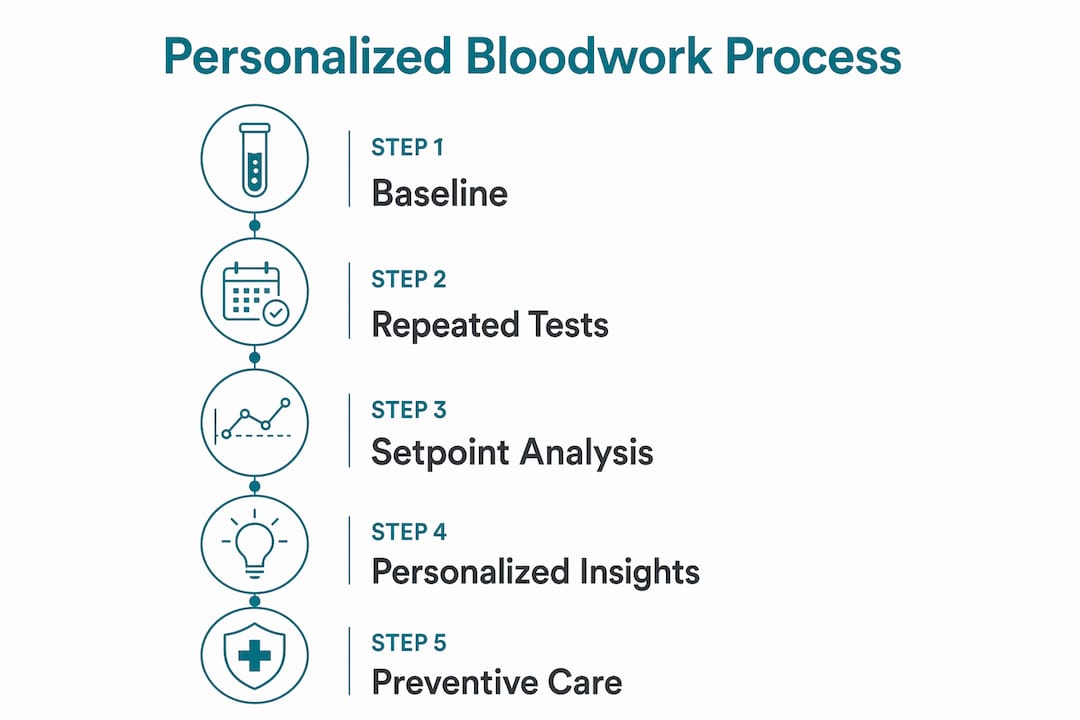
Personalized bloodwork works by establishing your unique biomarker setpoints through repeated testing over time, then flagging deviations from your personal baseline rather than a population average. Research confirms that many biomarkers are highly stable within individuals across long periods, which means your “normal” for a given marker can differ substantially from someone else’s while both values fall within the same population reference range.
Setpoints and adaptive reference intervals
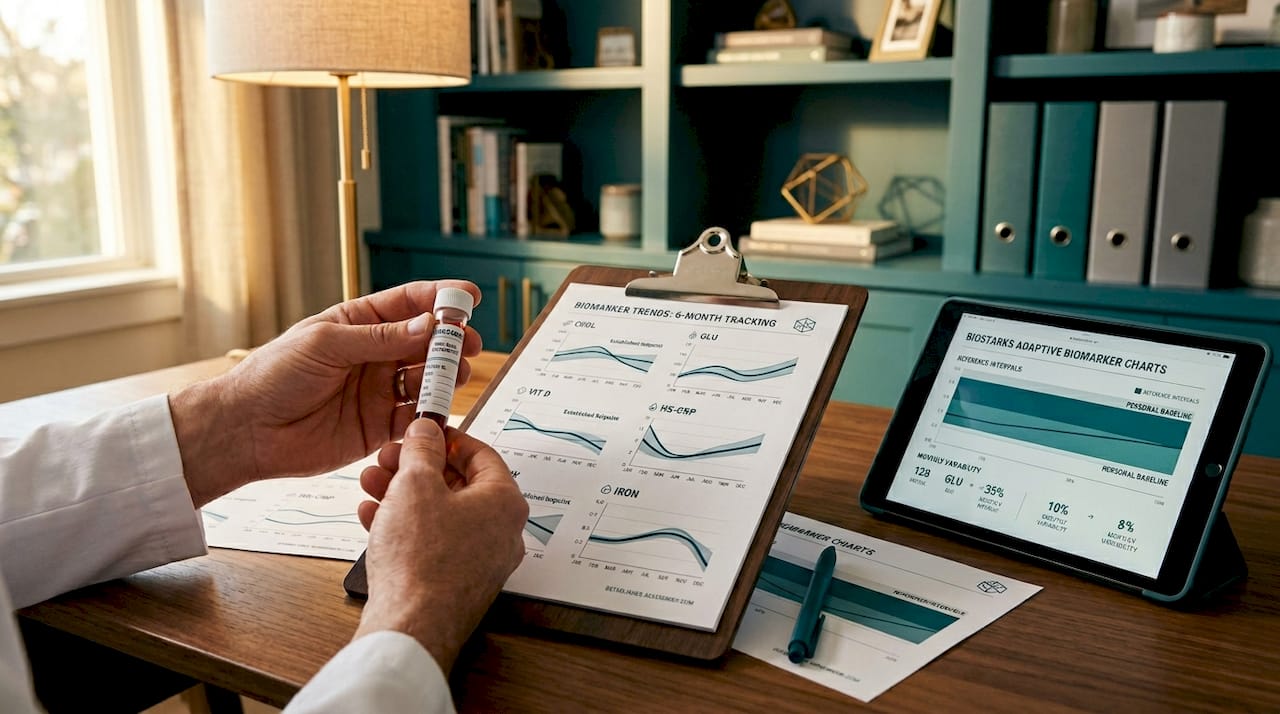
The core mechanism is the biomarker setpoint: the value your body consistently returns to under healthy conditions. Adaptive reference intervals build on this by updating as new data is collected from you specifically. According to research published in PLOS ONE, adaptive reference ranges use statistical modeling to create personalized thresholds that grow more precise with every additional test result you contribute.
Two primary modeling approaches exist. Z-score methods are simpler and faster to compute but offer lower sensitivity for detecting subtle shifts. Linear mixed-effects models are more complex but provide better sensitivity for catching early abnormalities, making them the preferred approach when longitudinal data is available. The practical implication is significant: a service using mixed-effects modeling will catch a meaningful drift in your ferritin or thyroid-stimulating hormone earlier than one relying on static population cutoffs.
Why longitudinal trends outperform single snapshots
Eric Topol, a leading cardiologist and digital medicine researcher, argues that longitudinal biomarker trends convey far more clinically useful information than any single test result. A value that sits comfortably within population norms but has shifted 20% from your personal setpoint over six months is a signal worth investigating. A single snapshot would never surface that pattern.
Pro Tip: Request copies of every blood test result you receive and store them in a personal health file. Even without a formal personalized testing service, tracking your own trends across years gives you a meaningful longitudinal dataset.
How does personalized bloodwork differ from standard lab testing?
The difference between personalized and standard lab testing comes down to the reference point used to judge your results. Standard lab reports define “normal” as the range covering the central 95% of a healthy reference population, which means 5% of healthy individuals will statistically fall outside normal limits on any given test. That is not a flaw in those individuals. It is a mathematical inevitability of how population ranges are constructed.
| Feature | Standard lab testing | Personalized bloodwork |
|---|---|---|
| Reference point | Population average (central 95%) | Your individual historical baseline |
| False positive risk | Higher (5% of healthy people flagged) | Lower (deviations measured against your setpoint) |
| Trend analysis | Rarely provided | Central to interpretation |
| Clinical utility | Broad screening | Precision monitoring and early detection |
| Data requirement | Single test sufficient | Improves with repeated testing over time |
The consequences of population-based interpretation are not trivial. The American Board of Family Medicine notes that clinical correlation is essential when evaluating out-of-range results, because population norms can produce false alarms that lead to unnecessary follow-up testing, patient anxiety, and even unwarranted treatment. Personalized benchmarking reduces this noise by anchoring interpretation to what is actually abnormal for you.
A useful analogy: your resting heart rate of 48 beats per minute might trigger a flag on a standard ECG report. For a trained endurance athlete, it is completely expected. Personalized bloodwork applies the same logic to dozens of biomarkers simultaneously.
Pro Tip: When reviewing a standard lab report, always ask your clinician whether an out-of-range value represents a change from your previous results. That single question shifts the conversation from population statistics to your personal biology.
What are the practical benefits of personalized bloodwork?
The benefits of tailored bloodwork extend well beyond avoiding false positives. Custom blood analysis gives you a precision tool for proactive health management, performance optimization, and early disease detection that standard annual panels simply cannot match.
-
Earlier detection of meaningful change. Small shifts from your personal setpoint can signal early metabolic risk even when values remain inside population norms. A creeping rise in fasting glucose or ApoB that stays “normal” by standard criteria but has climbed steadily over 18 months is exactly the kind of signal that personalized monitoring captures first.
-
Reduced diagnostic noise. Because your results are compared to your own history, the signal-to-noise ratio improves dramatically. You spend less time chasing borderline values that are simply part of your individual biology and more time acting on genuine deviations.
-
Performance and recovery optimization. Athletes and high-performers tracking markers like testosterone, cortisol, ferritin, and vitamin D benefit from knowing their functional ranges under training load versus rest. A ferritin level that is adequate for a sedentary person may represent functional depletion for someone running 50 miles per week. For a deeper look at performance-oriented panels, the bloodwork guide for hard-training athletes from HollyFit covers which markers matter most under load.
-
Chronic condition management. For individuals managing metabolic conditions, thyroid disorders, or cardiovascular risk, personalized benchmarking enables tighter monitoring. Biomarkers like HbA1c, hs-CRP, and ApoB carry far more meaning when tracked against your own trajectory rather than a population cutoff.
-
Convenience through at-home testing. Modern at-home biomarker testing has made repeated personalized testing practical. Kits that analyze markers including HbA1c, ApoB, triglycerides, and hs-CRP now deliver results analyzed by certified labs within approximately one week, removing the barrier of clinic visits for routine monitoring.
The role of biomarkers in disease prevention is well established in preventive medicine. Personalized bloodwork amplifies that role by making the data specific to you rather than statistically average.
What should you look for in a personalized bloodwork service?
Not every service that markets itself as “personalized” delivers true individualized health testing. The blood test personalization process varies significantly between providers, and the differences matter for the quality of insight you receive.
-
Adaptive reference ranges, not just population ranges. The defining feature of genuine personalized bloodwork is whether the service builds reference intervals from your own longitudinal data. A service that simply displays your results alongside standard population ranges is not offering true personalization, regardless of how it is marketed.
-
Repeated testing infrastructure. Personalized benchmarking requires multiple data points over time. A service that is designed for one-time use cannot deliver trend analysis. Look for subscription models or easy repeat ordering that encourages quarterly or semi-annual testing.
-
Lab certification. CLIA (Clinical Laboratory Improvement Amendments) certification and CAP (College of American Pathologists) accreditation are the minimum standards for labs processing diagnostic blood tests in the United States. Confirm that any service you use routes samples through certified facilities.
-
Data accessibility and usability. Your results should be available through a clear, well-designed portal or app that displays trends over time, not just your most recent values. The ability to visualize your biomarker trajectory is what transforms raw data into health intelligence.
-
Clinical context and interpretation support. Raw numbers without interpretation are of limited value. The best services provide explanatory context for each biomarker, flag meaningful deviations from your personal baseline, and ideally offer access to clinicians or health professionals for follow-up questions. Evaluating lab certifications and data accessibility before committing to a service is the single most important step in choosing well.
Key takeaways
Personalized bloodwork delivers its greatest value when repeated testing builds an individual biomarker baseline that makes deviations from your personal normal detectable long before population-based ranges would flag them.
| Point | Details |
|---|---|
| Individual setpoints matter | Your biomarker baselines are highly stable and unique, making population averages an imprecise reference. |
| Trends beat snapshots | Longitudinal data reveals meaningful shifts that single test results consistently miss. |
| Standard ranges have limits | 5% of healthy individuals test outside population norms, creating false positives without personal context. |
| Service quality varies | True personalization requires adaptive reference intervals, not just standard ranges with a wellness label. |
| Repeated testing is non-negotiable | Personalized benchmarking improves with every additional data point you contribute over time. |
Why I think most people are using bloodwork wrong
I have spent years looking at how individuals interact with their lab results, and the pattern is almost always the same. Someone gets an annual panel, scans the bolded “out of range” flags, feels relieved or alarmed, and files the paper away until next year. The data that could tell the most important story, the trajectory, never gets read because it never gets built.
The uncomfortable truth is that a single blood test is closer to a photograph than a film. It captures one moment in your biology, stripped of all the context that would make it meaningful. Relying exclusively on population reference intervals introduces latent diagnostic errors that neither the patient nor the clinician typically notices, because the error is invisible. You never know what the trend would have shown.
What I find genuinely exciting about the current moment in precision health is that the infrastructure for doing this properly is finally accessible outside of research institutions. The combination of at-home sample collection, certified lab analysis, and AI-assisted interpretation means that building a personal biomarker record over years is no longer a privilege reserved for clinical trial participants. Eric Topol has written compellingly about how integrating AI with longitudinal data holds real promise for making this kind of monitoring routine rather than exceptional.
My honest recommendation: treat your bloodwork like a financial portfolio. You would never evaluate your financial health from a single account balance on a single day. Apply the same logic to your biology, and the data becomes exponentially more useful.
— Romain
How Biostarks brings personalized bloodwork to your home
Biostarks, an AMR Labs SA company, is built specifically around the principle that your health data should be measured against your biology, not a statistical average. The platform analyzes vitamins, hormones, amino acids, lipids, minerals, and metabolic markers using advanced Swiss mass spectrometry, delivering results through a clear, longitudinal dashboard that tracks your personal biomarker trajectory over time.

At-home sample collection makes repeated testing practical, and every sample is processed by certified labs to the same standard as clinical diagnostics. If you are ready to move from annual snapshots to a genuine personal health record, explore the full Biostarks testing platform and see which panels align with your health and performance goals. For a side-by-side look at how different at-home kits compare, the biomarker testing kit comparison on the Biostarks blog is a practical starting point.
FAQ
What is personalized bloodwork?
Personalized bloodwork is the interpretation of blood test results using your individual biomarker baselines rather than population reference ranges. It relies on repeated testing over time to establish your personal setpoints and detect meaningful deviations from them.
How is personalized bloodwork different from a standard blood test?
A standard blood test compares your results to the central 95% of a reference population, meaning 5% of healthy people will appear abnormal. Personalized bloodwork compares your results to your own historical data, reducing false positives and improving clinical relevance.
How many tests do you need for personalized bloodwork to work?
Personalized benchmarking improves with every additional data point. Most adaptive reference interval models begin generating meaningful individual baselines after two to three tests, with accuracy increasing significantly by the fourth or fifth result.
Which biomarkers are most commonly tracked in personalized bloodwork?
Commonly tracked markers include HbA1c, ApoB, hs-CRP, triglycerides, ferritin, testosterone, cortisol, and vitamin D. The specific panel depends on your health goals, whether that is metabolic health, cardiovascular risk, hormonal balance, or athletic performance. For hormone-specific panels, understanding why testosterone panels need SHBG and free T alongside total testosterone is a useful starting point.
Is at-home personalized bloodwork as accurate as clinic-based testing?
At-home kits processed by CLIA-certified labs produce results that meet the same analytical standards as clinic-based draws. The key variable is sample collection quality, which well-designed kits address through clear instructions and validated collection methods.
This content is for educational purposes only and does not constitute medical advice. Always consult with a healthcare professional before making changes to your health regimen.


