

TL;DR:
- Most wellness advice is ineffective because it relies on population averages rather than your unique biology. A personalized, biomarker-based health plan offers measurable, real-time insights to guide targeted lifestyle changes. Regular retesting over appropriate intervals ensures sustained progress and meaningful long-term wellness improvements.
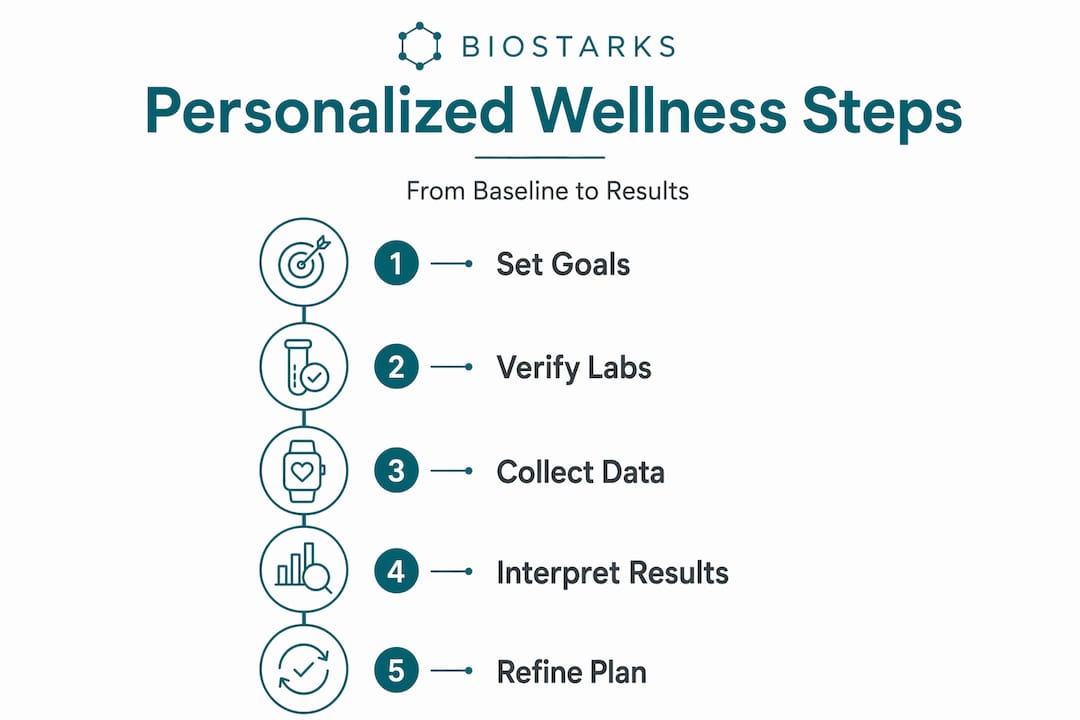
Most wellness advice fails you before you even try it. It’s built on population averages, not your biology. A personalized wellness optimization guide grounded in biomarker data changes that equation entirely, giving you a specific, measurable roadmap based on what’s actually happening inside your body right now. This guide walks through every stage of that process: choosing the right tests, collecting your data correctly, interpreting results in context, and verifying that your lifestyle changes are actually working.
Table of Contents
- Preparing for your personalized wellness journey
- Executing biomarker testing and collecting your health data
- Interpreting your biomarker results to tailor lifestyle changes
- Verifying progress and maintaining long-term wellness gains
- Rethinking wellness: the case for dynamic biomarker-driven personalization
- Achieve your personalized wellness goals with Biostarks
- Frequently asked questions
Key Takeaways
| Point | Details |
|---|---|
| Certified test quality | Choose at-home biomarker tests run in CLIA-certified labs following FDA regulations for dependable results. |
| Preparation matters | Follow pre-test conditions closely to ensure biomarker data accurately reflect your health status. |
| Interpret with context | Use biomarker trends combined with genetic and lifestyle factors for personalized, effective wellness plans. |
| Iterate and verify | Repeat testing at appropriate intervals to track progress and adjust interventions for sustained health gains. |
| Continuous personalization | Wellness optimization is a dynamic process relying on ongoing data and targeted adjustments, not one-time fixes. |
Preparing for your personalized wellness journey
The first mistake most people make is skipping the foundation. Before you draw a single drop of blood, you need to know whether the test you’re using is worth trusting.
Verifying test quality and certification
CLIA certification is the baseline quality standard for any lab analyzing human specimens in the U.S. Understanding CLIA and FDA regulations is essential for assessing whether an at-home biomarker test will produce clinically meaningful results. Without it, you’re trusting your health decisions to an unvalidated number.
Not all at-home tests require the same level of oversight. CLIA waived tests are categorized by the FDA as lower-risk for home use, meaning they can be performed outside a traditional clinical setting when the certifying lab meets specific quality standards. Knowing which category your test falls into tells you a lot about its appropriate use and limitations.
Setting goals that are actually grounded in evidence
Generic goal-setting (“lose weight,” “eat better”) gives you nothing to measure. Instead, anchor your starting goals to validated benchmarks. Healthy BMI ranges and activity recommendations from the NIDDK provide a reliable foundation for building individual wellness strategies that match your specific context, age, and metabolic profile.
Here’s what to confirm before your first test:
- The lab processing your samples holds CLIA certification
- The specific biomarkers tested have established clinical reference ranges
- Your goals map to measurable markers (e.g., targeting vitamin D optimization rather than vague “energy improvements”)
- You understand which values are trending zones vs. hard clinical thresholds
| Preparation step | Why it matters | What to check |
|---|---|---|
| Lab certification | Ensures result accuracy | CLIA certification number |
| Test category | Defines appropriate use context | FDA waived vs. non-waived classification |
| Baseline goals | Creates measurement targets | BMI, activity levels, specific biomarker targets |
| Marker selection | Focuses your intervention | Vitamins, hormones, lipids, metabolic markers |
Pro Tip: Before ordering any panel, map each biomarker to a specific lifestyle intervention you’re willing to act on. If you have no plan for a result, that test isn’t serving your wellness optimization strategies yet.
Building a personalized wellness monitoring plan from the start means your first test becomes a baseline, not a one-off curiosity.
Executing biomarker testing and collecting your health data
Accurate data requires controlled conditions. This is where most at-home testers lose reliability without realizing it.

Pre-collection conditions matter more than people think
Pre-collection factors like fasting, exercise, and hydration directly influence biomarker repeatability. A cortisol reading taken after a high-intensity workout isn’t comparable to one taken at rest. Triglycerides spike after eating. Even mild dehydration can concentrate certain blood markers artificially. These aren’t minor variables.
Follow this sequence for consistent, comparable results:
- Fast for 10 to 12 hours before collection (water only). This is non-negotiable for glucose, insulin, and lipid panels.
- Test at the same time of day, ideally between 7 and 9 AM. Hormones like cortisol and testosterone follow circadian rhythms that shift results significantly across the day.
- Avoid intense exercise for 48 hours before testing. Even moderate training elevates inflammatory markers and shifts creatine kinase levels.
- Stay well-hydrated the evening before but avoid excessive fluid intake the morning of collection, which can dilute certain markers.
- Follow kit-specific instructions exactly, including finger-prick technique, sample volume, and storage temperature before shipping.
- Ship samples the same day, using the pre-addressed packaging provided. Delays affect sample integrity more than most people expect.
Here’s what to track consistently at every test cycle:
- Date and time of collection
- Hours fasted before testing
- Sleep quality the night before
- Any recent illness, medication changes, or supplements started or stopped
- Exercise performed in the 48 hours prior
Pro Tip: Create a simple notes document or phone memo capturing these variables at every test. This context becomes essential when interpreting trends and reviewing your biomarker interpretation insights across multiple cycles.
Understanding the biomarker testing benefits available to you extends well beyond a single result snapshot. The real value comes from the pattern.
Interpreting your biomarker results to tailor lifestyle changes
A result outside the reference range is not automatically a problem. Context is everything.
Trends beat single values
A single low vitamin D reading could mean you tested in winter, didn’t supplement consistently, or have a genuine absorption issue. Personalized interventions based on biomarker trends lead to measurable, sustained improvements over years, while interventions based on one snapshot often miss the actual pattern. Always compare your current result to your prior baseline before acting.
Genetic context changes everything
Two people with identical ferritin readings may have completely different iron utilization profiles depending on genetic variants like HFE. Genetic predispositions influence baseline biomarker levels and how strongly those levels respond to lifestyle changes. Incorporating your genetic risk context alongside biomarker results makes your personalized health data significantly more actionable.
| Biomarker category | Relevant lifestyle intervention | Key confounding factors |
|---|---|---|
| Vitamin D | Sun exposure, supplementation | Season, skin tone, absorption genetics |
| Triglycerides | Carbohydrate intake, alcohol | Recent meals, fasting duration |
| hs-CRP (inflammation) | Sleep, stress, training load | Illness, injury, high-intensity exercise |
| Testosterone | Sleep quality, resistance training | Age, body fat, stress hormones |
| Ferritin (iron stores) | Dietary iron, supplementation | Genetic variants, menstrual cycle |
Here’s how to structure your interpretation process:
- Compare each result to your personal prior value, not just the population reference range
- Flag markers that are moving in the wrong direction even if they remain within “normal” limits
- Prioritize the two or three markers with the largest gaps between your current status and your target
- Integrate wearable data (sleep stages, resting heart rate, activity) to add physiological context to your numbers
Pro Tip: Reviewing your results alongside biomarkers for performance benchmarks helps distinguish between markers that indicate a training adaptation versus a genuine deficiency.
Verifying progress and maintaining long-term wellness gains
Applying lifestyle changes without retesting is like navigating without checking your position. You don’t know if you’re moving toward the target or away from it.
Why the retest interval is not arbitrary
Biomarker improvements are sustained over a long-term period averaging four or more years when people engage in repeated, personalized testing cycles. That’s not a short-term effect. The biology behind this is real: physiological adaptations to nutrition, exercise, and supplementation take weeks to months to register in blood-based markers. Retesting too soon generates noise, not signal.
Recommended retest intervals start at 90 days minimum, with studies showing a median interval of around 260 days between tests in effective longitudinal programs. This timeline reflects how long meaningful biological change actually takes.
Follow this verification cycle:
- Complete your first test to establish a personal baseline across all target markers.
- Implement specific lifestyle interventions tied to your top priority markers (nutrition changes, sleep protocols, supplementation, training adjustments).
- Wait at least 90 days before retesting. Allow your body time to respond.
- Compare results marker by marker, documenting what moved, what didn’t, and by how much.
- Adjust your intervention based on what the data shows, not what you assumed would work.
- Repeat the cycle, building a longitudinal picture of your biology over time.
| Time point | Action | Expected outcome |
|---|---|---|
| Week 0 | Baseline biomarker test | Identify priority markers |
| Weeks 1 to 12 | Implement targeted interventions | Physiological adaptation begins |
| Week 13 (minimum) | First retest | Detect measurable marker changes |
| Months 6 to 12 | Second retest cycle | Confirm or adjust intervention |
| Year 2 and beyond | Ongoing annual testing | Long-term trend tracking |
Pro Tip: Use your data-driven wellness transformation record as a running log. Even small consistent improvements compound meaningfully over a two-year period, and having the data makes them visible. A wellness optimization checklist can help you stay systematic between test cycles.
Rethinking wellness: the case for dynamic biomarker-driven personalization
Here’s the uncomfortable truth most wellness content won’t say directly: a single test result, without follow-up or context, is almost useless for making meaningful health decisions.
The wellness industry has a deep financial incentive to sell you the test and move on. But biomarkers function as trend signals requiring repeatability and context, not static targets you either hit or miss. One low magnesium reading doesn’t tell you whether you’re chronically depleted, acutely stressed, or simply tested under suboptimal conditions.
Many consumers mistakenly expect one-time biomarker tests to be sufficient, treating a single panel as a definitive health verdict. This misunderstanding leads to either unnecessary panic over normal variation or false reassurance from a single normal result that masks a developing trend.
What actually works is treating your health like a feedback system. You act, you measure, you adjust, and you measure again. This is not how wellness is typically sold, but it’s exactly how effective data-driven wellness functions in practice. The most meaningful biomarker story isn’t the number itself. It’s the direction, speed, and context of change over time.
Integrating genetic risk data, wearable metrics, and repeated blood biomarker panels creates a personalized picture that generic programs cannot replicate. This is what bespoke wellness solutions actually look like when they’re built on science rather than marketing.
Achieve your personalized wellness goals with Biostarks
You now have the framework. The next step is putting it into practice with testing infrastructure you can actually trust.

Biostarks at-home biomarker testing analyzes vitamins, hormones, amino acids, lipids, minerals, and metabolic markers using Swiss mass spectrometry, giving you clinical-grade data from a simple home collection. Each report translates complex results into clear, actionable guidance tied to your personal health context. The platform supports ongoing retesting cycles, so you’re not just collecting a snapshot but building the longitudinal data that makes real wellness optimization possible. Whether you’re targeting performance, longevity, or metabolic health, Biostarks connects your biomarker insights to the personalized recommendations that move the needle.
Frequently asked questions
What makes at-home biomarker testing trustworthy for health decisions?
At-home biomarker tests are clinically meaningful when processed by CLIA-certified laboratories following FDA quality standards, ensuring accuracy comparable to traditional clinical labs. Certification status is the single most important factor to verify before trusting any at-home test result.
How often should I retest my biomarkers for effective wellness tracking?
A minimum of 90 days between tests is recommended, with longitudinal studies showing an average retest interval of around 260 days in successful long-term wellness programs. Testing too frequently generates noise before biological changes can register.
Can biomarker tests account for genetic differences in health optimization?
Yes. Genetic predispositions influence baseline biomarker levels and how strongly they respond to lifestyle interventions, making genetic context a valuable layer for building more precise wellness plans.
How can I ensure my lifestyle changes align with my biomarker data?
Integrate your biomarker trends with activity data, sleep metrics, and genetic information to adapt your nutrition, supplementation, and training plans on a continuous basis. Treating your data as a feedback loop rather than a verdict produces the most reliable long-term results.


