

TL;DR:
- Longevity science focuses on extending healthspan, not just lifespan, by targeting biological aging mechanisms.
- Measuring progress involves molecular, physiological, and functional biomarkers like DNA methylation clocks and grip strength.
- Resilience and lifestyle habits such as exercise and sleep are more impactful for healthy aging than solely molecular optimization.
Most people assume longevity science is about living to 120. It isn’t. The real goal is extending the years you spend in genuinely good health, what researchers call healthspan, rather than simply adding time to the clock. This distinction changes everything about how you approach aging. Longevity science draws from molecular biology, physiology, and behavioral research to identify why bodies decline and what you can do about it. This guide breaks down what the field actually covers, which biological mechanisms drive aging, how to measure your own trajectory, and where the evidence is solid versus overhyped.
Table of Contents
- Defining longevity science: More than just living longer
- Inside the biology of aging: The 12 hallmarks explained
- Biomarker testing: Tracking your biological and functional age
- Benchmarks and evidence: What really predicts healthy aging?
- Controversies, challenges, and practical wisdom in longevity science
- Why measuring resilience matters more than slowing aging
- Take the next step: Track your biomarkers for actionable longevity insights
- Frequently asked questions
Key Takeaways
| Point | Details |
|---|---|
| Healthspan over lifespan | Longevity science aims to maximize years lived in good health, not just total years. |
| Test both function and molecules | Combining molecular and functional biomarker tests gives a better assessment of aging risk. |
| Validated metrics matter most | Grip strength and VO2 max are strong, evidence-backed predictors of healthy aging. |
| Beware the hype | Focus on proven lifestyle interventions over unproven supplements for the biggest longevity gains. |
| Track progress annually | Annual biomarker tracking helps you see trends and tailor your health strategy. |
Defining longevity science: More than just living longer
Longevity science is not anti-aging in the cosmetic sense. As the Longevity Science Library defines it, longevity science is the interdisciplinary study of aging mechanisms, with the goal of extending healthspan rather than just lifespan. That framing matters enormously for how you invest your time and resources.
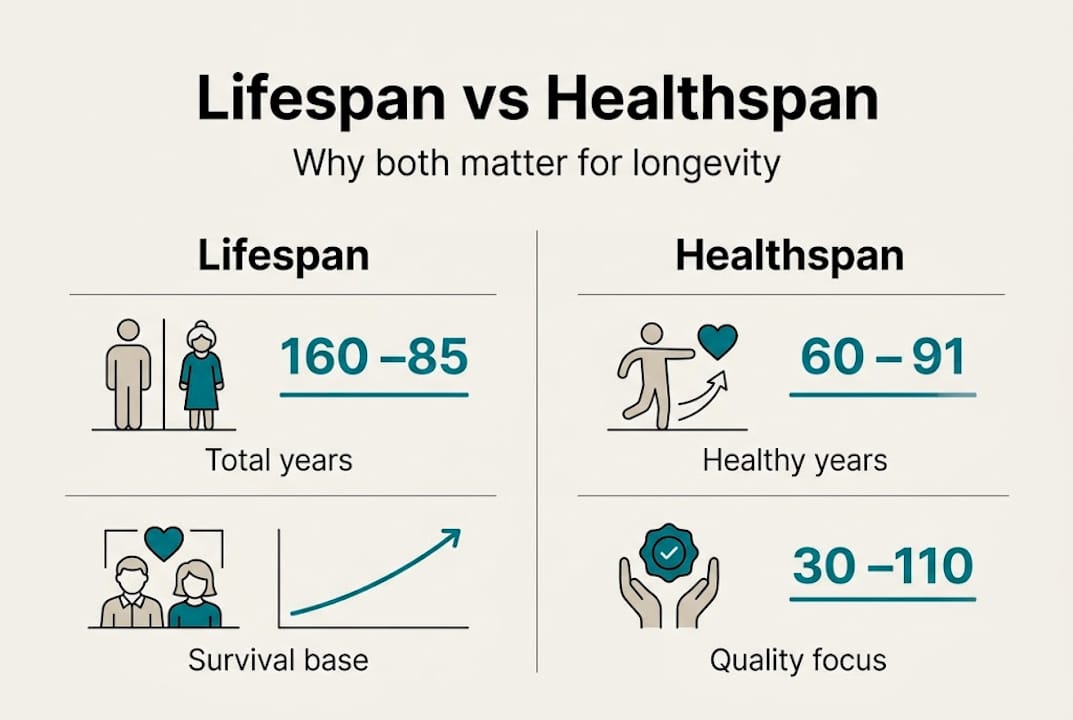
Lifespan vs. healthspan: Why both matter
| Concept | Definition | Why it matters |
|---|---|---|
| Lifespan | Total years lived | Baseline measure of survival |
| Healthspan | Years lived free of major disease or disability | Quality and function over time |
| Biological age | How old your body functions relative to chronological age | More actionable than birthdate |
The gap between lifespan and healthspan is the problem longevity science is solving. In many developed countries, people live long but spend their final decade managing chronic disease. Closing that gap is the mission.
The science takes a systems approach because aging is not caused by one thing. Nutrition’s role in healthy aging interacts with genetics, hormonal shifts, immune function, and cellular repair capacity. You cannot optimize one lever in isolation. That’s why researchers now work with the concept of the hallmarks of aging, a framework that maps the major biological processes driving decline.
The hallmarks framework also explains why biomarkers in longevity science are so central to the field. Without measurable signals, you’re guessing. With them, you can track whether your interventions are actually working at the biological level.
“The goal is not simply to add years to life, but to add life to years.” This principle, widely cited across geroscience, is what separates longevity science from conventional medicine’s reactive model.
Inside the biology of aging: The 12 hallmarks explained
With an understanding of longevity science’s broader goals, we can now look at the exact biological systems it targets. The 12 hallmarks of aging are organized into three categories: primary, antagonistic, and integrative.
The 12 hallmarks, organized by category
- Genomic instability (primary): DNA damage accumulates faster than repair mechanisms can fix it
- Telomere attrition (primary): Protective chromosome caps shorten with each cell division
- Epigenetic alterations (primary): Gene expression patterns drift away from youthful states
- Loss of proteostasis (primary): Misfolded proteins accumulate and impair cell function
- Disabled macroautophagy (primary): The cellular recycling system becomes less efficient
- Deregulated nutrient sensing (antagonistic): Pathways like mTOR and AMPK lose their calibration
- Mitochondrial dysfunction (antagonistic): Energy production becomes inefficient and generates more oxidative stress
- Cellular senescence (antagonistic): Damaged cells stop dividing but release inflammatory signals
- Stem cell exhaustion (integrative): Tissue repair capacity declines as stem cell pools shrink
- Altered intercellular communication (integrative): Signaling between cells becomes noisier and less precise
- Chronic inflammation (integrative): Low-grade systemic inflammation, often called “inflammaging,” drives disease
- Dysbiosis (integrative): Gut microbiome composition shifts in ways that worsen systemic health
These hallmarks do not operate independently. Mitochondrial dysfunction generates oxidative stress that worsens genomic instability. Cellular senescence amplifies chronic inflammation. Dysbiosis disrupts nutrient sensing. This interconnection is precisely why optimizing longevity biomarkers requires looking at multiple systems simultaneously rather than chasing a single marker.
Practical healthy aging tips that address multiple hallmarks at once, like resistance training combined with time-restricted eating, consistently outperform single-target approaches in the literature. This is not coincidence. It reflects the biology.
“Aging is not a single process. It is the convergence of multiple deteriorating systems, each amplifying the others.” Understanding this interconnection is what separates serious longevity practitioners from supplement shoppers.
Biomarker testing: Tracking your biological and functional age
But how do you actually measure progress in your own healthspan journey? Here’s where biomarker testing comes into play. Advanced biomarker testing has matured significantly, and the options now span three meaningful categories.
Three categories of longevity biomarker testing
- Molecular biomarkers: Epigenetic clocks like DunedinPACE and GrimAge measure biological aging rate at the DNA methylation level. Proteomic and metabolomic panels reveal systemic stress and metabolic efficiency. These tests are increasingly accessible through at-home blood collection.
- Physiological biomarkers: VO2 max (cardiorespiratory fitness), grip strength, and gait speed are among the most validated predictors of healthspan outcomes. They require specific equipment but are straightforward to measure.
- Functional assessments: Cognitive testing, balance assessments, and DEXA scans for body composition round out the picture. These capture how well your systems perform under real-world conditions.
According to Physiological Reviews, longevity biomarker testing spans molecular, physiological, and functional domains, and regular monitoring through blood panels, DEXA scans, and wearables is recommended for biohackers tracking healthspan trends.

Understanding what metabolic age means in practical terms helps contextualize these results. A 45-year-old with the metabolic profile of a 35-year-old has measurably different risk trajectories than their chronological peers. That gap is what you’re trying to widen in your favor.
The role of biomarkers extends beyond diagnosis. They function as a feedback loop. You implement an intervention, retest after 3 to 6 months, and assess whether the needle moved. Without that loop, you’re operating on assumption. Unlocking health data through regular testing transforms subjective wellness into objective, trackable progress.
Pro Tip: Don’t test everything at once. Start with a foundational panel covering inflammation (hs-CRP), metabolic health (HOMA-IR, fasting glucose), lipids (ApoB), and one functional measure like grip strength or VO2 max. Establish your baseline, then add complexity as you understand your individual patterns.
Benchmarks and evidence: What really predicts healthy aging?
Armed with testing tools, it’s critical to know which metrics actually give you meaningful feedback. Not all biomarkers are created equal, and the evidence hierarchy matters.
Longevity biomarker evidence strength
| Biomarker | Type | Evidence strength | Key threshold |
|---|---|---|---|
| DunedinPACE | Molecular | Very strong | Lower pace = slower aging |
| VO2 max | Physiological | Very strong | Top 25th percentile for age |
| Grip strength | Physiological | Strong | Every 5 kg decrease = 16% higher mortality |
| ApoB | Blood | Strong | Below 80 mg/dL |
| hs-CRP | Blood | Strong | Below 1 mg/L |
| HOMA-IR | Metabolic | Strong | Below 1.0 |
| Telomere length | Molecular | Moderate | Correlative, not causal |
Research published in Springer’s biomarker benchmarks confirms that DunedinPACE is the strongest mortality predictor among 14 consensus biomarkers, that a 5 kg decrease in grip strength links to 16% higher all-cause mortality, and that high VO2 max values strongly predict healthspan outcomes. Centenarians consistently show low inflammation and efficient metabolism even when other aging markers are present, suggesting resilience rather than perfect biomarker profiles is the real differentiator.
Key aging predictors from centenarian studies are instructive. These individuals don’t have perfect epigenetic clocks. They have robust immune function, low chronic inflammation, and strong metabolic flexibility. Their biology bends without breaking.
What the evidence actually supports:
- High cardiorespiratory fitness (VO2 max) is among the strongest predictors of all-cause mortality, with top-quartile fitness reducing risk by 45% compared to the bottom quartile
- Grip strength declines of 5 kg per decade are associated with meaningful increases in cardiovascular and all-cause mortality
- Strength training and mortality research consistently shows that resistance exercise is one of the most powerful modifiable predictors of healthspan
Pro Tip: Track blood biomarkers for aging at minimum annually, but pair them with functional tests every 6 months. Blood panels tell you what’s happening internally; functional tests tell you how your body is performing in the real world. You need both perspectives.
Controversies, challenges, and practical wisdom in longevity science
Yet as with any fast-growing field, it’s essential to sift fact from hype and understand the real-world limits of current longevity science. Several major debates shape how practitioners and researchers approach the field.
The core controversies:
- Aging as disease vs. natural process: Whether aging qualifies as a disease affects regulatory pathways for clinical trials and drug approvals. The debate is not purely academic. It determines which interventions get funded and tested.
- Geroscience vs. reactive medicine: Geroscience argues for targeting aging mechanisms before disease appears. Conventional medicine treats disease after it manifests. The gap between these models is enormous in terms of cost, timing, and outcomes.
- Healthspan vs. lifespan trade-offs: Columbia Public Health research confirms that extending healthspan does not require a trade-off with lifespan. Improving one tends to improve the other.
- Supplement hype vs. evidence: This is where most consumers get misled. Rapamycin, NAD+ precursors, senolytics, and various peptides generate enormous attention, but the human evidence for most remains thin. Exercise, dietary quality, sleep, and stress management have decades of robust evidence behind them.
Understanding types of aging biomarkers helps you evaluate these claims critically. When a supplement company claims their product “lowers biological age,” ask which biomarker they measured, over what timeframe, in what population, and whether the change was clinically meaningful.
Understanding metabolic age is another area where marketing often outpaces science. Metabolic age calculators vary wildly in methodology and validation. Treat them as directional signals, not precise measurements.
“The most powerful longevity interventions are also the least profitable to sell: consistent exercise, quality sleep, whole food nutrition, and stress regulation.” This is not a reason to dismiss them. It’s a reason to prioritize them.
Practical recommendations grounded in consensus evidence:
- Prioritize VO2 max and strength as your primary functional targets
- Use blood panels to catch metabolic drift early, before symptoms appear
- Apply skepticism to any single supplement claiming dramatic aging reversal
- Build testing into your routine as a feedback system, not a one-time curiosity
Why measuring resilience matters more than slowing aging
Having explored the empirical and practical landscape, here’s a perspective you won’t find in most longevity discussions.
The field has a bias toward molecular precision. DunedinPACE scores, methylation clocks, proteomic panels. These are genuinely useful tools, but they can create a false sense that aging is primarily a problem to be measured and chemically corrected. That framing misses something critical.
Centenarian research repeatedly shows that the longest-lived, healthiest individuals are not those with the most optimized biomarker panels. They are the ones with the greatest resilience: physical, psychological, and metabolic. They recover from illness faster. They maintain function under stress. Their systems bend rather than break.
A Yale study on positive aging found that 45% of adults over 65 actually improve cognitively or physically over time, and that positive age beliefs are independently associated with better health outcomes. This is not soft science. It reflects the measurable biological reality that psychological resilience influences inflammatory markers, immune function, and recovery capacity.
The practical implication is this: if you are spending more energy optimizing your epigenetic clock score than building physical capacity, improving sleep quality, and managing chronic stress, your priorities are inverted. The foundational habits produce the largest and most durable healthspan gains for most people. Molecular testing should inform and refine those habits, not replace them.
Geroscience is shifting toward what some call “Medicine 3.0,” a preventive model that acts on aging biology before disease appears. But the most underrated tool in that model is not a drug or a biomarker. It’s consistent, measurable behavior change tracked over years, not weeks.
Take the next step: Track your biomarkers for actionable longevity insights
Ready to start applying these insights and get real data on your own longevity journey?
Understanding the science of aging is the first step. Acting on it with precision data is where the real gains happen. At Biostarks, we make advanced biomarker testing accessible without requiring a clinic visit. Our at-home testing uses Swiss mass spectrometry to analyze vitamins, hormones, amino acids, lipids, minerals, and metabolic markers with the accuracy of a professional laboratory.

Whether you’re building your first baseline or refining an existing protocol, our panels give you the molecular and metabolic picture your healthspan strategy needs. Explore our longevity biomarker testing options and start tracking the metrics that actually predict healthy aging. Your biological age is not fixed. But you need data to change it.
Frequently asked questions
What is the primary difference between lifespan and healthspan?
Lifespan is the total number of years lived, while healthspan is how many of those years are spent free from major disease or disability. Longevity science prioritizes extending healthspan, not just adding years.
How often should I test biomarkers for aging?
Annual molecular biomarker testing combined with functional assessments every 6 months is the approach recommended for biohackers tracking healthspan trends. Consistency over time matters more than any single result.
Which biomarkers should biohackers prioritize for longevity?
Grip strength, VO2 max, ApoB, hs-CRP, and HOMA-IR are the most evidence-backed starting points. Columbia Public Health research recommends targeting ApoB below 80 mg/dL, hs-CRP below 1 mg/L, and HOMA-IR below 1.0 as foundational thresholds.
Is it possible to slow aging through diet or supplements?
Exercise, dietary quality, and sleep have robust evidence supporting their impact on healthspan. Most longevity supplements lack proof of meaningful effect in humans and should be approached with skepticism.
Are molecular biomarkers better than functional tests for predicting aging?
Functional biomarkers like grip strength and VO2 max are more validated for predicting outcomes than most molecular tests. Epigenetic clocks are correlative tools, not causal ones, and work best when paired with functional assessments.


