

TL;DR:
- Precision medicine uses individual genetic and biomarker data to personalize athlete training and nutrition.
- Common biomarkers like ferritin and hemoglobin inform tailored interventions and injury risk assessments.
- While promising, widespread adoption faces high costs, data complexity, and scientific limitations.
Most athletes spend years chasing marginal gains through harder training and stricter nutrition, assuming the same protocol that works for a teammate will work for them. It rarely does. Precision medicine in sports uses omics technologies to personalize nutrition, training, injury prevention, and performance optimization at the individual level. This guide breaks down exactly how genetics, biomarkers, and molecular data are reshaping what it means to train smart, where the science is solid, and where you should stay cautious before spending money on unproven tests.
Table of Contents
- What is precision medicine in sports?
- How genetics and biomarkers impact performance and injury risk
- Precision medicine in action: Real athlete examples and protocols
- Challenges, caveats, and current limitations
- A realistic path forward for athletes and coaches
- Ready to unlock your personalized performance edge?
- Frequently asked questions
Key Takeaways
| Point | Details |
|---|---|
| Personalized approach | Precision medicine tailors nutrition, training, and recovery to each athlete’s unique biology for improved results. |
| Actionable biomarkers | Markers like ferritin and blood metabolites offer evidence-based ways to target supplementation and optimize performance. |
| Current limitations | Challenges like high costs and unstandardized protocols mean athletes should focus on proven, practical interventions. |
| Don’t over-rely on genetics | Gene-based testing provides helpful clues but is not yet robust enough alone for predicting performance or talent. |
What is precision medicine in sports?
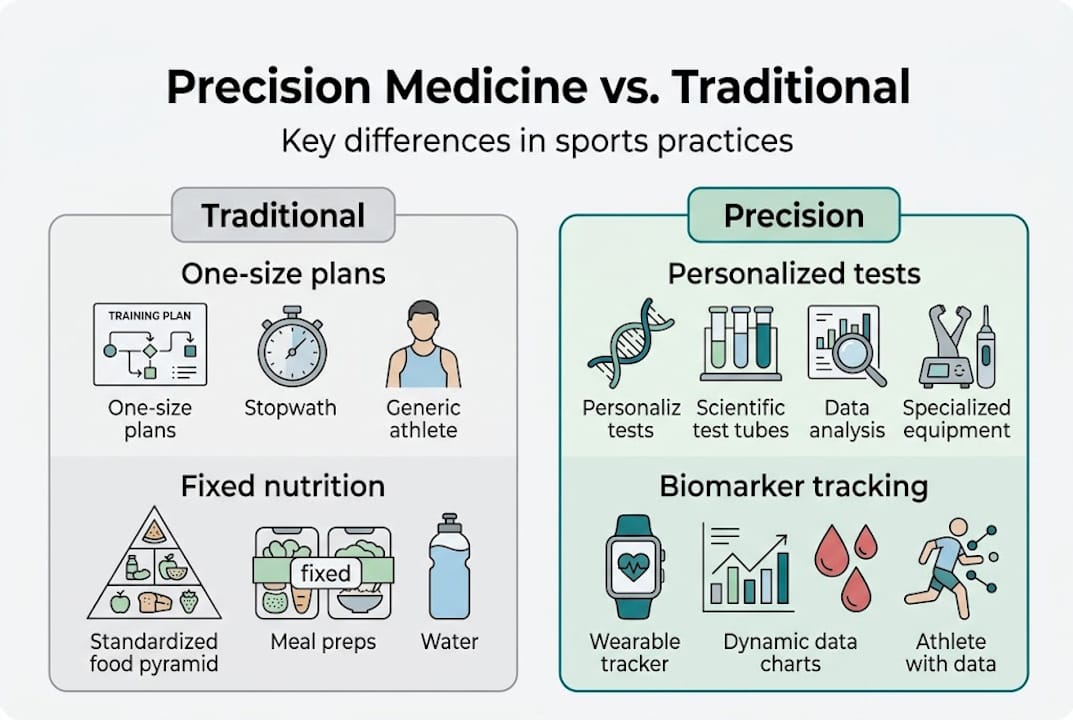
Precision medicine is not a single test or tool. It is a framework that replaces population-based averages with individual-specific data. In a traditional sports setting, a coach might prescribe the same carbohydrate loading protocol to every athlete on the team. Precision medicine asks a different question: what does this athlete need, based on their biology?
The engine behind this shift is a group of technologies called omics. Each one reads a different layer of your biology:
- Genomics: maps your DNA and identifies genetic variants that influence muscle fiber composition, injury risk, and nutrient metabolism
- Metabolomics: measures small molecules (metabolites) in your blood or urine that reflect your real-time physiological state
- Proteomics: analyzes proteins expressed in your body, which can signal inflammation, tissue damage, or adaptation to training
- Transcriptomics: reads gene expression patterns, showing which genes are actually active at a given moment
Together, these tools create a biological fingerprint. Omics-based precision medicine allows practitioners to tailor nutrition timing, training load, recovery windows, and injury screening to each athlete’s unique profile.
Here is how precision medicine compares to the traditional approach:
| Factor | Traditional approach | Precision medicine approach |
|---|---|---|
| Nutrition | General macros for the sport | Personalized based on metabolomics and genetics |
| Training load | Team-wide periodization | Individual load based on recovery biomarkers |
| Injury prevention | Reactive (treat after injury) | Proactive (screen genetic risk factors) |
| Supplementation | Standard protocols | Guided by deficiency biomarkers and SNPs |
| Recovery | Fixed rest days | Timed to individual physiological signals |
Understanding the biomarker testing benefits that come with this approach makes it clear why elite programs are adopting it fast. And if you want a deeper look at why biomarkers matter specifically for sport, the role of biomarkers for athletes covers the foundational science in detail.
How genetics and biomarkers impact performance and injury risk
Your DNA does not determine your destiny in sport, but it does set the playing field. Single nucleotide polymorphisms, or SNPs (pronounced “snips”), are tiny variations in your genetic code that influence how your body responds to training, handles stress, and recovers from injury.
Researchers have identified several SNPs with real clinical relevance for athletes. Genetics and SNPs can identify injury risks tied to collagen gene variants, such as heightened ACL rupture or Achilles tendon vulnerability, and performance traits like power-to-endurance ratio. This means a screening program can flag an athlete who carries a high-risk collagen variant and adjust their plyometric volume before an injury ever happens.
Here is a snapshot of key biomarkers and what they tell you:
| Biomarker | What it measures | Athletic relevance |
|---|---|---|
| Ferritin | Iron storage | Endurance capacity, oxygen transport |
| Hemoglobin | Oxygen-carrying red blood cells | Aerobic performance ceiling |
| Cortisol | Stress hormone | Overtraining detection, recovery status |
| CRP | Inflammation marker | Training load tolerance |
| Blood metabolites | Real-time metabolic state | Sprint potential, fuel utilization |
Here is a practical sequence for integrating genetic and biomarker data:
- Run a baseline blood panel covering ferritin, hemoglobin, cortisol, and key metabolites
- Add a genetic screen targeting injury-risk SNPs and nutrient metabolism variants
- Cross-reference results with performance data from training
- Build a targeted intervention: adjust iron intake, modify training load, or add specific recovery protocols
- Retest every 8 to 12 weeks to track adaptation
However, it is important to be honest about the limits here. Genomics for athletic performance is promising but premature for broad commercial use or talent identification, because gene-environment interactions are complex and current evidence remains weak for many claims. A genetic test alone will not tell you whether an athlete will become elite.
Pro Tip: Use genetic data to screen for risk factors and deficiencies, not to predict potential. The most actionable use of genetics right now is identifying what your body struggles to do, not what it is destined to achieve.
For a full breakdown of how athlete blood testing insights translate into training decisions, and how to approach biomarker interpretation without getting lost in the data, those resources are worth your time.
Precision medicine in action: Real athlete examples and protocols
Theory is useful. Real protocols are better. Here is how precision medicine tools actually play out in athlete programs.
In football and endurance sports, iron status is one of the most commonly mismanaged variables. Many athletes supplement iron without knowing their baseline ferritin or whether their genetics affect iron absorption. Ferritin and hemoglobin improve significantly when iron supplementation is guided by genetic polymorphisms tied to iron metabolism, rather than blanket dosing. Athletes who carry variants in genes like TMPRSS6 or HFE absorb and store iron differently, meaning the same supplement dose produces wildly different outcomes.

On the speed side, metabolomics is opening new doors. Blood metabolites predict sprint potential in young athletes, giving coaches an early signal of who may respond best to power-focused training before years of development are invested.
A practical precision medicine protocol looks like this:
- Baseline testing: Full blood panel plus targeted metabolomics at the start of a training block
- Genetic review: SNP screening for injury risk, nutrient metabolism, and recovery speed
- Tailored intervention: Adjust macronutrient ratios, supplement timing, and training intensity based on results
- Progress monitoring: Retest key biomarkers mid-block to confirm adaptation is occurring
- Coaching integration: Share data with the coaching team to align periodization with biological readiness
“The athletes who benefit most from precision medicine are not necessarily the most genetically gifted. They are the ones who act on their data consistently and adjust their protocols when the numbers shift.”
Pro Tip: Do not wait for symptoms to trigger testing. Schedule biomarker panels at the start of each training block so you catch deficiencies before they become performance limiters.
Exploring biomarker testing for athletes and understanding the types of biomarkers relevant to your sport will help you build a smarter testing calendar.
Challenges, caveats, and current limitations
Precision medicine in sports is genuinely exciting. It is also genuinely messy. Before you invest heavily in a full omics program, you need to know what the field has not yet solved.
The barriers are real:
- High costs: Full genomic sequencing and metabolomics panels remain expensive, limiting access for most amateur athletes and smaller programs
- Data overload: Omics produces enormous datasets that require specialized interpretation. Raw numbers without context can mislead as easily as they inform
- No standardized protocols: There is no universal consensus on which biomarkers to test, when to test them, or how to act on results across different sports
- Small sample sizes: Most sports science studies involve dozens of participants, not thousands, making it hard to generalize findings
- Ethical concerns: Genetic data raises serious questions about privacy, potential misuse by teams or insurers, and fairness in talent selection
The replicability issue is particularly striking. Only about 28% of sports and exercise studies successfully replicate, meaning a large portion of findings that look compelling in one study do not hold up when tested again. This does not mean the science is worthless. It means you should prioritize interventions backed by multiple independent studies, not a single exciting paper.
Statistic to know: Fewer than one-third of sports science findings replicate consistently. That number should shape how aggressively you adopt any single new protocol.
The advantages of metabolic testing are real, but they are best realized when testing is paired with expert interpretation. This is also why nutritionists using biomarkers are increasingly valuable partners for athletes navigating this space.
A realistic path forward for athletes and coaches
Here is an uncomfortable truth the precision medicine industry does not always advertise: most athletes will see the biggest gains not from cutting-edge genomics, but from fixing the basics that biomarkers reveal. Low ferritin. Poor sleep-driven cortisol spikes. Inadequate amino acid availability during recovery. These are not glamorous findings, but they are actionable.
Precision medicine shifts sports from one-size-fits-all to individualized approaches, and it works best for identifying specific deficiencies rather than broad optimization. That framing matters. It tells you where to start: with validated, high-confidence markers that have clear intervention pathways.
The athletes and coaches who get the most from this approach treat data as one input among many, not as the final word. Coaching intuition, training history, and athlete feedback all belong in the conversation alongside biomarker results. Genetic tests, in particular, should inform screening and risk management rather than dictate selection or limit opportunity.
Building a personalized nutrition and performance strategy around validated markers is a practical first step that pays dividends without requiring a full genomics program. Start there, then layer in more complexity as your understanding and budget grow.
Ready to unlock your personalized performance edge?
Precision medicine is no longer reserved for elite Olympic programs. The tools are more accessible than ever, and the most actionable starting point is understanding your own biomarker baseline.

At Biostarks, we make it straightforward to get science-driven data on your internal health status from home, using advanced Swiss mass spectrometry to analyze vitamins, hormones, amino acids, metabolic markers, and more. If you are ready to move from guesswork to precision, explore our personalized biomarker testing solutions and start building a protocol grounded in your actual biology. For a deeper look at how to optimize metabolic function as part of your performance strategy, that resource is a natural next step.
Frequently asked questions
What is the main benefit of precision medicine for athletes?
Precision medicine enables athletes to personalize training, nutrition, and recovery based on their unique genetic and biomarker profiles, replacing generic protocols with strategies that match their actual biology.
How can biomarkers help prevent sports injuries?
By analyzing genetic markers and SNPs linked to collagen structure and tissue resilience, athletes can identify elevated injury risks and adjust training loads or movement patterns before damage occurs.
Are genetic tests enough to predict athletic performance?
No. Gene-environment interactions are too complex, and current evidence for talent identification through genetics alone is weak. Genetics provide useful clues, but training, nutrition, and environment shape outcomes just as much.
What are the main challenges of precision medicine in sports?
High costs, data complexity, lack of standardized protocols, ethical concerns around genetic privacy, and limited replicability of many sports science findings are the primary barriers to widespread adoption.
Which biomarkers are most actionable for athletes right now?
Ferritin, hemoglobin, and blood metabolites are among the most validated and actionable, directly guiding iron supplementation decisions and offering early signals of sprint and endurance potential.


