

TL;DR:
- Measuring circulating amino acids provides insights into metabolic health that food logs and protein intake cannot reveal.
- Advanced LC-MS/MS technology enables precise, simultaneous quantification of multiple amino acids critical for diagnosis and performance optimization.
Most people think about amino acids in terms of protein shakes and muscle recovery. That framing misses about 90% of what amino acid measurement actually reveals. The real question of why measure amino acids goes much deeper than dietary adequacy. Circulating amino acid levels reflect how your body is metabolizing, not just what you ate. They signal metabolic imbalances, expose inefficiencies in protein utilization, and track anabolic responses in real time. Whether you’re an athlete, a clinician, or someone focused on long-term metabolic health, measuring amino acids gives you data that diet logs and total protein counts simply cannot.
Table of Contents
- Key Takeaways
- Why measure amino acids: the science behind the data
- Clinical and metabolic uses of amino acid profiling
- Performance nutrition and amino acid measurement
- Practical approaches for assessing amino acids
- My perspective: why this data is worth pursuing
- How Biostarks makes amino acid testing accessible
- FAQ
Key Takeaways
| Point | Details |
|---|---|
| Beyond diet tracking | Plasma amino acid levels reveal metabolic status that food records and protein intake targets cannot capture. |
| Precision technology required | LC-MS/MS with derivatization is the gold standard for reliably measuring 15 or more amino acids simultaneously. |
| Clinical diagnostic value | Amino acid profiling detects inherited metabolic disorders and guides treatment decisions from birth onward. |
| Performance nutrition edge | Oral amino acid tracers can quantify muscle protein synthesis within 2 to 2.5 hours, transforming how athletes track recovery. |
| Interpretation matters | Results only tell the full story when compared against method-validated, population-specific reference intervals. |
Why measure amino acids: the science behind the data
Amino acids are not passive nutrients waiting to be burned for energy. They are signaling molecules, enzyme cofactors, neurotransmitter precursors, and structural substrates. Your plasma amino acid profile at any given moment reflects a constant exchange between organs, including the gut, liver, skeletal muscle, kidneys, and brain. Measuring free amino acids in plasma captures a metabolic snapshot of inter-organ exchange that tells you far more than what your last meal contained.
Why standard protein tests fall short
A total serum protein test or a dietary recall tells you how much protein entered the system. It says nothing about whether leucine reached skeletal muscle in sufficient concentrations for anabolic signaling, whether glutamine is being consumed faster than it is synthesized under physiological stress, or whether a specific amino acid transport defect is creating a bottleneck. Those distinctions require direct measurement.
The technology that makes precision measurement possible
Amino acids present a real analytical challenge. Most have high polarity and no chromophore, meaning they absorb very little ultraviolet light, which rules out simple spectrophotometric detection. Separating isomers like leucine and isoleucine is particularly difficult because their molecular masses are identical and they co-elute on standard columns.
Liquid chromatography tandem mass spectrometry (LC-MS/MS) with derivatization solves these problems. A new derivatization agent known as 6-CiQ-NHS shows improved stability, sensitivity, and chromatographic separation for plasma amino acid samples, representing a meaningful advancement over older reagents. The result is a panel that can measure 15 or more amino acids simultaneously with the specificity and sensitivity required for both clinical and performance decisions.
Key technical requirements for reliable amino acid measurement include:
- Validated derivatization chemistry to prevent incomplete reactions that create false deficits
- Chromatographic separation capable of resolving structural isomers
- Stable isotope internal standards to account for matrix effects and analytical variability
- Method-specific quality control run in parallel with patient or subject samples
- Documented recovery data for each amino acid on the panel
Pro Tip: When evaluating an amino acid test provider, ask specifically whether their method is validated for each amino acid on the panel and whether they use stable isotope labeled internal standards. Those two details separate a reliable result from an unreliable one.
Clinical and metabolic uses of amino acid profiling
The clinical importance of amino acids has been recognized for decades in the context of rare inherited disorders. What has changed is the precision and accessibility of testing, and the recognition that amino acid imbalances are not limited to rare disease populations.

Detecting inherited metabolic disorders
Inborn errors of metabolism, including phenylketonuria, maple syrup urine disease, and homocystinuria, are characterized by the accumulation or depletion of specific amino acids. Newborn screening programs use tandem MS to quantify amino acids from dried blood spots, and early detection through MS/MS screening measurably reduces morbidity in these conditions. The dried blood spot format makes population-level screening practical from the first days of life.
Beyond rare disease, amino acid profiling serves clinicians in several critical contexts:
- Chronic kidney disease: elevated plasma phenylalanine and low tyrosine signal reduced renal clearance and impaired hydroxylation capacity
- Liver dysfunction: low branched-chain amino acids combined with elevated aromatic amino acids reflects compromised hepatic metabolism
- Nutritional deficiency: low plasma essential amino acids in patients receiving parenteral nutrition can guide formulation adjustments
- Metabolic syndrome investigation: altered glutamine and alanine ratios correlate with insulin resistance and systemic inflammation
Amino acid profiling is most powerful when aligned with a specific metabolic question. Population- and age-specific reference intervals are critical for accurate interpretation in both pathology and applied research.
The context in which a result is interpreted matters as much as the number on the report. A plasma glycine concentration that is entirely normal in a healthy adult may be pathologically elevated or depressed in a neonate. Clinicians who understand this use amino acid panels as targeted diagnostic tools rather than screening curiosities.
Performance nutrition and amino acid measurement
The argument for measuring amino acids in performance contexts comes down to one limitation of dietary tracking: intake does not equal utilization. You can calculate leucine consumption from a food log down to the milligram and still have no idea whether that leucine is reaching muscle tissue at a concentration sufficient to trigger the mechanistic target of rapamycin signaling pathway and initiate protein synthesis.
Amino acid tracers close that gap. Oral ingestion of labeled amino acids can replace cumbersome IV infusions for muscle protein synthesis studies, enabling more flexible and shorter metabolic assessments in applied sports science settings.
Here is how amino acid measurement translates into practical performance advantages:
- Quantify muscle protein synthesis directly. Studies show muscle protein synthesis can be measured within 2 to 2.5 hours using plasma precursor enrichments of labeled amino acids after feeding or exercise. This timeline is short enough for practical application in training research.
- Differentiate responders from non-responders. Two athletes consuming identical protein protocols can show meaningfully different anabolic responses at the plasma level. Measurement identifies who benefits from protein timing changes and who needs a different approach.
- Optimize amino acid dose and timing. Plasma appearance and clearance curves for specific amino acids after a meal show whether a given bolus is absorbed and circulated efficiently, or whether excess is oxidized before it reaches target tissue.
- Detect catabolism under energy restriction. Low plasma branched-chain amino acids during a calorie deficit signal accelerating muscle breakdown before it shows up on a scale or in a skinfold measurement.
Measuring circulating amino acids for personalized insights is one of the most direct methods available for moving beyond population-level nutrition guidelines and into truly individualized protocols.
Pro Tip: If you are an athlete using amino acid profiling to guide recovery, test plasma amino acids both in a fasted state and 90 minutes after a post-training protein feed. The delta between those two measurements tells you far more than either value alone.
Practical approaches for assessing amino acids
Understanding how to assess amino acids practically requires knowing which sample type is appropriate, what panels report, and where interpretation most commonly goes wrong.
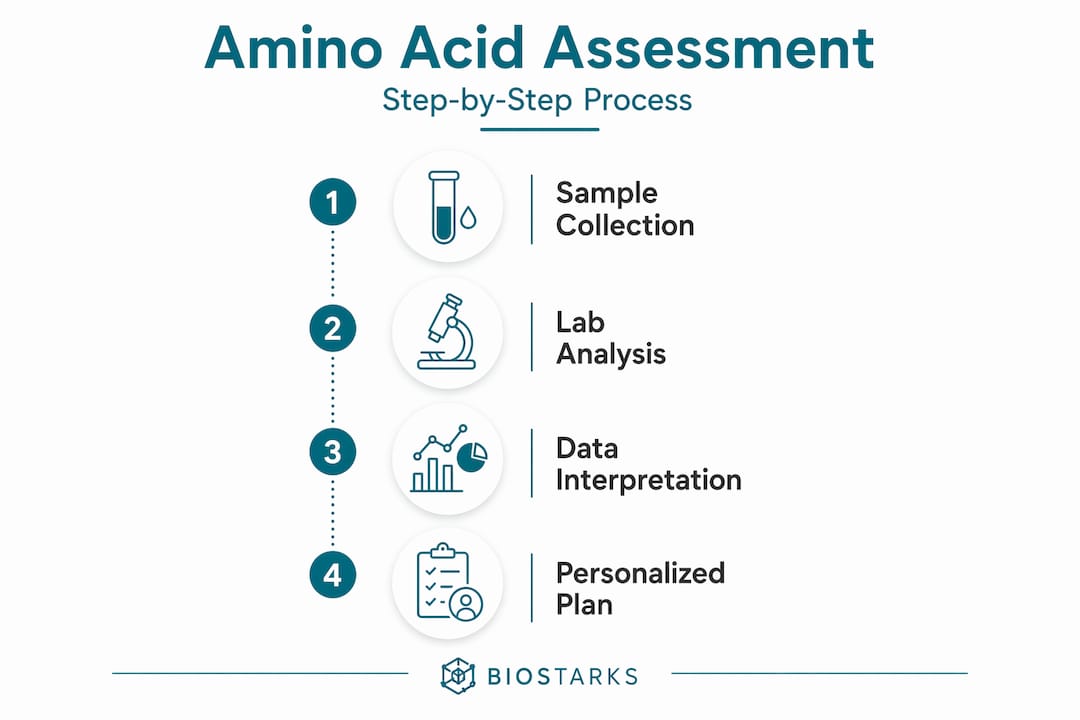
Sample types and what they measure
| Sample Type | Best For | Limitations |
|---|---|---|
| Fasted plasma | Metabolic status, clinical diagnostics, reference comparisons | Requires venipuncture; time-sensitive processing |
| Serum | General metabolic screening | Some amino acids degrade during clotting; slightly less accurate than plasma |
| Urine | Detecting renal aminoaciduria, organic acidemias | Reflects filtration and resorption, not systemic metabolic status |
| Dried blood spots | Newborn screening, remote testing, large-scale programs | Semi-quantitative for some analytes depending on method performance |
For performance and metabolic health applications, fasted plasma remains the reference standard. Dried blood spot formats offer real logistical advantages for at-home collection, but the analytical reliability varies by amino acid and provider. Not all analytes on a dried blood spot report carry equal quantitative confidence without explicit method validation data from the laboratory.
Common pitfalls in amino acid test interpretation include:
- Comparing results across different labs without checking whether the methods are equivalent
- Using adult reference ranges for pediatric samples or clinical populations with altered physiology
- Ignoring that incomplete derivatization or unstable analytes can produce apparent deficits that are analytical artifacts rather than biological findings
- Treating a single time point as definitive without accounting for meal status, time of day, and recent exercise
Choosing a qualified testing provider that uses validated amino acid measurement methods and reports against appropriate reference intervals is the single most important factor in getting results you can act on.
My perspective: why this data is worth pursuing
I’ve spent years working at the intersection of biomarker science and applied health optimization, and amino acid measurement consistently surprises people. Not because the results are exotic, but because they contradict assumptions. I’ve seen athletes with textbook protein intakes showing plasma leucine levels that barely register after feeding. I’ve seen clinicians dismiss unexplained fatigue and cognitive fog for months before an amino acid profile revealed a straightforward deficiency pattern driving the whole picture.
What I find most underappreciated is the gap between what we measure routinely and what actually drives outcomes. We routinely measure total protein. We routinely measure complete blood count. We do not routinely measure the actual building blocks that those proteins come from, even though circulating amino acid levels reveal metabolic imbalances that intake data alone will consistently miss.
The future of personalized nutrition is not a better food diary. It is higher-resolution metabolic data applied with clinical rigor. Amino acid profiling is already one of the clearest windows into that picture, and the technology to access it has never been more practical. What’s been missing is the context and interpretation to make those numbers meaningful. That’s where a data-driven approach, with validated methods and proper reference ranges, changes the conversation entirely.
— Romain
How Biostarks makes amino acid testing accessible
If you’ve followed this article to this point, you already know that measuring amino acids is more than a curiosity. It’s one of the most direct methods for assessing your metabolic status, refining your nutrition, and catching imbalances before they become problems.

Biostarks, an AMR Labs SA company, offers amino acid and metabolic biomarker testing using advanced Swiss mass spectrometry, with at-home sample collection and reports built for people who want to understand and act on their data. The platform analyzes amino acids alongside vitamins, hormones, lipids, and other metabolic markers to give you a complete metabolic picture rather than isolated numbers. Explore the Biostarks metabolic testing panels to see how professional-grade biomarker analysis translates into personalized, evidence-based decisions for your health and performance.
FAQ
Why measure amino acids instead of tracking protein intake?
Protein intake tells you what entered your body, but amino acid measurement reveals how your body processed it. Plasma amino acid profiling captures real-time metabolic status and identifies imbalances that dietary logs consistently miss.
What sample type is most reliable for amino acid testing?
Fasted plasma is the reference standard for clinical and metabolic amino acid assessment. Dried blood spots are practical for at-home collection but may be semi-quantitative for some amino acids depending on the lab’s validated method.
Can amino acid testing help with sports performance?
Yes. Oral amino acid tracers allow researchers and practitioners to measure muscle protein synthesis within 2 to 2.5 hours, and plasma amino acid profiles reveal whether dietary protein is reaching muscle tissue in concentrations that support recovery and growth.
How do labs measure amino acids accurately?
The gold standard is LC-MS/MS combined with validated derivatization chemistry. This method resolves structural isomers like leucine and isoleucine and quantifies 15 or more amino acids simultaneously with the sensitivity required for clinical decisions.
What can amino acid imbalances indicate?
Amino acid imbalances can signal inherited metabolic disorders, liver or kidney dysfunction, nutritional deficiency, accelerated muscle catabolism, and metabolic syndrome patterns. Accurate interpretation requires comparing results against method-validated, population-specific reference intervals.
This content is for educational purposes only and does not constitute medical advice. Always consult with a healthcare professional before making changes to your health regimen.


