

Feeling stuck despite putting effort into diet and training is a familiar challenge for many driven American and European adults. For those focused on peak performance and lasting wellness, guesswork is no longer enough. Biomarker insights give you real-time feedback by measuring molecules, proteins, and other biological markers directly from blood or urine, as shown in recent medical research. Discover how these tools move you past generic advice, empowering targeted decisions for athletic results and optimal metabolic health.
Table of Contents
- Defining Biomarker Insights In Personal Health
- Common Types Of Biomarkers Analyzed
- How At-Home Biomarker Testing Works
- Benefits For Performance And Wellness
- Risks, Limitations, And Cost Considerations
Key Takeaways
| Point | Details |
|---|---|
| Importance of Biomarkers | Biomarkers provide objective insights into your health, enabling personalized medicine by revealing individual biological states. |
| Categories of Biomarkers | Understanding different biomarker categories helps tailor health optimization strategies based on genetic predispositions and responses to interventions. |
| At-Home Testing Advantages | At-home biomarker testing simplifies the process of monitoring health, allowing easy sample collection and rapid results analysis. |
| Considerations for Testing | Assess the reliability, cost, and need for professional interpretation of biomarker tests to make informed health decisions. |
Defining Biomarker Insights in Personal Health
Biomarker insights represent a fundamental shift in how we understand our health. At their core, biomarkers are measurable biological substances or characteristics that objectively reflect what’s actually happening inside your body. Think of them as your internal health’s vital signs, far more detailed than traditional metrics. These can include molecules, proteins, lipids, nucleic acids, and other cellular markers found in blood, urine, or tissue samples. When you access biomarker data, you’re essentially obtaining a snapshot of your biological status at a specific moment, revealing everything from nutrient deficiencies to metabolic efficiency to inflammatory patterns.
What makes biomarker insights so valuable for your health optimization is their role in enabling personalized medicine. Rather than following one-size-fits-all health protocols, biomarkers allow you to tailor prevention and treatment based on your unique genetic makeup, lifestyle factors, and current health conditions. For instance, two people with identical fitness routines might have completely different vitamin absorption rates or inflammatory responses, revealed only through biomarker analysis. Biomarkers serve as objective indicators of both your current biological processes and your body’s response to the interventions you’re implementing, whether that’s a new training protocol, dietary change, or supplement regimen. This objective measurement eliminates guesswork and replaces it with data-driven decisions about your health trajectory.
The practical advantage for someone in your position is early detection and prevention. Biomarkers can reveal disease states, prognosis indicators, and optimal treatment responses long before you experience symptoms. You might discover that your metabolic markers are trending toward insulin resistance three years before developing type 2 diabetes, giving you a genuine window to intervene. Your amino acid profiles might show which nutrients your body struggles to absorb effectively, even if you eat a balanced diet. Your lipid panels provide insights into cardiovascular health beyond basic cholesterol numbers. By understanding these biological indicators now, you’re essentially getting ahead of potential health problems and optimizing the systems that directly impact your performance, energy, and longevity.
Pro tip: Start with baseline biomarker testing rather than waiting for symptoms or annual physicals, then retest every 3 to 6 months to track how your lifestyle and optimization strategies are actually working at the biological level.
Common Types of Biomarkers Analyzed
Not all biomarkers tell the same story about your health. Understanding the different categories helps you interpret what your test results actually mean and how they apply to your optimization goals. Biomarkers fall into distinct categories based on their function, and each one reveals something unique about your body’s current state or future trajectory. Seven main categories of biomarkers include susceptibility and risk markers that show genetic predisposition, diagnostic markers that detect active disease, prognostic markers that predict disease outcomes, monitoring markers that track disease progression or treatment response, predictive markers that forecast how you’ll respond to specific interventions, pharmacodynamic markers measuring your biological responses to therapy, and safety markers identifying potential toxic effects. This classification system helps you understand why certain markers matter for your specific health goals.
For someone focused on performance and metabolic optimization, the most relevant categories center on prevention and response tracking. Susceptibility biomarkers reveal your genetic predisposition to certain conditions, giving you early warning signals even before symptoms appear. For example, your ApoE gene status can indicate genetic risk for cognitive decline, while specific lipid patterns might signal cardiovascular vulnerability. Diagnostic biomarkers confirm the presence of current conditions, like elevated fasting glucose indicating metabolic dysfunction. Monitoring biomarkers track how your interventions are actually working at the biological level. When you make dietary changes or start a new training program, these markers show whether your inflammation is decreasing, your metabolic flexibility is improving, or your nutrient stores are rebuilding. This real-time feedback is invaluable because you’re not guessing whether your efforts are working. Predictive biomarkers forecast how your body will respond to specific treatments or supplements, helping you avoid wasting time and money on interventions unlikely to benefit you. Antecedent biomarkers for disease risk identification essentially work as your early warning system, showing patterns before they become problematic.
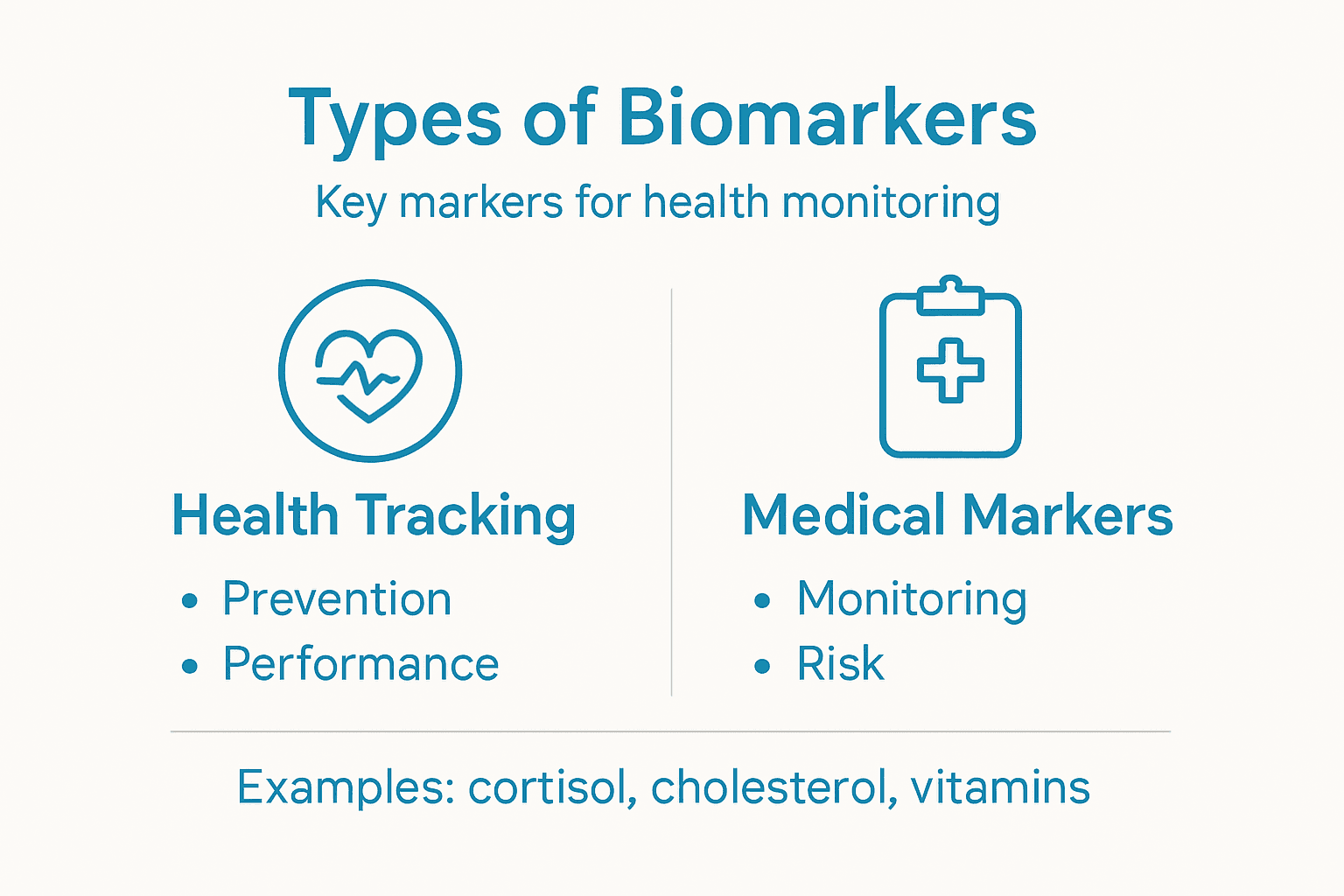
At Biostarks, an AMR Labs SA company, the biomarkers we analyze span multiple categories depending on your test selection. Whether you’re examining metabolic health markers, nutrient levels, or hormone balance, each biomarker serves a specific purpose in your optimization strategy. Some reveal what’s happening right now, while others predict future risks. Some show how well your body absorbs specific nutrients, while others indicate how effectively your training is driving physiological adaptations. The key is knowing which categories matter most for your current phase of health optimization and what action each marker warrants.
Pro tip: When reviewing your biomarker results, pay special attention to monitoring and predictive markers first, as these directly show how your current lifestyle choices are affecting your biology and what interventions you should prioritize next.
Here’s a summary of biomarker categories and their typical applications:
| Biomarker Category | What It Reveals | Example Marker | Typical Use Case |
|---|---|---|---|
| Susceptibility/Risk | Genetic predisposition | ApoE gene status | Early risk detection |
| Diagnostic | Active disease presence | Fasting glucose | Identifying health conditions |
| Prognostic | Expected disease outcome | Cancer markers | Assessing progression risk |
| Monitoring | Response to treatment/lifestyle | Inflammation panel | Tracking intervention success |
| Predictive | Likely reaction to interventions | Drug metabolism | Selecting optimal therapies |
| Pharmacodynamic | Biological changes from therapy | Hormone levels | Measuring treatment efficacy |
| Safety | Potential toxicity indicators | Liver enzymes | Ensuring interventions are safe |
How At-Home Biomarker Testing Works
At-home biomarker testing has transformed from a sci-fi concept into a practical reality. The process is straightforward yet backed by sophisticated laboratory science. When you order a test from Biostarks, an AMR Labs SA company, you receive a collection kit designed for easy self-sampling in your own home. You collect a small biological sample, typically through a simple finger prick for blood, a saliva sample, or a urine collection. The beauty of this approach is that you avoid scheduling appointments, driving to clinics, or sitting in waiting rooms. Instead, you complete the process in minutes from your kitchen or bathroom, then securely ship your sample to our certified laboratory using the prepaid envelope included in your kit.

Once your sample arrives at the laboratory, it enters an advanced analytical pipeline. Advanced biosensors detect biomarkers from small amounts of body fluids using technologies like semiconductor graphene-based sensors that identify biological molecules indicative of your health status. At Biostarks, we utilize Swiss mass spectrometry techniques, a gold-standard analytical method that provides exceptional precision and clarity. These methods analyze your sample for dozens of biomarkers simultaneously, including vitamins, minerals, amino acids, hormones, lipids, and metabolic markers. The process takes days rather than weeks because modern laboratory automation can process samples rapidly without sacrificing accuracy. Each biomarker measurement is calibrated against reference standards to ensure your results are objective and comparable to future tests.
What sets Biostarks apart is how we handle the results after analysis. You don’t receive a confusing lab report filled with medical jargon and reference ranges. Instead, self-collection of biological samples through convenient kits gets analyzed and transformed into actionable insights you can understand. Your personalized report explains what each biomarker means for your specific health optimization goals, whether that’s enhancing athletic performance through sport performance biomarkers, optimizing nutrition absorption, or supporting longevity. The report includes recommendations tailored to your results, showing you exactly which lifestyle adjustments, nutrients, or interventions might benefit you most. You can track changes over time when you retest, watching your biomarkers shift in response to your efforts and making data-driven adjustments to your health strategy.
Pro tip: Collect your sample in the morning when your body is in a fasted state, as this standardizes your biomarker values and makes comparisons between tests more meaningful and accurate.
Benefits for Performance and Wellness
Biomarker insights transform how you approach both athletic performance and overall wellness by replacing guesswork with objective data. If you’re training hard but not seeing results, the problem might not be your effort, it might be invisible to the naked eye. Blood biomarker profiling monitors athletes’ physiological and nutritional status to reveal deficiencies, oxidative stress levels, inflammation patterns, and red blood cell health that directly impact your capacity to perform. You could be iron deficient and not realize it, or training so hard that your inflammation is chronically elevated, preventing recovery and adaptation. Traditional coaching relies on how you feel and what you see in the mirror. Biomarkers show what’s actually happening at the cellular level, allowing you to make precise adjustments that accelerate progress.
For performance athletes, the advantage compounds over time. When you track biomarkers like cortisol, testosterone, insulin-like growth factor, and inflammatory markers across training cycles, you gain personalized longitudinal data that reveals your unique response patterns. One athlete might thrive with high training volume while another needs more recovery days to manage inflammation and stress hormones. One person’s metabolism might handle carb loading efficiently while another’s glucose control suggests different timing. By monitoring amino acid profiles, you discover which proteins your body absorbs well and which nutrients you’re wasting money on. Identifying biomarkers that predict physical and cognitive performance under stress enables you to optimize resilience when it matters most, whether that’s competition day or demanding work periods. This personalized approach consistently outperforms population-based training plans because it’s built on your individual biology.
For general wellness, biomarker insights work as an early warning system and motivation tracker combined. You might feel fine but discover your lipid ratios are trending toward cardiovascular risk, or your vitamin D is chronically low, affecting immunity and mood. Conversely, when you make dietary changes or start exercising regularly, biomarkers show you proof that your efforts are working at the biological level. You see inflammation dropping, energy production improving, nutrient stores rebuilding. This objective feedback keeps you consistent because you’re not just trusting the scale or your subjective feelings. At Biostarks, an AMR Labs SA company, our comprehensive biomarker testing reveals your unique nutritional needs, hormonal balance, metabolic capacity, and recovery status. The benefits extend across every aspect of your health, from better sleep quality and mental clarity to improved body composition and disease prevention.
Pro tip: Test your biomarkers at the same time of day and under similar conditions each time you retest, ideally after a fasted morning, to minimize normal daily fluctuations and make your comparisons meaningful.
Risks, Limitations, and Cost Considerations
Biomarker testing isn’t a magic solution, and understanding its limitations helps you use the data wisely. One significant challenge is that assay reliability, standardization, and validation vary across different testing methods and laboratories. A biomarker result is only as useful as the methodology that produced it. Not all biomarkers have been equally validated, and some show individual variability that makes interpretation complex. Your vitamin D level might fluctuate based on season, sun exposure, and supplementation timing. Your inflammation markers might spike temporarily from an infection or intense workout. Some biomarkers represent snapshots in time rather than stable traits. Additionally, complex diseases and health conditions involve multiple interacting biomarkers, making simple cause-and-effect conclusions risky. Finding that your homocysteine is elevated doesn’t automatically mean you’ll develop heart disease, because hundreds of other factors influence cardiovascular risk. You need context, professional interpretation, and longitudinal tracking to separate meaningful signals from normal biological noise.
The cost of biomarker testing is a real consideration for many people. Individual biomarker tests can range from affordable to expensive depending on which markers you choose and how frequently you test. The cost-effectiveness of biomarker testing varies by methodology and clinical context, meaning some tests offer better value than others depending on your specific health goals. Comprehensive testing packages from providers like Biostarks, an AMR Labs SA company, can represent a meaningful investment, though the ability to track progress over time and make data-driven decisions often justifies the expense for serious athletes and health optimizers. Insurance coverage varies significantly. Some biomarker tests fall under standard preventive care and are covered, while others are out-of-pocket expenses. You might find that comprehensive testing annually or quarterly costs more than you initially expected, especially if you’re testing multiple family members.
Another limitation worth acknowledging is that biomarker data requires proper interpretation and action. Having numbers without understanding what they mean leads to anxiety or misguided interventions. A slightly elevated liver enzyme might indicate nothing serious, or it might warrant investigation. Abnormal results need professional context before you make major health changes. Biomarker testing also cannot replace clinical diagnosis. If you have symptoms suggesting disease, biomarkers support diagnosis but don’t substitute for medical evaluation. Finally, be cautious about over-testing or obsessive tracking, which can create unnecessary stress rather than clarity. Some people retest too frequently, seeing normal fluctuations as concerning changes. The goal is informed decision-making, not compulsive monitoring.
Pro tip: Use biomarker testing strategically rather than obsessively, testing quarterly or semi-annually to track meaningful trends while avoiding the noise of normal biological variation and unnecessary anxiety.
Here’s an overview of key factors to consider before investing in biomarker testing:
| Factor | Impact on Choice | What to Ask Before Testing |
|---|---|---|
| Cost | Budget and frequency | Are packages or insurance options? |
| Reliability | Test accuracy and value | Is the lab certified and validated? |
| Interpretation Needs | Value of insights | Is professional guidance included? |
| Clinical Relevance | Real-world health action | Will results inform next steps? |
Unlock Your Health Potential with Precision Biomarker Testing
Understanding your body’s unique biomarker profile is key to overcoming the common challenge of guessing what your health needs. This article highlights the importance of personalized insights into your metabolic status, inflammation levels, and nutrient absorption to optimize performance and longevity. If you are ready to move beyond generic advice and gain real-time feedback on how your lifestyle impacts your biology, it is time to harness the power of advanced testing.
At Biostarks, we specialize in providing accurate, actionable biomarker data using Swiss mass spectrometry techniques. Our easy-to-use at-home collection kits empower you to monitor critical health markers with confidence. Whether you want to improve athletic recovery, manage metabolic health, or track nutritional status, our comprehensive reports translate complex lab results into clear recommendations.
Start your journey today by exploring our professional testing options tailored for athletes and health optimizers who demand precision. Visit Biostarks now to discover how science-driven biomarker insights can transform your approach to health. Take control of your health data and make decisions grounded in your unique biology instead of guesswork.
Frequently Asked Questions
What are biomarkers in health optimization?
Biomarkers are measurable biological substances or characteristics that reflect the state of your body’s health. They can reveal insights about nutrient deficiencies, metabolic efficiency, and inflammatory patterns based on samples from blood, urine, or tissues.
How can biomarker insights enhance personalized medicine?
Biomarker insights allow for tailored prevention and treatment based on individual genetic make-up, lifestyle factors, and health conditions, leading to more effective and personalized healthcare strategies compared to traditional one-size-fits-all approaches.
What types of biomarkers are most relevant for health monitoring?
Common biomarker categories include susceptibility and risk markers, diagnostic markers, prognostic markers, monitoring markers, predictive markers, pharmacodynamic markers, and safety markers, each providing unique insights into health status and responses to interventions.
How does at-home biomarker testing work?
At-home biomarker testing involves self-collection of biological samples, such as blood or saliva, using a collection kit. The samples are then sent to a certified laboratory for analysis, where advanced techniques provide insights that are easy to understand and actionable.


