

Your fitness tracker tells you how many steps you took and how long you slept. But it cannot tell you why you feel exhausted despite eight hours of rest, or why your energy crashes every afternoon. The gap between surface-level metrics and true health insight is where most wellness strategies fall short. Personalized approaches beyond basic wearables become possible only when you add objective, internal data to the picture. This guide breaks down what that data actually means, what the science says about its impact, and how you can use it to build a wellness strategy that works for your biology.
Table of Contents
- From steps to biomarkers: The data evolution in personal wellness
- How biomarker data powers actionable health plans
- What the evidence shows: Biomarker data and long-term health outcomes
- Pitfalls and limitations: Navigating data quality, overload, and interpretation
- Putting it all together: Personalizing your wellness strategy with data
- Take the next step: Unlock your wellness potential with biomarker insights
- Frequently asked questions
Key Takeaways
| Point | Details |
|---|---|
| Go beyond wearables | Validated biomarker data offers deeper, actionable insights than basic activity tracking alone. |
| Personalization is cyclical | Iterative testing, intervention, and retesting are crucial for optimizing health with data. |
| Quality over quantity | Focusing on 2-3 north star biomarkers prevents overload and leads to better results. |
| Integrate expert input | Consult professionals for interpretation so data-driven wellness is accurate and safe. |
From steps to biomarkers: The data evolution in personal wellness
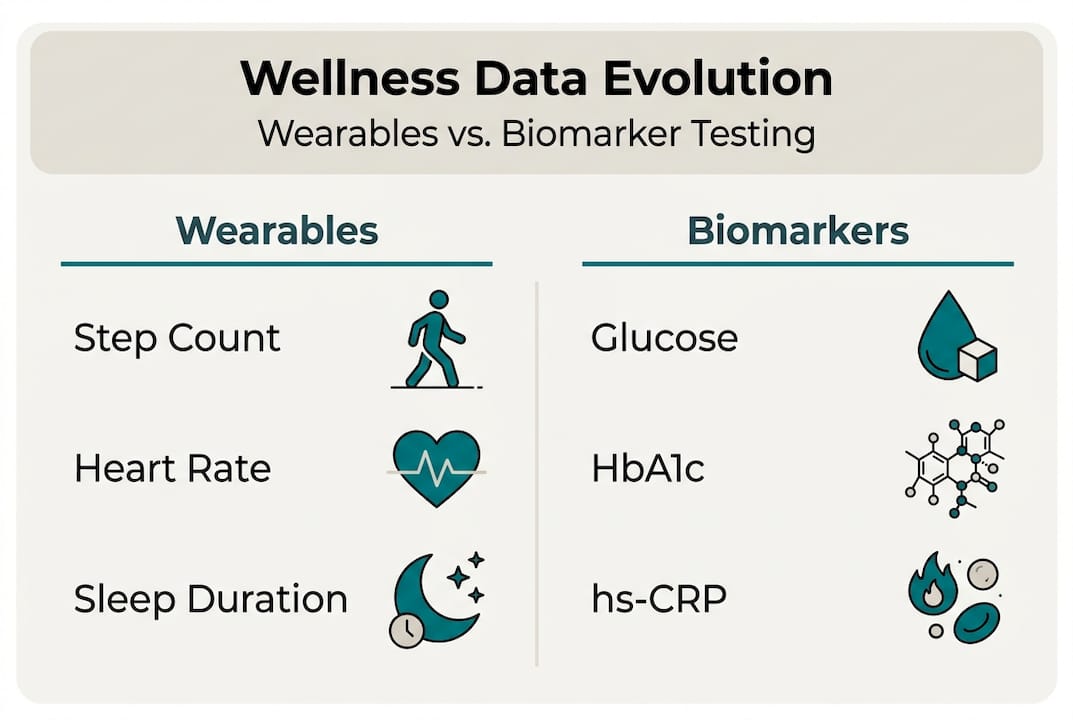
Fitness trackers have made health data mainstream. Step counts, resting heart rate, sleep stages, and calorie estimates are now part of daily life for millions of people. That is genuinely useful. But these metrics describe behavior and surface physiology. They do not explain what is happening inside your cells, your hormones, or your metabolic pathways.
Biomarker testing changes that equation entirely. Markers like fasting glucose, HbA1c, high-sensitivity C-reactive protein (hs-CRP), and lipid panels give you a direct window into metabolic and inflammatory status. These are the numbers that predict disease risk, guide nutrition decisions, and reveal whether your current lifestyle is actually working at a biological level. Understanding the full range of essential biomarker types helps you see which measurements matter most for your goals.
At-home biomarker tests now measure 28 to 600+ health markers, going far beyond what any wearable can offer. That is not a small upgrade. That is a fundamentally different category of information.
| Data type | What it measures | Depth of insight |
|---|---|---|
| Wearable tracker | Steps, heart rate, sleep duration | Behavioral and surface |
| Basic blood panel | Cholesterol, glucose | Snapshot metabolic |
| Advanced biomarker test | 28 to 600+ markers including hormones, amino acids, inflammation | Deep metabolic and cellular |
The role of biomarkers in health optimization is not just academic. It is the difference between guessing and knowing. And when you are making decisions about what to eat, how to train, and how to recover, knowing wins every time. Explore how biomarker insights for health translate raw numbers into real decisions.
How biomarker data powers actionable health plans
Knowing your biomarkers is only the first step. The real value comes from what you do with that information. The core cycle is straightforward: test, interpret, intervene, and retest. Baseline assessment, targeted intervention, and retesting form the engine of any personalized wellness plan that actually moves the needle.
Here is how that cycle works in practice:
- Establish your baseline. Run a comprehensive biomarker panel to see where you stand across key systems: metabolic, hormonal, inflammatory, and nutritional.
- Identify your priority markers. Not every number needs immediate action. Focus on the markers that are out of range or trending in the wrong direction.
- Design targeted interventions. Adjust nutrition, sleep, exercise, or supplementation based on what your data shows, not generic advice.
- Retest at regular intervals. Quarterly retesting lets you confirm whether your interventions are working and course-correct if they are not.
- Refine continuously. Your biology changes. Your plan should too.
Take hs-CRP as a concrete example. If your result comes back elevated, that signals systemic inflammation. You can then adjust your diet toward anti-inflammatory foods, reduce processed sugar, and prioritize sleep. Retest in 90 days. If hs-CRP drops, your intervention worked. If it does not, you dig deeper. That is biomarker interpretation in action.
“The most powerful thing about biomarker data is that it removes the guesswork. You stop following trends and start following your own biology.”
AI and machine learning now interpret multi-marker patterns, as seen in composite tools like the WHOOP Age score and the Longevity-Inflammation Index. These systems synthesize dozens of data points into a single, actionable number. They are useful for simplifying complexity, but they work best when the underlying data is validated and comprehensive. Pairing AI tools with solid metabolic marker strategies gives you both the big picture and the granular detail.

Pro Tip: Do not wait until something feels wrong to test. Baseline data collected when you feel healthy gives you a personal reference point that makes future results far more meaningful.
What the evidence shows: Biomarker data and long-term health outcomes
The science behind biomarker-driven wellness is not theoretical. Real studies are showing measurable improvements in health outcomes when people use this data systematically.
Pilot studies found hs-CRP can be reduced by 68% through targeted lifestyle interventions guided by biomarker feedback. That is a dramatic reduction in one of the most clinically significant inflammation markers. The same research shows that proteomic scores, which analyze patterns across hundreds of proteins, can predict multimorbidity and disease risk years before symptoms appear.
| Biomarker or tool | What it predicts | Evidence strength |
|---|---|---|
| hs-CRP | Cardiovascular risk, systemic inflammation | Strong, widely validated |
| HbA1c | Long-term glucose control, diabetes risk | Gold standard |
| DunedinPACE epigenetic clock | Biological aging rate, mortality | Emerging, highly promising |
| Proteomic composite scores | Multimorbidity, disease onset | Growing evidence base |
Epigenetic clocks represent the next frontier. DunedinPACE outperforms other markers for mortality prediction among 14 tested biomarkers. It measures the pace of biological aging, not just your chronological age. That distinction matters enormously for longevity planning.
“Multi-marker approaches consistently outperform single-marker testing because health is a system, not a single variable.”
For those working with health professionals, biomarker data for health professionals provides a framework for integrating these insights into clinical practice. And the proteomic disease risk data emerging from large-scale studies is making it increasingly possible to intervene before disease takes hold.
Pitfalls and limitations: Navigating data quality, overload, and interpretation
More data is not always better. This is one of the most important lessons in precision wellness, and it is one that gets overlooked constantly.
Wearable scores vary dramatically between devices and are often based on proprietary algorithms with no published validation. Two devices worn simultaneously can give you completely different readiness or recovery scores. That inconsistency is not a minor inconvenience. It can lead to genuinely bad decisions about training load, recovery, and stress management.
Common pitfalls to watch for:
- Data overload. Tracking 50 metrics at once leads to paralysis, not action. Prioritize ruthlessly.
- Unvalidated devices. Consumer wearables are not medical devices. Treat their outputs as directional, not diagnostic.
- Algorithmic black boxes. If you cannot see how a score is calculated, you cannot trust it blindly.
- Missing context. A biomarker out of range is a signal, not a diagnosis. Symptoms, history, and professional judgment all matter.
- One-time testing. A single snapshot is useful but limited. Trends over time are where the real insight lives.
Data overload is real. Focusing on two or three north star biomarkers may help most people take meaningful action without getting lost in the noise. For most people starting out, glucose, hs-CRP, and one hormonal marker cover a lot of ground.
Pro Tip: Before adding a new metric to your tracking routine, ask yourself: “What decision will I make differently based on this number?” If you cannot answer that clearly, skip it for now.
The path to data-driven wellness runs through quality data, not quantity. And even the best nutrition apps and AI personalization tools fail when the underlying data is incomplete or unreliable.
Putting it all together: Personalizing your wellness strategy with data
You now have the framework. Here is how to put it into practice without getting overwhelmed.
- Start with a comprehensive baseline test. Cover metabolic, inflammatory, hormonal, and nutritional markers. This is your starting map.
- Pick your top priorities. Choose two or three markers that align with your biggest health goals, whether that is energy, body composition, longevity, or performance.
- Make one or two targeted changes. Resist the urge to overhaul everything at once. Focused interventions produce clearer feedback.
- Track subjectively too. How you feel, your energy levels, your sleep quality, and your mood are data points. They add context that numbers alone cannot provide.
- Retest and review. Iterative feedback through test, intervene, and retest is the core engine of longevity optimization.
- Involve a professional. A nutritionist, physician, or health coach who understands biomarker data can help you interpret results in the context of your full health picture.
The goal is not to become obsessed with numbers. It is to use data as a feedback tool so your wellness decisions are grounded in your actual biology. Understanding metabolic health insights gives you a strong foundation, and connecting those insights to biomarkers in disease prevention shows you how proactive testing pays off over time.
Lessons from Google’s AI health coach study reinforce this: personalized medicine works best when it combines validated data, behavioral context, and human judgment. No single tool does it all.
Pro Tip: Set a calendar reminder for your quarterly retest before you even get your first results back. Building the habit of retesting is more important than any single data point.
Take the next step: Unlock your wellness potential with biomarker insights
Understanding the science is one thing. Acting on it is where real change happens. The foundation of any personalized wellness strategy is access to accurate, validated biomarker data that reflects your unique biology, not population averages.
At Biostarks, we use advanced Swiss mass spectrometry to analyze the markers that matter most for your health, performance, and longevity. Our at-home testing process is designed to be simple, precise, and genuinely actionable. You collect your sample at home, we run the analysis, and you receive a clear, personalized report with insights you can actually use. If you are ready to move beyond guesswork and build a wellness strategy grounded in your own data, explore your at-home biomarker testing options and take the first step toward knowing your numbers.
Frequently asked questions
What are the most important biomarkers for wellness monitoring?
Key markers include glucose, HbA1c, lipids, hs-CRP, ferritin, and thyroid hormones for a broad, clinically meaningful wellness view. These cover metabolic function, inflammation, cardiovascular risk, and hormonal balance in a single panel.
How often should I retest my biomarkers for optimal results?
Quarterly retesting is recommended to track meaningful changes and refine your wellness plan based on current data. More frequent testing is rarely necessary unless you are managing an active health condition.
Are wearables alone sufficient for precision wellness?
No. Wearable scores vary dramatically between devices and lack clinical validation, making them useful for behavioral tracking but insufficient for precision health decisions. Validated biomarker testing fills the gap that wearables cannot.
What limitations should I be aware of with health data?
Data overload can cause paralysis, so focusing on two or three key metrics is a smarter starting point than tracking everything at once. Device inconsistency and the need for expert interpretation are equally important limitations to keep in mind.
Is it possible to predict longevity or disease risk using these data?
Yes. DunedinPACE was the strongest mortality predictor among 14 tested biomarkers, and composite proteomic scores can identify disease risk years before symptoms emerge. These tools are advancing rapidly and becoming more accessible every year.


