

TL;DR:
- Advanced diagnostics detect molecular patterns and biological signals predictive of disease before symptoms arise, surpassing conventional tests. They utilize technologies like mass spectrometry, multi-omics profiling, AI interpretation, and continuous biosensing to generate personalized health risk models. These methods enable earlier detection, tailored treatments, and proactive health management when contextualized within clinical assessment.
Most people assume diagnostics exist to confirm a disease you already suspect you have. That framing misses what advanced diagnostics actually do. What are advanced diagnostics, exactly? They are specialized testing systems that measure molecular signals, biomarkers, and biological data at a level of precision that conventional lab work cannot reach. Rather than waiting for a threshold to be crossed, they detect patterns before symptoms appear. This guide covers how they work, what technologies drive them, and how both clinicians and patients can use this knowledge to make better health decisions.
Table of Contents
- Key takeaways
- What advanced diagnostics are
- How advanced diagnostic techniques work
- Benefits of advanced diagnostics in healthcare
- Advanced vs. conventional diagnostics
- Applying advanced diagnostics in practice
- My perspective on what advanced diagnostics really change
- How Biostarks brings advanced diagnostics to you
- FAQ
Key takeaways
| Point | Details |
|---|---|
| Beyond threshold testing | Advanced diagnostics measure molecular patterns predictively, not just reactive abnormal values. |
| Multimodal panels outperform single markers | Combining complementary biomarkers significantly improves accuracy over any single test. |
| AI powers interpretation | Machine learning integrates multi-omics and biosensor data to model individual health risk. |
| Clinical context is non-negotiable | A positive advanced test result always requires contextual interpretation alongside clinical findings. |
| At-home testing is now viable | Platforms like Biostarks bring mass spectrometry-level precision to consumer biomarker testing. |
What advanced diagnostics are
Advanced diagnostics are specialized tests and workflows that measure molecular, functional, and biomarker data well beyond what conventional blood panels capture. Where a standard metabolic panel tells you whether a value is above or below a fixed reference range, advanced diagnostics assess patterns across multiple biological layers to generate predictive, personalized risk profiles.
The technologies at the core of this field include:
- Multi-omics profiling: Genomics, proteomics, and metabolomics analyze DNA variants, protein expression, and metabolic byproducts simultaneously. Each layer adds a dimension of biological context.
- Mass spectrometry: Used extensively for molecular specificity, mass spectrometry can quantify hundreds of metabolites and proteins in a single blood draw with far higher resolution than immunoassay-based methods.
- Advanced imaging: MRI and PET scans provide functional and structural data that goes beyond anatomical snapshots, often used alongside molecular markers for composite risk models.
- Continuous biosensing and wearables: Real-time physiological monitoring captures time-series data on glucose, heart rate variability, oxygen saturation, and other markers that single-point tests miss entirely.
- AI-driven interpretation: Machine learning algorithms synthesize multi-omics, imaging, and biosensor outputs into individualized predictions rather than population averages.
The shift from reactive to predictive capability is the defining characteristic of this field. A conventional liver enzyme panel tells you whether inflammation is present today. An advanced hepatic biomarker profile combined with metabolomic data tells you whether fibrosis risk is building months before enzymes rise.
It is also worth being precise about what advanced diagnostics are not. They are not simply ordering more tests. A 2026 Clinical Chemistry and Laboratory Medicine analysis makes clear that precision diagnostics require selectivity, meaning tests are chosen based on clinical intent and molecular specificity rather than volume.
Pro Tip: When evaluating any advanced diagnostic panel, ask specifically which molecular technology underlies the measurement. Mass spectrometry-based assays and next-generation sequencing carry different precision profiles than immunoassay-based tests marketed with similar language.
How advanced diagnostic techniques work
Understanding the workflow behind these techniques removes a lot of the mystery around them. The process is not a single test but a coordinated sequence of data collection, analysis, and contextual interpretation.
- Sample collection: Blood, urine, cerebrospinal fluid, tissue biopsy, or continuous biosensor data serves as the raw input. For most advanced biomarker panels, a blood draw is sufficient. The sample type determines which markers are accessible and at what sensitivity.
- Biomarker assay and profiling: The sample is processed through the relevant analytical technology. Mass spectrometry profiles metabolites and proteins with molecular precision. Genomic sequencing identifies variants. Immunoassays quantify specific proteins. Each method has defined sensitivity and specificity that must be understood before interpreting results.
- Multimodal data integration: No single biomarker tells the full story. A 2026 Nature Medicine study on parkinsonian syndromes showed that combining α-synuclein, tau, and neurofilament markers in 166 participants significantly outperformed any single marker for diagnostic discrimination. This multimodal combination approach is standard in well-designed advanced diagnostic protocols.
- AI and machine learning analysis: Algorithms trained on population-level datasets identify risk patterns within your individual data. The output is not a binary positive or negative. It is a probability model that stratifies risk and flags trajectories requiring clinical attention.
- Clinical interpretation and decision support: Test results feed into a clinical conversation, not a standalone verdict. A key insight from Mayo Clinic’s 2026 plasma panel research is that performance at fixed specificity matters more than aggregate accuracy statistics. A test with 92% sensitivity at 95% specificity tells you far more about its real-world utility than an AUC number alone.
- Longitudinal monitoring: Advanced diagnostics gain power over time. Tracking biomarker trajectories across months or years reveals trends that a single data point never could.
A critical operational nuance: co-pathologies can confound individual markers. The same Nature Medicine study noted α-synuclein positivity in a subset of PSP patients, demonstrating that single markers can mislead when pathologies overlap. Complementary markers resolve this ambiguity.
Pro Tip: Never evaluate an advanced diagnostic result in isolation. Always ask your provider to contextualize findings against your clinical history, other biomarkers, and defined operating thresholds for that specific assay.
Benefits of advanced diagnostics in healthcare
The practical advantages of these techniques are not theoretical. They show up in earlier diagnoses, avoided misclassifications, and more personalized treatment plans.
- Earlier disease detection: A Mayo Clinic 2026 study demonstrated that a four-marker plasma panel using CA19-9, THBS2, ANPEP, and PIGR detected pancreatic ductal adenocarcinoma at stages I through IV with roughly 92% sensitivity at 95% specificity. Pancreatic cancer caught at stage I carries dramatically better survival odds than the same cancer found at stage III.
- Precision treatment matching: Molecular profiling identifies which treatment pathways match a patient’s specific disease subtype. Two patients with the same diagnosis can have entirely different molecular drivers, and advanced diagnostics reveal that distinction.
- Reduced misclassification and patient harm: Mass spectrometry-based precision diagnostics reduce the probability of misclassification by measuring molecular entities directly rather than using surrogate markers prone to cross-reactivity.
- Preventive health monitoring: Rather than waiting for symptoms, continuous and periodic biomarker tracking enables risk intervention before clinical disease develops. This is the role of biomarkers in preventive health: shifting the intervention point upstream.
- Personalized health optimization: Athletes, high-performers, and longevity-focused individuals use advanced biomarker panels to monitor recovery, metabolic efficiency, hormonal balance, and micronutrient status with specificity that general wellness checkups cannot provide.
The benefits of advanced diagnostics extend to health systems as well. Identifying high-risk individuals earlier reduces downstream costs from late-stage disease management, hospitalizations, and misdiagnosis-driven treatment failures.
Advanced vs. conventional diagnostics

Understanding what sets these approaches apart clarifies when each is appropriate.
| Feature | Conventional diagnostics | Advanced diagnostics |
|---|---|---|
| Testing framework | Static thresholds, reactive to symptoms | Predictive, continuous, and longitudinal |
| Marker scope | Single or few markers | Multi-omics, multimodal panels |
| Analytical technology | Immunoassay, basic chemistry | Mass spectrometry, NGS, AI modeling |
| Output | Binary normal/abnormal | Risk probability, trajectory, subtype |
| Clinical use | Diagnosis of existing conditions | Early detection, prevention, personalization |
| Interpretation | Population reference ranges | Individual baseline and trend analysis |
| Cost model | Low per-test, high downstream cost | Higher upfront, lower misclassification cost |
The transition from static thresholds to continuous, time-series monitoring represents a fundamental rethink of what laboratory medicine is for. Conventional testing asks: “Is this person sick right now?” Advanced diagnostics ask: “What is this person’s biological trajectory, and where does it lead?”
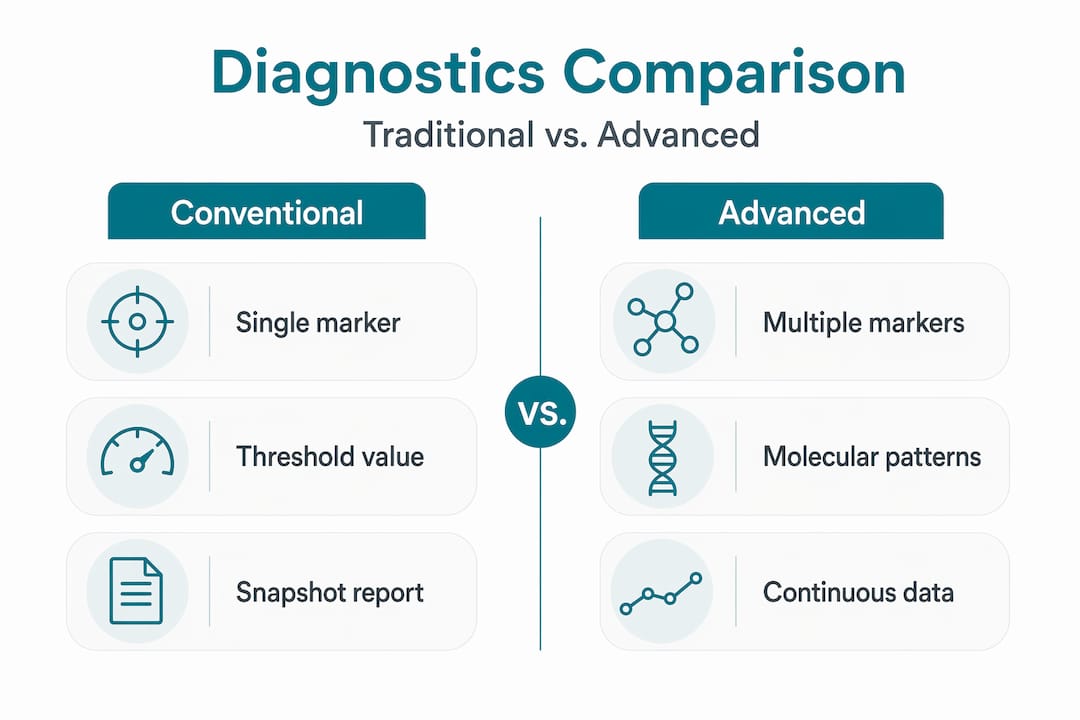
That said, advanced diagnostics are not always the right tool. A straightforward strep test or blood glucose check does not need mass spectrometry. Effective advanced diagnostics must balance selectivity with clinical need and cost-effectiveness. Ordering a full proteomics workup for a resolved viral infection is neither rational nor useful.
Applying advanced diagnostics in practice
Whether you are a clinician building a protocol or a patient trying to understand your options, the following steps provide a workable framework.
- Define the clinical question first. What biological process are you trying to assess? Metabolic function, hormonal status, early oncology risk, cardiovascular trajectory? The question determines which markers and technologies are appropriate. A complete biomarker checklist approach prevents over-testing while capturing what matters.
- Select fit-for-purpose technology. Match the test platform to the question. Mass spectrometry for amino acids, lipids, and metabolic markers. Genomic sequencing for heritable risk. Continuous biosensors for real-time physiological monitoring.
- Establish a personal baseline. A single test is informative. Serial measurements are transformational. Your biomarker values at 35 are more meaningful when compared to your own values at 40 than to a population average.
- Interpret with clinical context. Bring results to a provider who understands multimodal biomarker interpretation. Results need to be read against your symptoms, history, medications, and lifestyle. Binary interpretation of complex panels leads to unnecessary anxiety or missed signals.
- Act on trajectories, not snapshots. The future of advanced diagnostics lies in longitudinal monitoring. Treat each test as a data point in a longer series, not a verdict.
Pro Tip: Before ordering any advanced panel, ask your provider: “At what sensitivity and specificity was this assay validated, and for which population?” That single question separates clinically validated tools from marketing-driven wellness products.
My perspective on what advanced diagnostics really change
I’ve watched this field move from academic concept to clinical reality over the past decade, and the most important shift is not technical. It is psychological. The move from reactive to predictive diagnostics forces both clinicians and patients to engage with health as a dynamic system rather than a binary state.
What I’ve learned is that the hardest part is not generating the data. It is resisting the temptation to treat a single advanced biomarker result as a diagnosis. I’ve seen clinicians anchor too hard on one elevated protein or one flagged genetic variant, bypassing the multimodal context that makes these tools valid. The science is clear: single biomarkers mislead in complex diseases, and clinical judgment cannot be outsourced to a single number.
The opportunity here is genuinely significant. A patient who understands their own longitudinal biomarker trends is a different kind of patient. They ask better questions, they engage earlier, and they make choices grounded in their actual biology rather than generic population guidelines. That shift in agency is what precision diagnostics are ultimately for.
The technology will keep improving. AI models will get sharper. Assay sensitivity will increase. But the constraint will remain human interpretation, clinical judgment, and the willingness to act on probabilistic risk rather than wait for certainty. That is the skill worth building now.
— Romain
How Biostarks brings advanced diagnostics to you

Biostarks, an AMR Labs SA company, applies the same scientific rigor described in this guide to at-home biomarker testing using Swiss mass spectrometry. If the concepts here resonate, and you want to move from understanding to measurement, Biostarks provides panels that cover vitamins, hormones, amino acids, lipids, minerals, and metabolic markers with clinical-grade precision. The reports translate complex molecular data into clear, personalized insights you can act on with your healthcare provider. Explore advanced biomarker testing at Biostarks, or read more about precision test methodology to understand exactly how these measurements are made and validated.
FAQ
What are advanced diagnostics in simple terms?
Advanced diagnostics are specialized tests that measure molecular and biological signals to detect disease risk and health patterns before symptoms appear, using technologies like mass spectrometry, AI analysis, and multi-omics profiling.
How do advanced diagnostics differ from standard blood tests?
Standard blood tests compare single values to population thresholds. Advanced diagnostics combine multiple biomarkers, analyze trends over time, and use AI to generate individual risk models rather than binary normal or abnormal results.
What are examples of advanced diagnostic techniques?
Examples include mass spectrometry-based metabolomics, multimodal biomarker panels for neurodegenerative disease, plasma protein panels for early cancer detection, genomic sequencing, and continuous biosensing via wearable devices.
Can advanced diagnostics replace a doctor’s clinical judgment?
No. Advanced diagnostic results require contextual clinical interpretation alongside symptoms, history, and complementary markers. A single advanced biomarker result without clinical context can mislead, particularly when overlapping conditions are present.
What should I ask before getting an advanced diagnostic test?
Ask which analytical technology underlies the test, what sensitivity and specificity it was validated at, and for which patient population. This separates clinically validated assays from products without rigorous performance data.
This content is for educational purposes only and does not constitute medical advice. Always consult with a healthcare professional before making changes to your health regimen.


