

Training hard can feel like crossing an invisible line between progress and overload. Athletes and coaches everywhere realize that understanding what happens inside an athlete’s body matters as much as the sessions on the track or in the gym. Biomarkers act as the internal metrics that show how your cells and systems respond to training, nutrition, and recovery. Mastering these objective indicators empowers you to create truly individualized performance strategies—moving from guesswork to actionable physiological insights tailored to your unique needs.
Table of Contents
- What Are Biomarkers and Their Purpose
- Key Types of Biomarkers for Athletes
- How Biomarker Testing Enhances Training
- Personalized Nutrition and Recovery Strategies
- Pitfalls and Best Practices for Using Biomarkers
Key Takeaways
| Point | Details |
|---|---|
| Understanding Biomarkers is Essential | Biomarkers provide critical insights into your physiological state, helping athletes diagnose conditions, monitor recovery, and personalize training strategies. |
| Personalization of Nutrition and Recovery | Tailored nutrition and recovery plans based on biomarker data enhance performance and well-being better than generic approaches. |
| Strategic Testing Improves Decision Making | Conduct focused biomarker testing at key training phases to optimize training, nutrition, and recovery based on individual responses. |
| Integrate Multiple Data Sources | Combine biomarker insights with subjective feelings and performance data for a more comprehensive understanding of your training effectiveness. |
What Are Biomarkers and Their Purpose
A biomarker is an objective measure of biological state that tells you exactly what’s happening inside your body at any given moment. Think of biomarkers as the internal performance metrics of your physiology. Just as your coach tracks splits and power output during training, biomarkers track what’s occurring at the cellular and molecular level. They’re measurable indicators collected through blood samples, urine tests, or tissue analysis that reveal whether your body is thriving, struggling, or somewhere in between.
For athletes, biomarkers serve multiple critical functions. They help diagnose existing conditions that might be limiting your performance, predict future health risks before they become problems, and monitor how your body responds to training, nutrition, and recovery strategies. A biomarker might reveal that your iron levels are dropping despite feeling fine during workouts, or that your cortisol isn’t recovering properly after intense training blocks. These insights allow you to make adjustments before a small issue becomes a major setback. Biomarkers also provide the data needed to understand your individual baseline. Your iron metabolism, testosterone levels, and amino acid ratios are unique to you. What’s optimal for one athlete may be suboptimal for another, which is why personalized sport performance biomarker testing has become essential for serious competitors.
The power of biomarkers lies in their ability to turn invisible biological processes into visible, actionable data. Standard measures like blood pressure or heart rate are biomarkers you’ve known about for years. Advanced biomarkers go deeper. They measure things like vitamin D status, amino acid profiles, lipid metabolism, hormonal balance, and inflammatory markers. Each one reveals something about your capacity for recovery, your energy availability, your injury risk, or your overall metabolic function. When you’re training hard, pushing recovery limits, and trying to squeeze every percent of performance from your body, this level of insight matters enormously. You’re no longer guessing about whether your nutrition supports your training or whether your recovery protocols actually work. You have data.
Understanding your biomarkers transforms how you train and recover. Instead of following generic programming, you optimize based on your individual physiology. If your biomarkers show insufficient branched-chain amino acid levels, you adjust your protein timing and sources. If inflammation markers are elevated beyond your baseline, you dial back intensity and prioritize sleep. If your hormonal markers suggest you’re in a deep training adaptation, you push harder. This isn’t about obsessive testing or chasing perfect numbers. It’s about gathering meaningful data strategically, then using those insights to make smarter decisions about your preparation.
Pro tip: Begin with baseline testing during an easy training phase to establish your individual reference values, then retest after 8 to 12 weeks of focused training or nutritional changes to objectively measure how interventions affect your physiology.
Key Types of Biomarkers for Athletes
Athletes need to monitor different categories of biomarkers depending on their sport, training phase, and individual health status. The most practical biomarkers fall into several distinct categories that reveal different aspects of your performance potential and health status. Nutritional biomarkers show whether your body has adequate vitamins, minerals, and other micronutrients to support training demands. These include vitamin D levels, iron status, and B vitamin markers that directly influence energy production and oxygen transport. Hormonal biomarkers measure testosterone, cortisol, estrogen, and thyroid hormones that regulate training adaptations, recovery speed, and mood. Metabolic biomarkers track how your body processes fuel, including glucose metabolism, lipid profiles, and insulin sensitivity. Inflammatory and stress biomarkers such as C-reactive protein and cytokine levels tell you whether your immune system is managing training load appropriately or if you’re headed toward overtraining. Finally, hematological biomarkers like red blood cell count and hemoglobin reveal your oxygen-carrying capacity, critical for endurance athletes.
When it comes to energy availability, blood biomarker analysis for athletes includes specific measurements that guard against undertraining while identifying if you’re consuming enough calories to support your workload. One commonly overlooked category involves markers related to relative energy deficiency in sport, or REDs. These include body composition metrics, metabolic rate measurements, and specific blood markers like triiodothyronine (T3), a thyroid hormone that drops when energy availability becomes insufficient. When your T3 levels decline, your metabolism slows dramatically, impairing recovery and increasing injury risk. Many athletes feel fine on the surface while their biomarkers reveal they’re operating on a metabolic knife-edge. Detecting this pattern early through biomarker monitoring prevents the cascade of problems that follows prolonged energy deficit.
The categories break down into practical testing recommendations. Start with a foundational panel that covers iron status, vitamin D, complete blood count, and basic metabolic function. This gives you a baseline understanding of your nutritional status and oxygen-carrying capacity. Layer in hormonal markers during heavy training blocks to monitor whether your body is adapting or accumulating fatigue. Add inflammatory markers if you’re dealing with recurring injuries or persistent soreness that doesn’t match your training load. Consider thyroid function testing and glucose metabolism markers if you suspect energy availability problems or if you’re managing your weight carefully. The key is strategic testing rather than obsessive quarterly panels. You test to answer specific questions, not to collect data for its own sake.
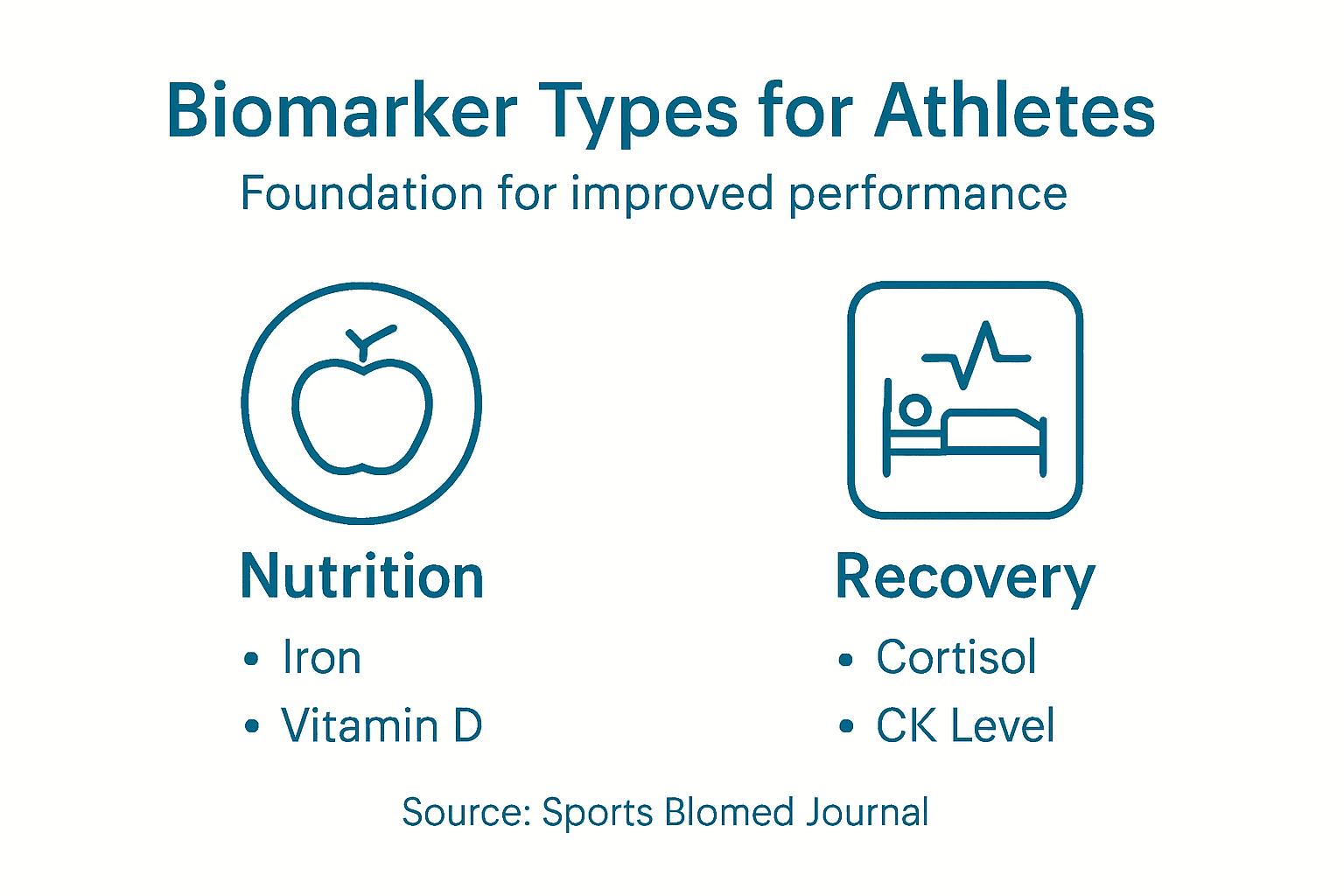
Different sports benefit from emphasizing different biomarker categories. Endurance athletes should prioritize iron, vitamin D, and hematological markers since oxygen transport determines performance. Strength athletes care more about testosterone, cortisol ratios, and protein metabolism markers. Team sport athletes benefit from inflammatory and immune markers since collision and high-intensity intermittent work creates different stress patterns. Rather than chasing every possible biomarker, identify which categories matter most for your sport, test strategically at key points in your training calendar, and use the results to guide nutrition, recovery, and training decisions.
Here’s a quick reference for key biomarker categories and what they reveal about your athletic performance:
| Biomarker Category | What It Measures | Insight Provided |
|---|---|---|
| Nutritional | Vitamins, minerals, micronutrients | Detects deficiencies affecting energy, health |
| Hormonal | Testosterone, cortisol, thyroid | Shows recovery, adaptation, stress response |
| Metabolic | Glucose, lipids, insulin sensitivity | Indicates energy usage and fueling efficiency |
| Inflammatory/Stress | C-reactive protein, cytokines | Flags injury risk, overtraining, immune load |
| Hematological | Hemoglobin, red cell count | Assesses oxygen transport and endurance |
Pro tip: Request blood draws at consistent times of day (preferably morning before breakfast) and during similar training phases across testing cycles, since these factors significantly affect marker levels and make results comparable across tests.
How Biomarker Testing Enhances Training
Biomarker testing transforms training from guesswork into precision execution. Instead of assuming your body is adapting well to your program, you have concrete data showing exactly how you’re responding. This shifts your entire approach to planning and decision making. When you know your iron levels are declining, you can address it immediately through nutrition or supplementation before it tanks your aerobic capacity. When your cortisol patterns show incomplete recovery, you modify intensity and sleep protocols rather than pushing harder and digging the hole deeper. When your inflammatory markers spike after a particular type of workout, you understand your body’s specific tolerance and adjust volume accordingly. This level of responsiveness is impossible without biomarker data because many of these signals don’t produce noticeable symptoms until they become serious problems.

The real power lies in personalization at scale. Generic training programs work for nobody in particular because they’re designed for an average athlete who doesn’t actually exist. Your recovery rate, nutrient absorption, hormonal responsiveness, and injury resilience are unique to you. Biomarker testing helps optimize and personalize conditioning by revealing your specific physiological responses to training stress and recovery interventions. This means you can adjust training intensity based on your actual adaptation status rather than a calendar. If your T3 levels indicate suppressed metabolism, dropping volume for two weeks makes sense even if the program says to push. If your testosterone and cortisol ratios suggest perfect recovery, that heavy session your coach suggested becomes the right call. You’re no longer following a template. You’re following your biology.
Biomarker testing also accelerates your learning about what works for your body. Every athlete tries different nutrition strategies, recovery methods, and training approaches. Most make changes based on feel, subjective soreness, or performance in isolated training sessions. Biomarkers let you measure what actually happened internally. Did that new supplement protocol actually improve your micronutrient status, or did it just feel better because you paid attention to nutrition? Did your recovery strategies actually reduce inflammation, or did soreness just decrease due to training adaptation? Did your new strength emphasis actually improve hormonal status, or did performance gains come from improved technique? When you test before and after a specific intervention, you know objectively whether it worked for your particular physiology. This accelerates your personal optimization cycle dramatically.
The practical application involves three key phases. First, establish your baseline by testing during a typical training week when you’re feeling good and performing well. This becomes your reference point for interpreting future results. Second, identify specific areas you want to improve or questions you want to answer. Are you concerned about iron status? Interested in measuring your real recovery patterns? Worried about overtraining? Test strategically to answer these questions. Third, make changes based on results and retest after 8 to 12 weeks to measure whether your interventions actually worked. This cycle of test, intervene, retest creates a data-driven feedback loop that beats intuition every single time. Your body will try to tell you what it needs if you’re paying attention to the right signals.
One critical consideration involves timing and context. The same person can show dramatically different biomarker values depending on when they test, how recently they trained, their sleep quality, nutrition timing, and stress levels. This doesn’t make biomarkers unreliable. It makes them more valuable because they reveal your actual training response, not just a snapshot. The goal is consistent testing conditions across your testing cycles so you can compare results meaningfully. Test at similar times of day, in similar training phases, under similar sleep and stress conditions. This consistency allows you to detect real changes in your physiology rather than noise from testing variation.
Pro tip: Create a simple spreadsheet tracking your biomarker results alongside training volume, intensity, and subjective recovery scores across multiple testing cycles to identify personal patterns and discover which interventions genuinely improve your specific biomarkers.
Personalized Nutrition and Recovery Strategies
Generic nutrition advice fails most athletes because it ignores your individual metabolism. One athlete thrives on a high-carbohydrate approach while another performs better with moderate carbs and higher fat intake. One recovers quickly on minimal sleep while another needs nine hours to fully adapt to training. One absorbs micronutrients efficiently while another has absorption issues despite eating adequate amounts. Biomarker data reveals these differences so you can stop following generic templates and start eating for your specific physiology. When your biomarkers show low iron despite adequate intake, you might have absorption issues requiring different food sources or supplementation timing. When your vitamin D levels plateau despite supplementation, you discover you’re a poor responder genetically and need higher doses. When your amino acid profiles show deficiencies in specific branched-chain aminos, you adjust protein sources to match your needs. This is personalization that actually works.
Personalized nutrition based on metabolic biomarkers and phenotype improves dietary quality and metabolic health far more effectively than generic recommendations applied to all athletes equally. Your biomarker profile reveals your metabolic phenotype, the unique way your body processes different macronutrients and micronutrients. Some athletes have naturally efficient glucose metabolism and can handle higher carbohydrate intakes without blood sugar spikes. Others show metabolic inflexibility, struggling to shift between fuel sources, requiring a more consistent macronutrient approach. Some athletes show signs of insulin resistance even without excess body fat, indicating they need lower glycemic load nutrition. Others have lipid profiles suggesting they handle fat effectively and can use higher-fat fueling strategies. Your biomarkers decode your specific metabolic type, allowing targeted nutrition that works with your physiology rather than against it.
Recovery strategies deserve the same personalization. Two athletes following identical recovery protocols experience completely different outcomes because their underlying physiology differs. One athlete shows persistent inflammation despite standard recovery methods, suggesting they need aggressive anti-inflammatory nutrition, extended sleep, or reduced training volume. Another athlete shows adequate inflammatory markers but depleted micronutrient status, indicating that recovery nutrition needs to prioritize nutrient density over calorie amount. Another shows hormonal imbalance suggesting they need strategic carbohydrate timing around workouts to support cortisol and testosterone patterns. When you test biomarkers post-workout and during recovery, you see exactly which recovery interventions actually work for your body. Does ice baths reduce your inflammatory markers or just feel refreshing? Does your current sleep protocol actually support hormonal recovery or just feel adequate? Does your post-workout nutrition actually replenish depleted micronutrients or just taste good? Your biomarkers answer these questions definitively.
The practical approach starts with your baseline nutrition and recovery biomarkers. These reveal your current metabolic status and recovery capacity. From here, you identify specific areas to address. Are micronutrient levels low across the board? Prioritize nutrient density. Are inflammatory markers elevated? Emphasize anti-inflammatory nutrition and extended recovery. Are hormonal markers imbalanced? Adjust macronutrient timing and training intensity. Are amino acid profiles incomplete? Adjust protein sources and timing. Make specific, targeted changes based on your biomarkers rather than implementing a new generic protocol. Retest after six to eight weeks of consistent implementation to measure whether your interventions actually improved your biomarker profile. This creates a personalized nutrition and recovery system tailored to your physiology, not borrowed from someone else’s success story.
One critical advantage emerges when you combine nutrition and recovery biomarkers with training data. You can now see the relationship between what you eat, how much you recover, and how you perform. Perhaps your performance drops not because training was too hard but because your nutrition didn’t match the training demand. Perhaps your recovery improves dramatically when you hit specific micronutrient targets. Perhaps your performance variability correlates with sleep and inflammation markers rather than workout intensity. These connections reveal which factors truly matter for your performance, allowing you to allocate your recovery resources and nutrition attention where they’ll have the biggest impact. Stop wasting effort on recovery interventions that don’t affect your biomarkers. Start doubling down on approaches that demonstrably improve your physiology.
Pro tip: Track your subjective recovery feelings (soreness, energy, mood) alongside biomarker results to identify which markers correlate best with how you actually feel, then focus future testing on those specific markers rather than testing everything every cycle.
Pitfalls and Best Practices for Using Biomarkers
Biomarker testing seems straightforward until you realize the numerous ways results can mislead you. A single biomarker result tells you almost nothing by itself. Context matters enormously. Your iron level of 45 micrograms per deciliter means something completely different depending on whether you just finished a hard training block, are in recovery week, tested fasted versus fed, or are dealing with an acute infection. Your cortisol level depends on time of day, sleep quality the night before, stress levels, and when you last trained. Your vitamin D might be lower in winter than summer regardless of supplementation. These contextual factors don’t invalidate biomarkers. They simply mean you need to understand the bigger picture before drawing conclusions. The biggest pitfall is treating a single result as definitive rather than as one data point requiring interpretation.
Another critical mistake involves over-testing and chasing perfect numbers. Some athletes become obsessed with optimizing every biomarker simultaneously, testing monthly or even more frequently. This creates noise rather than signal. Normal biological variation means your markers fluctuate constantly. If you test too frequently, you see random variation and mistake it for real change, leading to constant adjustments based on noise. Additionally, frequent testing costs money and time without providing proportional value. The best practice involves strategic testing at key points in your training calendar, not obsessive monitoring. Test during baseline assessment, after major training blocks, before competition, or when targeting specific adaptations. Between tests, implement your interventions consistently rather than constantly chasing results.
Validation and reproducibility matter far more than many athletes realize. Not all biomarker tests are created equal. Pitfalls in biomarker discovery include issues with sensitivity, specificity, and reproducibility that can lead to unreliable results. Some testing companies use outdated methodology, others cut corners on quality control, and some make claims about biomarker significance that lack strong scientific support. When selecting a testing provider, verify they use validated assays with established reference ranges for your population. Confirm they use modern analytical techniques like mass spectrometry for accuracy. Look for providers who report comprehensive quality metrics and explain their methodology transparently. Don’t choose based on price alone. A cheap test using questionable methodology wastes money more thoroughly than a premium test providing accurate data. Your data is only as good as the laboratory producing it.
Privacy and data security deserve serious attention. Biomarker testing generates sensitive health information you’d rightfully want protected. Verify that any testing provider maintains robust data security practices and complies with relevant health privacy regulations. Your biomarker data reveals intimate details about your physiology, and you deserve assurance it won’t be misused or breached. Before testing, understand exactly how your data will be stored, who can access it, and what happens to it if the company changes hands. Read privacy policies carefully, not just the summary.
The most important best practice involves using biomarkers as one tool within a larger system, not as the only truth. Your biomarkers are phenomenally valuable for revealing what’s happening inside your body, but they don’t replace common sense, subjective feel, performance data, or professional guidance. If your biomarkers suggest you’re recovered but you feel destroyed and your performance is tanking, something else is happening. If your biomarkers show perfect adaptation but you’re getting injured repeatedly, your training program needs adjustment regardless of what the markers say. Integrate biomarker insights with all your other information sources. Use them to challenge assumptions and test beliefs, but remain skeptical enough to notice when biomarkers conflict with reality. The data should inform your decisions, not dictate them.
Another key practice involves understanding your individual baseline rather than comparing yourself to population averages. Your optimal iron level, vitamin D level, or cortisol pattern might differ from someone else’s ideal state. What matters is how your markers change relative to your own baseline and how those changes correlate with your performance and health. Some athletes perform beautifully at vitamin D levels that would worry a doctor comparing them to population standards. Others struggle at levels that appear normal on a population chart. Establish your personal baseline when you’re healthy and performing well, then track how you deviate from that baseline as you implement interventions or training changes. This personal reference frame proves far more useful than population comparisons.
The table below summarizes best practices and common pitfalls of biomarker testing for athletes:
| Best Practice | Why It Matters | Common Pitfall |
|---|---|---|
| Test at key training phases | Ensures relevant and comparable data | Over-testing creates unnecessary noise |
| Establish personal baseline | Enables meaningful progress tracking | Comparing only to population averages |
| Use validated labs | Increases reliability of results | Relying on low-quality providers |
| Integrate subjective feel | Supports holistic decision making | Ignoring context or non-biological factors |
Pro tip: Document your biomarker test dates, results, major training focus, sleep quality, and how you felt during each testing period, then review your accumulated data every six months to identify personal patterns between specific biomarkers and your actual performance outcomes.
Unlock Your Full Athletic Potential with Precise Biomarker Insights
Understanding your unique biomarker profile is essential for maximizing performance and recovery. This article highlighted the challenges athletes face such as hidden nutrient deficiencies, hormonal imbalances, and energy availability issues that often go unnoticed until they impact your training and health. If you are serious about moving beyond guesswork, precise data from biomarker testing can empower smarter, personalized decisions to optimize your nutrition, training intensity, and recovery strategies.
Discover how you can start your journey with comprehensive at-home testing solutions tailored specifically for athletes. Our advanced Swiss mass spectrometry technology delivers detailed analysis of vitamins, hormones, amino acids, lipids, and metabolic markers so you get actionable insights that truly reflect your individual physiology. You do not have to settle for generic programs. With access to strategic biomarker panels from the Biostarks | Collection designed for real-world application, you can monitor your progress and adapt your health strategies based on meaningful data.
Start taking control of your athletic performance today. Visit Biostarks to explore our premium at-home biomarker testing and experience how precision health data can transform your training outcomes. Don’t wait for setbacks to disrupt your progress. Harness your unique biology with Biostarks | Collection and make next-level performance your reality.
Frequently Asked Questions
What are biomarkers and how do they help athletes?
Biomarkers are objective measures that reveal biological states within an athlete’s body, tracking cellular and molecular changes. They help diagnose conditions, predict health risks, and monitor responses to training and nutrition.
What types of biomarkers should athletes monitor for optimal performance?
Athletes should monitor nutritional, hormonal, metabolic, inflammatory/stress, and hematological biomarkers to assess their performance potential and overall health status.
How can I use biomarker testing to enhance my training and nutrition strategies?
Biomarker testing can help you identify specific areas to target for improvement. By understanding your unique physiology, you can adjust your nutrition and recovery strategies effectively based on concrete data.
Why is it important to establish a baseline for biomarker testing?
Establishing a baseline allows you to interpret future biomarker results meaningfully. It helps track how your body responds to training or dietary interventions over time, providing personalized insights for optimization.


