

TL;DR:
- Vitamins play a crucial biological role in supporting recovery processes such as tissue repair, inflammation control, and immune function. Proper assessment, targeted supplementation, and blood testing are essential to optimize vitamin levels and avoid interference with training adaptations. Personalized strategies, including regular biomarker monitoring, enable athletes to enhance recovery effectively without unnecessary or harmful supplementation.
Most athletes and health-focused individuals know vitamins matter, but the gap between knowing and applying that knowledge is enormous. The supplement aisle promises fast recovery in every bottle, yet research consistently shows that generic approaches miss the mark for most people. Understanding exactly how vitamins work at the biological level, which ones deserve your attention, and when to actually take them transforms recovery from guesswork into a precise, measurable strategy. This guide cuts through the noise and gives you actionable clarity.
Table of Contents
- Why vitamins are essential for recovery
- Key vitamins and their science-backed recovery benefits
- Personalization: Testing, dietary sources, and smart supplementation
- Recovery pitfalls: When supplementing does more harm than good
- A smarter recovery strategy: What most guides miss
- Take the next step: Personalize your vitamin recovery plan
- Frequently asked questions
Key Takeaways
| Point | Details |
|---|---|
| Target deficiencies | Focus on correcting actual vitamin deficiencies for optimum recovery rather than general supplementation. |
| Individualize your plan | Testing and personalizing vitamin intake enhances recovery and minimizes risk of over-supplementation. |
| Avoid high-dose pitfalls | Excessive vitamin C/E after workouts can diminish training benefits and delay adaptation. |
| Diet as foundation | Whole foods and proven dietary sources should be your primary strategy before adding supplements. |
| Track and adapt | Regularly assess vitamin needs according to training, seasons, and health changes for the best results. |
Why vitamins are essential for recovery
Recovery is not just about feeling less sore. It involves four deeply interconnected processes: tissue repair at the cellular level, inflammation control, immune function, and the structural training adaptations your body makes to become stronger and faster over time. Vitamins plug into every one of these mechanisms, not as passive bystanders but as active cofactors, antioxidants, and immune modulators. If you are missing them, the entire system slows down.
The essential role of vitamins in recovery comes down to their biochemical functions. Vitamins act as cofactors for enzymes that synthesize collagen, repair DNA, and produce energy. As antioxidants, they neutralize reactive oxygen species (ROS, unstable molecules generated during exercise) before ROS can damage muscle tissue. Without adequate vitamins, your body’s repair crews arrive late and under-equipped.
Key recovery processes directly supported by vitamins include:
- Muscle protein synthesis: B vitamins, especially B6 and B12, support amino acid metabolism, the raw material for muscle repair.
- Collagen production and connective tissue repair: Vitamin C is a required cofactor for collagen synthesis, making it critical after tendon, ligament, or joint stress.
- Antioxidant defense: Vitamins C and E neutralize exercise-induced oxidative damage before it compounds.
- Immune regulation: Intense training temporarily suppresses immune function. Vitamins D and C help maintain immune resilience during high training loads.
- Fatigue reduction: Science-driven supplementation shows that correcting vitamin deficiencies directly reduces chronic fatigue markers.
The antioxidant angle is particularly well-supported. Vitamins C and E protect cells from exercise-induced oxidative stress, meaningfully reducing muscle damage when your antioxidant status is adequate. Going further, research confirms that antioxidant vitamins reduce post-exercise lactate and creatine kinase levels, two of the most reliable markers of muscle damage and fatigue. Lower CK means less breakdown. Lower lactate means faster clearing of metabolic waste.
“Post-exercise antioxidant status directly predicts recovery speed. Athletes with adequate vitamin C and E consistently show lower creatine kinase levels and faster return to baseline strength than those with suboptimal intake.”
Key vitamins and their science-backed recovery benefits
Understanding their importance, let’s look at which vitamins really make a difference for recovery and how the science stacks up.
| Vitamin | Primary recovery function | Key research finding | Watch out for |
|---|---|---|---|
| Vitamin C | Collagen synthesis, antioxidant defense | Reduces CK and oxidative markers post-exercise | Doses above 400 mg/day may blunt adaptation |
| Vitamin E | Membrane antioxidant protection | Reduces lipid peroxidation in muscle cells | Fat-soluble; excess accumulates in tissue |
| Vitamin D | Muscle integrity, immune function, injury recovery | Deficiency linked to muscle weakness and delayed recovery | Requires blood testing to dose accurately |
| Vitamin B6 | Amino acid metabolism, neurotransmitter synthesis | Supports protein utilization for muscle repair | Neurological risk at very high chronic doses |
| Vitamin B12 | Red blood cell production, nerve health | Fatigue reduction, especially in endurance athletes | Vegans and older athletes often deficient |
Vitamin D deserves particular attention. Vitamin D deficiency affects over 30% of athletes, making it one of the most clinically significant recovery factors being overlooked. The consequences are real: muscle weakness, elevated injury risk, and measurably delayed recovery timelines. Supplementation corrects these deficits and improves strength and recovery markers in deficient individuals. The target is specific. Optimal serum 25(OH)D for athletes sits between 40 and 50 ng/mL. Below that window, you are leaving recovery capacity on the table. For practical guidelines for vitamin D3 supplementation, typical therapeutic doses of 2,000 to 5,000 IU per day are effective for raising levels in deficient athletes, with meta-analysis demonstrating SMD 3.77 improvement in serum levels with structured D3 protocols.

Vitamins C and E are powerful tools, but not without nuance. High doses may actually work against you. High-dose vitamin C above 400 mg/day can blunt training adaptations like mitochondrial biogenesis, the very process that makes you fitter over time. This is a classic case where more is not better. Learning how improving vitamin levels through targeted correction rather than aggressive supplementation produces better long-term outcomes.
Here’s how to prioritize vitamins based on your recovery scenario:
- Post-injury or joint stress: Prioritize vitamin C (400 mg or less from diet and supplementation combined) for collagen support, paired with vitamin D testing and correction.
- High training volume phases: B vitamin complex and vitamin D are most critical; both are frequently depleted under metabolic stress.
- Immune stress or overtraining risk: Vitamin D and C at moderate, food-first levels protect immune function without blunting adaptation.
- Endurance-heavy schedules: B12 and B6 support red blood cell production and energy metabolism; deficiency is common in plant-based athletes.
- General fatigue and poor recovery: Test first. Vitamin D deficiency is the single most common correctable issue found in athletes who feel chronically rundown.
Pro Tip: Before adding any vitamin supplement to your routine, run a blood test. Deficiencies are measurable and correctable. Guessing wastes money and can cause harm. Understanding micronutrient deficiencies specific to your profile is step one before spending a dollar on supplements.
Personalization: Testing, dietary sources, and smart supplementation
With the right vitamins identified, here’s how to tailor your recovery approach to your unique body and habits.
The multivitamin myth deserves direct confrontation. Multivitamins show no broad recovery benefits in well-nourished athletes and cannot substitute for a nutrient-dense diet. For many people, multivitamins are expensive urine. They provide average doses of average nutrients for an average person, and if you are reading this, you are not trying to be average. Individualized supplementation based on bloodwork consistently outperforms generic approaches.
| Vitamin | Best dietary sources | Typical supplement form | Practical benefit |
|---|---|---|---|
| Vitamin D | Fatty fish, fortified dairy, sunlight | D3 capsule, 2,000 to 5,000 IU | Essential if sunlight exposure is limited |
| Vitamin C | Citrus, bell peppers, broccoli, kiwi | Ascorbic acid, 200 to 400 mg | Adequate for most who eat varied whole foods |
| Vitamin E | Almonds, sunflower seeds, avocado | Mixed tocopherols | Rarely deficient in those eating healthy fats |
| Vitamin B12 | Meat, eggs, dairy, fortified foods | Methylcobalamin sublingual | Critical for vegans and older athletes |
| Vitamin B6 | Poultry, bananas, chickpeas | Pyridoxine HCl | Usually adequate in high-protein diets |
The most important reasons to get tested before supplementing include:
- Identifying true deficiency: Only blood testing reveals whether your levels are clinically low, insufficient, or optimal. Symptoms like fatigue and soreness overlap with dozens of conditions.
- Avoiding over-supplementation toxicity: Fat-soluble vitamins (D, E, A, K) accumulate in tissue. Excess antioxidants like C and E can actively interfere with the ROS-mediated signals your body uses to adapt to training.
- Tracking improvement over time: A single test gives you a baseline. Repeat testing confirms whether your dietary or supplementation changes are actually working.
- Catching hidden deficiencies: Vitamin D and B12 deficiencies rarely produce obvious symptoms until they are severe. Athlete blood testing catches these early, before performance suffers.
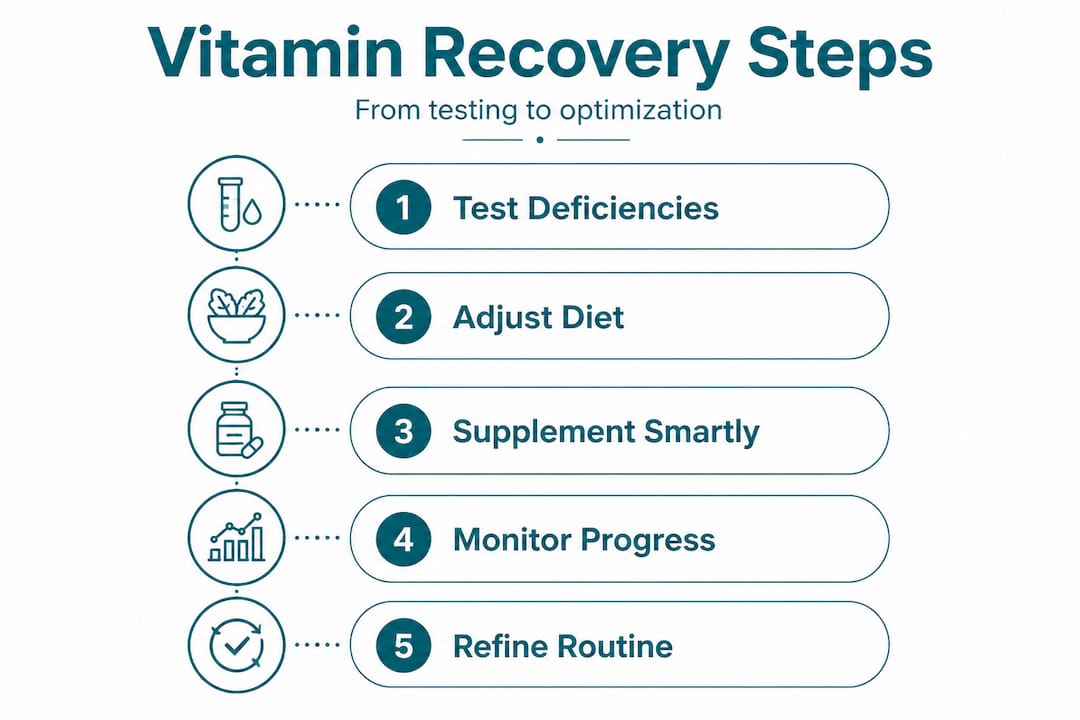
How to adjust your intake intelligently comes down to a layered approach. Start with diet. Whole foods provide vitamins with cofactors and synergistic nutrients that isolated supplements cannot replicate. Add sunlight for vitamin D if you live at a latitude and climate that allows it. Then layer in targeted supplementation only where testing for deficiencies confirms a real gap. This sequenced approach prevents waste, avoids harm, and builds a recovery strategy grounded in your actual biology.
Recovering faster after a tough workout is not just about what you take, it is also about when and how you structure the rest of your nutrition, sleep, and stress management alongside your vitamin strategy.
Pro Tip: If you travel frequently, train indoors, or follow a plant-based diet, your vitamin D and B12 status are most likely to drift into deficiency territory. Make these your first two priorities for analyzing vitamin levels and routine monitoring.
Recovery pitfalls: When supplementing does more harm than good
While personalization is essential, it’s just as important to know the risks when supplementing improperly.
The most common supplementation mistakes athletes make include:
- Megadosing antioxidants: Taking 1,000 mg or more of vitamin C daily around workouts in the belief that more protection equals more recovery. The evidence says otherwise.
- Skipping bloodwork: Supplementing based on marketing claims, general advice, or peer recommendations without knowing your actual levels.
- Ignoring dietary context: Taking vitamin supplements while eating a processed, nutrient-poor diet addresses the symptom but not the cause.
- Treating all vitamins equally: Fat-soluble vitamins accumulate; water-soluble ones generally do not. The risks are not the same across the board.
- Timing supplementation without considering its effect on adaptation: Taking high-dose antioxidants immediately before or after training can interfere with the very signals your body uses to get stronger.
The peri-workout timing issue is particularly misunderstood. High-dose vitamin C blunts mitochondrial biogenesis and other training adaptations when taken around exercise sessions. This means your body literally adapts less effectively to the training stimulus you just worked hard to create. The irony is real: the supplement meant to help recovery can reduce the training benefit that makes future recovery easier.
B vitamins are a different story. B vitamins are useful in high-stress recovery phases and do not carry the same adaptation-blunting risk. They support energy metabolism and neurotransmitter function without interfering with ROS signaling. This makes them a safer category for active supplementation during demanding training blocks.
Tracking vitamin levels over time is the only way to know whether your current strategy is working or quietly causing problems. One snapshot is a start. A pattern of data over months is a recovery asset.
“Personalization is not optional in recovery nutrition. Generic protocols ignore the most important variable: the individual. Blood data transforms supplementation from a gamble into a strategy.”
A smarter recovery strategy: What most guides miss
Most recovery guides frame the problem as “which vitamins should I take,” when the more important question is “which vitamins does my body actually need right now.” That shift in framing changes everything.
The “more is better” mentality in sports nutrition is one of the most persistent and harmful patterns we see. Athletes who train hard tend to believe that aggressive supplementation matches their aggressive training. But your body does not work that way. It works through precise signaling, and dumping high doses of antioxidants into that system disrupts signals rather than amplifying results.
Recovery is also not purely a vitamin problem. Sleep, stress management, carbohydrate timing, protein quality, and hydration all contribute to how quickly you bounce back from training. Vitamins matter enormously within that system, but they are one variable among many. The athletes who recover best are not those who take the most supplements. They are those who have optimized the full picture and use vitamins to fill specific, identified gaps.
Life changes shift your needs in ways a static supplementation protocol cannot accommodate. A change in training volume, a winter season with less sunlight, a new plant-based diet, a high-stress work period: all of these change your vitamin requirements meaningfully. Pairing regular bloodwork with honest self-assessment gives you a living, adaptive strategy rather than a one-time decision you forget about.
Wellness optimization strategies that stand the test of time share one characteristic. They are built on data, adjusted with experience, and humble enough to change when the evidence changes. That is the approach worth building.
Pro Tip: Schedule a vitamin panel every three to four months if you are in an active training cycle, and every six months during maintenance phases. Layer that data with notes on your sleep quality, training load, and subjective energy. The patterns you find will teach you more than any supplement label ever will.
Take the next step: Personalize your vitamin recovery plan
Recovery is not a guessing game when you have the right data. Every insight in this guide points toward one core truth: personalized, biomarker-driven decisions consistently outperform generic supplementation protocols. The gap between knowing vitamins matter and knowing which ones you actually need is a blood test wide.

Biostarks makes that step straightforward. Using advanced Swiss mass spectrometry, the platform analyzes your vitamin levels, hormones, amino acids, and other critical biomarkers from a home collection sample, then delivers clear, actionable reports. You will know exactly where your deficiencies are, what your levels look like against optimal ranges, and how to improve vitamin levels with precision. No guessing. No wasted supplements. Just a plan built around your biology, built for your recovery goals.
Frequently asked questions
Which vitamins speed up muscle recovery the most?
Vitamin D and antioxidants like vitamins C and E support faster recovery by reducing oxidative damage and muscle breakdown, particularly when correcting an existing deficiency that delays recovery.
Is it safe to take high-dose vitamin C or E after every workout?
Routine high-dose use is rarely beneficial and can be counterproductive, since high vitamin C doses blunt adaptations like mitochondrial biogenesis that make training effective long-term.
How do I know if I need vitamin supplementation for recovery?
Blood testing is the most reliable method, since testing before supplementing improves outcomes by identifying real deficiencies rather than assumed ones.
Can a multivitamin help with athletic recovery?
Not meaningfully. Multivitamins provide no broad recovery benefits for well-nourished individuals and cannot replace a quality diet or targeted supplementation based on individual bloodwork.
What serum vitamin D level supports optimal recovery?
Research places the optimal 25(OH)D at 40 to 50 ng/mL for athletes seeking peak muscle strength, reduced injury risk, and faster recovery timelines.
Recommended
- Optimize wellness: understanding the essentia… | Biostarks
- How to improve vitamin levels for optimal health | Biostarks
- Top metabolic health tips: boost energy and o… | Biostarks
- Wellness optimization strategies for personal… | Biostarks
- Top detoxification tips to boost recovery and wellness
- Implement science-driven supplementation for better health


