

TL;DR:
- Internal health data includes information from medical records and personal devices within your ecosystem. Proper organization, validation, and interpretation are essential for turning raw data into actionable insights. Privacy controls and standardized data practices ensure your sensitive information is protected while supporting research and wellness optimization.
Your fitness tracker says your resting heart rate dropped. Your health app flags low iron. Your doctor’s portal shows a lab result you don’t recognize. All of this is health data, but is it the same kind? The term “internal health data” means different things depending on whether you’re inside a hospital system or managing your own wellness stack. This article breaks down exactly what counts, how it’s organized, who controls it, and most importantly, how you can use it to make smarter decisions about your health.
Table of Contents
- What is internal health data?
- How is internal health data organized and used?
- Privacy and sharing: what happens to your internal health data?
- From raw data to actionable insights: using internal health data for wellness
- How is internal health data used beyond the individual?
- The difference that context makes: why internal health data requires smart interpretation
- How to start optimizing your internal health data
- Frequently asked questions
Key Takeaways
| Point | Details |
|---|---|
| Not just medical records | Internal health data includes device readings, app logs, and clinical results under your control, not just hospital files. |
| Context and standards matter | Understanding how your data is collected and validated is crucial for making it actionable and reliable. |
| Privacy is in your hands | You can manage what internal health data is shared and viewed through privacy settings and controls in each app or platform. |
| Action beats accumulation | Using internal health data thoughtfully can unlock personal wellness, but overreliance on raw numbers may be misleading. |
What is internal health data?
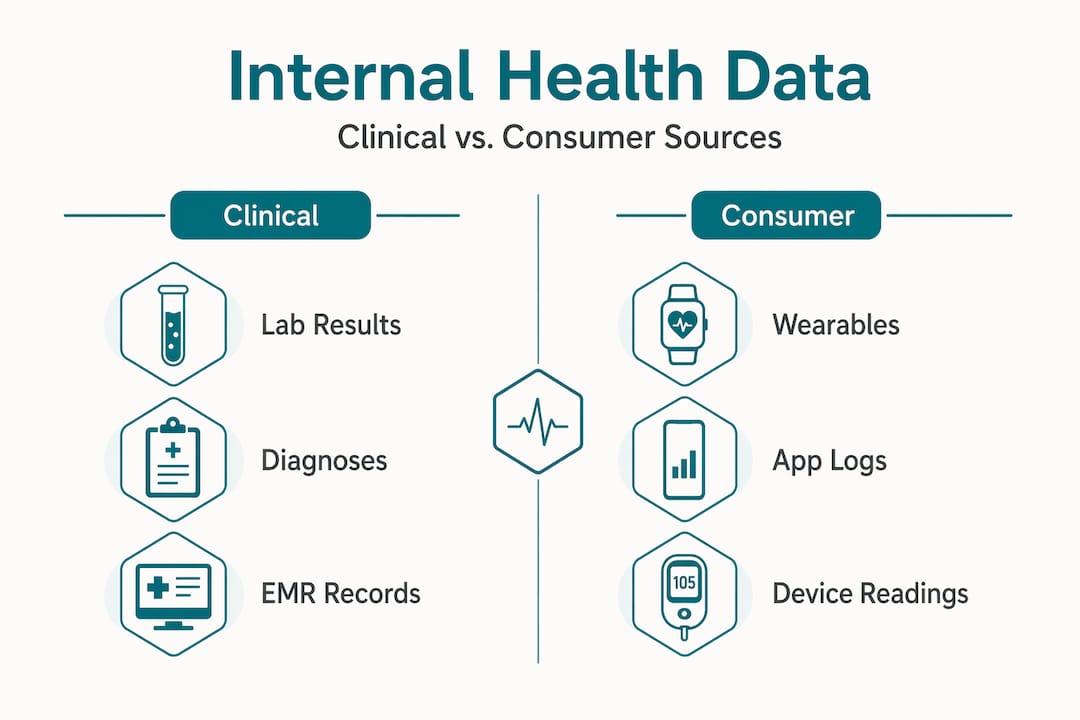
The phrase “internal health data” shows up in two very different conversations. In clinical settings, it refers to data generated and maintained within a provider’s own systems, things like Electronic Medical Records stored inside a hospital network. In the personal context, it refers to health data that lives within your own ecosystem, including apps, wearables, and devices you control. Both definitions point to the same core idea: data that stays within a defined boundary, whether that boundary is a hospital firewall or your smartphone.
The distinction matters for biomarker testing because not all health data is treated equally. A blood glucose value from a clinical lab carries different weight than a glucose estimate from a consumer wearable, even if the numbers look similar on screen.
Here’s a quick comparison of common internal health data types across settings:
| Data type | Clinical source | Personal/consumer source |
|---|---|---|
| Blood biomarkers | Lab-ordered panels, EMR | At-home test kits, synced lab reports |
| Vital signs | Nurse-recorded, in-patient monitors | Smartwatch, fitness tracker |
| Activity metrics | Physical therapy notes | Step counter, GPS app |
| Nutrition logs | Dietitian records | Manual app entries |
| Sleep data | Clinical sleep study | Wearable sleep tracker |
| Hormonal markers | Endocrinology lab results | At-home hormone test kits |
Common examples of internal health data you might already be generating include:
- Resting heart rate, HRV, and SpO2 from a wearable
- Lab results for vitamins, hormones, and lipids
- Sleep stages logged by a tracker
- Blood pressure readings synced to a health app
- Manually entered food and supplement logs
- Menstrual cycle data or stress scores
“For individuals, internal health data can include data in personal health apps that consolidate sources (devices, health records, and apps), where the user controls what is stored and shared.”
The EMR maintained within a provider’s organization and personal data consolidated in consumer apps represent the two ends of the same spectrum. One is managed by an institution. The other, you own.
How is internal health data organized and used?
After understanding the types of internal health data, it’s important to see how this information is organized, accessed, and standardized for actionable use.

In healthcare, the goal is interoperability, meaning your data should be readable and usable across different systems, providers, and tools. To achieve this, health data is structured into standardized data classes and elements, as defined by frameworks like the United States Core Data for Interoperability (USCDI) and guidelines from the Office of the National Coordinator for Health Information Technology (ONC). These frameworks define categories like clinical notes, lab results, medications, vital signs, and patient demographics so that data can flow cleanly from one system to another.
Here’s how clinical categories compare to what you see inside consumer wellness platforms:
| Clinical category (USCDI) | Consumer wellness equivalent |
|---|---|
| Laboratory values | Biomarker test results, blood panels |
| Vital signs | Wearable heart rate, blood pressure logs |
| Medications | Supplement tracker entries |
| Clinical notes | Personal health journal, coaching notes |
| Provenance (data origin) | Source tag in health app (e.g., “from Apple Watch”) |
| Diagnostic imaging | Not typically available in consumer apps |
Understanding how data flows is just as important as knowing what data exists. Here’s a simplified breakdown of the main steps:
- Collection: Data is captured through a device, lab test, or manual entry.
- Storage: It’s saved in an app, platform, or provider system with timestamps and source tags.
- Validation: The platform or lab checks the data for accuracy, flagging outliers or measurement errors.
- Sharing: Data is exchanged between systems or shared with providers, coaches, or third-party apps.
That validation step is where things get interesting for anyone using wearables. Standardized clinical categories reduce ambiguity when comparing results over time or across tools, but consumer-grade devices don’t always follow the same standards. A heart rate variability reading from one wearable brand may use a different algorithm than another, making direct comparisons unreliable without knowing the source.
Pro Tip: Before stacking data from multiple wearables or apps, check whether each platform labels its data source. That provenance tag tells you a lot about how much weight to give any single reading. Personalized health data is only as useful as the standards behind it, and biomarker data for health professionals follows stricter validation protocols than most consumer tools.
Privacy and sharing: what happens to your internal health data?
With a grasp on how internal health data is structured, let’s address one of the top concerns: privacy and sharing of this sensitive information.
Health data is among the most personal information you generate. When it stays within a clinical system, it’s protected by regulations like HIPAA in the United States. When it lives in a consumer app, the rules shift significantly. You bear more responsibility for who sees what.
Apple Health consolidates data from devices and apps, and users control which data is stored and what is shared with third-party apps and people they trust. That’s a strong privacy framework. But not every app follows the same philosophy. Some apps sell aggregated data to advertisers or research firms without making that clear at sign-up.
Here’s a checklist of privacy controls every health app user should verify:
- Data sharing permissions: Which third-party apps have access to your health data?
- Export options: Can you download a full copy of your data?
- Deletion policy: What happens to your data if you delete the app?
- Research opt-ins: Are you unknowingly contributing to research studies?
- Encryption standards: Is your data encrypted at rest and in transit?
- Account access: Who else (family, employer) might have indirect access?
The privacy risk increases when syncing personal health data to apps and third parties. Every new connection you authorize is a potential new exposure point. That doesn’t mean you should avoid syncing, but it does mean you should be deliberate about it.
Pro Tip: After setting up any new health device or app, spend five minutes reviewing its sharing settings. Go beyond the default. Check which third-party apps already have permission and revoke any you don’t recognize or actively use. Use the internal health status guide to understand what data is most sensitive and worth protecting.
In institutional settings, healthcare organizations maintain privacy through role-based access, audit logs, and strict data governance policies. Your records don’t just float freely inside a hospital network. They’re compartmentalized so that only relevant staff see relevant data.
From raw data to actionable insights: using internal health data for wellness
Understanding privacy is crucial, but the real power comes from using your internal health data wisely for actual wellness improvements.
There’s a meaningful gap between raw sensor output and an actionable health insight. Your wearable produces a stream of electrical signals that get processed into a heart rate number. That number gets compared to a population average to produce a “high” or “normal” label. By the time it reaches you, several layers of interpretation have already happened. The problem is you may not know what assumptions went into each layer.
Biomarker data may be raw sensor streams or lab values that require validation, contextualization, and longitudinal interpretation to avoid misleading conclusions. This is one of the most underappreciated realities in personal health optimization.
Here’s how to actually make your internal health data work for you:
- Track consistently: A single data point tells you almost nothing. A 90-day trend tells you a story. Commit to logging the same metrics at the same time of day.
- Validate your sources: Understand whether your data comes from a clinically validated lab or a consumer wearable algorithm. Treat them differently.
- Contextualize changes: A spike in cortisol after a stressful week is different from chronically elevated cortisol. Always ask “why” before drawing conclusions.
- Seek longitudinal trends: Short-term fluctuations are noise. Monthly and quarterly patterns are signal. Focus your attention on changes that persist.
- Avoid overreacting to single values: One low vitamin D reading doesn’t mean you have a deficiency. One elevated LDL reading doesn’t mean you need medication. Always verify before acting.
Statistic: Meaningful wellness insights typically require multiple correlated data types and comparison against validated clinical reference ranges, not just a single out-of-range value from one device.
Pro Tip: When interpreting any biomarker result, always check the reference range used by the lab or platform. Ranges vary based on population standards, lab methods, and clinical context. What looks alarming on one platform may fall well within normal limits on another. Lab data for training performance and metabolic health tracking both depend on this kind of standardized interpretation.
How is internal health data used beyond the individual?
On top of personal use, internal health data also plays a vital role at a societal and research level.
When your data is contributed to research (usually with your consent and after careful anonymization), it becomes part of something much larger. Researchers use aggregated, de-identified health data to identify disease patterns, evaluate treatment effectiveness, and guide public health policy. The key word is “de-identified,” which means your name, address, and other identifying markers are removed before your data enters any dataset.
“Internal health data may also be used in research and government contexts as de-identified electronic health records, with privacy and disclosure-avoidance controls.”
Common methods used to protect your privacy in research settings include:
- De-identification: Removing all personal identifiers before data is analyzed.
- Aggregate reporting: Publishing only group-level statistics, never individual-level results.
- Synthetic data generation: Creating artificial datasets that mirror real data patterns without using actual patient records.
- Secure data enclaves: Requiring researchers to work inside protected computing environments where data cannot be exported.
- Disclosure-avoidance techniques: Adding statistical noise to datasets to prevent re-identification.
These safeguards exist because de-identified health data is still valuable to researchers and, in the wrong hands, potentially sensitive. When used responsibly, the aggregate insights from millions of individual health records can drive breakthroughs in nutrition science, metabolic research, and preventive medicine.
The benefit flows back to you. Population-level findings from research studies inform the clinical reference ranges you compare your biomarkers against. They shape the supplement dosing guidelines your doctor uses. They improve the algorithms inside the apps on your phone.
The difference that context makes: why internal health data requires smart interpretation
Here’s an uncomfortable truth most health tech platforms won’t tell you: more data does not automatically mean better decisions. The biohacking community has a tendency to treat data collection as the goal. Get the gadget, sync the app, watch the numbers. But raw numbers without context are just noise dressed up as signal.
Physiological biometrics and molecular biomarkers both require actionable interpretation, not just collection. The best-in-class performance monitoring programs emphasize this distinction. Day-to-day variability in something like heart rate variability is expected. Misreading that variability as a health crisis leads to unnecessary anxiety and bad decisions.
The temptation to over-personalize is real. You get one reading that looks off, you change your supplement stack, adjust your diet, and alter your training load, all based on a single data point that may have been influenced by poor sleep the night before, dehydration, or even a bad sensor contact. That’s not optimization. That’s reactive tinkering.
What actually moves the needle is pairing any new metric with a clear reference standard, longitudinal context, and ideally some expert interpretation. A validated lab test repeated quarterly, interpreted against clinical reference ranges and your personal baseline, gives you something you can act on. A wearable metric with no clinical validation, viewed in isolation, gives you something to worry about.
What drives real health improvement isn’t collecting more data. It’s understanding fewer, better-validated data points in the right context.
The best practices for biomarker analysis point to the same conclusion: precision matters more than volume. Knowing your ferritin, folate, and homocysteine levels from a validated lab test is worth more than 10 consumer app scores with unknown methodology.
How to start optimizing your internal health data
You now have a clearer picture of what internal health data actually is, where it comes from, how it’s organized, and what it takes to turn it into something genuinely useful. The next step is building a data practice that’s grounded in validated sources and smart interpretation.

At Biostarks, we built our platform specifically for people who want to go beyond surface-level wellness metrics. Our at-home biomarker testing uses Swiss mass spectrometry to analyze vitamins, hormones, amino acids, lipids, minerals, and metabolic markers with clinical-grade precision. That means you get validated lab data, not estimated scores. Every result comes with clear reference ranges, trend tracking, and actionable insights.
If you’re ready to take control of your health data, optimize your wellness with Biostarks and explore how data-driven personalized wellness can help you move from guesswork to clarity. Your internal health data is already being generated. The question is whether you’re using it well.
Frequently asked questions
What counts as internal health data for personal wellness?
Any health data generated or stored within your personal apps, devices, or medical provider’s records qualifies as internal health data, including wearable metrics, lab results, and manually entered logs.
How can I control what internal health data is shared with apps?
Most health platforms, like Apple Health, let you set per-source permissions so you control which third parties access your data and what they can see or store.
Does syncing device data to an app increase privacy risks?
Yes, because syncing health data to third parties changes your privacy profile and creates additional exposure points that should be actively managed in your app settings.
Why do biomarker results sometimes look different between apps or labs?
Results can differ because each platform uses different measurement standards, reference ranges, and validation methods for data classes, making direct comparisons unreliable without knowing the source.
How is my internal health data used in research?
In research, your data is anonymized and aggregated by programs like the US Census Bureau’s EHealth initiative, which uses disclosure-avoidance controls to protect your identity before any analysis takes place.


