

TL;DR:
- Lab data reveals hidden physiological factors limiting athletic performance.
- Proper timing and interpretation of biomarkers guide effective training and recovery adjustments.
- Athletes benefit most by acting on trends and focusing on high-impact biomarkers over time.
Most athletes believe that if they train hard enough and eat right, results will follow. That logic works, until it doesn’t. When progress stalls, fatigue lingers, or recovery drags on longer than it should, the usual fixes rarely help. The missing piece is often invisible: a physiological limiter buried in your blood chemistry. Lab data gives you a window into what’s actually happening inside your body, not just what you feel or guess. By the end of this article, you’ll understand which biomarkers matter most, how to collect and interpret them correctly, and how to turn those numbers into smarter, more personalized training decisions.
Table of Contents
- What lab data actually measures and why it matters
- How lab data is collected and interpreted
- Practical examples: How lab insights translate into better results
- Expert-level nuance: Avoiding common pitfalls and misinterpretations
- The real value of lab data: Less about numbers, more about action
- Ready to use lab data to personalize your training?
- Frequently asked questions
Key Takeaways
| Point | Details |
|---|---|
| Lab data identifies hidden limiters | Blood tests reveal deficiencies or imbalances that impact training results and wellness. |
| Personalization drives improvement | Interpreting biomarker trends allows for smarter adjustments and more effective plans. |
| Context and timing matter | Results must be understood in light of workouts, retest intervals, and individual factors for best outcomes. |
| Balanced approach is key | Lab data offers value when used with fundamentals like smart training, nutrition, and rest. |
What lab data actually measures and why it matters
Lab data isn’t just for sick people. For athletes and health-focused individuals, it’s one of the most precise tools available for understanding what’s working in your physiology and what’s quietly holding you back. Blood biomarkers including hormones, micronutrients, inflammation markers, and iron/ferritin play a key role in identifying hidden physiological limiters that no training app can detect.
Here’s what a solid biomarker panel typically covers:
- Iron and ferritin: Low ferritin is one of the most common silent limiters in endurance athletes, reducing oxygen-carrying capacity and causing fatigue that mimics overtraining.
- Hormones: Testosterone, cortisol, and thyroid hormones regulate energy, muscle repair, and stress response. Imbalances here can flatten your performance plateau for months.
- Inflammation markers: CRP and IL-6 signal systemic inflammation that slows recovery and increases injury risk.
- Micronutrients: Vitamin D, magnesium, zinc, and B12 are frequently deficient in active individuals, each affecting energy metabolism and immune function.
- Metabolic markers: Fasting glucose, insulin, and lipid panels reveal how efficiently your body manages fuel during training and recovery.
One of the most important distinctions in athletic lab work is the difference between clinical reference ranges and performance-optimized zones. A standard lab might flag your ferritin as “normal” at 18 ng/mL, but biomarker testing benefits research shows that athletes typically need ferritin above 50 ng/mL to sustain peak output. That gap between “not sick” and “performing optimally” is exactly where lab data earns its value.
“The goal isn’t to find disease. It’s to find the gap between where you are and where you could be.”
Understanding the role of biomarkers in performance means recognizing that even subtle deficiencies or imbalances can compound over weeks and months. A slightly elevated cortisol-to-testosterone ratio, for example, won’t show up in how you feel on day one. But over a training block, it can erode muscle synthesis and increase burnout risk significantly.
How lab data is collected and interpreted
Knowing the targets is only part of the equation. How you collect and interpret this data determines whether it actually changes anything for you.
The process generally follows these steps:
- Schedule your test strategically: Choose a time when you’re in a baseline state, not mid-competition season or immediately after a peak training week.
- Collect your sample: At-home testing kits allow you to collect blood via a finger prick or small draw, then mail it to a certified lab. Clinic-based draws remain an option for larger panels.
- Lab processing: Samples are analyzed using advanced techniques such as mass spectrometry, which provides high-resolution data on dozens to hundreds of markers simultaneously.
- Expert or AI-driven interpretation: Comprehensive blood panels covering 20 to 500+ markers are analyzed against performance-optimized zones, not just standard clinical cutoffs.
- Personalized action plan: Results are translated into specific recommendations covering nutrition, supplementation, recovery, and training load adjustments.
- Retest and track trends: Retesting every 3 to 6 months lets you measure progress and refine your approach over time.
The comparison below shows the difference between what a routine panel covers versus a full athlete blood testing process:
| Marker category | Routine blood panel | Advanced athletic panel |
|---|---|---|
| Iron/ferritin | Basic iron only | Full iron panel + ferritin |
| Hormones | Rarely included | Testosterone, cortisol, thyroid |
| Inflammation | CRP sometimes | CRP, IL-6, fibrinogen |
| Micronutrients | Not standard | Vitamin D, B12, magnesium, zinc |
| Metabolic markers | Basic glucose | Insulin, HbA1c, lipid subfractions |
| Amino acids | Not included | Full amino acid profile |
Interpreting key hormone markers requires context. A single data point rarely tells the full story. Trends across multiple tests reveal whether your cortisol is chronically elevated or whether your testosterone is recovering well between training blocks.

Pro Tip: Always time your blood draw at least 48 hours after your last hard training session. Exercise transiently elevates markers like CK, cortisol, and inflammatory cytokines, which can skew results and lead to unnecessary interventions.
Practical examples: How lab insights translate into better results
To make data less abstract, the following examples show how specific lab discoveries have fueled measurable improvements.
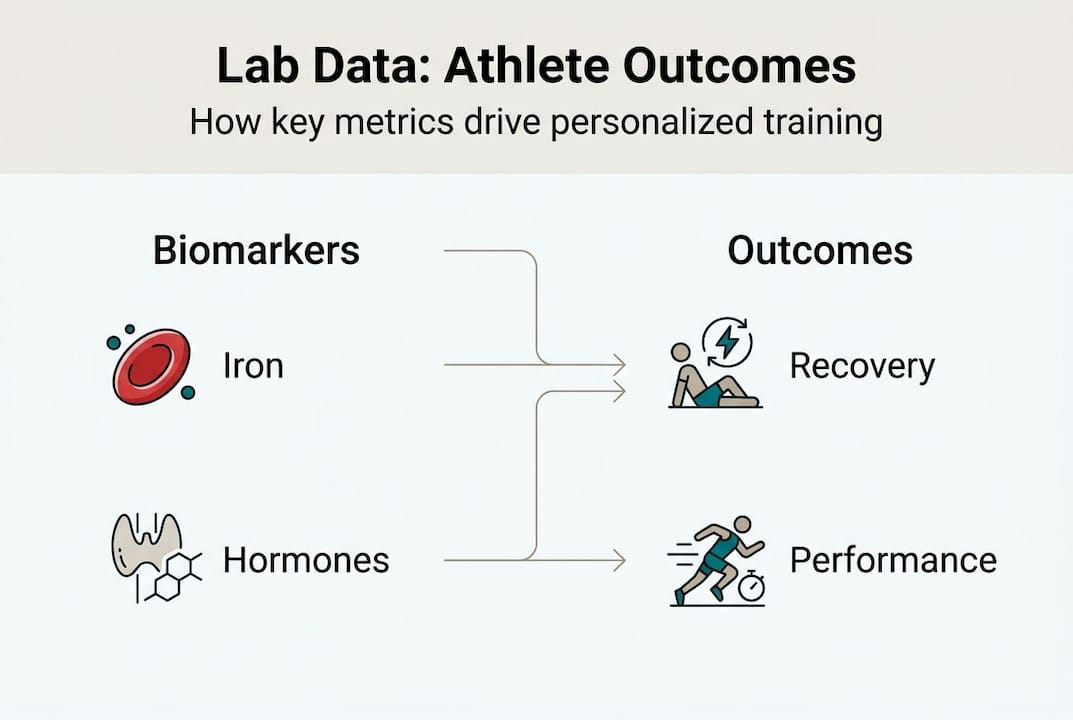
Consider a competitive cyclist who reports persistent fatigue despite adequate sleep and solid training volume. Her ferritin comes back at 14 ng/mL. After targeted iron supplementation and dietary adjustments, her ferritin climbs to 62 ng/mL over 12 weeks. Her perceived effort drops, and her power output improves measurably. Iron optimization resolving performance issues like this is one of the most well-documented applications of biomarker testing in endurance sports.
Here are four scenarios where lab data has made a direct difference:
- Ferritin deficiency: Fatigue and poor VO2 max response resolved through iron supplementation guided by serial testing.
- Elevated CK levels: Creatine kinase as a recovery marker signaled insufficient protein intake and inadequate rest days, prompting a training load reduction that prevented overtraining syndrome.
- Low vitamin D: Linked to increased injury frequency and immune suppression in winter training blocks, corrected through targeted supplementation.
- Cortisol imbalance: Chronically elevated morning cortisol identified a stress overload pattern, leading to a deload week and sleep protocol changes that restored hormonal balance.
Using biomarker interpretation for health insights means connecting the numbers to real interventions. A step-by-step hormone analysis approach helps you prioritize which markers to act on first and which to monitor over time.
Key insight: Athletes who retest after targeted interventions consistently show improved biomarker profiles alongside subjective performance gains, confirming that the intervention worked and that the original data was actionable.
Pro Tip: Don’t use lab data in isolation. Combine it with wearable metrics like HRV, sleep quality scores, and your own training log. When your subjective feel, wearable data, and lab results all point in the same direction, you have a strong signal worth acting on.
Expert-level nuance: Avoiding common pitfalls and misinterpretations
While effective, lab data isn’t magic. Understanding its nuances and limitations prevents wasted effort and confusion.
The most important caveat is timing. Endurance exercise transiently alters lab values, and interpreting results without accounting for recent training history can lead to misdiagnosis. A post-race ferritin drop, for example, often reflects hemodilution rather than true iron deficiency.
Sex-specific reference ranges also matter. Female athletes have different hormonal baselines, iron requirements, and inflammatory responses. Using male-derived reference ranges to interpret a female athlete’s results introduces systematic error that can lead to unnecessary supplementation or missed deficiencies.
Four main pitfalls to avoid:
- Poor timing: Drawing blood within 24 hours of intense exercise distorts inflammation, hormone, and muscle damage markers.
- Chasing minor or unproven markers: Focusing on obscure biomarkers with weak evidence distracts from the high-impact basics.
- Over-testing: Testing too frequently creates noise rather than signal and can generate anxiety around normal fluctuations.
- Ignoring fundamentals: Lab data works best when training, nutrition, and sleep are already solid. It’s a fine-tuning tool, not a shortcut.
| Where lab data excels | Where it’s less useful |
|---|---|
| Identifying deficiencies and imbalances | Predicting race-day performance directly |
| Tracking recovery and adaptation trends | Replacing subjective training feedback |
| Personalizing supplementation | Diagnosing acute illness or injury |
| Optimizing hormonal health | Guiding technique or skill development |
It’s also worth noting the honest criticism: biomarkers remove barriers but lack strong evidence for direct performance gains beyond the basics. The biggest results still come from consistent training, smart nutrition, and quality sleep. Lab data accelerates progress by removing hidden obstacles, not by replacing the work.
“Biomarker testing is most powerful when used to identify what’s limiting you, not to validate what you’re already doing right.”
Tracking hormonal health over time is one area where consistent lab monitoring genuinely outperforms guesswork, especially for athletes managing high training loads across multiple seasons.
The real value of lab data: Less about numbers, more about action
After years of working with lab data across different athlete profiles, one pattern stands out clearly: the people who benefit most aren’t the ones who test the most. They’re the ones who act on what they find.
A panel showing 40 biomarkers is only useful if you can identify the two or three that are actually limiting you right now and do something about them. The temptation to optimize everything simultaneously leads to paralysis, not progress. Focus on trends, not single data points. A ferritin that moves from 18 to 55 ng/mL over six months tells a far more powerful story than any one-time snapshot.
The real edge in using precision medicine for athletic performance comes from pairing objective data with honest self-assessment. Numbers confirm what you suspect or reveal what you’ve missed. Either way, they sharpen your focus. The athletes who treat lab data as one input among many, rather than the final word, consistently make smarter decisions and stay healthier over the long term.
Ready to use lab data to personalize your training?
Understanding your biomarkers is the first step toward training that’s built around your actual physiology, not a generic template. At-home testing has made this level of insight accessible to every serious athlete and health-focused individual, without needing a clinic visit or a specialist referral.

Biostarks uses advanced Swiss mass spectrometry to analyze a wide range of biomarkers, from hormones and amino acids to inflammation markers and metabolic indicators. The result is a clear, actionable report that shows you exactly where to focus. If you’re ready to stop guessing and start optimizing, explore your personalized lab testing options and take the first concrete step toward performance built on real data.
Frequently asked questions
Which lab markers are most important for athletes?
Key athletic markers include iron and ferritin, hormones like thyroid and cortisol, and inflammation indicators such as CRP. Blood biomarkers including hormones and ferritin are consistently cited as the most impactful starting points for performance optimization.
How often should lab data be tested for training purposes?
Retesting every 3 to 6 months is the standard recommendation, giving enough time for interventions to take effect while keeping your data current through training cycles.
Can lab data really boost athletic performance?
Lab testing helps by identifying and removing limiting factors, but the primary performance gains still come from training, nutrition, and sleep. Biomarkers remove barriers but don’t replace the fundamentals that drive adaptation.
Are there risks to using lab data in training?
The main risk is misinterpretation. Endurance exercise transiently alters labs, so poor timing or over-testing can generate misleading signals that distract from what actually matters in your training.
Recommended
- Why choose data-driven wellness for optimal h… | Biostarks
- How data transforms personalized wellness: 28… | Biostarks
- 7 Key Biomarker Testing Benefits for Athletes… | Biostarks
- Role of Biomarkers for Athletes: Unlocking Pe… | Biostarks
- Top climbing training trends to boost performance in 2026 - Gripnatic


