

TL;DR:
- Amino acid analysis provides a detailed assessment of food and blood amino acid profiles.
- Laboratory methods vary, with enzymatic and microwave hydrolysis improving detection of labile amino acids.
- Testing guides personalized nutrition, optimizing performance and addressing metabolic health issues.
Even the most carefully planned high-protein diet can fall short on essential amino acids. Hitting your daily protein target in grams tells you almost nothing about whether your body is actually getting the specific building blocks it needs to build muscle, regulate hormones, and support metabolic health. Amino acid analysis changes that. It moves you from guessing to knowing, giving you a precise picture of what’s in your food, your supplements, and your blood. Whether you’re an athlete chasing peak performance or someone focused on long-term metabolic health, understanding amino acid analysis is one of the most powerful tools you’re probably not using yet.
Table of Contents
- What is amino acid analysis?
- How amino acid analysis works: Methods and nuances
- Interpreting amino acid analysis results for nutrition
- Applications: Optimizing health and performance with amino acid analysis
- The real-world impact of amino acid analysis: Beyond the lab
- Unlock your nutritional potential with personalized amino acid analysis
- Frequently asked questions
Key Takeaways
| Point | Details |
|---|---|
| Analysis reveals true protein quality | Amino acid analysis goes beyond protein grams to measure nutritional adequacy. |
| Different methods yield different results | Enzymatic or microwave hydrolysis preserves labile amino acids for more accurate profiles. |
| Athletes benefit from targeted AA optimization | Testing AA levels guides precise dietary tweaks for peak performance and recovery. |
| Interpreting AA data enables health personalization | Results from AA analysis should inform customized nutrition and metabolic health strategies. |
| Choose methodology carefully | Always check which lab method was used, as standard acid hydrolysis can miss key amino acids. |
What is amino acid analysis?
Amino acid analysis is the process of measuring the types and amounts of amino acids present in a biological sample, food, or supplement. Think of it as a detailed audit of your protein quality, not just quantity. While a nutrition label tells you there are 30 grams of protein per serving, amino acid analysis tells you exactly how much leucine, lysine, methionine, and every other amino acid is actually in that serving and whether those amounts are meaningful for your goals.
At its core, the process works in two stages: breaking down proteins into their individual amino acid components, then separating and detecting each one. The most common breakdown method is acid hydrolysis, where the protein sample is exposed to hydrochloric acid at high heat, cleaving peptide bonds and releasing individual amino acids. For specific amino acids that don’t survive acid conditions, labs use alkaline or enzymatic hydrolysis instead.
Once broken down, the amino acids are separated and quantified using detection techniques like:
- HPLC (high-performance liquid chromatography): the gold standard for most routine amino acid profiling
- LC-MS/MS (liquid chromatography tandem mass spectrometry): offers higher sensitivity and specificity, especially for clinical samples
- Capillary electrophoresis: useful for rapid screening but less common in clinical nutrition labs
As primary methodologies show, the choice of hydrolysis paired with the right separation technique determines both accuracy and which amino acids can be reliably detected.
Amino acid analysis isn’t just a food science tool. When applied to blood or plasma samples, it becomes a window into your metabolic status, revealing deficiencies and imbalances that standard blood panels completely miss.
For athletes and health-conscious individuals, this is where biomarker testing health data becomes genuinely actionable. Knowing that a plant-based protein source is low in specific essential amino acids lets you make targeted adjustments rather than relying on broad dietary guidelines that weren’t designed with your specific physiology in mind.
How amino acid analysis works: Methods and nuances
With the concept clarified, let’s look at how amino acid analysis actually works in the lab and what makes some approaches more accurate than others.
The method chosen matters enormously. Standard acid hydrolysis using 6N hydrochloric acid at 110°C for 24 hours is reliable for most amino acids, but it completely destroys tryptophan and causes partial degradation of cysteine and methionine. That’s a significant blind spot if you’re trying to evaluate complete protein quality.

Here’s how the main methods compare:
| Method | Strengths | Limitations |
|---|---|---|
| Acid hydrolysis | Reliable for most AAs, widely standardized | Destroys Trp, degrades Cys/Met |
| Alkaline hydrolysis | Preserves Trp | Destroys most other AAs |
| Enzymatic hydrolysis | Preserves labile AAs (Trp, Cys, Met) | Slower, more expensive |
| Microwave hydrolysis | Fast, preserves sensitive AAs | Requires specialized equipment |
For plant-based protein analysis, standard acid hydrolysis often underestimates key amino acids. Microwave-assisted and enzymatic methods are increasingly preferred because they preserve the amino acids most likely to be limiting in plant proteins. Recovery rates for tryptophan, methionine, and cysteine improve substantially when enzymatic or microwave hydrolysis is used instead of the standard acid approach.
Common pitfalls in amino acid analysis include:
- Sample contamination during collection or preparation, which skews absolute values
- Incomplete hydrolysis, leaving peptide bonds intact and underreporting total amino acid content
- Conversion artifacts, where asparagine converts to aspartate and glutamine converts to glutamate during hydrolysis, making it impossible to distinguish them without specialized techniques
For biomarker analysis best practices, the method used is as important as the result itself. A number without methodological context is just noise. The accuracy differences between methods can be substantial enough to change your nutritional conclusions entirely.
Pro Tip: Always ask which hydrolysis method was used when receiving amino acid analysis results. If tryptophan isn’t reported, the lab likely used standard acid hydrolysis, and your protein quality picture is incomplete.
Interpreting amino acid analysis results for nutrition
Once methods yield data, interpreting results is where nutrition and performance optimization really begins.
Amino acid analysis produces two types of values. Absolute values express amino acid concentrations in units like micromoles per liter (µmol/L) for blood samples or milligrams per gram of protein for food samples. Relative ratios compare individual amino acids against each other or against a reference protein like egg white or casein.
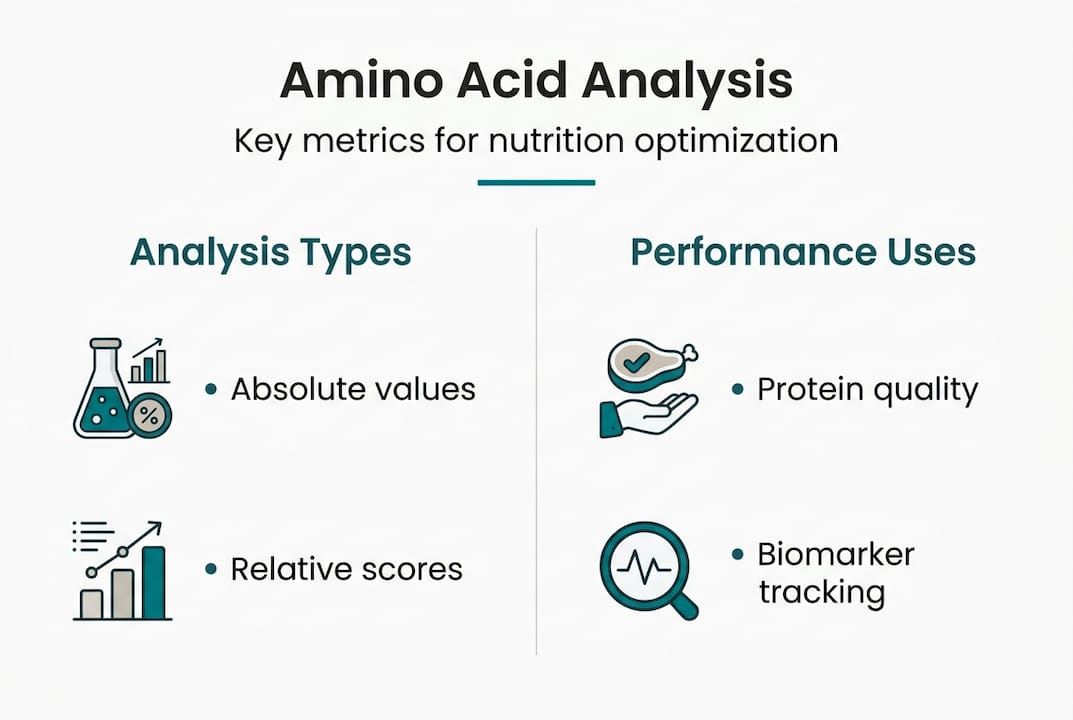
These numbers feed directly into protein quality metrics. The older PDCAAS (protein digestibility-corrected amino acid score) compared a protein’s essential amino acid profile against a reference and corrected for digestibility. The newer DIAAS (digestible indispensable amino acid score) is more precise because it accounts for digestion at the end of the small intestine rather than fecal digestibility, giving a more accurate picture of what your body actually absorbs.
Here’s a simplified example of how this works in practice:
| Amino acid | Reference need (mg/g protein) | Pea protein (mg/g protein) | Score |
|---|---|---|---|
| Lysine | 45 | 70 | 1.56 |
| Methionine + Cysteine | 22 | 11 | 0.50 |
| Tryptophan | 6 | 8 | 1.33 |
In this example, methionine plus cysteine is the limiting amino acid, capping pea protein’s DIAAS score at 0.50 regardless of how strong it scores elsewhere. Without amino acid analysis, you’d never know.
Quantitation of amino acids using absolute and relative measures gives you the foundation for these calculations, but interpreting them correctly requires context:
- Compare blood plasma values against established reference ranges, not just population averages
- Consider the timing of sample collection since plasma amino acids fluctuate significantly after meals
- Look at the ratio of essential to non-essential amino acids, not just individual values
For athletes and health-focused individuals, understanding types of biomarkers for personal health means recognizing that amino acid data is most powerful when interpreted alongside other metabolic markers like insulin, cortisol, and inflammatory markers.
Applications: Optimizing health and performance with amino acid analysis
Now, let’s see how amino acid analysis drives actionable strategies for optimizing nutrition and athletic performance.
For athletes, the practical applications are immediate. Amino acid analysis of your diet reveals whether your protein sources are actually delivering the branched-chain amino acids (BCAAs) and lysine your muscles need for repair and growth. Blood plasma testing then shows whether those dietary amino acids are reaching your circulation in meaningful concentrations. The gap between what you eat and what circulates in your blood can be surprisingly large.
Key applications include:
- Supplement selection: Identifying which protein sources fill specific amino acid gaps rather than just adding more total protein
- Recovery optimization: Monitoring plasma leucine (reference range: 70 to 170 µmol/L) to time protein intake around training
- Metabolic disorder screening: Clinical amino acid analysis detects conditions like PKU (phenylketonuria) and methylmalonic acidemia (MMA) by measuring specific amino acid elevations in blood
- Dietary adequacy for plant-based athletes: Identifying limiting amino acids in vegan diets and correcting them through food combining or targeted supplementation
Protein optimization for athletic needs through amino acid analysis is especially relevant given that research suggests endurance athletes need approximately 1.8 to 2.0 grams of protein per kilogram of body weight per day, and the amino acid composition of that protein matters as much as the total amount.
Pro Tip: If you’re a performance athlete, schedule plasma amino acid testing at consistent times, ideally in a fasted state in the morning, to get comparable data across testing periods.
For athlete blood testing and performance, amino acid panels give you something generic protein tracking never can: specificity. And for those managing metabolic health more broadly, biomarkers for athlete performance show that amino acid status correlates with recovery speed, immune function, and even cognitive performance under training stress. The food amino acid profile analysis research supports integrating both dietary and plasma analysis for the most complete picture.
The real-world impact of amino acid analysis: Beyond the lab
Stepping back, there’s a perspective that mainstream nutrition conversations consistently miss: protein quantity and amino acid adequacy are not the same thing, and treating them as equivalent is costing athletes and health-focused individuals real performance gains.
Most nutrition advice is built around grams of protein per day. That’s useful as a starting point, but it obscures enormous variation in amino acid composition between protein sources. Two people eating identical amounts of total protein from different sources can have dramatically different plasma amino acid profiles. One thrives. The other plateaus and can’t figure out why.
Lab data without methodological transparency makes this worse. A reported amino acid value that came from standard acid hydrolysis is missing tryptophan entirely. If you don’t know that, you might conclude your protein source is adequate when it isn’t.
The real insight from analyzing food amino acid profiles is that personalized testing combined with contextual interpretation actually changes outcomes. It’s not about having more data. It’s about having the right data interpreted by someone who understands what it means for your specific goals. That’s what biomarker interpretation insights at the individual level can deliver that population-level guidelines simply cannot.
Unlock your nutritional potential with personalized amino acid analysis
Understanding amino acid analysis is one thing. Acting on it is where real change happens.
At Biostarks, we use advanced Swiss mass spectrometry to analyze your amino acid biomarkers from a simple at-home sample, giving you precise, actionable data on your nutritional status. Whether you’re optimizing recovery, addressing a plateau in performance, or managing long-term metabolic health, our personalized biomarker testing translates complex amino acid data into clear, targeted nutrition strategies. You get the methodology, the context, and the interpretation, not just a number. Take the next step toward precision nutrition and see exactly where your protein quality stands.
Frequently asked questions
What are the main methods used in amino acid analysis?
Acid hydrolysis is standard, but enzymatic and microwave methods improve accuracy for labile amino acids like tryptophan, cysteine, and methionine that degrade under standard conditions.
How does amino acid analysis help athletes?
It identifies essential amino acid gaps in both diet and blood plasma, enabling targeted nutrition adjustments for performance, recovery, and muscle protein synthesis rather than relying on generic protein targets.
Can amino acid analysis detect metabolic disorders?
Yes, clinical amino acid screening can identify conditions like PKU by detecting elevated phenylalanine levels in blood, making it a valuable tool beyond sports nutrition.
Why are some amino acids underreported in analysis?
Amino acids like tryptophan degrade during standard acid hydrolysis, and asparagine converts to aspartate, making them difficult to measure accurately without specialized hydrolysis methods.
What is a typical protein requirement for endurance athletes?
Research supports 1.8 to 2.0 grams of protein per kilogram of body weight per day for endurance athletes, with amino acid composition being as important as total protein intake.


