

TL;DR:
- Proper preparation is essential for accurate at-home metabolic profiling, including fasting and exercise avoidance.
- Longitudinal testing over time reveals true health trends, not just single snapshot results.
- Professional metabolomics labs use advanced mass spectrometry and quality controls for precise biomarker analysis.
Metabolic profiling is one of the most powerful tools available for optimizing performance and long-term health, yet most people undermine their own results before they even collect a sample. A skipped fasting window, a morning workout before the draw, or misreading a reference range can turn precise data into noise. The good news is that fixing these gaps does not require a clinical setting. With the right protocols and a clear framework for interpreting what your biomarkers are telling you, at-home testing can deliver insights that are genuinely actionable, not just interesting numbers on a page.
Table of Contents
- What is metabolic profiling and why does it matter?
- Key requirements for accurate at-home metabolic profiling
- How to perform and track at-home tests step by step
- Analyzing and interpreting your results for better health outcomes
- Lab-level tips: maximizing accuracy if you use a professional metabolomics panel
- The overlooked power of consistent metabolic monitoring
- Ready to enhance your metabolic insights?
- Frequently asked questions
Key Takeaways
| Point | Details |
|---|---|
| Preparation is crucial | Careful adherence to testing protocols directly improves metabolic profile accuracy. |
| Track your trends | Long-term monitoring reveals true changes in your metabolism, not just random fluctuations. |
| Personalized action matters | Use your unique biomarker data to tailor nutrition and training for best performance and wellness. |
| Lab partnerships boost precision | Advanced labs use quality-control measures that offer the most reliable results for complex cases. |
What is metabolic profiling and why does it matter?
Metabolic profiling is the systematic measurement of biomarkers that reflect how your body produces, uses, and stores energy. A biomarker is any measurable biological indicator, from blood glucose and insulin to amino acids, lipids, and hormones, that signals how well a specific metabolic pathway is functioning. Think of it as a live readout of your body’s internal operating system.
For athletes, this data goes well beyond basic bloodwork. It can reveal whether your body is efficiently burning fat as fuel, how well you recover between sessions, and whether your current nutrition plan is actually supporting your training load. For health-focused individuals, it flags early signs of metabolic dysfunction long before symptoms appear.
Here is what a robust metabolic profile can tell you:
- Energy substrate use: Are you primarily burning carbohydrates or fat at rest and during exercise?
- Hormonal balance: Are cortisol, testosterone, and thyroid markers supporting or limiting your goals?
- Micronutrient sufficiency: Are deficiencies in B vitamins, magnesium, or zinc slowing your metabolic rate?
- Inflammatory load: Are chronic markers like CRP or oxidized lipids quietly degrading performance?
- Amino acid status: Is protein synthesis keeping pace with training demand?
“Personalized nutrition guided by biomarker data can significantly enhance metabolic flexibility, and integrating multi-omics approaches provides the most complete picture of individual metabolic function.”
Understanding which metabolic health biomarkers matter most for your specific goals is the foundation. From there, you can use personal health biomarkers to build a nutrition and training strategy that is genuinely tailored to your biology, not a generic template.
Key requirements for accurate at-home metabolic profiling
The quality of your results depends almost entirely on what you do in the 24 to 48 hours before you collect your sample. Most testing errors are not lab errors. They are preparation errors.
Essential preparation protocols:
- Fast for 8 to 12 hours before sample collection
- Avoid alcohol for at least 48 hours prior
- Skip intense exercise for 24 to 48 hours before testing
- Collect your sample first thing in the morning
- Stay well hydrated the evening before, but avoid excess water right before the draw
- Pause non-essential supplements for 24 hours unless instructed otherwise
| Variable | Recommended window | Why it matters |
|---|---|---|
| Fasting duration | 8 to 12 hours | Stabilizes glucose, insulin, and lipid readings |
| Exercise avoidance | 24 to 48 hours | Prevents acute inflammation and hormone spikes |
| Alcohol avoidance | 48 hours | Alcohol disrupts liver enzymes and lipid metabolism |
| Sample timing | Morning, post-sleep | Cortisol and hormones follow circadian rhythms |
| Supplement pause | 24 hours | Prevents artificial elevation of micronutrient markers |
For athletes specifically, the stakes are higher. A hard training session the day before can temporarily spike creatine kinase, lactate, and inflammatory cytokines, making your results look like a metabolic problem when you are actually just well-trained. Strict preparation protocols are the single most effective way to reduce variability.
“Preparation is not a formality. It is the variable that separates meaningful data from expensive guesswork.”
Pro Tip: If you train in the morning, schedule your test on a rest day or after a full day off. This protects the integrity of your hormonal and inflammatory markers more than any other single step. Review the full at-home test preparation checklist before your first collection, and use the at-home testing guide to build a repeatable pre-test routine. Also check the natural metabolic assessment resource for lifestyle factors that support baseline accuracy.
How to perform and track at-home tests step by step
With your preparation locked in, the actual collection process is straightforward. But a few small technique errors can still compromise sample quality.
Step-by-step collection process:
- Wash your hands thoroughly with warm water for 30 seconds to improve blood flow
- Let your hand hang at your side for 30 seconds before the finger-prick
- Use the lancet on the side of your fingertip, not the pad, for less discomfort and better flow
- Wipe away the first drop of blood with a clean tissue (it may contain tissue fluid)
- Allow subsequent drops to fall naturally into the collection device without squeezing
- Cap, label, and store the sample as directed, typically refrigerated until dispatch
- Ship the same day or as early as possible to preserve sample integrity
| Protocol level | Suitable for | Key markers targeted |
|---|---|---|
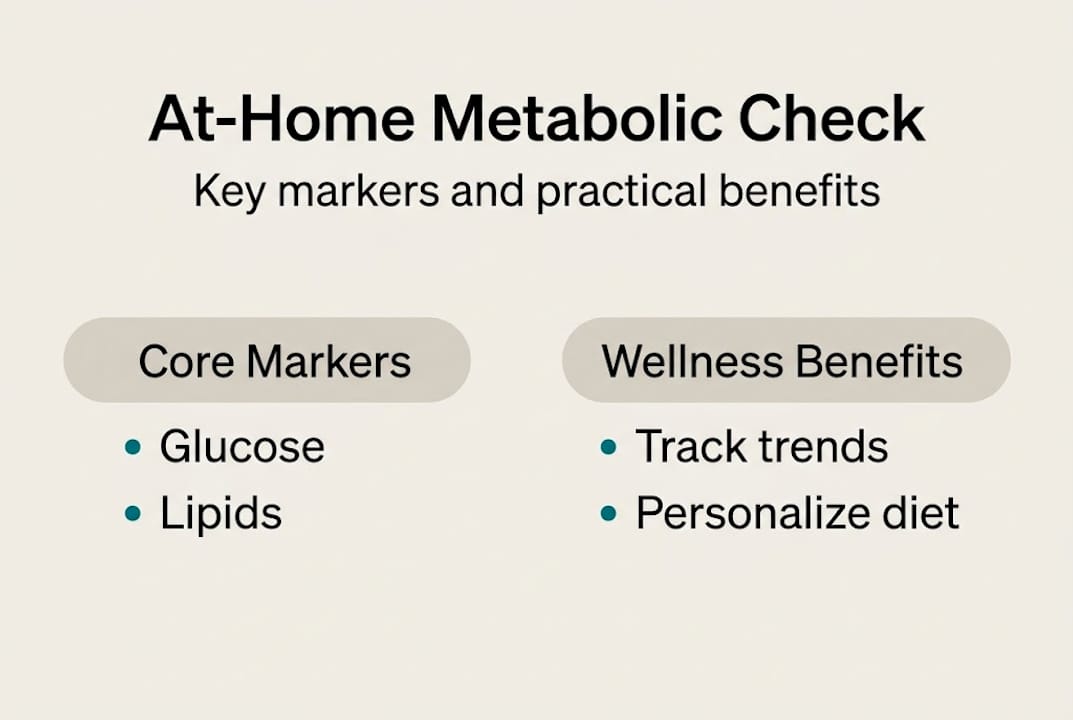
| Standard at-home | General health monitoring | Glucose, lipids, vitamins, hormones |
| Advanced at-home | Active individuals, athletes | Amino acids, inflammatory markers, cortisol |
| Lab-based panel | Elite athletes, clinical needs | VO2 max metabolites, phospholipids, RMR |
For athletes pursuing elite-level data, advanced testing protocols including indirect calorimetry for RMR and VO2 max, lactate threshold testing, and targeted metabolomics can identify distinct metabolic signatures, such as elevated phospholipids in endurance-trained athletes, that standard panels miss entirely.
Pro Tip: Track your tests in a simple spreadsheet with the date, preparation notes, and any recent training or diet changes. This context transforms raw numbers into a story about your metabolic trajectory.
Review example metabolic markers to understand which panels align with your goals, and explore the wellness testing benefits of regular profiling before deciding on your testing frequency.
Analyzing and interpreting your results for better health outcomes
Receiving your results is the moment most people get stuck. A number outside the reference range triggers either panic or dismissal, and neither response is useful. Context is everything.
What to look for when reviewing biomarker results:
- Direction of change: Is a marker moving toward or away from optimal over multiple tests?
- Cluster patterns: Are several related markers shifting together? That signals a systemic issue, not a random fluctuation.
- Athlete-specific baselines: Trained athletes often have naturally lower resting insulin, higher HDL, and elevated creatine kinase. These are adaptations, not problems.
- Hormonal ratios: Testosterone to cortisol ratio, for example, is more informative than either marker alone.
- Metabolic flexibility indicators: Can your body shift between fat and carbohydrate oxidation efficiently? Fasting glucose, fasting insulin, and triglyceride-to-HDL ratio together paint this picture.
Research confirms that training-adapted metabolic profiles in athletes include lower sulfated steroids and higher phospholipid concentrations in oxidative athletes, patterns that only become meaningful when monitored across multiple time points.

When a marker consistently trends outside your personal optimal range, that is the signal to act. For nutrition adjustments, work with a practitioner who understands optimizing with biomarkers. For training load changes, use the data to guide periodization. And when multiple systems appear dysregulated simultaneously, consulting a nutritionist using biomarker strategies can accelerate your progress significantly. For a full framework on using data to reach your ceiling, the peak health optimization guide is a strong next step.
Lab-level tips: maximizing accuracy if you use a professional metabolomics panel
At-home testing is powerful, but professional metabolomics panels add a layer of analytical precision that is worth understanding, especially if you are making high-stakes decisions about your health or training.
“In professional metabolomics labs, accuracy depends on rigorous MS workflow controls: rapid quenching of metabolic activity, pooled quality control samples run throughout the batch, and internal standards that correct for ion suppression and instrument drift.”
Here is what separates a high-quality lab from a basic one:
- Mass spectrometry (MS) technology: Look for labs using liquid chromatography-mass spectrometry (LC-MS) or gas chromatography-mass spectrometry (GC-MS). These methods offer far greater sensitivity and specificity than immunoassay-based panels.
- Internal standards: A reliable lab spikes each sample with known reference compounds to correct for variability introduced during processing.
- Pooled QC samples: Quality control samples run at regular intervals throughout each batch catch instrument drift before it contaminates your results.
- Certified reference materials: Labs that validate against certified external standards demonstrate a commitment to reproducibility.
- Transparent methodology: Any reputable provider should be able to tell you exactly which platform they use and how they handle quality control.
When evaluating a service, ask directly: what is the coefficient of variation for your key assays? A CV below 15% is generally acceptable for metabolomics. Above that, variability in the method itself may be larger than the biological changes you are trying to detect.
Understanding the full range of biomarker types available through professional panels helps you choose the right test for your specific question, rather than defaulting to the most popular option.
The overlooked power of consistent metabolic monitoring
Here is the perspective most testing guides skip: a single metabolic profile is almost never enough to act on confidently. It is a photograph. What you actually need is a film.
We have seen individuals convinced they had a cortisol problem based on one elevated morning reading, only to find that three subsequent tests showed normal levels once they controlled for a stressful week and poor sleep. The single data point was real, but it was not representative. Longitudinal tracking told the actual story.
The real gains from metabolic profiling come from running intervention cycles: test, adjust one variable (nutrition, sleep, training load), retest after 8 to 12 weeks, and compare. This approach turns biomarker data into a feedback loop rather than a verdict. It also builds your personal reference range, which is far more meaningful than population averages.
Athletes who track metabolic health consistently over a full training season often discover that their “problem” markers resolve naturally during recovery phases, while true deficiencies persist across all conditions. That distinction changes everything about how you intervene. Shift your mindset from “what do my results say today” to “what direction am I moving in,” and your testing investment will pay off many times over.
Ready to enhance your metabolic insights?
You now have the framework to collect cleaner samples, interpret results with real context, and build a monitoring routine that generates genuine progress over time. The next step is putting it into practice with tools built for exactly this purpose.
Biostarks at-home metabolic testing uses advanced Swiss mass spectrometry to analyze over 100 biomarkers from a simple at-home sample, with results delivered in a clear, actionable report. Whether you are optimizing athletic performance or building a long-term health baseline, the platform pairs precision lab science with expert interpretation support. Follow the step-by-step test process to get started, and let your biology guide your next move.
Frequently asked questions
What is the best way to prepare for metabolic profiling at home?
Fast for 8 to 12 hours, avoid exercise and alcohol for 24 to 48 hours, and collect your sample first thing in the morning for the most stable and accurate readings.
How often should I track my metabolic profile for optimal results?
Test every 2 to 3 months, or after any significant change in training or diet, to capture meaningful longitudinal trends rather than isolated snapshots.
Can I improve my metabolic flexibility with personalized nutrition?
Yes. Tailoring your diet based on biomarker feedback is one of the most direct ways to enhance metabolic flexibility and improve both performance and body composition.
What extra steps do professional labs take to ensure result accuracy?
Reputable labs use mass spectrometry workflows with pooled quality control samples and internal standards to correct for ion suppression and instrument variability across each batch.


