

TL;DR:
- Long-term multivitamin use does not lower overall mortality risk in healthy adults, highlighting the importance of targeted, evidence-based supplementation. Correcting specific deficiencies, like vitamin D, can enhance longevity, while blanket use offers little benefit; personalized testing is essential. Biomarker-guided strategies, rather than general supplementation, optimize metabolic health and reduce unnecessary risks.
Millions of people swallow a multivitamin every morning believing it is their insurance policy against aging. It is an appealing idea, but the science tells a more complicated story. Long-term multivitamin use shows no lower all-cause mortality risk compared to nonuse in healthy adults, according to a large epidemiological analysis. That does not mean vitamins are irrelevant to longevity. It means the strategy matters enormously. This guide separates the evidence from the marketing, so you can make decisions that actually move the needle on lifespan and metabolic wellness.
Table of Contents
- The promise and pitfalls of multivitamins
- Targeting deficiency: Where vitamins deliver longevity gains
- B vitamins, biomarkers, and mechanistic plausibility
- Smart vitamin strategies: Precision versus blanket supplementation
- Our perspective: Why precision beats pill-popping for longevity
- Unlock your vitamin longevity profile with Biostarks
- Frequently asked questions
Key Takeaways
| Point | Details |
|---|---|
| Multivitamin limits | Daily multivitamin use does not consistently improve lifespan for healthy adults. |
| Deficiency impact | Correcting vitamin deficiencies, especially D, can meaningfully boost longevity. |
| Precision matters | Testing your vitamin status and targeting specific needs avoids risks and maximizes results. |
| Mechanisms vs outcomes | Intermediate biomarkers offer clues, but direct evidence for longevity endpoints is limited. |
| Practical action | Use data-driven approaches—not blanket supplements—for metabolic health and longevity. |
The promise and pitfalls of multivitamins
Walk into any pharmacy and the messaging is clear: multivitamins support energy, immunity, heart health, and long life. The wellness industry has built a billion-dollar category on that promise. The problem is that population-level trial data consistently fails to back it up for generally healthy people.
Randomized trials and systematic reviews do not support broad claims that multivitamin and mineral supplements improve all-cause mortality. Benefits, when they do appear, tend to be population-specific and endpoint-specific. A frail elderly person with multiple dietary gaps looks very different from a well-nourished athlete who eats a diverse whole-food diet. Lumping them together in a blanket recommendation is where the science breaks down.
A large-scale mortality analysis tracking hundreds of thousands of American adults found no lifespan advantage associated with daily multivitamin use. None. That finding did not make headlines the way supplement launches do, but it should shape how you think about your morning routine.
Here is a quick breakdown of where the evidence actually lands:
| Claim | Evidence level | Verdict |
|---|---|---|
| Multivitamins reduce all-cause mortality | Large RCTs and meta-analyses | Not supported for healthy adults |
| Multivitamins prevent cardiovascular disease | Multiple large trials | Generally null |
| Correcting vitamin D deficiency lowers mortality | Observational cohort studies | Supported |
| Broad multivitamin use improves COVID-19 outcomes | Rapid review evidence | Not supported |
| Targeted repletion of confirmed deficiency | Clinical evidence | Supported |
Understanding the essential role of vitamins in metabolism does not automatically justify supplementing without data. These nutrients are cofactors in critical enzymatic pathways, but more is not always better when your baseline is already adequate.
Key pitfalls that trip people up most often:
- Assuming “natural” means safe at any dose
- Confusing association with causation in observational studies
- Treating supplements as a substitute for dietary quality
- Ignoring interactions between fat-soluble vitamins (A, D, E, K) and medications
- Stacking multiple products without knowing whether overlap creates excess
The evidence-based multivitamin benefits that do exist tend to apply in narrow, defined scenarios. Pregnant women need folate. People with confirmed B12 malabsorption need supplementation. Individuals who avoid sunlight and live at high latitudes often need vitamin D. These are targeted, data-driven applications, not broad longevity prescriptions.
Targeting deficiency: Where vitamins deliver longevity gains
While blanket supplementation offers little for most, the story changes significantly when actual vitamin deficiencies are involved. This is where precision nutrition earns its name.
Vitamin D is the clearest example. Vitamin D deficiency is associated with increased premature mortality and measurable life expectancy lost at age 50, according to a US cohort study and systematic review. The data quantifies actual years of life expectancy, not just a statistical hazard ratio. That makes it one of the most actionable findings in preventive medicine today.

The mechanism is plausible. Vitamin D receptors exist in virtually every tissue in the body, including immune cells, cardiac muscle, and brain tissue. Deficiency disrupts calcium homeostasis, impairs immune regulation, and correlates with higher rates of cardiovascular disease, cancer, and all-cause mortality. Correcting it is not a biohack. It is basic preventive care.
Here is how to approach deficiency identification systematically:
- Get your 25-hydroxyvitamin D tested. This is the standard serum marker for vitamin D status. Optimal range for longevity is debated, but most clinical frameworks target 40 to 60 ng/mL.
- Check your magnesium status. Magnesium is required to convert vitamin D to its active form. Low magnesium can blunt the benefit of supplementation even when you’re taking adequate doses.
- Review your dietary pattern for gap nutrients. B12, iron, and zinc are commonly deficient in specific dietary patterns (vegan, heavily processed food, low-calorie diets).
- Confirm with a clinical reference range. Subclinical deficiency often has no obvious symptoms, which is exactly why testing matters.
- Retest after 8 to 12 weeks of correction. Supplementation without retesting is guesswork.
Pro Tip: Vitamin D supplementation without testing first is one of the most common precision nutrition mistakes we see. Dosing to a confirmed deficiency is a fundamentally different strategy from prophylactic supplementation, and the clinical outcomes reflect that difference.
A micronutrient deficiency guide can help you map which nutrients are most relevant to your dietary pattern and health history. And if you want to understand how clinicians and nutritionists translate biomarker data into outcomes, biomarker strategies for deficiencies offers a practitioner-level look at the process.
Use the vitamin D deficiency checklist as a practical starting point if you are unsure whether your symptoms or risk factors warrant urgent testing. Geography, skin tone, BMI, and sun exposure are all relevant inputs into that clinical picture.
B vitamins, biomarkers, and mechanistic plausibility
Beyond deficiencies, biohackers and health-conscious individuals often look to vitamins for deeper mechanistic effects, particularly through intermediate biomarkers. The B-complex vitamins are the most popular target here, and the science is genuinely interesting but also genuinely humbling.
The core hypothesis: B6, B9 (folate), and B12 lower homocysteine, an amino acid that accumulates in the blood and correlates with cardiovascular disease and cognitive decline. Lower homocysteine should mean lower vascular risk. It is a clean, biologically sensible story.
The trials disagree. Homocysteine-lowering B-complex therapy, reviewed by the Cochrane Collaboration, has not shown a clear reduction in cardiovascular events in randomized controlled trials. You can successfully lower the biomarker without changing the outcome that matters. That gap, between a moving intermediate marker and a hard endpoint, is one of the most important lessons in precision medicine.
“Intermediate biomarker improvements create mechanistic plausibility, but RCT evidence for translating these changes into reduced all-cause mortality remains limited.” This tension between mechanism and outcome is central to honest longevity science.
The same logic applies to other trendy biomarker targets. Telomere lengthening, epigenetic aging clocks, and inflammatory markers are useful signals, but they are not endpoints. Using intermediate biomarkers produces mechanistic plausibility without the RCT endpoint evidence to confirm that improving them translates to longer, healthier lives.
This is not a reason to ignore biomarkers. It is a reason to use them intelligently. Key considerations for the biohacker using biomarkers to guide vitamin strategy:
- Distinguish between surrogate endpoints (homocysteine, CRP) and hard endpoints (mortality, heart attack)
- Look for clusters of biomarker improvement, not single-marker optimization
- Track biomarker aging prediction tools as signals, not as definitive diagnoses
- Pair biomarker data with dietary and lifestyle context before concluding a vitamin intervention is responsible
- Reference top longevity biomarkers to understand which markers carry the most predictive weight in peer-reviewed literature
The science around supplements and aging is evolving quickly, but the core principle holds: mechanistic plausibility is a hypothesis, not a result. B vitamins are worth monitoring and correcting if deficient. They are not a cardiovascular longevity protocol on their own.
For a broader synthesis of where longevity science biomarkers currently stand, the evidence base is rich, nuanced, and far more conservative than most supplement marketing suggests.
Smart vitamin strategies: Precision versus blanket supplementation
With these limitations and possibilities in mind, what should you actually do if you want to put vitamins to work for longevity and metabolic wellness? The answer is structured, sequential, and grounded in your individual biology, not in generic population advice.
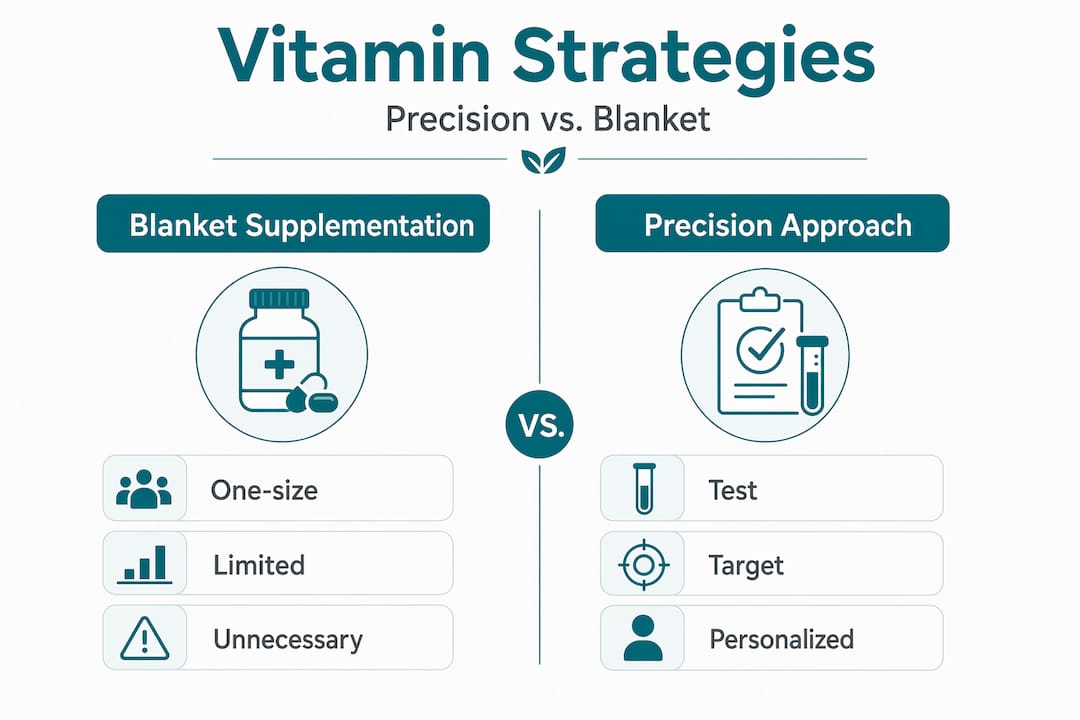
Precision vitamin strategies are what the evidence base supports, not blanket approaches. High-dose supplementation carries real toxicity risks, and the effect of any given dose depends heavily on your baseline status. Someone with serum vitamin D at 18 ng/mL responds very differently to 2,000 IU per day than someone already at 55 ng/mL.
Here is the evidence-based framework we recommend:
- Test before you supplement. Know your baseline levels across vitamins D, B12, folate, B6, and any others relevant to your health history or dietary pattern. This is non-negotiable for a precision approach.
- Correct confirmed deficiencies first. Prioritize nutrients where your levels fall below clinical reference ranges. This is where vitamin intervention has the strongest outcome data.
- Dose to your individual response, not to a population average. Follow-up testing at 8 to 12 weeks confirms whether supplementation is achieving repletion.
- Avoid high-dose fat-soluble vitamins without clinical oversight. Vitamins A, D, E, and K accumulate in tissue. Toxicity is real and measurable. The supplement safety tips framework is a practical reference for navigating dosing boundaries.
- Integrate vitamin status into your broader metabolic picture. Vitamins do not operate in isolation. Insulin resistance, gut permeability, inflammation, and liver function all affect how you absorb and utilize nutrients. The daily vitamins guide outlines nutrient interactions worth knowing before you build a stack.
- Monitor metabolic biomarkers alongside vitamin levels. Fasting glucose, lipids, inflammatory markers, and hormonal panels give you the context to interpret whether your vitamin strategy is supporting broader metabolic function.
Pro Tip: Improving vitamin levels is not just about supplementation. Dietary shifts, UV exposure, gut health optimization, and reducing medication interference can all move your levels significantly without adding another capsule.
Personalized health data is what transforms a generic supplement routine into a genuine longevity strategy. And optimizing metabolic function requires treating vitamins as one layer in a much larger system, not as the system itself.
Our perspective: Why precision beats pill-popping for longevity
Here is what years of working with biomarker data across thousands of users teaches you: the people most convinced they have their nutrition dialed in are often the ones most surprised by their lab results. A high-quality diet does not guarantee optimal micronutrient status. Age, genetics, gut function, medication use, and sun exposure create gaps that food alone may not close.
The real problem with multivitamins is not that they are dangerous. For most people, they are probably harmless. The problem is that they create a false sense of coverage. You take the pill, you feel like you have addressed your nutritional risk, and the deeper question of what your body actually needs never gets asked.
The biohackers who make genuine longevity gains are not the ones with the most expensive supplement stacks. They are the ones who know their numbers. They test, they identify actual gaps, they correct with precision, and they retest to confirm the intervention worked. That cycle, test, correct, retest, is not glamorous. It does not generate compelling content. But it is how you build an evidence-based longevity practice rather than a wellness performance.
One more uncomfortable truth: high-dose supplementation is not more protective, it is often less. The relationship between many vitamins and health outcomes follows a U-shaped curve. Too little is harmful. Optimal is beneficial. Too much creates new risks. This is especially true for vitamin A, vitamin E, and vitamin D at extreme doses.
Personalized health data improves wellness outcomes because it removes the guesswork. You stop optimizing for a population average and start optimizing for yourself. That shift, from generic to individual, is where precision health earns its value.
Unlock your vitamin longevity profile with Biostarks
If this article has made one thing clear, it is that knowing your actual vitamin status changes everything about how you approach supplementation and longevity strategy. Generic advice cannot account for your baseline levels, your absorption patterns, or your metabolic context.

Biostarks makes precision testing accessible without a clinic visit. Our at-home biomarker panels use advanced Swiss mass spectrometry to measure vitamins, metabolic markers, hormones, amino acids, and more, giving you the exact data you need to move from guesswork to a strategy grounded in your own biology. When you know what your body actually needs, every intervention becomes more targeted, more efficient, and more likely to produce real results. Explore Biostarks wellness solutions and take the first step toward a longevity practice built on data, not assumptions.
Frequently asked questions
Does taking multivitamins daily actually help you live longer?
Large studies show no lifespan association with daily multivitamin use for generally healthy adults. The evidence does not support routine use as a longevity strategy.
Which vitamin deficiencies most impact longevity?
Vitamin D deficiency is the most robustly linked to higher mortality, with research quantifying life expectancy lost at age 50. Other deficiencies matter, but the evidence is less consistent.
Are B-complex vitamins proven to prevent heart disease or support longevity?
Despite a plausible mechanism through homocysteine reduction, B-complex trials do not demonstrate clear cardiovascular event reduction. Mechanism and outcome are not the same thing.
What’s the best strategy for vitamins and longevity?
Precision approaches grounded in testing, deficiency correction, and careful dosing are what the evidence supports. Blanket supplementation does not meet that standard.
Can improving vitamin status affect metabolic wellness?
Correcting confirmed deficiencies has clear metabolic benefits, but only when the deficiency is first verified through testing. Supplementing without baseline data is imprecise and potentially counterproductive.


