

TL;DR:
- Measuring blood 25-hydroxyvitamin D levels provides essential data to guide targeted supplementation and prevent deficiency-related health issues. Routine testing is unnecessary for healthy individuals but critical for those with malabsorption, certain medical conditions, or high-risk factors. Accurate interpretation requires consistent lab methods, as results guide safe, effective vitamin D management.
Vitamin D testing measures the concentration of 25-hydroxyvitamin D (25(OH)D) in your blood, the clinically recognized marker for assessing your body’s vitamin D status. Understanding why check vitamin D levels matters goes beyond curiosity. Low levels impair calcium absorption, weaken bones, and compromise immune defense, while unmonitored supplementation carries real toxicity risks. The Endocrine Society, Harvard Health, and Mass General Brigham all emphasize that testing is most valuable when it guides a specific clinical decision, not as a blanket wellness screen. Knowing your numbers gives you the data to act precisely, not blindly.
Why checking vitamin D levels matters for your health
Vitamin D is not a passive nutrient. It functions as a hormone precursor that controls gene expression across dozens of tissue types, including bone, muscle, and immune cells. Without adequate levels, your body cannot absorb calcium or phosphorus efficiently, and the downstream effects reach far beyond your skeleton.

The biological case for monitoring is straightforward. Without adequate vitamin D, calcium absorption drops to just 10 to 15% of dietary intake. That figure means most of the calcium in your food passes through your gut unused, regardless of how much dairy or leafy greens you consume. The practical consequence is accelerated bone loss and elevated fracture risk over time.
Vitamin D’s role extends well past calcium metabolism:
- Immune regulation: Vitamin D modulates inflammation and supports infection-fighting cells, reducing the risk of autoimmune conditions like lupus and multiple sclerosis.
- Cancer risk reduction: Supplementation with 1,000 to 2,000 IU daily may reduce advanced cancer risk by approximately 20%, according to Mass General Brigham researchers.
- Metabolic function: Adequate vitamin D status is associated with better insulin sensitivity and lower rates of prediabetes progression.
- Bone disease prevention: Deficiency causes rickets in children and osteomalacia in adults, both of which are entirely preventable with timely correction.
The importance of vitamin D levels becomes clear when you recognize that deficiency rarely announces itself with obvious symptoms. Fatigue, muscle weakness, and low mood are common vitamin D deficiency symptoms, but they overlap with dozens of other conditions. A blood test removes the guesswork.
Who should consider getting tested?
Not everyone needs a vitamin D test. The Endocrine Society and AAFP explicitly state that routine testing is not recommended for healthy children and adults without clinical risk factors. This position reflects the absence of evidence-based target levels for broad disease prevention in the general population. Testing every healthy adult does not improve outcomes and generates unnecessary follow-up.
Testing is clinically indicated when results will directly change how a patient is managed. The following groups have the strongest rationale for checking their levels:
- Malabsorption conditions: Individuals with Crohn’s disease, celiac disease, or a history of gastric bypass surgery absorb vitamin D poorly through the gut. Testing confirms whether oral supplementation is reaching therapeutic levels.
- Hypocalcemia: Low blood calcium is a direct downstream signal of vitamin D insufficiency. Testing 25(OH)D is a standard step in the diagnostic workup.
- Nephrotic syndrome: Kidney disease impairs the conversion and retention of vitamin D metabolites, making baseline and follow-up testing medically relevant.
- Medications that increase catabolism: Anticonvulsants like phenytoin and rifampin accelerate vitamin D breakdown. Patients on these drugs face elevated deficiency risk without obvious dietary changes.
- High-risk life stages: Children aged 1 to 18, pregnant adults, and adults over 75 face elevated deficiency risk due to growth demands, fetal transfer, and reduced skin synthesis with age.
Geographic and lifestyle factors also shift the calculus. People living above 37 degrees north latitude (roughly the line from San Francisco to Richmond, Virginia) produce little to no vitamin D from sun exposure between October and March. Dark skin pigmentation reduces cutaneous synthesis by up to 99% in some studies. These factors do not automatically justify testing, but they raise the prior probability of deficiency enough to warrant a conversation with your physician.
Pro Tip: If you are unsure whether you qualify for a clinically indicated test, ask your doctor specifically about your malabsorption history, current medications, and sun exposure patterns. That framing moves the conversation from “I want to check” to “here is why my results would change my care.”
How to interpret your vitamin D test results
The standard test is a serum 25(OH)D measurement, reported in either nanograms per milliliter (ng/mL) or nanomoles per liter (nmol/L). To convert: 1 ng/mL equals 2.5 nmol/L. Most U.S. labs report in ng/mL.
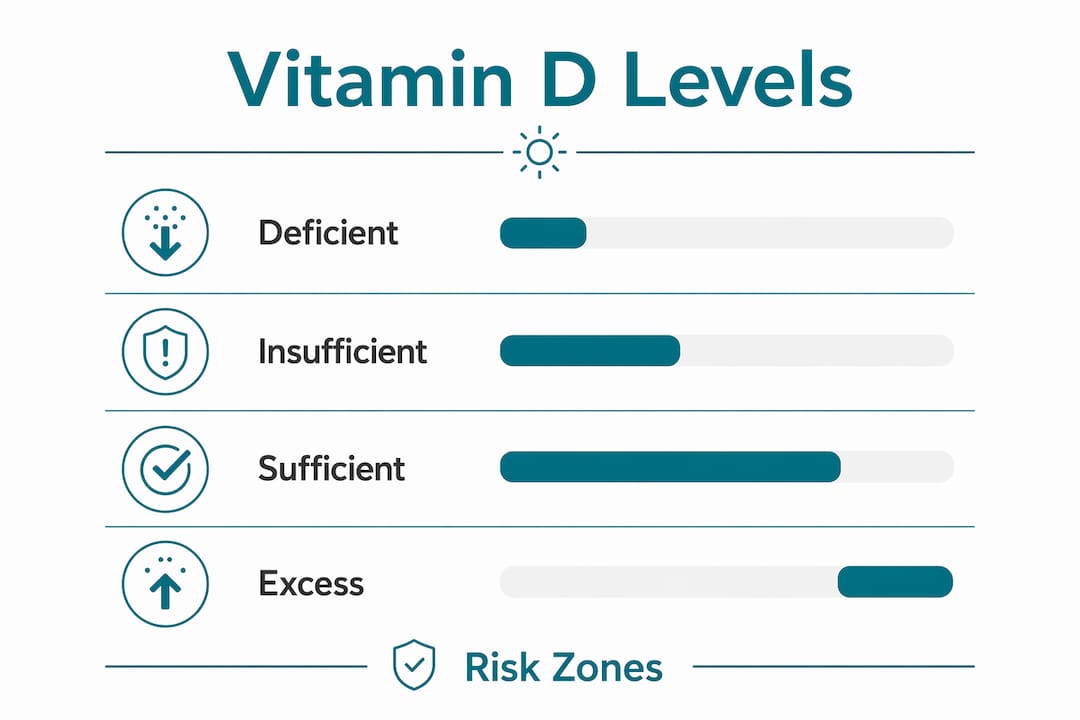
| Level (ng/mL) | Classification | Clinical implication |
|---|---|---|
| Below 20 | Deficient | Bone disease risk; supplementation indicated |
| 20 to 50 | Sufficient | Adequate for most health outcomes |
| Above 50 | Potentially excessive | Increased risk of adverse effects |
| Above 150 | Toxic range | Hypercalcemia, kidney stones, cardiac risk |
Levels below 20 ng/mL indicate deficiency, while the 20 to 50 ng/mL range is broadly recognized as sufficient for skeletal and immune health. The table above reflects widely used clinical thresholds, though no single universally agreed target exists for disease prevention beyond bone health.
One critical caveat: inter-lab variability in vitamin D assay methods can produce meaningfully different results from the same blood sample. NIST research confirms that assay comparability affects how results should be interpreted, which is why clinicians recommend repeating tests at the same laboratory when tracking changes over time. A result of 28 ng/mL at one lab and 22 ng/mL at another does not necessarily mean your levels dropped. It may simply reflect a different assay method.
Levels above 50 ng/mL do not confer additional benefit for most people and begin to increase the risk of hypercalcemia. The idea that higher is always better does not hold for vitamin D. The goal is sufficiency, not saturation.
Benefits and risks of supplementation guided by testing
Testing transforms supplementation from a guessing game into a targeted intervention. Many people supplement with vitamin D without knowing their blood levels, which creates a real risk of inadvertent overdosing. Harvard Health reports that doses above 100 mcg (4,000 IU) per day exceed the established safe upper limit and are linked to hypercalcemia, kidney stones, and increased fall risk in older adults. That last point is counterintuitive. High-dose vitamin D, which many people take specifically to protect their bones, can paradoxically increase fall risk when levels climb too high.
The benefits of testing-guided supplementation are concrete:
- Corrects true deficiency: Targeted supplementation restores calcium absorption from the 10 to 15% deficiency range back to the normal 30 to 40% range.
- Reduces cancer risk: The 20% reduction in advanced cancer risk observed in supplementation studies applies to doses in the 1,000 to 2,000 IU range, not megadoses.
- Supports immune function: Correcting deficiency reduces inflammatory burden and supports the innate immune response during infection.
- Avoids unnecessary cost and risk: Testing confirms whether you actually need to supplement, preventing months of unnecessary pill-taking.
“The strongest causal evidence for vitamin D links it to skeletal health. Testing and supplementation should be clinically indicated, not reflexive.” This framing from a state-of-the-art review published in 2025 captures the current scientific consensus precisely.
Current evidence also shows that supplementation benefits in healthy adults aged 19 to 74 without deficiency are not proven. This does not mean vitamin D is unimportant. It means that supplementing when you are already sufficient adds no measurable benefit and introduces unnecessary risk. Testing is the only way to know which category you fall into.
Pro Tip: If your test result falls between 20 and 30 ng/mL, discuss with your doctor whether a modest supplement of 1,000 to 2,000 IU daily is appropriate before jumping to higher doses. Most people in this range do not need aggressive correction.
Understanding micronutrient deficiencies more broadly can also help you contextualize where vitamin D fits within your overall nutritional picture.
Key takeaways
Checking vitamin D levels is medically justified when results will change clinical management, and testing-guided supplementation protects against both deficiency and toxicity.
| Point | Details |
|---|---|
| Test when clinically indicated | Testing is recommended for malabsorption, hypocalcemia, nephrotic syndrome, and high-risk life stages. |
| Deficiency threshold is 20 ng/mL | Levels below 20 ng/mL impair calcium absorption and bone health; correction is warranted. |
| Avoid routine population screening | No evidence supports universal testing in healthy adults without risk factors. |
| High doses carry real risks | Doses above 4,000 IU daily increase hypercalcemia and fall risk; test before supplementing. |
| Use consistent lab methods | Repeat tests at the same laboratory to track changes accurately across time. |
The case for knowing your number before you supplement
I have spent years reviewing biomarker data across thousands of health-conscious individuals, and vitamin D is the nutrient that surprises people most consistently. Not because deficiency is rare. It is not. But because the gap between what people assume about their levels and what their blood actually shows is wider than almost any other marker I track.
The conventional wisdom says: take a vitamin D supplement, especially in winter, and you will be fine. That advice is not wrong exactly, but it is imprecise in a way that matters. I have seen people supplementing 5,000 IU daily for years with levels well above 60 ng/mL, sitting in a range where the risk-benefit ratio has already flipped. I have also seen people taking 2,000 IU daily who remain deficient because an underlying gut issue is blocking absorption entirely. Neither person would know without a test.
What I find most underappreciated is the assay variability problem. Two labs can return results that differ by 8 to 10 ng/mL from the same sample. If you are tracking your levels over time, which is the right way to monitor any biomarker, switching labs mid-course can make it look like your levels changed when they did not. This is not a theoretical concern. It is a documented measurement challenge that NIST has studied directly.
My honest position: vitamin D testing is not for everyone, and the Endocrine Society is right to push back against reflexive population-wide screening. But for anyone with a known risk factor, a history of gut issues, or a genuine interest in optimizing their vitamin levels, testing is the only way to move from assumption to data. Sun exposure, diet, and supplements all matter. But none of them tell you what your blood actually contains.
— Romain
Precision vitamin D monitoring with Biostarks
Biostarks, an AMR Labs SA company, offers at-home biomarker testing that includes vitamin D (25(OH)D) alongside vitamins, minerals, hormones, and metabolic markers, all analyzed using advanced Swiss mass spectrometry. The platform delivers lab-grade precision without a clinic visit, giving you the data to make informed decisions about supplementation and lifestyle. Reports are clear, personalized, and designed to be acted on, not filed away. If you are ready to move from guessing to knowing, explore your testing options at Biostarks and get a complete picture of your internal health status.
FAQ
What does a vitamin D blood test actually measure?
A vitamin D blood test measures serum 25-hydroxyvitamin D (25(OH)D), the primary circulating form of vitamin D and the accepted clinical marker for assessing overall vitamin D status in the body.
What level of vitamin D is considered deficient?
Levels below 20 ng/mL (50 nmol/L) are classified as deficient by most clinical laboratories, indicating impaired calcium absorption and elevated risk for bone disease.
Is it safe to supplement vitamin D without testing first?
Low-dose supplementation of 1,000 to 2,000 IU daily is generally considered safe for most adults, but doses above 4,000 IU daily exceed the safe upper limit and can cause hypercalcemia and kidney stones without a confirmed deficiency.
Who should not bother with routine vitamin D testing?
Healthy children and adults without risk factors, malabsorption conditions, or relevant medications do not benefit from routine vitamin D screening, according to current Endocrine Society and AAFP guidelines.
Why do vitamin D results vary between labs?
Different laboratories use different assay methods, and inter-lab variability can produce results that differ by several ng/mL from the same blood sample. Repeating tests at the same lab is the most reliable way to track changes over time.
This content is for educational purposes only and does not constitute medical advice. Always consult with a healthcare professional before making changes to your health regimen.


