

TL;DR:
- Aging is driven by 12 biological mechanisms, which can be studied and targeted for intervention.
- Validated longevity methods include dietary restriction, exercise, and emerging therapies like senolytics.
- Personal biomarkers and multi-system clocks help track aging and guide individualized health decisions.
Most people assume aging is something that simply happens to you, like weather. But the biology tells a different story. Aging is driven by at least 12 identifiable mechanisms that researchers can study, target, and in some cases, slow. This is not speculative wellness talk. It is peer-reviewed science backed by decades of comparative biology, clinical trials, and increasingly, data from your own blood. This article breaks down the frameworks shaping longevity research, the interventions with real evidence behind them, the biomarkers worth tracking, and how you can use all of it to make smarter decisions about your own healthspan.
Table of Contents
- Decoding the biology of aging: Hallmarks, SENS, and species clues
- From frameworks to action: Validated longevity interventions
- Measuring longevity: Biomarkers, clocks, and what to track
- Personalized aging: The rise of multi-system clocks and proteomics
- Why real progress in longevity requires more than ‘anti-aging’ fads
- Explore your longevity data with personalized biomarker insights
- Frequently asked questions
Key Takeaways
| Point | Details |
|---|---|
| Aging is measurable | Scientific frameworks and biomarkers allow you to quantifiably track the aging process rather than guessing or relying on appearance. |
| Personalized data is power | Biomarker panels and multi-system clocks enable tailored interventions that can extend healthspan based on your unique biology. |
| Evidence beats fads | Sticking to validated interventions and monitoring your results outperforms hype-driven anti-aging trends. |
| Gut microbiota matters | Your gut’s ecosystem is a critical and modifiable factor in biological aging and disease risk. |
Decoding the biology of aging: Hallmarks, SENS, and species clues
For most of medical history, aging was treated as background noise, an unavoidable backdrop to disease. That changed when researchers began cataloging the specific biological events that cause cells and tissues to deteriorate. Two frameworks now dominate the field, and understanding how they differ matters if you want to apply this science to your own life.
The hallmarks of aging framework identifies 12 primary mechanisms driving age-related decline. These include genomic instability, telomere shortening, epigenetic alterations, loss of proteostasis (the system that keeps proteins folded correctly), disabled macroautophagy, deregulated nutrient sensing, mitochondrial dysfunction, cellular senescence, stem cell exhaustion, altered intercellular communication, chronic inflammation, and dysbiosis. Each hallmark is both a target for research and a potential lever for intervention.
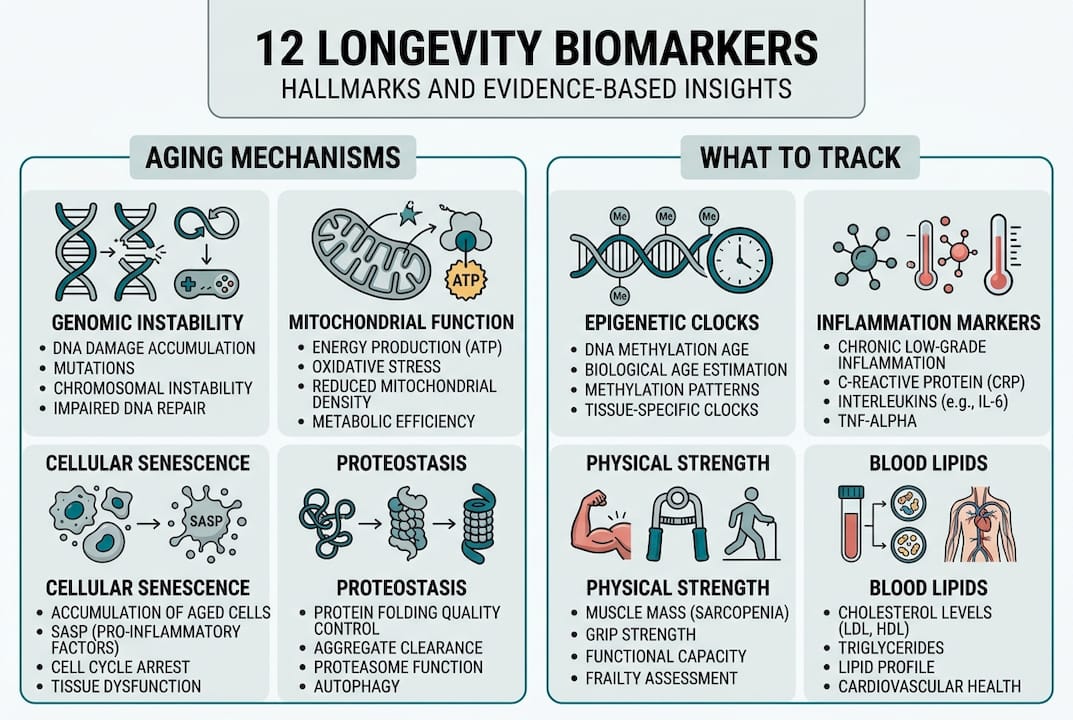
The SENS model, developed by biogerontologist Aubrey de Grey, takes a different angle. Where the Hallmarks framework focuses on understanding causal mechanisms, SENS prioritizes damage repair and rejuvenation. Think of it this way: Hallmarks asks “why does the engine degrade?” while SENS asks “how do we fix the engine before it breaks down completely?” Both are valuable, and researchers increasingly treat them as complementary rather than competing.
Animal studies add a third dimension. Comparative biology reveals that some mechanisms of longevity are shared across species (“public” mechanisms) while others are species-specific (“private” mechanisms). Bats, for example, live far longer than rodents of similar size, partly due to enhanced DNA repair and immune tolerance. Naked mole rats show almost no age-related cancer incidence. Beavers display metabolic flexibility that buffers oxidative stress. These species do not just live longer by accident. They have evolved specific biological tools that researchers are now working to understand and replicate.
“The goal is not just to understand why we age, but to identify which mechanisms are most actionable for extending healthy human lifespan.”
Here is a quick comparison of the two main frameworks:
| Framework | Core focus | Primary goal | Practical application |
|---|---|---|---|
| Hallmarks of aging | 12 causal mechanisms | Understand and target root causes | Guides biomarker selection and drug targets |
| SENS | Accumulated cellular damage | Repair and rejuvenate before failure | Informs therapies like senolytics and gene editing |
Tracking hallmarks and longevity biomarkers gives you a direct window into which of these mechanisms may be most active in your biology right now.
From frameworks to action: Validated longevity interventions
Understanding the biological causes is only the first step. What about the interventions making a measurable impact?
Key interventions validated in model organisms include genetic manipulation, dietary restriction, exercise, senolytics (drugs that clear senescent cells), and partial cellular reprogramming. The critical caveat: not everything that works in mice translates cleanly to humans. Rapamycin extends lifespan in rodents reliably, but its effects in healthy humans are still under investigation. This is why predicting aging with interventions requires ongoing personal measurement, not just following a protocol.
Here is what the evidence currently supports:
- Dietary restriction and fasting protocols have the most robust cross-species data. Caloric restriction extends lifespan in yeast, worms, flies, and rodents. In humans, it improves metabolic markers, reduces inflammation, and lowers biological age scores.
- Exercise is the most accessible and well-validated intervention. Resistance training preserves muscle mass and metabolic rate. Zone 2 cardio improves mitochondrial density and insulin sensitivity. Both matter for healthspan.
- Senolytics (such as dasatinib plus quercetin) clear senescent cells in animal models and early human trials show promise for reducing inflammatory markers. Still largely pre-clinical for healthy populations.
- Partial cellular reprogramming using Yamanaka factors is generating significant excitement. Early results in animal models suggest it can reverse epigenetic age. Human applications are years away but the trajectory is compelling.
- Pharmacological interventions like metformin and NAD+ precursors are widely used in longevity-focused communities, though evidence for lifespan extension in healthy humans remains limited.
| Intervention | Evidence strength | Human data available | Primary mechanism |
|---|---|---|---|
| Dietary restriction | Strong | Yes | Nutrient sensing, autophagy |
| Exercise | Strong | Yes | Mitochondrial function, inflammation |
| Senolytics | Moderate | Early trials | Senescent cell clearance |
| Reprogramming | Emerging | Animal models only | Epigenetic reset |
| Metformin | Moderate | Observational | AMPK activation |
Pro Tip: Before adding any pharmacological intervention to your routine, establish a baseline with biomarker testing. Without data, you cannot know whether an intervention is helping, neutral, or quietly causing harm.
Measuring longevity: Biomarkers, clocks, and what to track
Understanding interventions sets the stage for measurement. How do you know if your efforts are working?
The answer lies in tracking the right biomarkers. Not all markers are equally predictive, and the field has moved well beyond cholesterol panels. Here is what actually matters:
Epigenetic clocks measure biological age by analyzing DNA methylation patterns. DunedinPACE outperforms other biomarkers in predicting mortality risk among consensus aging markers. It measures the pace of aging, not just a static age estimate. This is a meaningful distinction: two people with the same chronological age can have very different aging rates.
Clinical chemistry panels give you metabolic context. Key markers include:
- HbA1c (average blood glucose over 3 months)
- Creatinine and eGFR (kidney function)
- HDL and LDL cholesterol fractions
- hsCRP (high-sensitivity C-reactive protein, a marker of chronic inflammation)
- Fasting insulin and HOMA-IR (insulin resistance index)
Understanding the role of health biomarkers in this context is not about finding disease. It is about detecting drift before it becomes damage.
Performance markers like grip strength and gait speed are surprisingly powerful predictors of long-term outcomes. They reflect neuromuscular integrity, metabolic reserve, and systemic resilience in ways that blood tests alone cannot capture.
Pro Tip: Do not just test once. Biological age and metabolic markers shift with behavior. Test, intervene, retest. The signal only becomes meaningful when you have a trend, not a single data point. Explore using biomarker insights to build a feedback loop that actually informs your decisions. You can also track metabolic health through specific panels designed for this purpose.
Personalized aging: The rise of multi-system clocks and proteomics
We have seen what to measure. So what are the newest tools making tracking highly individualized and actionable?

The frontier of longevity measurement is multi-system clocks and proteomic aging scores. These tools go beyond a single biomarker or tissue type to give you a systems-level picture of how your body is aging.
Systems Age quantifies aging across 11 organ systems using blood DNA methylation data. It can tell you, for example, that your cardiovascular system is aging faster than your metabolic system, or that your immune biology looks younger than your chronological age. The PHAS proteomic score uses blood proteins to predict chronic disease risk with high specificity. These are not research curiosities. They are becoming clinically relevant tools.
A 7-biomarker clinical clock has been validated in large cohorts to predict biological age and disease risk. The PHAS score, using 22 serum proteins, adds cardiometabolic risk prediction on top of age estimation. Together, they represent a shift from “how old are you?” to “how is each part of your biology aging?”
One finding that surprises many people: gut microbiota modulates proteomic age scores, meaning your microbiome composition actively influences how old your blood proteins make you look. This opens a practical door. Microbiome-targeted interventions, including dietary fiber, fermented foods, and targeted probiotics, may shift your proteomic aging trajectory.
Key features of leading aging clocks:
| Clock type | Data source | Systems covered | Disease prediction |
|---|---|---|---|
| DunedinPACE | DNA methylation | Whole-body pace | Mortality, morbidity |
| Systems Age | DNA methylation | 11 organ systems | Organ-specific risk |
| PHAS | Serum proteins (22) | Cardiometabolic | Chronic disease risk |
| Clinical 7-marker | Blood chemistry | Metabolic, renal | Age and disease |
Exploring personal biomarker panels and blood biomarker insights can help you decide which combination of clocks and markers fits your goals and baseline health picture.
Why real progress in longevity requires more than ‘anti-aging’ fads
Here is the uncomfortable truth most longevity content avoids: the market is flooded with products claiming to reverse aging, and almost none of them have been tested with the rigor applied to the interventions described above. Resveratrol supplements, NMN megadoses, cryotherapy protocols, and dozens of other trends have passionate advocates and thin evidence.
The science is clear that even validated interventions do not work equally for everyone. Dietary restriction improves metabolic markers in most people but can be counterproductive for individuals with certain hormonal profiles or lean muscle deficits. Exercise is universally beneficial, but the optimal type and dose vary significantly by individual biology.
This is where data-driven longevity separates itself from trend-chasing. Incremental, measurable gains built on reliable clocks and repeated testing will always outperform a single dramatic intervention. The goal is not to find the one thing that adds 20 years. It is to build a feedback loop where every decision is informed by real data about your real biology. That is where meaningful progress actually happens.
Explore your longevity data with personalized biomarker insights
Ready to take a data-driven approach to your own aging and longevity journey? Understanding the science is powerful, but measurement is what makes it personal.
At Biostarks, we offer advanced at-home biomarker testing analyzed with Swiss mass spectrometry, giving you precise, actionable data across metabolic, hormonal, and longevity-relevant markers. Whether you are building your first baseline or refining an existing protocol, our longevity biomarkers guide is a strong starting point. Real progress in healthspan starts with knowing where you actually stand, not where you assume you do.
Frequently asked questions
What is the strongest predictor of mortality among longevity biomarkers?
Epigenetic clocks like DunedinPACE outperform other consensus biomarkers in predicting mortality risk, making them the current gold standard for biological age assessment.
How does gut microbiota impact aging and longevity?
Your gut microbiome actively shapes blood protein profiles linked to biological aging. Microbiota modulates proteomic age scores, which means microbiome-targeted strategies like dietary fiber and fermented foods may shift your aging trajectory.
Can animal studies on longevity be applied to humans?
Comparative biology identifies both shared and species-specific longevity mechanisms, so some animal findings point to relevant human targets, but direct translation is not guaranteed and requires human validation.
Which interventions have the strongest evidence for extending healthspan?
Dietary restriction and physical activity have the most robust evidence across species. Senolytics and cellular reprogramming are validated in model organisms but remain largely pre-clinical for healthy human populations.


