

TL;DR:
- Biomarker discovery involves a rigorous multi-stage process that identifies validated biological indicators for health and disease monitoring. It is essential for reliable diagnostics, personalized medicine, and early detection, with modern methods employing AI to improve accuracy and reduce panel size. Only biomarkers proven through independent validation can effectively guide personal health decisions and advance consumer testing.
Biomarker discovery is the multi-stage scientific process of identifying and validating measurable biological indicators that objectively reveal health status, disease progression, or treatment response. Understanding this process matters far beyond academic research. It sits at the foundation of every blood test your doctor orders, every cancer screening protocol, and every personalized nutrition plan built on real data. The field has accelerated sharply with proteomics, genomics, and machine learning, moving biomarker science from hospital labs into consumer health tools. If you care about optimizing your health with precision, knowing how biomarkers are discovered tells you exactly how much to trust the numbers you act on.
What is biomarker discovery and why does it matter?
Biomarker discovery is defined as a rigorous multi-stage pipeline that screens thousands of biological candidates and narrows them down to a validated set of indicators reproducible across independent populations. The process spans from initial large-scale screening to confirmation in hundreds or thousands of independent samples. That scale is what separates a reliable clinical marker from a statistical coincidence.
The significance of biomarker discovery for personal health is direct. Biomarkers measure biological processes objectively, unlike symptom-based assessments, which depend on subjective reporting and often detect disease only after significant damage has occurred. A validated biomarker can flag metabolic dysfunction, cardiovascular risk, or hormonal imbalance years before symptoms appear.
The importance of biomarkers also extends into pharmaceutical development. Average drug development costs exceed $1 billion, and biomarker integration shortens timelines by improving patient selection and early decision-making. When a drug trial uses predictive biomarkers to enroll only patients likely to respond, failure rates drop and costs fall. That efficiency ultimately reaches patients faster.
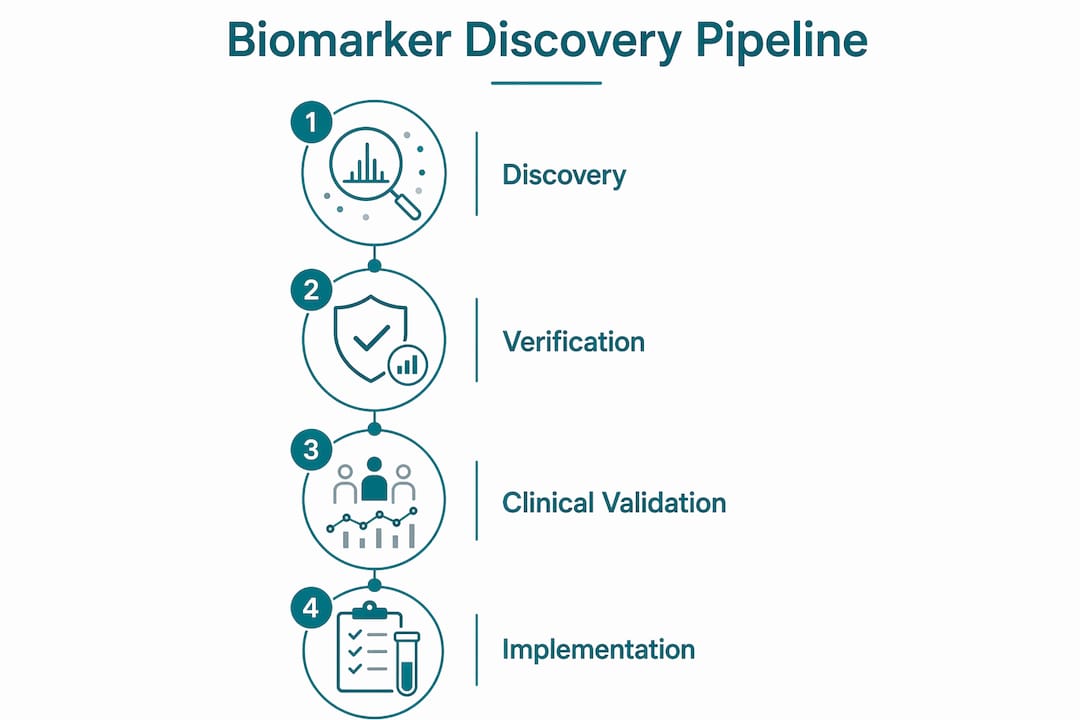
How are biomarkers discovered? the four-stage pipeline
The biomarker development process follows a defined sequence. Each stage filters candidates more aggressively, so only the most reproducible and clinically useful markers survive.
-
Discovery phase. Researchers cast a wide net using proteomics, genomics, and multi-omics platforms. High-throughput proteomic tools can measure thousands of proteins from small biological samples, generating massive datasets that reveal novel disease biology. This phase produces hundreds of candidate markers.
-
Verification phase. Targeted testing narrows the candidate list. Researchers retest the most promising markers in independent sample sets to confirm the initial signal was not a data artifact. Many candidates are eliminated here.
-
Clinical validation. Surviving candidates enter large, multi-cohort studies. This phase tests whether the marker performs consistently across diverse real-world populations, not just the controlled group where it was first identified. Validation requires statistical rigor and external datasets.
-
Clinical implementation. Validated markers are translated into tests that are affordable, reproducible, and practical in clinical settings. A marker that works in a research lab but requires equipment unavailable in most hospitals never reaches patients.
Pro Tip: When evaluating any biomarker-based health product, ask specifically whether the markers used have passed clinical validation in independent cohorts. Discovery-phase markers, while promising, are not yet reliable enough to guide personal health decisions.
The biomarker identification methods used in each stage have evolved significantly. Mass spectrometry, next-generation sequencing, and liquid biopsy platforms now allow researchers to analyze biological complexity at a resolution that was impossible a decade ago.

What makes biomarker discovery so difficult?
Most biomarker candidates fail. Successful translation requires multidisciplinary collaboration and external cohort testing, and the majority of candidates never clear that bar. The obstacles are specific and worth understanding.
-
Overfitting. Machine learning models trained on small datasets can identify patterns that exist only in that dataset. Overfitting produces false positives, and independent multi-cohort validation is the only reliable check against it. A marker that looks perfect in 50 samples may perform no better than chance in 5,000.
-
The translational gap. The largest bottleneck in biomarker research is the failure to replicate findings from controlled cohorts in diverse real-world populations. Biological variability across age, sex, ethnicity, and lifestyle creates noise that small studies cannot account for.
-
Single-marker fragility. Effective biomarker panels rely on multiple synergistic markers rather than single indicators to improve diagnostic stability. A single elevated protein level rarely tells the full story. Panels that combine lipid markers, inflammatory proteins, and metabolic indicators are far more robust.
-
Measurement feasibility. A biomarker is only useful if it can be measured reliably, affordably, and at scale. Research-grade assays that cost thousands of dollars per sample cannot drive population-level diagnostics.
-
Biological variability. Biomarker levels shift with time of day, diet, stress, and hydration. Study designs must control for these variables or risk identifying confounders rather than true disease signals.
Pro Tip: A common misconception is that biomarker discovery is a single breakthrough moment. It is actually a filtering process that takes years and requires statisticians, clinicians, and biologists working together. Treat any “newly discovered biomarker” headline with appropriate skepticism until validation data is published.
Understanding these challenges helps you evaluate biomarker data for health professionals and consumer tools with the right level of critical thinking.
Traditional vs. ai-driven biomarker identification methods
The contrast between conventional statistical approaches and modern computational methods is significant. Traditional biomarker research techniques rely on univariate statistics and standard regression models. These methods work well for simple, well-understood biological relationships but struggle with the high-dimensional complexity of genomic and proteomic datasets.
| Characteristic | Conventional Methods | AI-Driven Methods (e.g., GSCFS) |
|---|---|---|
| Dataset handling | Works best with low-dimensional data | Handles thousands of variables efficiently |
| Accuracy improvement | Baseline statistical performance | 3–20% accuracy gain over traditional methods |
| Biomarker panel size | Larger panels, more redundancy | 20–50% smaller gene subsets |
| Gene interaction modeling | Limited | Preserves gene-gene interactions |
| Speed | Slower with large datasets | Faster candidate filtering |
The Gradual Spatial Constraint Feature Selection framework, known as GSCFS, outperforms traditional techniques by 3–20% in accuracy while producing biomarker panels that are 20–50% smaller. Smaller panels mean lower testing costs and simpler clinical implementation. That is a direct path from research efficiency to patient benefit.
Machine learning accelerates discovery by filtering high-dimensional genomic data while preserving the gene-gene interactions that univariate methods miss entirely. This matters because most diseases are not caused by a single gene or protein acting in isolation. They emerge from networks of interacting biological signals.
The practical implication for personal health is real. As AI-driven biomarker research techniques become standard, the tests available to consumers will become more accurate, cover more biological systems, and require smaller blood samples. The gap between research-grade diagnostics and at-home testing is closing faster than most people realize.
How biomarker discovery shapes personal health and medical diagnostics
The applications of validated biomarkers in medicine and personal health are broad and growing. Clinical diagnostics are shifting from symptom-based assessments toward biomarker-driven diagnostics that enable earlier and more precise intervention. This shift changes what is possible for individuals who want to act before symptoms appear.
-
Earlier disease detection. Biomarkers can identify metabolic dysfunction, cardiovascular risk, and hormonal imbalance years before clinical symptoms develop. Early detection changes outcomes.
-
Personalized treatment. Predictive and pharmacodynamic biomarkers are foundational for personalized medicine, allowing clinicians to predict treatment response and monitor it in real time. A cancer patient’s tumor biomarker profile now determines which therapy they receive.
-
Treatment monitoring. Biomarkers track whether a therapy is working. Inflammatory markers, for example, fall measurably when an anti-inflammatory treatment is effective. This gives clinicians objective feedback rather than relying on patient-reported symptoms.
-
Performance and longevity optimization. Athletes and health-focused individuals use biomarker testing for performance to track recovery, hormonal balance, nutrient status, and metabolic efficiency. These are the same validated markers used in clinical research, applied to optimization rather than disease treatment.
-
Consumer health tools. Platforms like Biostarks bring validated biomarker panels directly to individuals through at-home testing. The markers analyzed, including vitamins, hormones, amino acids, lipids, and metabolic indicators, are measured using Swiss mass spectrometry, the same technology used in research-grade laboratories.
Understanding how data transforms personalized wellness through biomarkers is the practical endpoint of everything the discovery pipeline produces. The science exists to serve your health decisions, not just academic publications.
Key takeaways
Biomarker discovery is a multi-stage validation pipeline, and only markers that survive independent cohort testing are reliable enough to guide personal health decisions.
| Point | Details |
|---|---|
| Four-stage pipeline | Discovery, verification, clinical validation, and implementation each filter candidates more aggressively. |
| AI improves accuracy | Methods like GSCFS achieve 3–20% accuracy gains and reduce panel size by 20–50% over traditional approaches. |
| Validation is non-negotiable | Most candidates fail because overfitting and the translational gap prevent real-world replication. |
| Panels beat single markers | Multi-marker combinations deliver more stable and accurate diagnostics than any single biomarker alone. |
| Personal health applications | Validated biomarkers now power at-home testing for metabolic, hormonal, and nutritional optimization. |
Why biomarker science is the most underrated tool in personal health
I have spent years watching people make health decisions based on how they feel rather than what their biology actually shows. The frustrating part is not that they lack motivation. It is that they lack data. Biomarker science is the mechanism that converts biological complexity into readable, actionable numbers, and most people have no idea how rigorous the process behind those numbers actually is.
What strikes me most about the current state of biomarker research is the speed of convergence between research-grade methods and consumer tools. Five years ago, the kind of metabolic and proteomic profiling now available through at-home platforms required a hospital referral and weeks of waiting. That gap has closed because the validation pipeline has matured and the technology costs have dropped.
The shift I find most significant is the move away from single-marker diagnostics. Clinicians and researchers have learned, often through expensive failures, that biology does not reduce to one number. A comprehensive panel that captures lipid metabolism, inflammatory status, hormonal balance, and micronutrient levels tells a story that no single marker can. That is the direction the field is moving, and it is the right one.
My honest advice: do not wait for symptoms. The entire point of biomarker-driven health is that the signal appears long before the problem becomes obvious. Use the tools that validated science has made available, interpret the results with qualified guidance, and treat your biology as the data source it actually is.
— Romain
Discover your biomarker profile with Biostarks
Understanding the science behind biomarker discovery is the first step. Knowing your own numbers is where it becomes personal.

Biostarks, an AMR Labs SA company, applies the same validated biomarker science described in this article to at-home testing panels that measure vitamins, hormones, amino acids, lipids, minerals, and metabolic markers using Swiss mass spectrometry. The results are not raw data. They are interpreted reports designed to show you exactly where your biology stands and what to do about it. Whether you are focused on longevity, metabolic health, or athletic performance, explore Biostarks’ testing panels to see which biomarker profile fits your goals.
FAQ
What is biomarker discovery in simple terms?
Biomarker discovery is the scientific process of identifying and validating biological indicators that objectively measure health, disease, or treatment response. It spans from large-scale screening to multi-cohort clinical validation before any marker is used in medicine.
How long does the biomarker discovery process take?
The full pipeline from initial discovery to clinical implementation typically takes many years. Each stage, from verification to large-cohort validation, requires independent testing to confirm that results replicate across diverse populations.
Why do most biomarker candidates fail?
Most candidates fail due to overfitting in small datasets and the translational gap, where findings in controlled cohorts do not replicate in real-world populations. Rigorous external validation is the only reliable filter.
What role does machine learning play in biomarker research?
Machine learning frameworks like GSCFS filter high-dimensional genomic and proteomic data more efficiently than conventional statistics, improving accuracy by 3–20% while reducing biomarker panel size by 20–50%.
How do validated biomarkers apply to personal health optimization?
Validated biomarkers power at-home testing panels that track metabolic function, hormonal balance, nutrient status, and inflammatory markers, giving individuals objective data to guide health decisions before symptoms appear.
This content is for educational purposes only and does not constitute medical advice. Always consult with a healthcare professional before making changes to your health regimen.


