

For many European professionals and athletes committed to peak wellness, old-school health screenings can feel limiting when every detail counts. Understanding your metabolic health demands a closer look at precise indicators known as biomarkers. Advanced lab testing uncovers these measurable biological signals, delivering scientifically validated insights far beyond routine checkups. Discover how leveraging personalized biomarker analysis can guide smarter decisions for performance and long-term health.
Table of Contents
- Defining Advanced Lab Testing And Biomarkers
- Types Of Biomarkers Analyzed In Lab Testing
- Swiss Mass Spectrometry Techniques Explained
- Real-World Health Applications For Individuals
- Comparing Advanced Testing To Traditional Methods
- Risks, Costs, And Data Interpretation Challenges
Key Takeaways
| Point | Details |
|---|---|
| Advanced Lab Testing Enhances Health Insights | Advanced lab testing provides deeper understanding of health through molecular-level analysis of biomarkers, surpassing traditional diagnostic methods. |
| Diverse Biomarker Categories Offer Comprehensive Analysis | Lab testing analyzes various biomarkers, including exposure, response, susceptibility, molecular, and protein markers, for more tailored healthcare strategies. |
| Mass Spectrometry Techniques Improve Molecular Detection | Advanced mass spectrometry allows precise identification and quantification of molecular structures across various scientific disciplines. |
| Proactive Health Management Through Personalized Strategies | Advanced testing enables early disease detection and personalized health interventions, empowering individuals in managing their wellness. |
Defining Advanced Lab Testing and Biomarkers
Advanced lab testing represents a sophisticated approach to understanding human health through precise, molecular-level analysis of biomarkers. These biomarkers are scientifically validated indicators that provide critical insights into an individual’s physiological processes, disease risks, and potential therapeutic responses. Biomarker measurement technologies enable healthcare professionals to move beyond traditional diagnostic methods by examining specific molecular characteristics.
The FDA and National Institutes of Health define biomarkers as objectively measured characteristics that reflect normal biological processes, pathogenic conditions, or responses to medical interventions. These indicators encompass a wide range of biological features, including:
- Molecular markers from genetic sequences
- Protein and enzyme levels in blood
- Metabolic pathway indicators
- Radiographic and physiologic measurements
- Histologic tissue characteristics
Modern advanced lab testing goes beyond simple blood work by utilizing cutting-edge technologies like genomics, proteomics, and metabolomics. These sophisticated analytical techniques allow for comprehensive health assessment that can detect potential health issues before they become symptomatic. By analyzing intricate biological data points, these tests provide a deeper understanding of an individual’s unique physiological landscape.
Pro tip: Consult with healthcare professionals who specialize in precision medicine to interpret advanced biomarker test results accurately and develop personalized health optimization strategies.
This content is for educational purposes only and does not constitute medical advice. Always consult with a healthcare professional before making changes to your health regimen.
Types of Biomarkers Analyzed in Lab Testing
Advanced lab testing encompasses a diverse range of biomarker categories that provide comprehensive insights into human health. Biomarker testing techniques analyze multiple biological indicators across different molecular and cellular levels, enabling healthcare professionals to develop precise diagnostic and preventive strategies.
Laboratory analysis typically focuses on several key biomarker types:
- Exposure Markers: Quantify chemical levels within the body
- Response Markers: Indicate biological changes from environmental interactions
- Susceptibility Markers: Reveal genetic variations affecting disease risk
- Molecular Markers: Assess genetic sequences and expressions
- Protein Biomarkers: Measure specific protein levels and interactions
Modern diagnostic technologies like DNA sequencing, fluorescence in situ hybridization (FISH), and immunohistochemistry (IHC) enable sophisticated biomarker analysis. These methods allow researchers to detect minute molecular changes that traditional testing might miss. By examining biomarkers across blood, urine, tissues, and cellular components, healthcare professionals can develop targeted interventions that address individual physiological variations.
Different medical disciplines utilize biomarker testing uniquely, with oncology, cardiovascular research, and personalized medicine leading innovative approaches. The ability to analyze complex biological indicators transforms how medical professionals understand, predict, and manage health conditions.
Here’s a summary of how advanced lab testing benefits different medical fields:
| Medical Field | Main Application | Example Biomarkers |
|---|---|---|
| Oncology | Early cancer detection and treatment | Genetic mutations, proteins |
| Cardiovascular Research | Risk prediction and prevention | Cholesterol, enzymes |
| Personalized Medicine | Tailoring therapies to individual needs | Metabolic markers, genes |
| Endocrinology | Hormone balance monitoring | Hormonal levels |
These fields use advanced testing to uncover precise health information.
Pro tip: Request a comprehensive breakdown of your biomarker test results and discuss potential lifestyle or medical interventions with a healthcare professional specializing in precision medicine.
This content is for educational purposes only and does not constitute medical advice. Always consult with a healthcare professional before making changes to your health regimen.
Swiss Mass Spectrometry Techniques Explained
Mass spectrometry represents a cutting-edge analytical technique that enables unprecedented molecular analysis in scientific research. Advanced mass spectrometry methods/Instrumentation_and_Analysis/Mass_Spectrometry) provide researchers with powerful tools to precisely identify and quantify complex molecular structures with exceptional accuracy.
The core components of mass spectrometry involve three fundamental stages:
- Ionization: Converting sample molecules into charged particles
- Mass Analysis: Separating ions based on mass-to-charge ratios
- Detection: Measuring and recording ion signals
Swiss mass spectrometry techniques leverage sophisticated instrumentation to achieve remarkable precision. These advanced methods operate under carefully controlled vacuum conditions, allowing for extremely sensitive molecular detection. By utilizing state-of-the-art ion sources, specialized mass analyzers, and high-resolution detectors, researchers can examine molecular structures with unprecedented detail.

Modern applications of mass spectrometry span multiple scientific disciplines, including medical research, pharmaceutical development, environmental monitoring, and forensic analysis. The technique’s ability to provide detailed molecular insights makes it an invaluable tool for understanding complex biological systems and identifying minute chemical variations.
Pro tip: Request detailed explanations from laboratory technicians about the specific mass spectrometry techniques used in your diagnostic testing to better understand the molecular analysis process.
This content is for educational purposes only and does not constitute medical advice. Always consult with a healthcare professional before making changes to your health regimen.
Real-World Health Applications for Individuals
Advanced lab testing offers transformative real-world health applications that empower individuals to take proactive control of their wellness journey. Real-world evidence generation provides critical insights into personalized health management strategies, enabling more precise and targeted interventions.
Key real-world health applications include:
- Disease Prevention: Early detection of potential health risks
- Personalized Nutrition: Identifying specific metabolic needs
- Performance Optimization: Understanding individual physiological capabilities
- Chronic Condition Management: Tracking biological markers over time
- Genetic Risk Assessment: Evaluating inherited health predispositions
Modern lab testing technologies transcend traditional diagnostic approaches by offering comprehensive molecular insights. These advanced techniques allow individuals to understand their unique biological landscape, moving beyond generic health recommendations to tailored, data-driven strategies. By analyzing detailed biomarkers, people can make informed decisions about lifestyle modifications, nutritional interventions, and preventive healthcare.
Healthcare professionals increasingly leverage these sophisticated testing methods to develop more nuanced, personalized treatment plans. From athletes seeking peak performance to individuals managing chronic conditions, advanced lab testing provides unprecedented visibility into individual health dynamics, enabling more proactive and precise health management approaches.
Pro tip: Schedule an annual comprehensive biomarker assessment to track your health trends and discuss potential preventive strategies with your healthcare provider.
This content is for educational purposes only and does not constitute medical advice. Always consult with a healthcare professional before making changes to your health regimen.
Comparing Advanced Testing to Traditional Methods
Advanced laboratory testing represents a significant leap forward from traditional diagnostic approaches, offering unprecedented precision and depth of molecular insights. Laboratory testing standards demonstrate how modern techniques provide superior sensitivity, specificity, and reproducibility compared to conventional methods.
Key differences between advanced and traditional testing methods include:
- Sensitivity: Advanced methods detect minute molecular changes
- Speed: Faster turnaround times for critical results
- Comprehensiveness: Multidimensional analysis beyond single-marker approaches
- Precision: Higher accuracy and reduced measurement variability
- Personalization: Tailored insights into individual biological processes
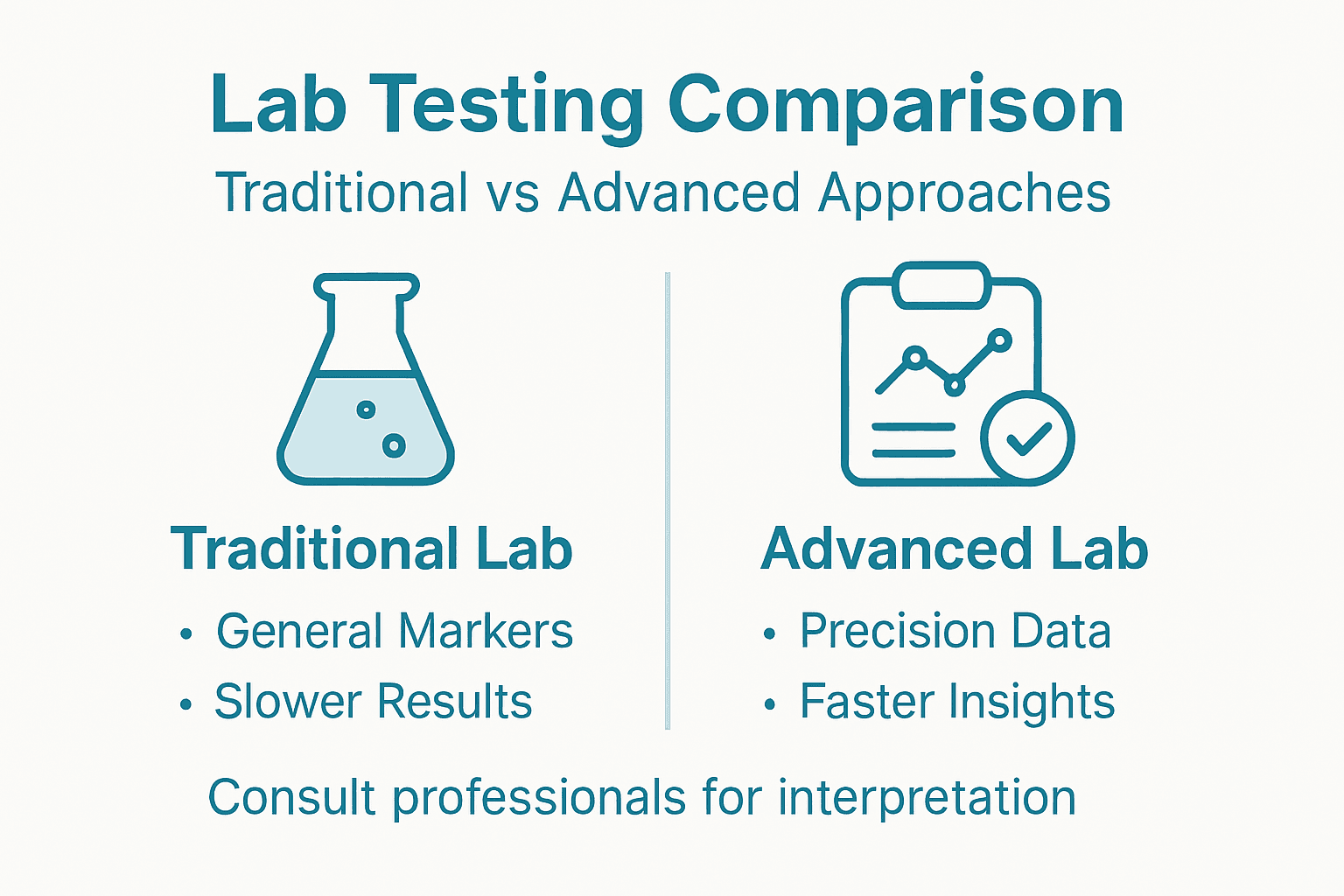
Traditional laboratory testing often relied on broad, generalized markers that provided limited insights. In contrast, advanced testing technologies enable a molecular-level understanding of an individual’s health, capturing nuanced biological variations that previously went undetected. These sophisticated techniques allow healthcare professionals to move beyond reactive healthcare toward proactive, preventative strategies.
Below is a comparison of advanced and traditional lab testing:
| Characteristic | Traditional Testing | Advanced Testing |
|---|---|---|
| Data Depth | Broad, basic markers | Molecular-level insight |
| Diagnostic Speed | Slower results | Rapid turnaround |
| Personalization | Generalized approach | Individual-specific |
| Accuracy | Moderate | Very high |
| Cost | Lower | Higher |
This comparison highlights advanced testing’s superior detail and speed.
Statistical method comparison studies rigorously evaluate the performance of advanced testing techniques, ensuring they meet stringent scientific and clinical standards. By employing advanced statistical analyses, researchers can confidently validate the reliability and effectiveness of new diagnostic approaches, ultimately improving patient care and medical understanding.
Pro tip: Request a comprehensive explanation of your lab test methodology to understand the depth and precision of the diagnostic approach.
This content is for educational purposes only and does not constitute medical advice. Always consult with a healthcare professional before making changes to your health regimen.
Risks, Costs, and Data Interpretation Challenges
Advanced laboratory testing introduces complex considerations beyond traditional diagnostic approaches, requiring comprehensive risk management and careful financial planning. Laboratory risk assessment strategies help organizations navigate the multifaceted challenges associated with sophisticated molecular testing technologies.
Key risks and challenges include:
- Technical Risks: Equipment malfunction and calibration errors
- Financial Challenges: High technology and expertise costs
- Interpretative Complexities: Potential false positives/negatives
- Data Management: Handling large, intricate molecular datasets
- Safety Considerations: Managing biohazards and chemical exposures
The financial landscape of advanced testing extends beyond direct testing expenses. Sophisticated technologies require specialized personnel, continuous training, and robust quality assurance protocols. Healthcare organizations must invest not just in equipment, but in comprehensive expertise that can accurately interpret complex molecular data and translate scientific insights into meaningful clinical recommendations.
Data interpretation represents perhaps the most nuanced challenge in advanced laboratory testing. Molecular-level analysis demands profound scientific understanding, with results requiring contextual interpretation that considers individual biological variations, potential interfering factors, and broader health contexts. Professionals must navigate intricate reference intervals and understand the subtle differences between statistically significant variations and clinically meaningful findings.
Pro tip: Consult with healthcare professionals who specialize in molecular diagnostics to ensure comprehensive understanding of your advanced laboratory test results.
This content is for educational purposes only and does not constitute medical advice. Always consult with a healthcare professional before making changes to your health regimen.
Unlock Your Health Potential with Advanced Biomarker Testing
The article highlights the challenge of translating complex, molecular-level biomarker insights into clear, personalized health strategies. Many individuals struggle to understand their unique physiological landscape and need precise, actionable data to optimize wellness, performance, and longevity. By leveraging cutting-edge Swiss mass spectrometry and comprehensive biomarker panels, you can overcome these barriers and gain clarity on vitamins, hormones, metabolic markers, and more.
Discover how Biostarks provides a seamless solution for this need through its at-home testing collections designed for personalized health optimization. Whether you are aiming for metabolic balance, improved performance, or deeper health insights, our Professional Collection and Public Collection empower you with scientifically rigorous, data-driven results.

Take control of your health today by visiting Biostarks and order your advanced biomarker test. Get personalized, high-resolution insights delivered to your doorstep and unlock the power of precision medicine for true wellness transformation.
Frequently Asked Questions
What are biomarkers in advanced lab testing?
Biomarkers are scientifically validated indicators that provide insights into physiological processes, disease risks, and therapeutic responses. They include molecular markers, protein levels, and metabolic indicators analyzed through advanced testing techniques.
How does advanced lab testing differ from traditional diagnostic methods?
Advanced lab testing offers more sensitivity, speed, and comprehensiveness compared to traditional methods. It provides molecular-level insights and personalized information, allowing for proactive health management rather than reactive care.
What types of biomarkers are commonly analyzed in advanced lab testing?
Commonly analyzed biomarkers include exposure markers, response markers, susceptibility markers, molecular markers, and protein biomarkers. These provide critical information about health risks and individual biology.
What are the real-world applications of advanced lab testing?
Real-world applications include disease prevention through early detection, personalized nutrition based on metabolic needs, chronic condition management, and genetic risk assessment, empowering individuals to make informed health decisions.
Recommended
- 7 Key Advantages of Metabolic Testing for Wel… | Biostarks
- 7 Key Biomarker Testing Benefits for Athletes… | Biostarks
- Why Track Metabolic Health: Unlocking Persona… | Biostarks
- Why Use Biomarker Insights for Health Optimiz… | Biostarks
- Telehealth in Mental Health: Expanding Access in California - ReviveHealthTherapy


