

Choosing the best path to lasting wellness often starts with the right information. Many North American adults are discovering how biomarkers can reveal unique clues about their health, from disease risk to how their bodies respond to lifestyle changes. This article clears up common misconceptions and explains how biomarkers give personalized feedback for those seeking better performance and longevity through at-home testing.
Table of Contents
- Biomarkers Defined And Common Misconceptions
- Types Of Biomarkers And Key Distinctions
- Precision Testing Techniques And Swiss Innovation
- Clinical Applications For Personalized Health
- Risks, Limitations, And Cost Implications
Key Takeaways
| Point | Details |
|---|---|
| Understanding Biomarkers | Biomarkers serve as crucial indicators of health, aiding in disease diagnosis, prognosis, and treatment prediction. |
| Types of Biomarkers | Classification includes diagnostic, prognostic, predictive, susceptibility, monitoring, and pharmacodynamic biomarkers, each with specific applications. |
| Precision Testing Enhancement | Advanced technologies and AI are revolutionizing biomarker analysis, enabling personalized health strategies and enhanced predictive accuracy. |
| Risks and Limitations | While promising, biomarker testing has potential drawbacks, including false results and economic barriers, necessitating careful consideration in clinical settings. |
Biomarkers Defined and Common Misconceptions
Biomarkers are sophisticated molecular indicators that reveal critical insights about our body’s biological processes, health status, and potential disease progression. These measurable characteristics act as crucial signposts, providing a window into our internal physiological landscape through precise scientific analysis.
Fundamentally, biomarkers represent objectively measurable characteristics that offer profound health information. They can be classified into several key categories:
- Diagnostic biomarkers: Indicating the presence of a specific disease
- Prognostic biomarkers: Revealing potential disease progression
- Predictive biomarkers: Suggesting likely treatment responses
- Screening biomarkers: Identifying early disease risk
Contrary to popular misconceptions, biomarkers represent complex biological indicators that require rigorous scientific validation. Many individuals mistakenly believe that a single biomarker can definitively diagnose a condition, when in reality, comprehensive health assessment demands intricate, multi-dimensional analysis.
The scientific community recognizes that biomarker interpretation demands nuanced understanding. Challenges include standardizing measurement techniques, ensuring reproducibility, and accounting for individual genetic variations. Not all biomarkers are created equal - their predictive power depends on robust research, population-specific validation, and sophisticated analytical methods.
Biomarkers are not magical predictors, but sophisticated scientific tools that provide probabilistic insights into human health.
Validation stages are critical in determining a biomarker’s clinical utility. Researchers must demonstrate:
- Analytical validity (accurate measurement)
- Clinical validity (meaningful correlation with health outcomes)
- Clinical utility (actionable insights for patient care)
Pro tip: Always consult healthcare professionals when interpreting biomarker results, as context and individual variation play significant roles in accurate health assessment.
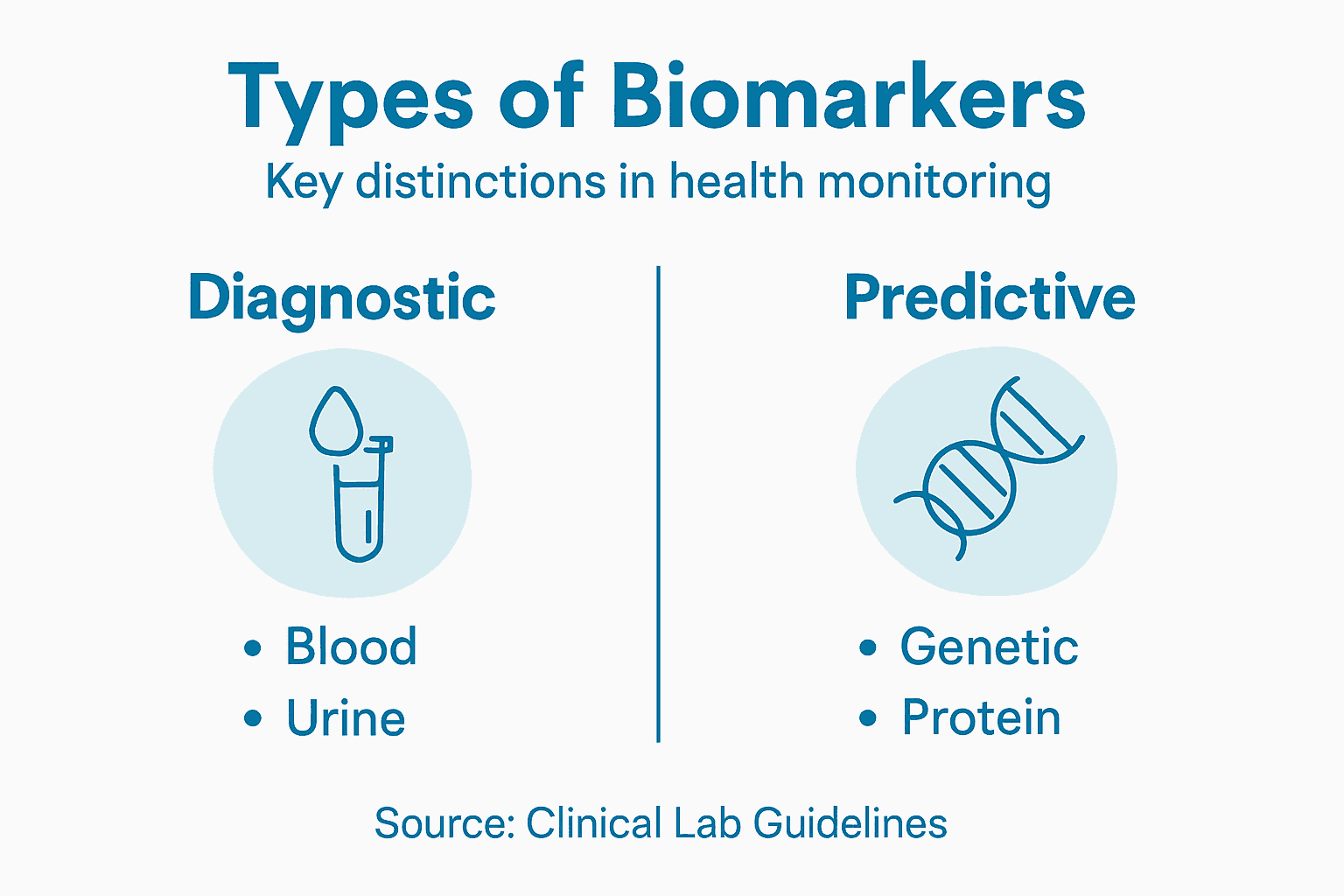
Types of Biomarkers and Key Distinctions
Biomarkers represent a sophisticated spectrum of molecular indicators, each serving unique functions in understanding human health. Molecular and biochemical changes reveal distinct biomarker categories that provide critical insights into disease progression, treatment responses, and individual health risks.
The primary types of biomarkers can be comprehensively classified into several key categories:
- Diagnostic biomarkers: Confirm the presence of specific diseases
- Prognostic biomarkers: Predict potential disease outcomes
- Predictive biomarkers: Indicate likely treatment responses
- Susceptibility biomarkers: Assess individual disease risk
- Monitoring biomarkers: Track disease progression or treatment effectiveness
- Pharmacodynamic biomarkers: Evaluate drug interactions and responses
Each biomarker type offers a unique lens into human health, with nuanced applications that extend far beyond simple medical diagnostics. Molecular profiling enables researchers to decode complex biological signals, transforming how we understand individual health trajectories.
The scientific community recognizes that biomarker interpretation requires sophisticated analytical approaches. Different biomarkers serve specific purposes - from early disease detection to monitoring treatment efficacy. Some focus on genetic predispositions, while others track metabolic changes or protein expressions.
Not all biomarkers are created equal - their value lies in precise, context-specific interpretation.
Key distinctions between biomarker types include:
Here’s a comparison of key biomarker categories and their analytical focus:
| Biomarker Type | Primary Purpose | Typical Molecular Target | Clinical Impact |
|---|---|---|---|
| Diagnostic | Detect presence of disease | Proteins, DNA mutations | Early disease identification |
| Prognostic | Forecast disease outcomes | Gene expression profiles | Guides risk stratification |
| Predictive | Estimate response to treatment | Genetic variants, receptors | Informs therapy selection |
| Monitoring | Track progression or effectiveness | Metabolites, protein levels | Adjusts ongoing management |
| Susceptibility | Assess risk of developing disease | Polymorphisms | Enables preventive strategies |
| Pharmacodynamic | Measure drug response | Enzyme activity, biomarkers | Evaluates medication safety |
- Timing of assessment
- Specific health insights provided
- Complexity of molecular analysis
- Potential for personalized interventions
Pro tip: Consult healthcare professionals who can help you understand the nuanced implications of your specific biomarker results, as interpretation requires expert context and comprehensive health understanding.
Precision Testing Techniques and Swiss Innovation
Advanced precision testing technologies are revolutionizing our understanding of human health through cutting-edge molecular analysis. Swiss research institutions stand at the forefront of biomedical innovation, developing sophisticated techniques that transform how we interpret complex biological data.
The core of precision testing encompasses several groundbreaking methodologies:
- High-throughput genomic sequencing: Rapidly analyzing entire genetic landscapes
- Proteomics: Mapping intricate protein interactions and expressions
- Metabolomics: Tracking comprehensive metabolic network changes
- Multi-omics integration: Combining diverse molecular datasets for holistic insights
Artificial intelligence plays a critical role in processing these complex datasets, enabling researchers to uncover subtle patterns that traditional analysis might overlook. Swiss scientists have developed advanced algorithms that can simultaneously analyze multiple biological markers, providing unprecedented depth of health understanding.
The technological sophistication of precision testing extends beyond simple measurement. These techniques allow for personalized health mapping that can predict potential health risks, optimize treatment strategies, and provide insights into individual metabolic functioning with remarkable accuracy.
Swiss innovation transforms raw biological data into actionable health intelligence.
Key technological advancements in precision testing include:
- Ultra-sensitive molecular detection methods
- Machine learning-enhanced data interpretation
- Real-time biomarker tracking
- Comprehensive multi-system health assessments
Pro tip: Seek healthcare providers who leverage advanced precision testing technologies to gain the most comprehensive understanding of your personal health profile.

Clinical Applications for Personalized Health
Personalized health represents a transformative approach to medical care, where biomarkers provide disease prevention insights through precise, individualized diagnostic strategies. Modern healthcare increasingly recognizes that each patient’s biological profile is unique, demanding customized assessment and intervention approaches.
Clinical applications of personalized health leverage biomarker analysis across multiple critical domains:
- Preventive Healthcare: Early detection of potential health risks
- Treatment Optimization: Tailoring interventions to individual genetic profiles
- Chronic Disease Management: Monitoring and predicting disease progression
- Metabolic Health: Understanding individual metabolic functioning
- Performance Enhancement: Identifying physiological strengths and limitations
Precision medicine transforms traditional healthcare by moving beyond generalized treatment protocols. Instead of applying standardized approaches, clinicians can now develop targeted strategies that account for an individual’s specific genetic, metabolic, and physiological characteristics.
Through comprehensive biomarker analysis, healthcare professionals can create nuanced health profiles that enable proactive and predictive medical interventions. These insights allow for early detection of potential health risks, personalized lifestyle recommendations, and more effective treatment strategies tailored to an individual’s unique biological makeup.
Personalized health is not about predicting the future, but empowering individuals to shape their health trajectory.
Key clinical applications encompass:
- Genetic risk assessment
- Targeted pharmaceutical interventions
- Nutritional and lifestyle optimization
- Comprehensive health monitoring
Pro tip: Request a comprehensive biomarker analysis from healthcare providers to gain deep insights into your personal health potential and develop targeted wellness strategies.
Risks, Limitations, and Cost Implications
Biomarker testing involves complex technical and ethical challenges that extend far beyond simple medical diagnostics. While promising, these advanced technologies are not without significant potential drawbacks that patients and healthcare providers must carefully consider.
Key risks and limitations in biomarker testing include:
- False Positive/Negative Results: Potential for misleading health interpretations
- Technical Variability: Inconsistent measurement across different testing platforms
- Population Heterogeneity: Challenges in developing universally applicable markers
- Data Privacy Concerns: Potential misuse of sensitive genetic information
- Interpretation Complexity: Requires sophisticated medical expertise
Diagnostic uncertainty remains a critical concern in biomarker testing. Not all molecular indicators translate directly into definitive health predictions, and overreliance on single biomarkers can lead to premature or incorrect medical interventions.
Economic barriers represent another significant challenge in widespread biomarker adoption. Advanced testing technologies often come with substantial costs, potentially creating healthcare accessibility disparities. High-resolution molecular analysis requires expensive infrastructure, sophisticated equipment, and specialized professional expertise.
The promise of personalized medicine must be balanced against practical implementation challenges.
Specific cost and implementation challenges include:
To clarify practical implications, here’s a summary of biomarker-related risks and their potential impact on patients:
| Risk Area | Challenge Description | Impact on Patient Care |
|---|---|---|
| Technical Variation | Inconsistent results | Reduces reliability of diagnosis |
| Interpretation Complexity | Requires expert analysis | May cause misunderstanding |
| Economic Accessibility | High test costs | Limits broad access |
| Data Privacy | Sensitive genetic info | Risks unauthorized disclosure |
| Diagnostic Uncertainty | Ambiguous findings | Delays optimal intervention |
- High initial testing expenses
- Complex interpretation requirements
- Limited insurance coverage
- Ongoing maintenance of advanced diagnostic technologies
Pro tip: Always discuss potential biomarker test limitations with healthcare professionals and understand the broader context of your specific health assessment.
Unlock Your Health Potential with Precision Biomarker Insights
Understanding the complex role of biomarkers in health optimization is essential for those seeking to take control of their wellness journey. The article highlights common challenges such as interpreting multifaceted biomarker data and the need for personalized, precise analysis to guide effective health decisions. If you are striving to decode your unique biological signals and achieve optimized performance, longevity, and metabolic health, you will appreciate the advanced solutions offered by Biostarks. Our platform uses Swiss mass spectrometry for high-resolution testing of vitamins, hormones, amino acids, and more — delivering clarity and actionable insights directly to you.
By choosing Biostarks | Collection, you gain access to sophisticated yet user-friendly at-home biomarker testing that bridges scientific rigor with practical wellness management. Whether you are a health-conscious individual, an athlete, or focused on longevity, our precision testing empowers you with detailed metabolic maps tailored to your needs.
Take control of your health with data you can trust now. Visit Biostarks and explore how advanced biomarker analysis can transform your personalized health strategy. Start your journey today with Biostarks | Collection and experience the future of health optimization.
Frequently Asked Questions
What are biomarkers and how do they play a role in health optimization?
Biomarkers are measurable characteristics that provide insights into biological processes and health status. They help in early disease detection, predicting treatment responses, and tracking disease progression, thereby optimizing health management and interventions.
How can I use biomarkers to improve my health?
You can use biomarkers for preventive healthcare by undergoing tests that identify potential health risks, personalizing treatment plans to your genetic profile, and optimizing lifestyle choices based on individual metabolic responses and health monitoring.
Are there risks associated with biomarker testing?
Yes, biomarker testing carries risks such as false positive or negative results, technical variability across testing platforms, and the complexity of interpretation which requires expert analysis, potentially leading to diagnostic uncertainties.
What should I discuss with my healthcare provider regarding biomarker tests?
It’s essential to discuss the potential limitations of biomarker tests, their relevance to your health situation, and the associated costs. Understanding how to interpret the results and the implications for your health management is also crucial.
Recommended
- 7 Essential Types of Biomarkers for Personal … | Biostarks
- Why Use Biomarker Insights for Health Optimiz… | Biostarks
- 7 Key Biomarker Testing Benefits for Athletes… | Biostarks
- Biomarker Interpretation for Personalized Hea… | Biostarks
- Health Benefits of Air and Water Purification at Home - Coway Water Purifier


