

Unlocking peak performance and longevity often begins with understanding the signals inside your body. Biomarker analysis empowers you to measure real biological processes and capture early signs of potential health risks, helping you personalize every wellness strategy. By leveraging at-home testing, you gain privacy and actionable data from molecular markers that reflect your unique physiology. Discover how interpreting biomarker results opens a path to precision health optimization tailored for your goals.
Table of Contents
- Biomarker Analysis Defined And Explained
- Types Of Biomarkers And What They Reveal
- How At-Home Testing Works Safely
- Real-World Benefits Of Biomarker Tracking
- Risks, Limits, And Misconceptions Revealed
- Comparing Biomarker Analysis To Alternatives
Key Takeaways
| Point | Details |
|---|---|
| Understanding Biomarkers | Biomarkers are measurable indicators that reveal important information about health and disease risks, playing a vital role in personalized healthcare. |
| Diverse Biomarker Types | There are various biomarker categories, including diagnostic and prognostic types, that each serve distinct medical purposes in improving patient outcomes. |
| At-Home Testing Benefits | At-home testing offers an accessible way to monitor personal health, enabling individuals to understand their biological markers while ensuring sample integrity and data protection. |
| Limitations and Misconceptions | Despite their benefits, biomarkers can have limitations, and results should be interpreted in context, highlighting the importance of professional guidance for accurate assessments. |
Biomarker Analysis Defined and Explained
Biomarkers are objectively measured characteristics that provide critical insights into an individual’s health status, biological processes, and potential disease risks. Measurable biological indicators represent a powerful tool in modern healthcare for understanding complex physiological dynamics.
At its core, biomarker analysis involves detecting and interpreting specific molecular, genetic, or cellular indicators that reveal essential information about normal bodily functions, pathogenic processes, and potential therapeutic responses. These indicators can range from proteins and hormones to genetic mutations and metabolic byproducts.
Key characteristics of biomarker analysis include:
- Objective measurement of biological processes
- Identification of potential health risks
- Tracking disease progression
- Monitoring treatment effectiveness
- Enabling personalized healthcare strategies
Biomarker categories are diverse and serve multiple clinical applications:
- Risk assessment biomarkers
- Screening indicators
- Diagnostic markers
- Staging signals
- Treatment response indicators
Precision and technology play crucial roles in biomarker analysis. Advanced omics technologies enable researchers to detect intricate molecular changes with unprecedented accuracy, transforming how healthcare professionals understand individual health profiles.
Pro tip: Consult healthcare professionals to interpret your biomarker results comprehensively and develop personalized health strategies based on your unique molecular profile.
This content is for educational purposes only and does not constitute medical advice. Always consult with a healthcare professional before making changes to your health regimen.
Types of Biomarkers and What They Reveal
Biomarkers represent a sophisticated spectrum of biological indicators that provide nuanced insights into human health. Molecular and physiological characteristics play a crucial role in understanding individual health profiles, disease progression, and potential treatment responses.
The landscape of biomarker types is diverse, encompassing seven primary categories that serve distinct medical purposes:
- Susceptibility/Risk Biomarkers: Identify potential predispositions to specific health conditions
- Diagnostic Biomarkers: Detect the presence of a particular disease or medical condition
- Monitoring Biomarkers: Track disease progression or treatment effectiveness
- Prognostic Biomarkers: Predict potential disease outcomes
- Predictive Biomarkers: Indicate likelihood of responding to specific treatments
- Pharmacodynamic Biomarkers: Measure the body’s response to therapeutic interventions
- Safety Biomarkers: Assess potential risks or side effects of medical treatments
Precision medicine leverages these biomarker categories to develop targeted healthcare strategies. Comprehensive health assessment tools enable healthcare professionals to analyze genetic, environmental, and physiological factors that influence an individual’s health trajectory.

Understanding the nuanced roles of different biomarker types allows for more personalized and proactive healthcare approaches. These molecular indicators provide a window into complex biological processes, helping individuals and medical professionals make informed decisions about prevention, diagnosis, and treatment.
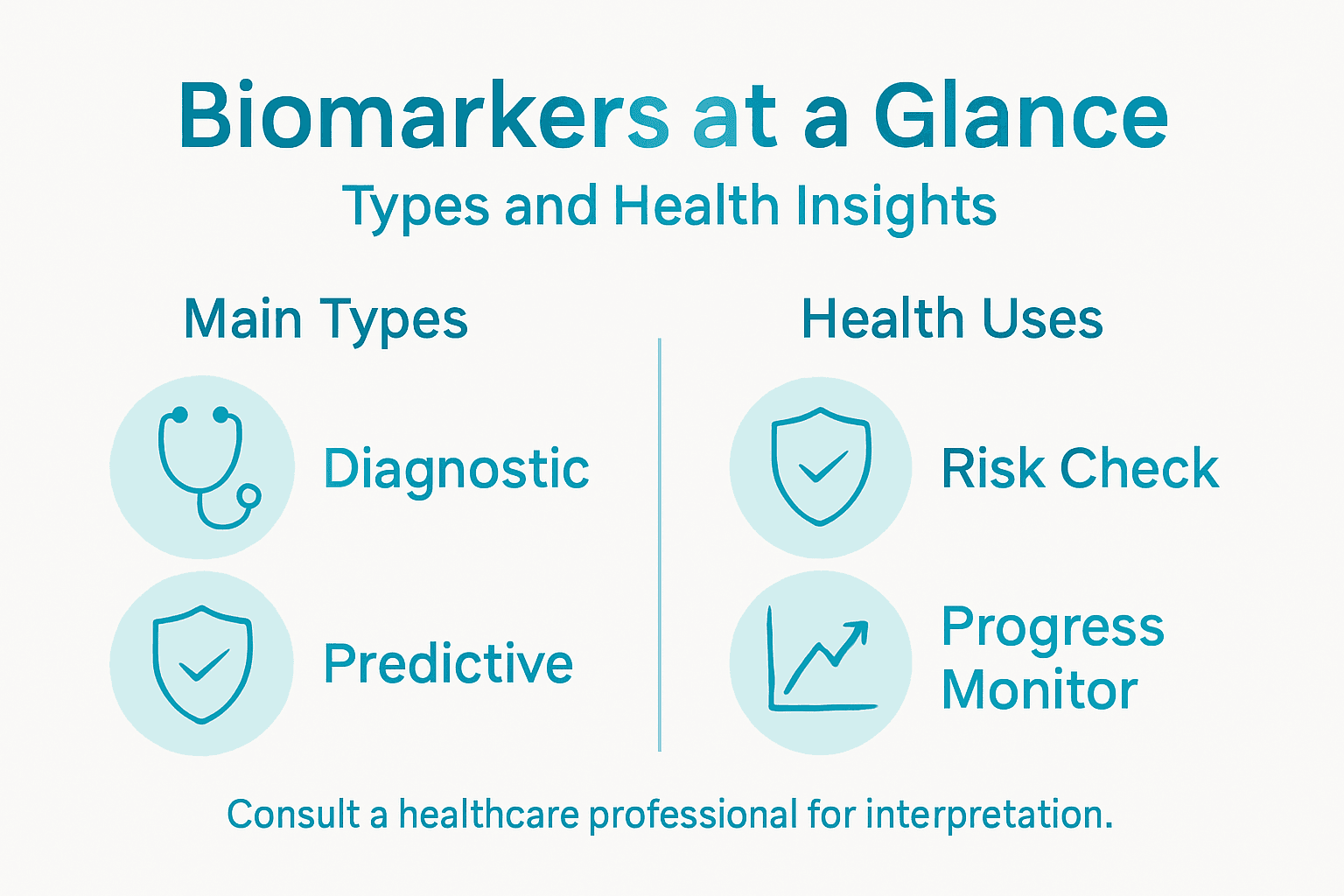
Pro tip: Consult with healthcare professionals who can help you interpret specific biomarker results and develop personalized health strategies tailored to your unique molecular profile.
This content is for educational purposes only and does not constitute medical advice. Always consult with a healthcare professional before making changes to your health regimen.
How At-Home Testing Works Safely
At-home testing represents a revolutionary approach to personal health monitoring, enabling individuals to gain critical insights without extensive medical infrastructure. At-home health testing methods provide a convenient and accessible pathway to understanding individual biological markers with precision and confidentiality.
The process of safe at-home testing involves several critical components:
- Sample Collection: Precise, standardized methods for collecting biological samples
- Packaging: Sterile, secure packaging that maintains sample integrity
- Transportation: Temperature-controlled shipping to preserve sample quality
- Laboratory Analysis: Advanced scientific techniques for accurate results
- Data Protection: Strict confidentiality protocols for personal health information
Key safety considerations in at-home testing include:
- Using FDA-approved or clinically validated testing kits
- Following exact instructions for sample collection
- Understanding potential limitations of home testing
- Consulting healthcare professionals for comprehensive interpretation
- Maintaining proper storage and handling of testing materials
Technological innovations have transformed at-home testing, making complex health assessments more accessible. Wellness testing processes now leverage advanced mass spectrometry and molecular analysis techniques that provide unprecedented accuracy and detail.
At-home testing bridges the gap between personal health curiosity and professional medical insights, offering a proactive approach to wellness management.
Pro tip: Always read and follow testing kit instructions meticulously, and store your testing materials in a cool, dry place away from direct sunlight to maintain sample integrity.
This content is for educational purposes only and does not constitute medical advice. Always consult with a healthcare professional before making changes to your health regimen.
Real-World Benefits of Biomarker Tracking
Biomarker tracking represents a transformative approach to understanding individual health, moving beyond traditional reactive healthcare models. Early disease detection strategies enable proactive interventions that can significantly improve long-term health outcomes and quality of life.
Key real-world benefits of comprehensive biomarker tracking include:
- Personalized Prevention: Identifying potential health risks before symptoms emerge
- Targeted Treatment: Developing precise therapeutic strategies based on individual molecular profiles
- Performance Optimization: Understanding metabolic and physiological baseline conditions
- Chronic Disease Management: Monitoring subtle biological changes over time
- Lifestyle Intervention Guidance: Creating data-driven health optimization strategies
The practical applications of biomarker tracking are extensive:
- Detecting early signs of metabolic disorders
- Assessing cardiovascular disease risks
- Monitoring inflammatory responses
- Evaluating hormonal balance
- Tracking nutritional deficiencies
Precision medicine continues to evolve, with biomarker insights revolutionizing how healthcare professionals approach individual wellness. By providing granular data about internal biological processes, biomarker tracking empowers individuals to make informed decisions about their health.
Biomarker tracking transforms healthcare from a reactive model to a proactive, personalized approach, giving individuals unprecedented insights into their biological landscape.
Pro tip: Maintain a consistent tracking schedule and work with healthcare professionals to develop a comprehensive interpretation strategy for your biomarker results.
This content is for educational purposes only and does not constitute medical advice. Always consult with a healthcare professional before making changes to your health regimen.
Risks, Limits, and Misconceptions Revealed
Biomarker analysis, while powerful, is not a magic solution for health prediction. Biomarker interpretation challenges reveal complex nuances that require sophisticated understanding and careful navigation.
Common misconceptions about biomarkers include:
- Believing biomarkers provide absolute diagnostic certainty
- Assuming all biomarkers are equally reliable
- Thinking biomarker results are permanently fixed
- Expecting instant and comprehensive health insights
- Overlooking individual biological variability
Key risks and limitations in biomarker tracking encompass:
- Potential for false positive/negative results
- Challenges in standardizing measurement techniques
- Individual biological variation affecting interpretations
- Complex interactions between different biomarkers
- Privacy concerns related to personal health data
Scientific precision demands a nuanced approach. Biomarker data interpretation requires professional guidance to ensure accurate understanding and appropriate actions.
This summary table clarifies common misconceptions versus the actual realities of biomarker analysis:
| Misconception | Reality |
|---|---|
| Biomarkers give absolute certainty | Results must be contextually interpreted |
| All biomarkers are equally reliable | Reliability varies by marker and method |
| One result tells the whole story | Health is influenced by multiple factors |
| Biomarker levels never change | Values can fluctuate over time |
Biomarkers are powerful tools, but they are signals, not definitive verdicts. Interpretation requires context, expertise, and comprehensive analysis.
Pro tip: Always consult healthcare professionals for comprehensive biomarker result interpretation, avoiding self-diagnosis or radical health decisions based solely on individual test results.
This content is for educational purposes only and does not constitute medical advice. Always consult with a healthcare professional before making changes to your health regimen.
Comparing Biomarker Analysis to Alternatives
Biomarker analysis represents a sophisticated approach to health assessment that transcends traditional diagnostic methods. Molecular-level diagnostic insights enable a more comprehensive understanding of individual health beyond conventional testing techniques.
Key differences between biomarker analysis and alternative diagnostic approaches include:
- Imaging Techniques: Static snapshots vs. dynamic molecular tracking
- Symptom-Based Assessments: Reactive vs. proactive health monitoring
- Genetic Testing: Potential risk indicators vs. functional biological responses
- Physical Examinations: Surface-level observations vs. internal molecular signals
- Blood Panel Tests: Limited markers vs. comprehensive molecular profiling
Comprehensive comparison of diagnostic approaches:
Here’s a concise reference table showing how different diagnostic methods contribute unique strengths in healthcare evaluation:
| Approach | Primary Strength | Limitation |
|---|---|---|
| Biomarker Analysis | Molecular-level detail | Needs expert interpretation |
| Imaging (MRI, X-ray) | Visualizes anatomy | Less dynamic information |
| Genetic Testing | Assesses risk factors | Doesn’t reflect current state |
| Physical Examination | Immediate observation | May miss hidden conditions |
| Standard Blood Panel | Detects common issues | Limited marker coverage |
- Detection Sensitivity
- Early Warning Potential
- Personalization Level
- Cost-Effectiveness
- Accessibility
Precision medicine continues to evolve, with advanced diagnostic strategies highlighting biomarkers as a critical component of comprehensive health evaluation. While not replacing existing methods, biomarker analysis provides an additional layer of sophisticated biological understanding.
Biomarker analysis is not a standalone solution, but a powerful complementary tool that enhances our ability to understand complex health dynamics.
Pro tip: Consider biomarker analysis as part of a holistic health assessment strategy, integrating multiple diagnostic approaches for comprehensive insights.
This content is for educational purposes only and does not constitute medical advice. Always consult with a healthcare professional before making changes to your health regimen.
Unlock Your Health Potential with Precise Biomarker Insights
Understanding the complexity of your internal health through biomarker analysis can be challenging. Many individuals face uncertainty about interpreting their biological signals or tracking their metabolic and hormonal balance effectively. With goals like personalized prevention, performance optimization, and longevity in mind, you need a solution that transforms intricate laboratory data into clear, actionable insights. Biostarks addresses this need by offering advanced at-home biomarker testing that measures vitamins, hormones, amino acids, lipids, minerals, and metabolic markers with Swiss-engineered precision.

Ready to take control of your health journey with the power of biomarker insights Today is the time to explore our Biostarks | Collection where you will find user-friendly testing kits designed for accuracy and convenience. Experience how our proprietary mass spectrometry techniques deliver high-resolution data you can trust. Visit Biostarks now and partner with a platform that empowers you to optimize your wellness with scientific rigor and personalized clarity.
Frequently Asked Questions
What are biomarkers and why are they important?
Biomarkers are measurable biological indicators that provide insights into an individual’s health status, biological processes, and potential disease risks. They are crucial for understanding complex physiological dynamics and guiding personalized healthcare strategies.
How can biomarker analysis contribute to personalized healthcare?
Biomarker analysis helps identify an individual’s specific health risks, monitors disease progression, and assesses treatment effectiveness, enabling tailored healthcare strategies that address unique molecular profiles.
What types of biomarkers exist and what do they indicate?
There are several types of biomarkers, including susceptibility/risk biomarkers, diagnostic biomarkers, and prognostic biomarkers. Each type serves distinct medical purposes, such as identifying health predispositions or predicting treatment responses.
What are the challenges and limitations of biomarker analysis?
Challenges include potential false positive or negative results, difficulties in standardizing measurement techniques, and individual biological variability. It’s also crucial to interpret results contextually with professional guidance.
Recommended
- 7 Key Biomarker Testing Benefits for Athletes… | Biostarks
- Why Use Biomarker Insights for Health Optimiz… | Biostarks
- 7 Essential Types of Biomarkers for Personal … | Biostarks
- Biomarker Interpretation for Personalized Hea… | Biostarks
- Personalized Fertility Care: Transforming Outcomes for Women 35+


