

TL;DR:
- A biomarker action plan is a structured framework that links measurable biological markers to specific health decisions for personalized intervention. Effective plans prioritize decision-driven biomarker selection, standardized collection conditions, and regular reassessment within an interpretive framework like FDA-NIH BEST. Starting with clear questions and focusing on operational accuracy ensures reliable data that truly guides health optimization.
A biomarker action plan is a structured, decision-driven framework that uses measurable biological markers to guide specific, personalized health improvements. Knowing how to create a biomarker action plan separates people who collect health data from those who actually act on it. The difference lies in starting with the decisions you need to make, not the biomarkers themselves. Frameworks like the FDA-NIH BEST glossary and expert methodologies from organizations like Synexa Life Sciences and FlexPointBio give you the scaffolding to build a plan that is purposeful, reproducible, and genuinely useful for optimizing your wellness and performance.
How to create a biomarker action plan that drives real decisions
The most common mistake in biomarker strategy development is selecting markers before defining what question they need to answer. Decision-first biomarker selection is the foundational principle: every biomarker in your plan must map to a specific health decision you need to make. Without that anchor, you end up with a panel of interesting numbers and no clear path forward.
Start by listing the health decisions you face right now. These fall into a few practical categories:
- Mechanism confirmation: Is my intervention actually working at a biological level? For example, tracking fasting insulin and HOMA-IR to confirm that a low-carbohydrate protocol is improving insulin sensitivity.
- Safety monitoring: Are any of my current habits or supplements creating physiological stress? Liver enzymes (ALT, AST) and kidney markers (creatinine, eGFR) answer this directly.
- Performance stratification: Am I in the optimal physiological range for the outcome I want, whether that is endurance, body composition, or cognitive function?
- Longitudinal tracking: Is my health trajectory moving in the right direction over months or years?
Each decision category demands a different level of measurement confidence and a different reassessment frequency. A safety monitoring decision requires tighter reference ranges and more frequent retesting than a long-term trajectory question. Misalignment between biomarkers and health goals consistently produces inconclusive data. Defining your decision first prevents that outcome.
Pro Tip: Rank your decisions by urgency, not by how exciting the biomarker sounds. Starting with the most inefficient gap in your current health picture produces the fastest, most meaningful results.

Which biomarkers and measurement methods fit your plan?
Once your decisions are defined, biomarker selection becomes a matching exercise rather than a guessing game. The FDA-NIH BEST framework classifies biomarkers into standardized roles: diagnostic, monitoring, prognostic, predictive, pharmacodynamic, and safety. Using this vocabulary prevents ambiguity when interpreting results and communicating with healthcare providers.
The table below maps common biomarker roles to practical examples and the decisions they support:
| Biomarker role | Example markers | Decision supported |
|---|---|---|
| Diagnostic | HbA1c, fasting glucose | Confirm metabolic dysfunction |
| Monitoring | hs-CRP, cortisol | Track inflammation or stress response over time |
| Prognostic | ApoB, Lp(a) | Estimate long-term cardiovascular risk trajectory |
| Predictive | Pancreatic autoantibodies | Identify disease progression risk before symptoms |
| Safety | ALT, creatinine | Detect organ stress from interventions |
Beyond role classification, you need to evaluate three operational factors before committing to any marker. First, sample type: blood, urine, saliva, and dried blood spots each have different stability profiles and logistical requirements. Second, assay readiness: assay performance in research settings often differs from clinical or at-home settings, so early engagement with your lab partner is not optional. Third, timing: cortisol measured at 8 a.m. and cortisol measured at 4 p.m. are functionally different data points. Biological rhythms, fasting status, and proximity to exercise all affect result validity.
Specialized markers like pancreatic islet autoantibodies predict disease progression in ways that routine glucose panels cannot, which illustrates why role-specific frameworks matter. Treating all biomarkers as interchangeable is one of the most expensive errors in creating biomarker plans.
Pro Tip: When building your initial panel, choose one marker per decision category rather than five. A focused panel with high-quality data outperforms a sprawling panel with inconsistent collection.
How to build a practical workflow for collection, interpretation, and follow-up
Designing the workflow is where most biomarker plans either succeed or collapse. Operationalizing a biomarker strategy means covering the full biospecimen lifecycle: from the moment you collect a sample to the moment you make a decision based on the result.
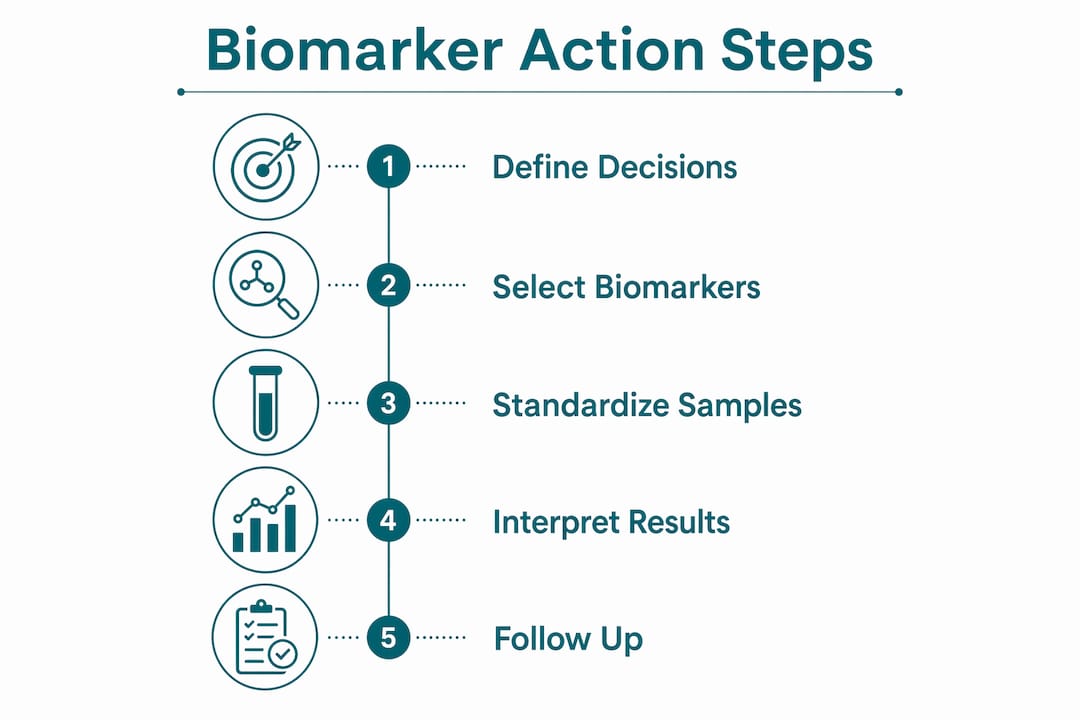
Build your workflow in four sequential phases:
- Pre-analytical standardization. Define fixed conditions for every collection: fasting duration (typically 10 to 12 hours for metabolic panels), time of day, hydration status, and whether recent illness or intense exercise should trigger a postponement. Consistency here is the single largest driver of longitudinal data quality.
- Sample collection and handling. Match your collection method to your assay requirements. Dried blood spot cards work well for at-home lipid and hormone panels. Venous draws remain the gold standard for high-sensitivity markers like hs-CRP or advanced lipid fractionation. Document the collection time and conditions every single time.
- Lab processing and result return. Turnaround time affects how quickly you can act. Logistical realities like courier delays, temperature excursions, and lab backlogs are not edge cases. Build buffer time into your interpretation schedule so a delayed result does not stall your decision cycle.
- Contextual interpretation and follow-up. Never interpret a single result in isolation. Compare each value against your personal baseline, the reference range, and the trajectory from prior tests. A biomarker data interpretation workflow that incorporates the FDA-NIH BEST role classification prevents you from over-reacting to normal biological variation.
“A biomarker strategy that cannot be executed reliably in the real world produces data that cannot be trusted. Operational readiness is not a secondary concern. It is the plan.” — FlexPointBio
Biomarker strategies should also be adaptive. Experts recommend dropping or refining markers as evidence accumulates rather than locking in a fixed panel indefinitely. Schedule a formal plan review every three to six months to assess which markers are still earning their place.
What are the most common pitfalls in biomarker plan development?
Even well-designed plans fail when execution introduces variability or when interpretation lacks a structured framework. These are the pitfalls that most frequently undermine biomarker strategy development:
- Pre-analytical variability. Collecting a cortisol sample after a stressful commute, or measuring testosterone without controlling for time of day, produces data that reflects your morning rather than your physiology. Standardizing sampling conditions like fasting status and time of collection is the most underrated step in creating a biomarker plan.
- Treating biomarkers as interchangeable. ApoB and LDL-C both relate to cardiovascular risk, but they answer different questions. Using one as a substitute for the other without understanding the distinction produces misleading conclusions.
- Skipping context of use definition. Properly defining a biomarker’s context of use prevents ambiguous data and maximizes the clinical utility of your results. A monitoring biomarker used as if it were a diagnostic one will consistently mislead you.
- Chasing novelty over utility. High-plex multi-omic panels are scientifically impressive, but they require a pre-specified interpretation framework to generate valid conclusions. Without that framework, you accumulate data without gaining clarity.
- No reassessment schedule. A plan without a built-in review cycle becomes outdated as your health status, goals, and interventions change.
Pro Tip: Before adding any new biomarker to your panel, ask one question: “Which specific decision will this marker improve?” If you cannot answer in one sentence, the marker is not ready for your plan.
The role of biomarkers in health optimization is only realized when the plan behind them is as rigorous as the science that produced them.
Key takeaways
A biomarker action plan works only when every marker is tied to a specific decision, collected under standardized conditions, and interpreted within a structured framework like FDA-NIH BEST.
| Point | Details |
|---|---|
| Start with decisions, not markers | Define the health question each biomarker must answer before selecting it. |
| Use the FDA-NIH BEST framework | Classify each marker by role (diagnostic, monitoring, predictive) to prevent misinterpretation. |
| Standardize pre-analytical conditions | Fix fasting duration, time of day, and collection context to protect data quality. |
| Build an adaptive review cycle | Reassess your panel every three to six months and drop markers that no longer serve a decision. |
| Match assay to operational reality | Confirm lab turnaround, sample stability, and collection feasibility before committing to a marker. |
Why I think most people build biomarker plans backwards
After working closely with health-optimization data for years, the pattern I see most often is this: someone gets excited about a specific biomarker, adds it to their panel, and then tries to figure out what to do with the result afterward. That is backwards, and it is surprisingly common even among people who are otherwise rigorous about their health.
The decision-first approach feels counterintuitive at first because we are conditioned to think more data is always better. It is not. A single well-chosen marker tied to a clear question gives you more leverage than a 50-marker panel with no interpretation plan. I have seen people retest the same markers quarterly for two years without ever changing a behavior, because they never defined what result would trigger what action.
The other thing I would push back on is the idea that operational logistics are a detail to sort out later. They are not. The best biomarker selection in the world is worthless if your sample degrades in transit or if you collected it two hours after a high-intensity workout without noting that context. The personalized wellness data that actually changes behavior is the data you trust, and you only trust data collected under consistent, documented conditions.
Start small. Pick two or three markers that answer your most pressing health questions. Build the collection habit. Then expand.
— Romain
How Biostarks supports your biomarker action plan

Biostarks, an AMR Labs SA company, provides at-home biomarker testing across longevity, metabolic health, nutrition, and weight management using advanced Swiss mass spectrometry. Every test is designed to give you the kind of precise, contextualized data that a structured biomarker plan requires. Whether you are tracking hormones, lipids, amino acids, vitamins, or metabolic markers, Biostarks delivers lab-grade results with reports built for interpretation, not just reference ranges. For those who need professional-grade collection tools to support operational accuracy, the Biostarks Pro collection offers solutions designed for consistency and reliability. Explore the full biomarker testing platform to find the panel that fits your health decisions.
FAQ
What is a biomarker action plan?
A biomarker action plan is a structured framework that links specific measurable biological markers to defined health decisions, guiding personalized interventions based on objective data rather than symptoms alone.
How do I choose which biomarkers to include in my plan?
Start by identifying the specific health decision each marker must support, then classify it using the FDA-NIH BEST framework to confirm its role as diagnostic, monitoring, predictive, or safety-related before adding it to your panel.
How often should I retest my biomarkers?
Reassessment frequency depends on the biomarker’s role and your intervention timeline. Safety and monitoring markers may warrant retesting every 8 to 12 weeks, while prognostic markers tracking long-term trends are typically reviewed every three to six months.
Why does pre-analytical standardization matter so much?
Physiological variables like fasting status, time of day, and recent exercise directly affect biomarker readings. Standardizing these conditions before every collection is what makes longitudinal data comparable and clinically meaningful.
Can I build a biomarker plan without a clinician?
You can design the framework and collect data independently using validated at-home testing platforms, but interpreting results in the context of your full health picture and making clinical decisions based on them should involve a qualified healthcare professional.
This content is for educational purposes only and does not constitute medical advice. Always consult with a healthcare professional before making changes to your health regimen.


