

TL;DR:
- Elite athletes often have internal biomarker abnormalities despite feeling healthy externally.
- Detailed biomarker panels reveal specific deficiencies that routine tests may miss.
- Proper interpretation and regular testing can optimize performance, recovery, and long-term health.
Most athletes assume that if they’re training hard and feeling okay, their internal health must be fine. That assumption is costing them performance, recovery time, and long-term wellbeing. Research shows that 62.6% of Olympic athletes had at least one biomarker abnormality across a sample of 2,525 competitors, with dyslipidemia (20.4%), iron deficiency (9.7%), and glucose intolerance (8.4%) appearing most often. These are not sick people. These are world-class athletes who look and feel fine on the outside. Detailed health insights change the game by revealing what routine checkups never catch, and this guide walks you through exactly how.
Table of Contents
- What are detailed health insights and biomarker panels?
- Why do health-conscious individuals and athletes need detailed insights?
- What do the numbers mean: Interpreting biomarker results
- Common misconceptions: Limits and realistic expectations
- The future of detailed health insights
- What most people overlook about detailed health insights
- Unlock your own detailed health insights
- Frequently asked questions
Key Takeaways
| Point | Details |
|---|---|
| Hidden health issues common | Even elite athletes show a high prevalence of biomarker abnormalities. |
| Personalized panels boost insights | Detailed biomarker panels reveal more actionable data for health optimization. |
| Data needs context | Interpreting results and combining them with symptoms and lifestyle is crucial. |
| Routine testing has limits | Regular biomarker testing does not always translate to direct performance gains. |
| Innovation is driving precision | New technologies, like multi-omics and personalized reference ranges, will further empower health-conscious individuals and athletes. |
What are detailed health insights and biomarker panels?
Detailed health insights are data-driven reports generated from the analysis of multiple biomarkers measured simultaneously. A biomarker is any measurable biological signal, such as a hormone level, vitamin concentration, inflammatory marker, or metabolic enzyme, that reflects what is happening inside your body at a molecular level. You can read more about the types of biomarkers used in personal health tracking to understand the scope involved.
Standard annual bloodwork might check a dozen values. Detailed panels go far deeper. For example, WHOOP’s athlete-optimized panels screen 75 to 89 biomarkers per panel through Quest Diagnostics, using serial testing to establish baselines and track how interventions, like dietary changes or training load shifts, affect your biology over time. Integration with wearables adds another layer, allowing continuous data to complement lab snapshots.
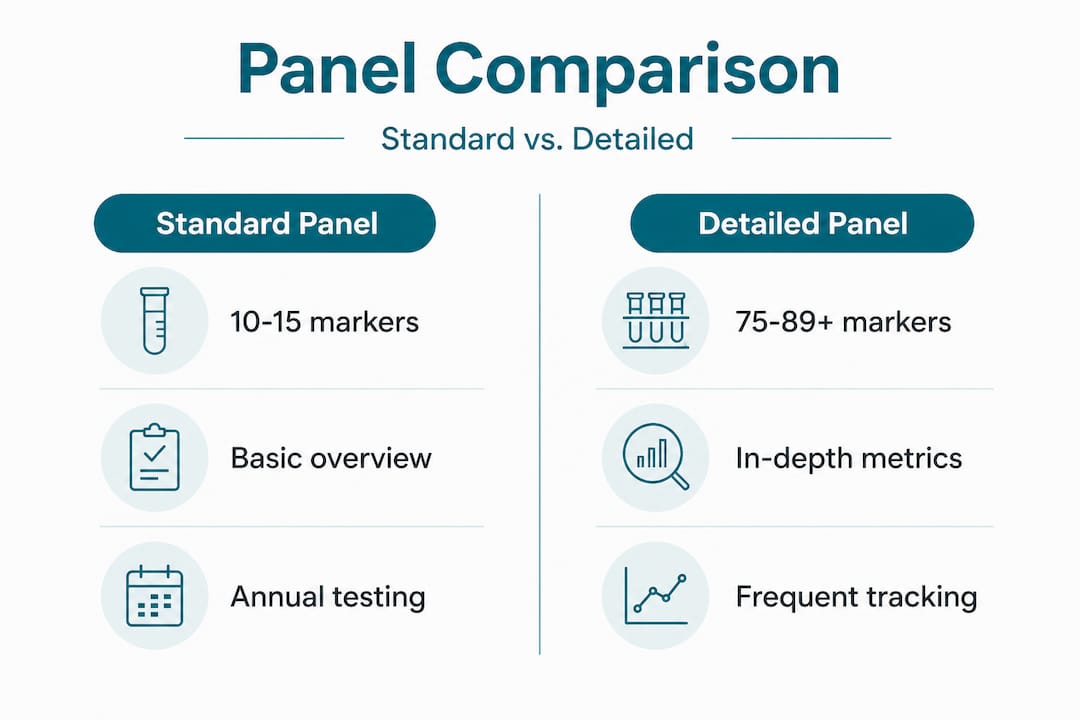
The difference between a standard panel and an advanced one is not just quantity. It is specificity and context. Here is a quick comparison:
| Feature | Standard health check | Detailed biomarker panel |
|---|---|---|
| Number of markers | 10 to 15 | 75 to 89+ |
| Hormonal analysis | Basic (TSH only) | Full thyroid, sex hormones, cortisol |
| Nutritional depth | Iron, B12 | Ferritin, zinc, omega-3 index, vitamins D, K2, B complex |
| Metabolic markers | Glucose, cholesterol | Insulin resistance, IGF-1, HbA1c, triglyceride ratios |
| Amino acids | None | Full amino acid profile |
| Reporting style | Normal/abnormal flag | Trend-based, personalized interpretation |
When you look at it this way, a routine panel is like checking the oil and nothing else before a long road trip. A detailed panel checks every fluid, every belt, and every sensor. For athletes and health-conscious individuals, the value of unlocking health data this granular is enormous, because the problems that matter most are rarely the obvious ones.
Here is what an effective detailed testing approach includes:
- Baseline establishment: Multiple tests over several weeks to define your personal normal
- Intervention tracking: Before and after testing to confirm whether a supplement or training change is working
- Seasonal monitoring: Catching shifts related to training load, travel, diet changes, or stress
- Wearable integration: Connecting continuous heart rate variability, sleep, and oxygen data to lab results
Pro Tip: Do not treat your first panel as a standalone result. Run it again 60 to 90 days later under similar conditions. That second data point is where the real insight begins.
Why do health-conscious individuals and athletes need detailed insights?
The argument for detailed testing is not theoretical. It is grounded in real prevalence data and real consequences. When 62% of Olympians show biomarker abnormalities despite training at the highest level, the message is clear: elite conditioning does not protect you from internal deficiencies.
“Over 62% of 2,525 Olympic athletes showed at least one biomarker abnormality, including dyslipidemia (20.4%), iron deficiency (9.7%), and glucose intolerance (8.4%). Most of these athletes had no obvious symptoms.” — PubMed, 2026
Iron deficiency is a perfect example of a silent saboteur. You can have suboptimal ferritin levels for months before classic anemia symptoms appear. In the meantime, your VO2 max drops, recovery slows, and motivation tanks. Female athletes carry a disproportionate share of this burden. Research specifically identifies female athletes as higher risk for iron deficiency and Relative Energy Deficiency in Sport (REDs), a syndrome where chronic low energy availability suppresses hormones, impairs bone density, and increases injury risk.

Thyroid function is another area that detailed testing catches where standard checks miss. Overtraining can suppress Free T3 (the active thyroid hormone) even when TSH, the marker most doctors check, looks normal. A suppressed Free T3 means slower metabolism, impaired muscle protein synthesis, and sluggish recovery. Without testing it directly, you would never know.
The biomarker testing benefits for athletes and biohackers break down into three core priorities:
- Preventing deficiency: Identifying low iron, zinc, magnesium, or vitamin D before they become performance-limiting problems
- Monitoring recovery: Tracking cortisol, inflammation markers, and anabolic hormones to know when your body is truly ready for the next hard training block
- Prolonging longevity: Catching early markers of metabolic dysfunction, insulin resistance, or lipid imbalance decades before they show up as disease
High-frequency monitoring is also making the picture more dynamic. Research on saliva-based multi-omics in soccer demonstrates that non-invasive testing can detect hydration status, inflammatory load, and supplement effects in real time across a competitive season. This kind of frequent, low-burden monitoring is where the field is heading, and it matters for anyone serious about the role of biomarkers in optimizing long-term performance.
| Biomarker | What it reveals | Risk if ignored |
|---|---|---|
| Ferritin | Iron storage capacity | Fatigue, reduced endurance |
| Free T3 | Active thyroid hormone output | Slowed recovery, low motivation |
| IGF-1 | Anabolic signaling and growth | Muscle loss, poor adaptation |
| Omega-6/3 ratio | Inflammatory balance | Prolonged soreness, injury risk |
| HbA1c | Long-term glucose control | Insulin resistance, energy instability |
What do the numbers mean: Interpreting biomarker results
Getting detailed results is the first step. Understanding what they mean is where most people struggle. The key distinction to grasp immediately is the difference between normal and optimal.
A normal range on a lab report is usually set to capture 95% of the general population. For a sedentary adult in their 50s, that reference range may be perfectly appropriate. For a 28-year-old training 12 hours per week, it is often too broad to be useful. The biomarker interpretation process must account for your specific physiology, training demands, and goals.
The IOC REDs consensus is one of the clearest frameworks for understanding this gap. It identifies subclinically low Free T3 and IGF-1 as early indicators of energy deficiency that suppress recovery and performance long before clinical thresholds are crossed. These values might fall within a lab’s normal range while still sitting in the bottom quartile, where function is already impaired.
Here is how to approach interpreting your key results:
- Ferritin: Values below 30 ng/mL are often linked to impaired endurance and fatigue, even when hemoglobin is normal. Optimal for most athletes is above 50 ng/mL
- Free T3: If you are in the lowest quartile of the normal range and experiencing sluggish recovery, that number warrants attention regardless of what TSH shows
- IGF-1: Low normal levels combined with poor muscle adaptation and slow recovery may indicate energy deficiency rather than inadequate training
- Omega-6/3 ratio: A ratio above 10:1 is associated with pro-inflammatory conditions; most athletes benefit from a target closer to 4:1 or below
- Vitamin D (25-OH): Levels under 40 ng/mL are linked to reduced immune function and impaired muscle recovery, yet labs often flag anything above 20 as acceptable
Pro Tip: When reviewing your results, sort by percentile within the normal range, not just flagged abnormals. The bottom quartile of normal is where athletes often find the most actionable information, particularly for Free T3, IGF-1, and ferritin. Your athlete blood testing approach should always prioritize personalized ranges over population averages.
Common misconceptions: Limits and realistic expectations
Here is an uncomfortable truth that the biomarker testing space does not always advertise loudly enough: detailed testing is not a performance multiplier on its own. If your values are already optimal, correcting nothing will add nothing to your race time or squat max.
Research is direct about this. No strong evidence supports the idea that routine detailed testing directly improves race times or strength in healthy athletes whose values are already within optimal ranges. The gains from testing come from identifying and fixing what is actually broken, not from having data for its own sake.
This matters because the wellness space is full of people spending significant money on testing without getting meaningful results, often because they skip the foundational habits that actually drive most adaptation.
Common misconceptions to avoid:
- Testing is a shortcut: Biomarker data cannot replace sleep, nutrition quality, training consistency, or stress management. It can tell you why those fundamentals are not working, but it cannot substitute for them
- One test tells the whole story: A single snapshot has limited value. Trends across multiple tests over months are where the real signal lives
- Fixing a marker fixes everything: Correcting a low ferritin level (below 30 to 40 ng/mL, the optimal ferritin range for athletes) will improve endurance in someone who was iron deficient. But it will not suddenly transform a poorly structured training plan into a winning one
- Higher is always better: Normalizing a high value, such as reducing an elevated omega-6/3 ratio, reduces inflammation risk but does not boost performance beyond what good baseline health provides
The value of precision medicine in athletic performance lies in its ability to identify the specific limiting factor in your biology. When you find that factor and address it, the return is real. When you test without that targeted intention, the return is mostly just interesting data. Biomarker testing is a diagnostic tool, not a performance supplement. Using it well means pairing every panel with a clear question you are trying to answer, and the health optimization insights you gain become genuinely actionable.
The future of detailed health insights
The field is moving fast, and the trajectory is toward more precision, more frequency, and less friction. Here is what is already reshaping this space:
- Personalized reference ranges: Instead of population-level normals, future panels will use your own historical data to define what is truly normal for you specifically
- Continuous wearable integration: Real-time glucose, HRV, oxygen saturation, and skin temperature data will be layered against lab biomarkers to create dynamic health pictures instead of static snapshots
- Non-invasive high-frequency testing: Saliva-based multi-omics can already detect hydration status, oxidative stress, and anti-doping relevant compounds in professional soccer players without a single needle stick
- Multi-omics convergence: Combining genomics, proteomics, metabolomics, and microbiome data into one interpretive layer will give practitioners a biological portrait with far more resolution than any single test type currently allows
The practical implication is that testing frequency will increase while burden decreases. Instead of one or two annual panels, athletes may run lightweight monthly checks calibrated to their training cycle, with full multi-panel assessments timed to off-season transitions or new training blocks. The role of advanced lab testing will shift from reactive to proactive, identifying risk years or even decades before function declines.
What most people overlook about detailed health insights
Here is a perspective you will not see in many product pages or wellness listicles: numbers without context can do more harm than good.
We see it regularly. Someone gets a panel back, notices a borderline low Free T3, and immediately spirals into supplement stacking, restrictive eating, and anxious follow-up testing every few weeks. The data became the source of stress rather than the solution to it. Ironically, chronic psychological stress is itself one of the fastest ways to suppress thyroid function and spike cortisol, creating the very problem the testing was meant to detect.
Biomarker data is powerful precisely because it removes guesswork. But guesswork replaced by obsession is not an improvement. The smartest approach we have seen is to treat your panel results as conversation starters, not conclusions. Bring them to a sports medicine physician, a registered dietitian, or a performance coach who can layer in the context of your symptoms, training load, sleep quality, and stress levels. A low ferritin number means one thing in an athlete who is tired and underperforming. It means something different in an athlete who is hitting personal bests and feels excellent.
The role of biomarkers in athlete performance is to inform your strategy, not to replace your intuition about how you actually feel. When the data and your lived experience align, that is your strongest signal to act. When they conflict, that is your strongest signal to dig deeper before changing anything.
Pro Tip: Use your biomarker results to ask better questions, not to immediately buy a stack of supplements. The test tells you what the number is. Your body tells you whether it matters.
Unlock your own detailed health insights
You have just walked through the evidence for why detailed biomarker panels matter, how to interpret results intelligently, and where realistic expectations should sit. The next move is yours.

Biostarks makes this process precise and accessible. Using advanced Swiss mass spectrometry, our at-home testing panels analyze vitamins, hormones, amino acids, lipids, minerals, and metabolic markers with the same rigor applied in elite sports medicine clinics. You collect your sample at home, and we deliver a clear, personalized report with actionable insights built around your actual biology. If you are ready to move beyond guesswork and start making data-driven decisions about your health and performance, explore personalized biomarker testing and see which panel fits your goals. Your baseline starts here.
Frequently asked questions
How often should I do detailed biomarker testing?
Serial biomarker testing every two to three months helps establish personal baselines and reveals how your body responds to training changes or interventions over time.
Are non-invasive biomarker tests reliable?
Emerging evidence shows that saliva-based multi-omics can reliably detect hydration status, stress markers, and supplement effects in professional athletes, making non-invasive testing a credible option for high-frequency monitoring.
Does detailed testing directly improve my athletic performance?
No strong evidence supports routine testing boosting performance in already-healthy athletes. The real value comes from identifying and correcting specific deficiencies that are limiting your capacity.
Which biomarkers are most important for athletes?
The IOC REDs consensus highlights Free T3 and IGF-1 as critical energy deficiency indicators, alongside ferritin, omega-6/3 ratio, and vitamin D as the highest-priority markers for most athletes.
Are women athletes at higher risk for certain deficiencies?
Yes. Female athletes face higher rates of iron deficiency (16.5% versus 4.2% in males) and a greater risk of REDs, making targeted, regular biomarker monitoring especially important for this group.


