

TL;DR:
- Standard food labels cannot accurately reflect individual mineral absorption and overall status.
- Personalized biomarker tracking with ICP-MS provides precise insights into true mineral levels.
- Monitoring individual mineral ranges helps optimize health, athletic performance, and aging processes.
Most Americans walk around with mineral imbalances they don’t know exist. Standard nutrition labels tell you what’s in your food, but they can’t tell you what your body actually absorbs, retains, or uses. The gap between intake and status is where performance plateaus, fatigue settles in, and cognitive sharpness quietly fades. Subclinical deficiencies and excesses that dietary estimates miss are exactly what personalized biomarker tracking is designed to catch, giving you a real picture of your internal mineral landscape rather than a population-average guess.
Table of Contents
- Why minerals matter: More than just vitamins’ sidekicks
- How personalized biomarker tracking uncovers real mineral needs
- Understanding optimal ranges: Not too little, not too much
- Personalizing mineral tracking: Contexts, pitfalls, and practical tips
- Our perspective: Why most people get mineral tracking wrong (and how to fix it)
- Ready to optimize your mineral status with your own biomarker data?
- Frequently asked questions
Key Takeaways
| Point | Details |
|---|---|
| Mineral tracking reveals hidden imbalances | Personalized biomarker data helps you detect deficiencies or excesses standard tracking misses. |
| Bioindividual needs beat broad guidelines | Your optimal mineral levels depend on your genetics, age, and lifestyle—not just RDAs. |
| Food sources come first | Aim for minerals from food and confirm true need before using supplements. |
| Context matters for everyone | Athletes, vegans, and aging adults should prioritize personalized tracking and strategies. |
Why minerals matter: More than just vitamins’ sidekicks
Minerals don’t get the same cultural attention as vitamins, but they arguably deserve more. They are the structural backbone of enzymes, the cofactors that fire your mitochondria, and the regulators of nerve transmission and immune signaling. Without adequate magnesium, your ATP production stalls. Without zinc, your immune cells can’t replicate properly. Without iron in the right range, oxygen delivery to your brain and muscles drops. Every one of those outcomes shows up as a symptom you’ve probably attributed to stress, poor sleep, or aging.
The frustrating part is that modern diets and lifestyles create mineral imbalances in subtle, compounding ways. High-phytate foods like whole grains and legumes bind zinc and iron, reducing absorption. Chronic stress depletes magnesium through increased renal excretion. Alcohol disrupts zinc and selenium status. Even high-intensity training shifts your mineral demands dramatically. The result is a moving target that a static food label simply cannot capture.
Here’s what makes mineral imbalances particularly tricky to catch:
- Fatigue from low magnesium looks identical to fatigue from low iron or even from overtraining
- Brain fog from suboptimal zinc is indistinguishable from brain fog from poor sleep
- Muscle cramps from low calcium or potassium are often blamed on dehydration alone
- Mood changes linked to selenium or iodine insufficiency are routinely misattributed to stress
“Serum is not always a reliable proxy for total body mineral stores due to tight homeostatic regulation. This is precisely why clinical-grade biomarker panels, rather than dietary estimates, offer a clearer window into your true mineral status.” This is especially true for magnesium, where serum magnesium assessments using photometric or ICP-MS methods can still underrepresent intracellular deficits.
That’s why monitoring mineral levels through validated biomarker panels is increasingly viewed not as a niche move for elite athletes, but as a foundational practice for anyone serious about their health. Knowing your numbers gives you a basis for action. Without them, you’re essentially managing your performance by feel alone.
How personalized biomarker tracking uncovers real mineral needs
If minerals matter so much, how do you actually determine what your body really needs? That’s where personalized tracking changes everything.
Food tracking apps like Cronometer or MyFitnessPal are useful starting points, but they measure what you eat, not what you absorb. Bioavailability varies enormously based on your gut microbiome composition, digestive enzyme activity, the presence of absorption inhibitors in your meals, your genetic variants, and your current health status. Two people eating the same diet can have completely different serum mineral profiles. This isn’t theory; it’s consistent with what clinical testing reveals in practice.

Serum analysis using ICP-MS methodology is the gold standard for directly assessing trace mineral status. Inductively coupled plasma mass spectrometry offers exceptional sensitivity and can simultaneously quantify multiple minerals, from selenium and zinc to copper, manganese, and molybdenum, at concentrations that standard clinical labs often can’t detect. It’s not just more accurate; it’s a fundamentally different category of information.
| Tracking method | What it measures | Key limitation |
|---|---|---|
| Food diary app | Estimated dietary intake | Misses bioavailability entirely |
| Standard clinical panel | Broad serum values, few minerals | Limited sensitivity, few markers |
| ICP-MS biomarker panel | Actual serum mineral concentrations | Requires sample, costs more |
| Hair mineral analysis | Long-term mineral exposure | Poor standardization, lower reliability |
Consider these contexts where personalized biomarker data matters most:
- Athletes: Training volume changes sweat-loss minerals rapidly; RDAs were not designed for this demand
- Vegans and vegetarians: Non-heme iron and plant-source zinc have lower bioavailability; intake numbers look adequate but status often doesn’t match
- Adults over 50: Gastric acid production declines with age, reducing calcium, magnesium, and B12 absorption; dietary intake becomes a less reliable predictor of status
- Anyone on long-term medications: Proton pump inhibitors, diuretics, and metformin all deplete specific minerals
Pro Tip: Don’t assume that because your diet looks balanced on paper, your minerals are too. Bioavailability is the variable that food apps systematically ignore.
Crucially, precision health biomarker data also helps you identify if you’re already getting too much of something. Excess copper, for instance, competes with zinc absorption. High-dose iron without confirmed deficiency can generate oxidative stress. Precision testing shifts the conversation from generic recommended daily intakes to your own optimal concentrations, which is the true foundation of personalized nutrition. Understanding the role of biomarkers in health means recognizing that population-level guidelines were never built to optimize individual performance.
Understanding optimal ranges: Not too little, not too much
Once measured, understanding what your biomarker results mean isn’t straightforward. It’s not just deficient or not. The concept of an optimal range adds a layer of nuance that most people, and frankly many clinicians, miss.
The classic U-shaped dose-response curve applies to most minerals. Below a threshold, you see deficiency symptoms. Above another threshold, toxicity or competitive inhibition kicks in. Between those two points is your optimal window, and that window is not the same for every person. Your genetics, your other mineral levels, your health status, and your lifestyle all shift where that optimal point sits.
The evidence here is striking. Higher iron and zinc intake was associated with poorer cognitive performance in certain populations, with odds ratios between 1.25 and 1.36 for low cognitive scores at higher intake levels. The same study found nonlinear relationships between calcium and magnesium status and bone mineral density, meaning there’s a point past which additional intake stops helping and may start hurting. More is not always better.
Here’s a simplified reference for key minerals and what to watch for:
| Mineral | Deficiency signals | Excess signals | High-risk groups |
|---|---|---|---|
| Magnesium | Muscle cramps, anxiety, fatigue | Diarrhea, low blood pressure | Athletes, high-stress individuals |
| Iron | Fatigue, poor focus, pale skin | Oxidative stress, organ damage | Vegans, women of childbearing age |
| Zinc | Low immunity, poor wound healing | Copper deficiency, nausea | Vegans, older adults |
| Selenium | Hair loss, thyroid dysfunction | Nail brittleness, nerve damage | Low soil-content regions |
| Calcium | Bone loss, muscle cramps | Kidney stones, calcification | Post-menopausal adults |
What this means practically is that optimizing your mineral status is not a one-time fix. It’s an ongoing calibration. Your needs in a high-training block differ from your needs during recovery. Your needs at 35 differ from your needs at 55. That’s why types of biomarkers matter so much in this context. Selecting the right biomarker at the right time gives you actionable, timely data rather than a static snapshot that quickly becomes outdated.
Key insight: The reference range on a lab report marks the boundary between “clinically concerning” and “normal for the population.” It does not mark the boundary between average and optimal for you.
Personalizing mineral tracking: Contexts, pitfalls, and practical tips
Now that you know the importance of optimal ranges, let’s see how context matters and how you can put mineral tracking into action for your unique situation.
Different populations face uniquely different mineral pressures. Athletes lose minerals through sweat, especially sodium, magnesium, and zinc, at rates that make standard RDAs inadequate. Vegans face structurally lower bioavailability for iron and zinc due to the dominance of plant-based sources. Aging reduces intrinsic factor production, hydrochloric acid levels, and overall gut absorptive efficiency. People with kidney disease alter their excretion patterns in ways that cause mineral accumulation rather than depletion. And individuals exposed to environmental toxins like lead or mercury need monitoring for heavy metals that compete directly with essential mineral absorption.
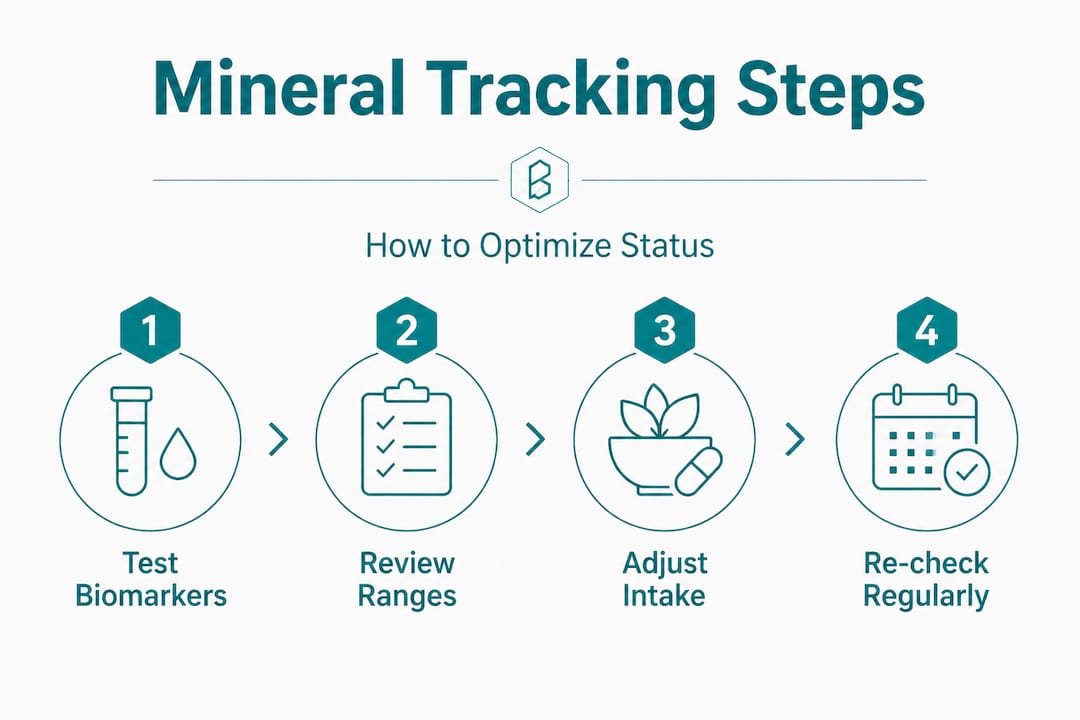
Here’s how to start tracking minerals the smart way:
- Start with a baseline panel. Get a comprehensive serum mineral panel using ICP-MS technology before making any dietary or supplementation changes. This gives you your actual starting point.
- Identify your risk context. Are you an endurance athlete? Post-menopausal? Vegan? These contexts flag which minerals to prioritize in your tracking.
- Align diet first. Use your results to guide food choices. If zinc is low, increase shellfish, red meat, or pumpkin seeds. If selenium is suboptimal, consider Brazil nuts or selenium-rich fish.
- Add supplements only with confirmation. Food sources are preferred over supplements for their synergistic nutrient profiles and lower risk of overcorrection. High-dose supplements show little benefit and meaningful risk without a confirmed deficiency.
- Retest at meaningful intervals. Depending on your context, retesting every 3 to 6 months allows you to assess whether interventions are working.
- Track trends, not single data points. One reading is useful. A series of readings over time reveals your trajectory and tells you whether your body is actually responding to changes.
Pro Tip: If you’re supplementing magnesium because “everyone says you’re probably deficient,” stop and test first. Magnesium supplementation at high doses when levels are already adequate can suppress parathyroid hormone and interfere with calcium metabolism. This is the exact problem that data-driven tracking prevents.
For those using biomarker testing for athletes, the timing of testing matters too. Testing during peak training load gives you a different picture than testing during recovery. Both are valuable, but they answer different questions. And for personalized wellness biomarkers, the goal is always to move from population averages to your own lived, biological reality.
Our perspective: Why most people get mineral tracking wrong (and how to fix it)
Here’s something worth saying plainly: most people who think they’re tracking their mineral health are not actually tracking it at all.
They’re tracking their food intake. That’s not the same thing. The step from “I ate spinach and almonds today” to “my magnesium status is optimal” involves so many variables, from phytate content and cooking methods to gut transit time and genetic polymorphisms in mineral transporters, that the food log becomes a rough estimate at best and a misleading one at worst.
The more nuanced mistake happens with broad health panels or OTC test kits. These typically measure three to five minerals at low analytical sensitivity. They produce results that look reassuringly “normal” because they’re compared against population reference ranges built from average healthy adults, not optimized athletes or aging individuals or metabolically stressed professionals. Normal is not optimal. That distinction matters more than most people appreciate.
What we’ve seen consistently is that the real breakthrough comes not from adding more supplements or rotating through elimination diets, but from accessing accurate, individualized mineral data and then acting on it deliberately. That’s it. The path to better energy, sharper cognition, and sustained performance runs through your actual biology, not through the nutrition advice designed for the median adult.
The future of mineral tracking is not more apps with fancier databases. It’s using biomarker insights derived from clinical-grade testing to build feedback loops between your lifestyle choices and your internal physiology. That’s where real progress happens, and it’s available now, not at some future date when the technology matures. The technology is already here. The question is whether you’re using it.
Ready to optimize your mineral status with your own biomarker data?
Understanding the theory of mineral tracking is one thing. Seeing your own numbers is where real change begins.

Biostarks offers at-home biomarker mineral testing powered by advanced Swiss mass spectrometry, the same ICP-MS technology discussed throughout this article. You collect your sample at home, send it in, and receive a detailed, personalized report that maps your actual mineral concentrations against evidence-based optimal ranges, not just population averages. From there, you get clarity on exactly where to focus your nutrition, supplementation, and lifestyle decisions. No guessing. No averages. Just your data, precisely analyzed and clearly explained. Explore Biostarks mineral testing and start building your personal baseline today.
Frequently asked questions
What is the best way to track my mineral levels accurately?
Personalized serum biomarker analysis using ICP-MS methodology outperforms food diary apps or dietary estimates for true accuracy because it measures what’s actually circulating in your body, not what you theoretically consumed.
Can tracking minerals improve my cognitive or athletic performance?
Yes, keeping minerals in their personal optimal ranges supports both cognitive and physical output, while excess intake of certain minerals like iron and zinc has been associated with poorer cognitive performance in some populations.
Should I take mineral supplements if feeling tired or stressed?
Only if a deficiency is confirmed through biomarker testing. High-dose supplements carry real risk of harm when no deficiency exists, making food sources the safer first line of action.
Who especially needs to track minerals carefully?
Athletes, vegans, and older adults face the highest mineral tracking demands due to sweat losses, lower bioavailability, reduced absorption efficiency, and in some cases, environmental toxic exposures that standard dietary guidance doesn’t address.
Recommended
- Why Monitor Minerals: 60% Face Deficiencies H… | Biostarks
- Unlock Health Reports for Peak Performance in… | Biostarks
- Why track hormonal health for personalized we… | Biostarks
- 7 Ways to Track Metabolic Health Naturally fo… | Biostarks
- Forstå mineraler: Derfor er de vigtige for din sundhed – Vitaminone.dk


