

TL;DR:
- Holistic biomarker analysis evaluates over 50 to 275 markers across multiple systems to provide personalized health insights before symptoms appear. It uses pattern recognition, functional ranges, and multi-omics data to detect early dysfunction and guide proactive interventions. Regular retesting and expert interpretation help track health trajectories and optimize wellness outcomes.
Holistic biomarker analysis is the process of evaluating an extensive set of biological markers across multiple physiological systems to deliver personalized insights for optimizing health and wellness. Where a standard annual physical checks 20–30 biomarkers, a truly integrative assessment examines 50 to over 275 specialized markers spanning thyroid hormones, cardiovascular lipids, nutrient metabolism, and inflammatory pathways. The goal is not simply to flag disease. It is to reveal the full biological picture before symptoms appear, so you can act on data rather than wait for a diagnosis. Platforms like Biostarks, an AMR Labs SA company, apply Swiss mass spectrometry to deliver exactly this level of depth from a home blood sample.
What is holistic biomarker analysis and what does it measure?
Defining holistic biomarker analysis starts with understanding what gets measured and why volume matters. Standard clinical panels catch acute problems. A multi-omics assessment integrates data from five biological layers: genomics, epigenomics, transcriptomics, proteomics, and metabolomics. Each layer answers a different question about your biology.
- Genomics reveals inherited DNA variants that predispose you to certain conditions.
- Epigenomics shows how environment and lifestyle switch genes on or off.
- Transcriptomics measures which genes are actively producing proteins right now.
- Proteomics quantifies the proteins those genes produce and how they function.
- Metabolomics captures the small molecules your cells generate during energy production, detoxification, and repair.
Together, these layers close the gap between your genetic blueprint and your lived biology. A single omics layer tells you what could happen. All five together tell you what is happening.
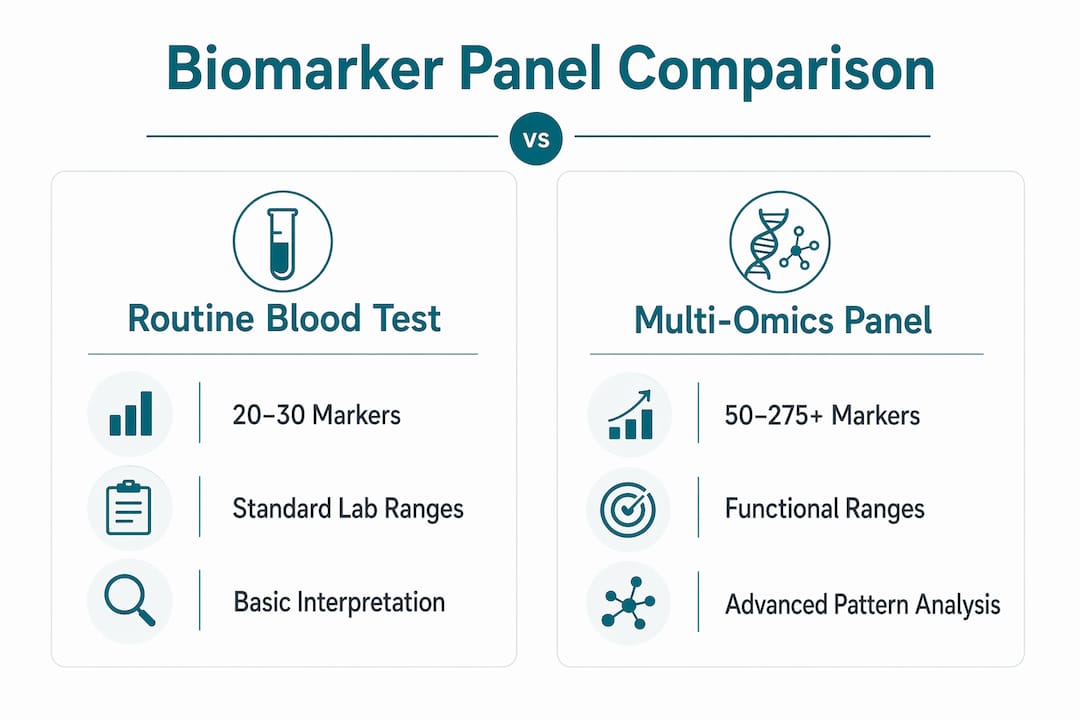
Routine blood tests vs. multi-omics holistic panels

| Feature | Routine blood test | Multi-omics holistic panel |
|---|---|---|
| Number of markers | 20–30 | 50–275+ |
| Biological layers | Biochemistry only | Genomics, proteomics, metabolomics, and more |
| Reference standard | Normal vs. abnormal | Functional optimal ranges |
| Primary goal | Detect existing disease | Anticipate and prevent dysfunction |
| Interpretation | Single-marker flags | Pattern and cluster analysis |
The difference is not just quantity. It is the interpretive framework applied to the data. Biostarks uses types of biomarkers across all major categories, from vitamins and amino acids to hormones and metabolic markers, to build a complete biological profile rather than a snapshot of one system.
How does holistic biomarker analysis differ from conventional testing?
The most important distinction is the reference standard used to judge results. Conventional labs flag a result as abnormal only when it crosses a disease threshold. Functional reference ranges target optimal levels, not just the absence of pathology. That means a vitamin D level of 22 ng/mL might pass a standard screen but still fall well short of the 40–60 ng/mL range associated with immune resilience and bone density maintenance.
Pattern recognition separates integrative biomarker evaluation from isolated testing even further. High triglycerides, elevated fasting glucose, and low HDL cholesterol each fall within normal limits individually. Together, they signal metabolic syndrome risk before any single marker triggers a clinical flag. That cluster-based reading is something a standard panel cannot deliver.
Limitations of conventional testing:
- Checks too few markers to detect early multi-system dysfunction
- Uses population-average reference ranges that miss individual variation
- Produces isolated values with no pattern or trend analysis
- Offers no predictive insight into burnout, hormonal drift, or inflammatory load
- Rarely accounts for age, genetics, or lifestyle context in interpretation
Advantages of a systemic biomarker examination:
- Detects early cardiovascular stress and inflammatory burden before symptoms appear
- Uses functional ranges calibrated to optimal, not merely acceptable, health
- Identifies multi-marker patterns that predict complex conditions
- Supports longitudinal tracking to reveal health trajectories over time
- Pairs data with expert clinical interpretation for personalized guidance
Pro Tip: Ask your provider to compare your results against functional optimal ranges, not just standard lab cutoffs. The difference between “normal” and “optimal” is often where meaningful health gains are found.
What technologies make advanced biomarker profiling possible?
Multi-omics data is vast, heterogeneous, and measured on different scales. Genomic data is categorical. Metabolomic data is continuous. Proteomic data is quantitative but sparse. Combining these into a coherent biological picture requires computational tools that go well beyond a spreadsheet.
Machine learning techniques including dimensionality reduction methods like PCA, t-SNE, and UMAP compress thousands of variables into interpretable patterns. Variational autoencoders and network analysis tools like iOmicsPASS identify predictive biomarker subnetworks, clusters of markers that move together and signal a shared biological process. These tools catch non-linear relationships that traditional statistical models miss entirely.
Data integration follows three broad strategies:
- Early integration combines raw data from all omics layers before analysis, maximizing information but requiring careful normalization.
- Intermediate integration extracts features from each layer separately, then merges them for joint modeling.
- Late integration analyzes each omics layer independently and combines the conclusions at the interpretation stage.
The emerging role of AI in biomarker research moves the field beyond hypothesis-driven models. Instead of testing one marker at a time, AI scans the full biological network for unexpected correlations. That shift is what makes multifactorial biomarker analysis genuinely predictive rather than merely descriptive.
Pro Tip: When evaluating any biomarker service, ask whether results are interpreted using functional ranges and pattern analysis or simply flagged against standard lab cutoffs. The analytical method determines the clinical value of the report.
How can you use biomarker data to optimize your health?
The clinical interpretation process is what transforms raw numbers into a personalized plan. Biomarker meaning shifts based on age, genetics, medications, and lifestyle. A PSA level that warrants close monitoring in a 45-year-old carries different implications for a 75-year-old. Context is not optional. It is the interpretive foundation.
Here is how a well-structured biomarker strategy moves from data to results:
- Define your health goal. Longevity, athletic performance, metabolic resilience, and hormonal balance each require different marker sets. Defining the context of use before testing shapes which assays are selected and how results are interpreted.
- Collect a baseline panel. A comprehensive first test establishes your biological starting point across all major systems.
- Identify functional gaps. Compare your results against optimal functional ranges to find where your biology is underperforming, not just where it is failing.
- Build a personalized intervention plan. Physician-guided interpretation translates data into specific actions: targeted supplementation, hormone optimization, dietary adjustments, or inflammation management protocols.
- Retest at regular intervals. Longitudinal monitoring reveals whether interventions are working and tracks your health trajectory over months and years.
- Adjust based on trends, not single results. One data point is a snapshot. Three or four over time is a story your biology is telling you.
Practical examples of what this looks like in real life include discovering that low ferritin explains persistent fatigue despite normal hemoglobin, or that elevated homocysteine signals a methylation issue addressable with targeted B vitamins. Biostarks reports on 28 essential biomarkers with the kind of depth that makes these connections visible. The goal is not a list of problems. It is a map of leverage points where targeted action produces measurable change.
Metabolic markers are particularly powerful here. Fasting insulin, HOMA-IR, and triglyceride-to-HDL ratio together reveal insulin sensitivity years before a standard glucose test would raise any concern. Catching that pattern early gives you time to act through diet, exercise, and sleep before metabolic dysfunction becomes a clinical diagnosis.
Key takeaways
Holistic biomarker analysis is the most complete method available for understanding your biology before disease takes hold, combining multi-omics data, functional reference ranges, and pattern recognition into a single personalized health picture.
| Point | Details |
|---|---|
| Breadth of markers | Holistic panels assess 50–275+ markers versus 20–30 in a standard physical. |
| Multi-omics integration | Five biological layers, from genomics to metabolomics, reveal what single-layer tests miss. |
| Functional ranges matter | Optimal reference ranges catch dysfunction that standard normal/abnormal cutoffs overlook. |
| Pattern over single values | Clusters of markers predict complex conditions even when individual results appear normal. |
| Longitudinal tracking | Retesting over time transforms isolated data points into a meaningful health trajectory. |
Why I think most people are testing too little and interpreting even less
Most people who get bloodwork done walk away with a sheet of numbers and a reassurance that everything looks fine. That is not health intelligence. That is absence-of-crisis confirmation.
What I have seen, working at the intersection of data and preventive health, is that the real value of a comprehensive biomarker study is not in any single marker. It is in the relationships between markers. Cortisol, DHEA-S, and free testosterone do not tell you much in isolation. Together, they describe your stress adaptation capacity with precision that no symptom questionnaire can match.
The shift from reactive to anticipatory health care is not a philosophical preference. It is a practical one. Catching inflammatory burden or hormonal drift six months before it becomes a clinical problem gives you options. Waiting for symptoms removes most of them.
My caution is this: do not treat biomarker results as mandates. A single elevated marker is not a diagnosis. It is a signal worth investigating in context. Age, genetics, training load, sleep quality, and recent illness all shape what a number means. The data is only as useful as the interpretation applied to it. That is why expert guidance is not a luxury in this process. It is the mechanism that turns a report into a plan.
Track trends. Work with someone who understands functional ranges. And retest. The biology you see at month three is not the same biology you started with.
— Romain
Start your comprehensive biomarker assessment with Biostarks

Biostarks, an AMR Labs SA company, offers advanced at-home biomarker testing powered by Swiss mass spectrometry. The panels cover vitamins, hormones, amino acids, lipids, minerals, and metabolic markers, analyzed with the depth and precision that integrative biomarker evaluation requires. Every report is built to show you not just where your biology stands today, but where it is heading. If you are ready to move from guesswork to data-driven health decisions, explore Biostarks’ testing panels and see what a complete biological picture looks like for your specific goals. Your baseline is the starting point. What you do with it determines everything.
FAQ
What is holistic biomarker analysis?
Holistic biomarker analysis is a comprehensive evaluation of 50 to 275+ biological markers across multiple physiological systems, using functional reference ranges and pattern recognition to deliver personalized health insights beyond standard clinical testing.
How many biomarkers does a holistic panel typically assess?
A holistic panel assesses 50 to over 275 markers, compared to the 20–30 markers in a standard annual physical, covering thyroid, cardiovascular, hormonal, metabolic, and nutrient systems.
Why are functional reference ranges better than standard lab ranges?
Functional ranges target optimal biological performance rather than simply distinguishing sick from not-sick, which means they catch early metabolic dysfunction and hormonal drift that standard cutoffs miss entirely.
Can biomarker patterns predict disease before symptoms appear?
Yes. Clusters of markers, such as elevated triglycerides combined with low HDL and high fasting glucose, signal metabolic syndrome risk even when each individual marker falls within the normal range.
How often should I retest my biomarkers?
Longitudinal monitoring every three to six months is the standard approach for tracking health trajectories and measuring whether interventions are producing the intended biological changes.
This content is for educational purposes only and does not constitute medical advice. Always consult with a healthcare professional before making changes to your health regimen.


