

TL;DR:
- Comprehensive biomarker panels reveal internal health beyond routine checkups, enabling proactive optimization.
- At-home testing offers fast, detailed results, allowing personalized health interventions and trend tracking.
- Interpreting biomarkers requires understanding optimal ranges, trends, and integrating results with lifestyle factors.
Your annual physical says everything looks fine. But fine is not the same as optimized. Routine checkups measure a narrow slice of your biology, and traditional checkups can miss internal changes that comprehensive biomarker panels catch early. Internal health is not just the absence of disease. It is the quality of your metabolic, hormonal, and cellular function right now. At-home biomarker testing has changed what is possible for health-conscious individuals who want real answers, not just reassurance. This article breaks down what internal health actually means, how modern testing works, and how to turn your results into action.
Table of Contents
- What is internal health? Beyond the basics
- How biomarker testing reveals your internal health
- What do your biomarkers really mean? Interpreting and applying results
- Going deeper: Limitations, edge cases, and practical applications
- A new era: Proactive, personalized, but not perfect
- Ready to unlock your internal health?
- Frequently asked questions
Key Takeaways
| Point | Details |
|---|---|
| Internal health explained | Internal health reflects the body’s invisible systems and processes, not just how you feel day to day. |
| Power of biomarker testing | Modern at-home panels measure dozens to over a hundred markers, revealing risks that regular checkups miss. |
| Trends beat snapshots | Tracking biomarker trends over time gives more meaningful insights than single test results. |
| Optimize, don’t obsess | Use personalized biomarker data for proactive changes, but combine it with strong foundational habits. |
What is internal health? Beyond the basics
Most people define health as how they feel. No symptoms, no problem. But your body runs thousands of silent processes every hour, and many of them can drift off course long before you notice anything. Internal health is the sum total of those unseen processes: your metabolic rate, inflammation levels, hormone balance, nutrient status, and cellular repair activity.
Routine checkups typically measure blood pressure, basic cholesterol, and blood glucose. That is useful, but it is a very small window. Internal health can be assessed using biomarker panels that track key markers far beyond what a standard doctor visit covers. Think of it this way: a standard panel is like checking if your car has gas. A biomarker panel is like running a full diagnostic on every system under the hood.
Biomarkers are measurable biological indicators that reflect the state of a specific process in your body. Some are direct, like fasting glucose. Others are derived calculations, like HOMA-IR (a formula that estimates insulin resistance from glucose and insulin values together). Both types give you information that a symptom never could.
Here is what a meaningful internal health picture actually includes:
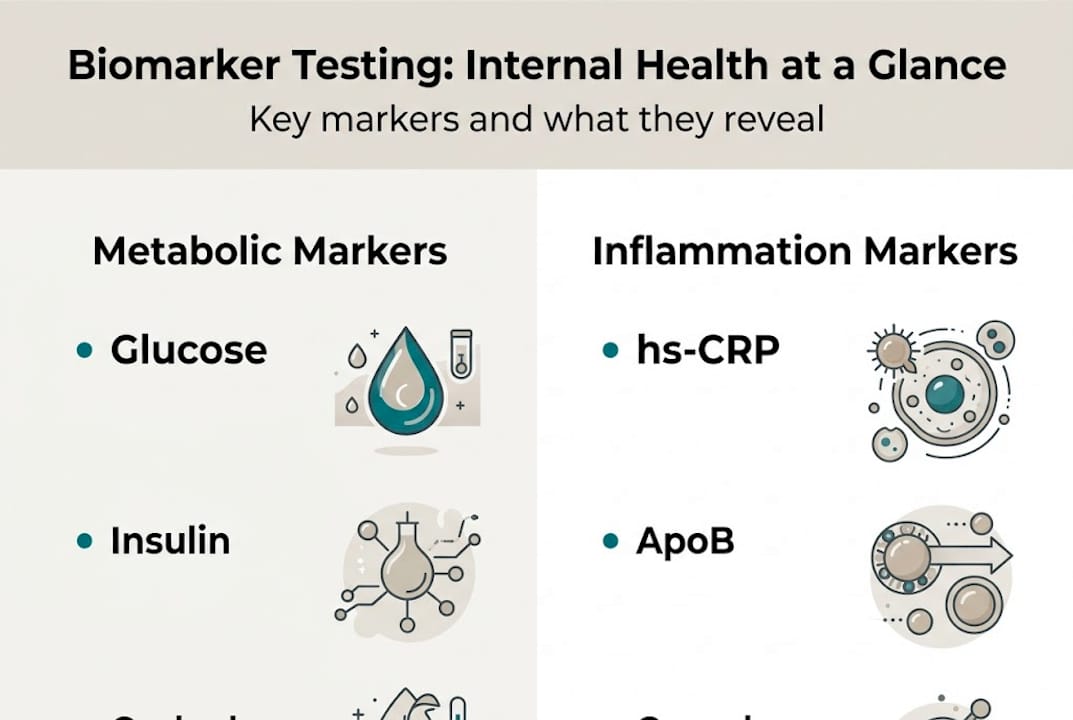
- Metabolic markers: fasting insulin, glucose, HbA1c, triglycerides
- Hormonal markers: testosterone, cortisol, DHEA, thyroid panel
- Inflammatory markers: hs-CRP, IL-6, homocysteine
- Nutrient status: vitamin D, B12, magnesium, zinc, omega-3 index
- Cardiovascular risk: ApoB, Lp(a), LDL particle size
- Amino acids and metabolic intermediates: tracked via advanced mass spectrometry
Biohackers and performance-focused individuals have shifted from reactive to proactive by using this kind of data. Instead of waiting for symptoms, they use biomarker data to spot trends, intervene early, and measure whether their interventions are actually working.
“The goal isn’t to find disease. It’s to understand your current state well enough to improve it before problems develop.”
This shift in mindset is what separates a standard health check from a genuine internal health strategy. It is not about fear. It is about having a real baseline and knowing which direction you are trending.
How biomarker testing reveals your internal health
Knowing you need more data is one thing. Knowing how to get it is another. The good news is that the testing landscape has expanded dramatically, and you no longer need a referral or a clinical visit to access detailed biomarker analysis.
Here is a quick comparison of the main testing options:
| Testing method | Panel size | Sample type | Turnaround |
|---|---|---|---|
| At-home kit (mail-in) | 28 to 120+ markers | Finger-prick or venous | 3 to 7 days |
| Clinical lab (doctor order) | Variable | Venous draw | 1 to 5 days |
| Mobile phlebotomy | Large panels | Venous draw | 2 to 5 days |
| Point-of-care device | Limited (5 to 15) | Finger-prick | Minutes |
Popular panels range from 28 to over 120 biomarkers, using finger-prick or venous draw depending on the provider. Smaller panels work well for focused tracking (like metabolic health or thyroid function), while larger panels give you a full-body snapshot.
Here is how the at-home biomarker testing process typically works:
- Order your kit online and receive it within a few days
- Follow the sample collection instructions (finger-prick lancet or venous draw with a mobile phlebotomist)
- Activate your sample with the included code and mail it to the certified lab
- Receive a digital report with your results, reference ranges, and trend data
- Use the dashboard to compare results over time or share with your practitioner
One of the most powerful developments in this space is data integration. Wearable integration enables continuous trend monitoring, so your HRV data from a smartwatch can sit alongside your cortisol and testosterone results in a single dashboard. That context makes interpretation far more meaningful.
Pro Tip: If you are new to biomarker testing, start with a mid-sized panel covering metabolic, hormonal, and inflammatory markers. You will get enough data to act on without feeling overwhelmed by 120 numbers at once.
The types of biomarkers you choose to track should align with your specific goals, whether that is longevity, athletic performance, metabolic optimization, or hormonal balance. There is no one-size-fits-all panel, but there are smart starting points.
What do your biomarkers really mean? Interpreting and applying results
Getting your results is the easy part. Making sense of them is where most people get stuck or, worse, misread what the numbers are actually telling them.

The first thing to understand is the difference between direct and derived markers. A direct marker like fasting glucose tells you your blood sugar at a single point in time. A derived marker like HOMA-IR combines fasting glucose and fasting insulin to estimate how resistant your cells are to insulin. The derived marker gives you far more clinical insight, but it requires both inputs to be meaningful.
The second distinction is between standard reference ranges and optimal ranges. Standard ranges are built from population averages, which include people who are sick, sedentary, and metabolically compromised. Optimal ranges differ from standard ranges, and trends over time are more valuable than any single result.
| Marker | Standard range | Biohacker-optimal range |
|---|---|---|
| Fasting glucose | 70 to 99 mg/dL | 72 to 85 mg/dL |
| Fasting insulin | Below 25 uIU/mL | Below 8 uIU/mL |
| Vitamin D (25-OH) | 20 to 50 ng/mL | 50 to 70 ng/mL |
| hs-CRP | Below 3.0 mg/L | Below 0.5 mg/L |
| ApoB | Below 130 mg/dL | Below 80 mg/dL |
High-leverage markers like ApoB and fasting insulin provide earlier cardiovascular and metabolic warning than general cholesterol tests. They are leading indicators, meaning they shift before disease develops. Standard LDL cholesterol, by contrast, is a lagging indicator. It reflects a problem that may already be entrenched.
Pro Tip: Do not panic over a single out-of-range result. Look at the direction of your trend across two or three tests. A marker moving toward optimal over six months tells a better story than a snapshot that looks slightly off.
Your biomarker report insights become genuinely powerful when you combine them with lifestyle context. A high cortisol reading means something different if you just finished a hard training block versus if you have been sleeping eight hours and feeling calm. Numbers need narrative.
Using actionable biomarker insights means connecting each result to a specific intervention: adjusting your diet, modifying your training load, adding a targeted supplement, or simply retesting in 90 days to see if your baseline intervention worked.
Going deeper: Limitations, edge cases, and practical applications
Biomarker testing is powerful, but it is not infallible. Understanding where it fits and what it cannot do is just as important as knowing what it reveals.
Some of the most important clinical findings come from edge cases that standard panels miss entirely. Normal cholesterol but high Lp(a) is a classic example of hidden cardiovascular risk that only shows up when you look deeper. Lp(a) is a genetic cardiovascular risk factor that does not respond to diet or exercise the way LDL does. You would never know it was elevated without testing for it specifically.
Here is when you should consider moving beyond a standard panel:
- Family history of early heart disease, stroke, or metabolic conditions
- Unexplained fatigue, mood changes, or performance decline despite good habits
- Persistent inflammation markers without an obvious cause
- Planning a significant dietary or training intervention and wanting a true baseline
- Symptoms that standard bloodwork has not explained
Advanced panels that include metabolic health tracking and amino acid profiling via mass spectrometry can surface patterns that basic chemistry panels miss. Swiss-grade mass spectrometry, for instance, can quantify dozens of amino acids and metabolic intermediates with a precision that standard immunoassay methods cannot match.
That said, there is a real risk of over-reliance. Over-monitoring can backfire if not combined with foundational habits. Tracking 120 biomarkers every month while sleeping six hours and skipping meals is not optimization. It is expensive noise.
“Data without behavior change is just a collection of numbers. The test is the starting point, not the destination.”
The best practices for biomarker analysis always include pairing your results with the fundamentals: consistent sleep, whole food nutrition, structured movement, and stress management. Biomarker testing tells you where you are. Your habits determine where you go.
Also worth noting: at-home tests do not replace clinical evaluation. Abnormal findings, especially in cardiovascular or endocrine markers, should always be reviewed with a qualified practitioner who can interpret results in the full context of your health history. The role of advanced lab testing is to inform, not to diagnose.
A new era: Proactive, personalized, but not perfect
Here is what we have learned working at the intersection of precision testing and real-world wellness: most people who invest in biomarker panels get excited about the data and then forget that the data is only as useful as the habits surrounding it.
The biohacking community sometimes treats testing as the intervention itself. It is not. It is a feedback mechanism. The real power of understanding your biomarkers comes from using trends, not snapshots, to make small, consistent adjustments over months and years.
What we find most valuable is this: biomarker testing removes the guesswork. You stop wondering if your fatigue is from low iron or low vitamin D or poor sleep. You know. And knowing lets you act with precision instead of trying five things at once and hoping one works. That is a genuine upgrade in how you manage your health. Just do not let the pursuit of perfect numbers replace the joy of actually feeling well.
Ready to unlock your internal health?
If you are serious about understanding what is actually happening inside your body, the next step is straightforward. At-home biomarker testing gives you a detailed, actionable picture of your metabolic, hormonal, and cellular health without a clinic visit or a referral.

At Biostarks, we use advanced Swiss mass spectrometry to analyze vitamins, hormones, amino acids, lipids, minerals, and metabolic markers from a simple at-home sample. Our reports are built for people who want clarity, not just numbers. Whether you are optimizing performance, tracking longevity markers, or simply building a real health baseline, explore Biostarks biomarker testing and take ownership of your internal health today.
Frequently asked questions
What is the difference between standard and optimal biomarker ranges?
Standard ranges reflect population averages, while optimal ranges are more aggressive and tailored to peak wellness and performance outcomes for individuals.
How often should I retest my internal health markers?
For most people, annual baseline testing is sufficient. Testing every 3 to 6 months is common for biohackers actively optimizing performance.
Do at-home biomarker test kits offer results as reliable as lab tests?
At-home results match labs when processed by CLIA/CAP-certified facilities, but periodic validation against a clinical lab is a smart practice.
Can biomarker panels detect silent issues before symptoms appear?
Yes. Advanced markers like hs-CRP, ApoB, and fasting insulin can flag problems before symptoms arise, enabling genuinely proactive intervention.
Are biomarker tests a substitute for seeing a doctor?
No. Biomarker testing is a powerful tool, but it should complement clinical evaluation, not replace medical diagnosis or supervision.


