

TL;DR:
- Effective nutrient tracking requires calculating energy needs and setting personalized macro and micronutrient goals.
- Using verified apps like Cronometer and tracking 3–4 days weekly improves data accuracy and habit consistency.
- Personalizing checklists based on individual labs, symptoms, and diet helps identify actual nutrient gaps for better health outcomes.
Nutrition tracking sounds straightforward until you’re staring at three conflicting macro calculators, a supplement stack with no context, and an app that’s never heard of the food you actually eat. The core mechanics of nutrient tracking involve calculating your daily energy needs, setting macro and micronutrient targets, and reviewing your data weekly — but knowing what to do and knowing how to do it well are two different things. This article gives you a structured, evidence-based checklist to cut through the noise, pick the right tools, and build a habit that produces real results — not just more data.
Table of Contents
- How to set up your core nutrient tracking checklist
- Top nutrient tracking tools: Apps, features, and accuracy
- Personalizing your checklist: Micronutrients, conditions, and context
- Weekly review and adjustment: Making your checklist work long-term
- Why most nutrient tracking advice misses the mark — and what actually works
- Take the next step with personalized nutrient tracking
- Frequently asked questions
Key Takeaways
| Point | Details |
|---|---|
| Checklist foundation | Calculate your needs, set macro and micronutrient targets, and track for reliability. |
| Choose the right tools | Use accurate apps and immediate logging for optimal tracking and minimal error. |
| Personalize for success | Tailor your checklist to dietary style, health conditions, lab data, and symptoms for best results. |
| Weekly review is key | Focus on end-of-week trends and gentle adjustments, not daily perfection. |
| Integrate biomarkers | Combine app data with laboratory biomarkers for truly individualized nutrient tracking. |
How to set up your core nutrient tracking checklist
A checklist is only as good as its foundation. Before you open a single app or log a single meal, you need to know what you’re actually measuring and why.
Here are the foundational steps to structure your tracking checklist:
- Calculate your TDEE and BMR. Your Total Daily Energy Expenditure (TDEE) and Basal Metabolic Rate (BMR) are the baseline. Setting macronutrient targets — protein at 15–20% of daily energy requirements, fat at 25–40% — and micronutrient goals based on established RDAs are essential first steps before anything else.
- Set specific micronutrient goals. Don’t just track calories. Identify 4–6 micronutrients most relevant to your health goals (iron, vitamin D, magnesium, B12) and set target ranges based on official Dietary Reference Intakes.
- Designate your tracking days. Commit to tracking 3–4 days per week, including at least one weekend day. Weekend eating patterns differ significantly from weekday patterns, and missing them skews your averages.
- Schedule a weekly review session. Block 15 minutes every Sunday (or your chosen day) to review averages, spot gaps, and adjust targets. Consistency in review matters as much as consistency in logging.
- Adapt the checklist to your diet style. Whether you’re following a vegan, ketogenic, Mediterranean, or any other pattern, your checklist items should reflect those specific nutritional risks and priorities.
Tracking 3–4 days, including a weekend day, gives you a reliability coefficient of r=0.8 or higher — meaning your data becomes genuinely predictive of your actual intake. That’s the threshold where your tracking stops being guesswork.
“The most effective nutrition tracking systems are the ones people actually use. Simplicity and personalization are not compromises — they are the strategy.” — Registered Dietitian perspective on sustainable tracking
Pro Tip: Set up your entire week’s checklist structure on Sunday night. Pre-filling your tracking days, review slot, and key nutrient targets takes under 10 minutes and dramatically increases weekly compliance.
For a broader framework that connects nutrient tracking to long-term health goals, the wellness optimization checklist from Biostarks offers a strong complement. And if you want to see how biomarkers fit into this picture from day one, reviewing biomarker checklist steps is worth your time. The Harvard diet guidelines also recommend building eating habits around whole food patterns before optimizing individual nutrients — a principle worth anchoring your checklist to.
Top nutrient tracking tools: Apps, features, and accuracy
With your checklist framework set, the next step is selecting the right tracking tools for unbeatable accuracy. Not all apps are built the same — and the differences are significant enough to affect your results.
Here’s a side-by-side comparison of the leading tools:
| App | Nutrients tracked | Accuracy | Best for |
|---|---|---|---|
| Cronometer | 84 nutrients | ±3.5% | Micronutrient depth |
| MyFitnessPal | ~20 core nutrients | Moderate | General macro tracking |
| MacroFactor | Core macros + weight trends | Adaptive | Macro optimization |
| PlateLens | Calories + macros | ±1.2% (AI photo) | Quick visual logging |
Key features to evaluate when choosing your app:
- Database size and verification. Cronometer pulls from verified USDA and NCCDB data sources, reducing the risk of user-submitted errors.
- Barcode scanning vs. AI photo logging. PlateLens uses AI photo recognition with ±1.2% calorie accuracy, which significantly outperforms manual entry.
- Adaptive macro adjustment. MacroFactor adjusts your macro targets based on real weight trend data, which is genuinely useful if your goals change over time.
- Micronutrient depth. If tracking vitamins and minerals matters to you (and it should), Cronometer’s 84-nutrient database is the clear frontrunner.
Manual entry, by contrast, carries 12–31% error rates — a gap wide enough to invalidate your data entirely. Using a digital food scale and logging immediately after eating (not at the end of the day) closes most of that gap.
Pro Tip: Log your meal the moment you plate it — not after you’ve eaten. Memory-based logging introduces portion distortion almost every time.
For anyone tracking performance or longevity goals, the importance of mineral tracking goes well beyond magnesium and calcium. Electrolytes, zinc, and selenium all have direct functional impact that most general apps underreport.
Personalizing your checklist: Micronutrients, conditions, and context
Once you know your basics and your tool, it’s time to make your checklist truly your own. A generic checklist applied to a vegan athlete with low ferritin and a desk worker with insulin resistance will produce very different results — and it should.
Here’s how to personalize your checklist systematically:
- Run baseline labs. Before adjusting targets, know where you actually stand. Ferritin, vitamin D, B12, magnesium, and fasting glucose are a practical starting set.
- Log symptoms alongside food. Fatigue, brain fog, muscle cramps, and poor sleep are often early signals of micronutrient gaps that app data alone won’t catch.
- Analyze your dietary pattern. Identify structural risks based on what you consistently eat (or avoid).
- Adjust checklist priorities based on risk. Use your lab data and symptom log to weight your tracking toward the nutrients most likely to be insufficient for you.
Here’s a quick reference for common populations and their priority nutrients:
| Population / condition | Priority nutrients to track |
|---|---|
| Vegan / plant-based | B12, iron, zinc, omega-3, calcium |
| Ketogenic diet | Electrolytes, fiber, magnesium |
| Type 2 diabetes | Carbohydrates, glucose load, fiber |
| Older adults (65+) | Vitamin D, calcium, B12, protein |
| Endurance athletes | Iron, sodium, magnesium, carbohydrates |
Micronutrient insufficiencies affect around 30% of adults, yet most people tracking nutrition are only monitoring calories and three macronutrients. That’s a significant blind spot.

Fat-soluble vitamins — A, D, E, and K — deserve a specific flag on your checklist. Unlike water-soluble vitamins, they accumulate in tissue and over-supplementation carries real toxicity risk. Food-first is always the safer starting point.
Pro Tip: Before adding any supplement to your routine, check whether your diet can realistically provide that nutrient. Most single-nutrient gaps can be closed with targeted food swaps rather than pills.
For a structured approach to uncovering what your body is actually missing, identifying micronutrient deficiencies is a practical next read. And if you want to understand how at-home biomarker testing fits into a personalized tracking system, that guide lays out the full picture.
Weekly review and adjustment: Making your checklist work long-term
Personalizing your checklist is only the beginning — true progress comes from ongoing review and smart tweaks. Most people set up their tracking system and then never adjust it, which is how good habits turn into stale routines.
Here’s what a productive end-of-week review looks like:
- Average your macros and calories. Don’t evaluate individual days. Look at 3–4 day averages to identify genuine trends.
- Check micronutrient gaps. Which nutrients consistently fall below 80% of your target? Those are your real priorities.
- Cross-reference symptoms and biomarkers. If fatigue spiked mid-week, what does your iron or B12 average look like? Connect the dots.
- Note friction points. Which meals are hardest to log accurately? Identify one fix per week — a better scale, a saved meal template, or a pre-logged recipe.
- Recalibrate targets if needed. If your weight, activity level, or health goals shifted, update your TDEE and macro targets accordingly.
Personalized checklists and consistent feedback increase tracking adherence by 15–25%, which compounds significantly over months. That’s not a small difference — it’s the gap between people who see results and people who quit by February.
“Stop evaluating yourself on yesterday’s numbers. Weekly trends are where the real signal lives — daily data is just noise waiting to be averaged out.” — Sports dietitian on sustainable tracking psychology
Research published in nutrition adherence studies confirms that tracking flexibility — focusing on weekly patterns rather than daily perfection — reduces psychological burden without sacrificing accuracy.
Connecting your review sessions to broader health goals makes them feel purposeful rather than mechanical. Using wellness optimization strategies alongside your weekly check-in keeps the bigger picture in view. And if you want to understand how data transforms personalized wellness, that connection between tracking and biomarker feedback is exactly where the leverage is.
Why most nutrient tracking advice misses the mark — and what actually works
Here’s what most nutrition tracking content gets wrong: it treats tracking as a data entry problem when it’s actually a signal interpretation problem. Logging your meals accurately is table stakes. The real work is knowing what the numbers mean for your body specifically.
Generic advice focused on calories and macros misses the nuances entirely. Manual tracking error rates of 40–60% mean that without weighing food and using verified databases, your data may be directionally correct at best. And without real lab data, you’re optimizing against targets that may not even apply to you.
The practitioners who get the best outcomes with their clients — and the individuals who actually sustain their tracking habits long-term — share two behaviors. They combine app data with periodic lab testing. And they focus on food variety and trend direction rather than daily totals. Consulting nutritionist biomarker outcomes research makes the case clearly: biomarkers change the conversation from “am I hitting my targets?” to “are my targets actually working?”
Tracking precision matters. But it only becomes powerful when it’s anchored to real biological feedback.
Take the next step with personalized nutrient tracking
Your checklist is built. Your tool is selected. Your review cadence is set. The final lever — the one most tracking guides leave out — is knowing whether your targets are calibrated to your actual biology.
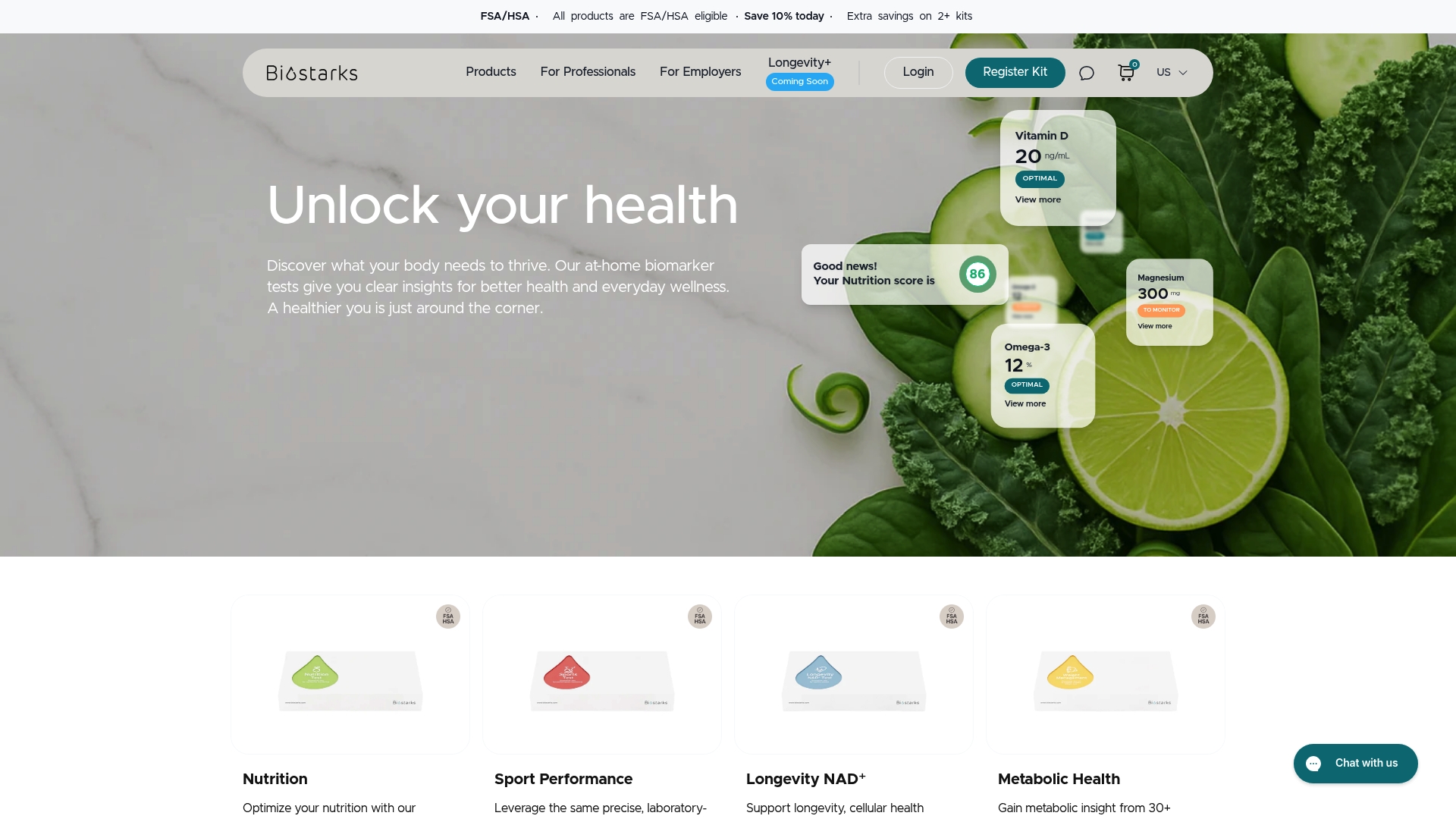
Biostarks offers personalized laboratory testing that analyzes vitamins, minerals, hormones, amino acids, and metabolic markers using advanced Swiss mass spectrometry — the same precision used in clinical research, delivered at home. Pair your checklist with real biomarker data and you stop guessing about what your body needs. If you’re ready to see what at-home biomarker tracking looks like in practice, that’s where to start. Precision tracking deserves precision data.
Frequently asked questions
How many days do I need to track nutrients for reliable results?
Tracking 3 to 4 days, including at least one weekend day, gives you a reliability coefficient of r=0.8–0.85 — enough to make your intake estimates genuinely predictive.
Which nutrient tracking app is most accurate?
Cronometer leads for micronutrient depth with 84 nutrients tracked at ±3.5% accuracy, while PlateLens AI photo logging achieves ±1.2% calorie accuracy for users who prefer visual logging over manual entry.
What if I eat a special diet, like vegan or keto?
Personalize your checklist based on your diet’s structural gaps: vegans should monitor B12, iron, zinc, and omega-3, while keto followers should add electrolytes and fiber to their priority list.
Should I aim for daily perfection in tracking?
No. Weekly trends outperform daily perfection every time — focusing on consistency over 3–4 days reduces tracking stress while preserving the accuracy that matters.
How do lab tests and symptoms help my tracking?
Lab tests and symptom logs establish your real baseline nutrient status, allowing you to calibrate targets to your biology rather than population averages alone.
Recommended
- 7 Key Steps for a Complete Biomarker Checklist | Biostarks
- Track metabolic health: at-home biomarker tes… | Biostarks
- Wellness optimization checklist: 25% better m… | Biostarks
- 7 Ways to Track Metabolic Health Naturally fo… | Biostarks
- Irish moss explained: benefits and risks for women over 40 – Caribella


