

Many people assume all biomarker tests deliver equally reliable results, but that’s far from true. Precision testing reveals critical differences in how consistently tests measure your health markers. For athletes and health-conscious individuals relying on biomarker data to optimize performance and wellness, understanding precision tests isn’t optional. These specialized protocols assess whether your test results are reproducible and trustworthy, directly impacting the decisions you make about nutrition, training, and recovery. Without validated precision, you’re building your health strategy on shifting sand.
Table of Contents
- Key takeaways
- What precision tests are and why they matter
- How precision is measured: methodology and standards
- Nuances and challenges in biomarker precision testing
- Practical tips for interpreting and using precision test results
- Explore reliable biomarker testing with Biostarks
- Frequently asked questions
Key Takeaways
| Point | Details |
|---|---|
| Precision testing purpose | Precision testing assesses whether biomarker results are reproducible and trustworthy across identical samples. |
| Replicates over days | Labs perform two to three replicate measurements over five days to capture repeatability and reproducibility. |
| Impact on decisions | Precise measurements help athletes and health planners distinguish real changes from noise. |
| Factors affecting precision | Storage, transport, reagent batch differences, instrument calibration, analyst training, and environmental conditions all influence precision and must be controlled. |
| Ask for precision data | Ask providers for precision validation data and coefficient of variation values to judge reliability. |
What precision tests are and why they matter
Precision tests refer to laboratory verification protocols standardized by CLSI EP15-A3 to assess the reproducibility and repeatability of quantitative biomarker assay measurements. Think of precision as the test’s ability to hit the same target repeatedly. When you measure vitamin D levels three times using a precise method, you should get nearly identical results each time. Variability indicates problems with the assay itself, not changes in your biology.
The CLSI EP15-A3 protocol represents the gold standard for precision evaluation. Labs run 2-3 replicate measurements over 5 days using the same samples and equipment. This approach captures both repeatability, which measures consistency within a single run, and reproducibility, which assesses consistency across different days and conditions. The protocol generates statistical metrics like standard deviation and coefficient of variation that quantify how much results fluctuate.
These metrics matter enormously for practical applications. A test with poor precision might show your testosterone levels varying by 20% day to day, even though your actual levels remain stable. You’d waste time and money chasing phantom deficiencies or celebrating false improvements. Precise tests eliminate this noise, revealing true biological patterns.
For athletes and health optimizers, precision builds the foundation for actionable insights. You need confidence that a 15% increase in your ferritin levels reflects real iron status improvement, not measurement error. Without validated precision, you’re essentially guessing whether interventions work. The step-by-step guide to at home blood testing becomes far more valuable when backed by precise measurements.
Key factors affecting precision include:
- Sample stability during storage and transport
- Reagent consistency across different batches
- Instrument calibration and maintenance protocols
- Analyst technique and training standardization
- Environmental conditions like temperature fluctuations
Pro Tip: When evaluating any biomarker test, ask the provider for their precision validation data. Reputable companies openly share coefficient of variation values and testing protocols. If they can’t provide this information, consider it a red flag.
Poor precision creates cascading problems beyond individual results. It undermines longitudinal tracking, where you monitor biomarkers over months to assess trends. If your test has high variability, you can’t distinguish meaningful changes from random fluctuations. This defeats the entire purpose of regular monitoring for performance optimization or preventive health.
How precision is measured: methodology and standards
The established methodology for precision testing follows rigorous statistical principles designed to capture real-world variability. The methodology involves running multiple replicates of control samples over several days to calculate repeatability (SDr) and reproducibility (SDi), verifying if methods meet precision specs such as CV <5-10%. This multi-day approach ensures the test performs consistently under varying conditions that mirror actual use.
Here’s the typical precision testing workflow:
- Select control samples representing low, medium, and high biomarker concentrations
- Run 2-3 replicate measurements of each sample daily for 5 consecutive days
- Calculate within-run repeatability using standard deviation from same-day replicates
- Calculate between-day intermediate precision using data across all testing days
- Express results as coefficient of variation percentage for easy interpretation
- Compare calculated values against predetermined acceptance criteria
The coefficient of variation provides an intuitive precision metric. It expresses standard deviation as a percentage of the mean value, making comparisons across different biomarkers straightforward. A CV of 5% means results typically vary by plus or minus 5% from the average.

FDA 2025 guidance requires biomarker precision validation using ICH M10 principles, with CV thresholds of ≤15-20% at low levels and ≤5-10% at higher concentrations. These thresholds reflect practical realities. At the lower limit of quantification, where you’re detecting tiny amounts of a substance, some additional variability is inevitable and acceptable. As concentrations increase, precision should improve dramatically.
| Concentration Level | Acceptable CV Range | Practical Implication |
|---|---|---|
| LLOQ (detection limit) | 15-20% | Higher variability tolerated for trace amounts |
| Low-mid range | 10-15% | Moderate precision for emerging deficiencies |
| Mid-high range | 5-10% | Tight precision for optimal health monitoring |
| High concentrations | <5% | Excellent precision for toxicity detection |
Regulatory standards exist because precision directly impacts clinical and personal health decisions. The FDA adapted ICH M10 pharmaceutical guidelines for endogenous biomarkers, recognizing their unique challenges. Unlike drug compounds where you can create pure standards, endogenous substances like hormones or vitamins exist naturally in blood, requiring different validation approaches.
Pro Tip: Pay special attention to precision data at the concentration ranges relevant to your health goals. If you’re monitoring vitamin D for deficiency prevention, precision at 20-40 ng/mL matters more than precision at 80 ng/mL. Check whether validation covers your target range.
These rigorous protocols ensure that when you receive biomarker results, the numbers reflect your actual biology rather than laboratory variability. The best practices for biomarker analysis success start with validated precision, then build interpretation and action planning on that solid foundation.
Nuances and challenges in biomarker precision testing
Endogenous biomarkers lack standard reference materials, so authentic samples are used for nominal values, with stability and matrix effects being critical for precision assessment. This creates unique validation challenges. You can’t simply spike a clean sample with known amounts of testosterone or vitamin B12 because the biological matrix affects how assays perform. Real blood contains proteins, lipids, and countless other compounds that interact with measurement chemistry.
Matrix effects represent one of the trickiest precision challenges. Chemical interactions within blood can enhance or suppress assay signals, creating variability that standard protocols might miss. A test might show excellent precision with spiked samples but perform poorly with authentic biological specimens. This is why validation must use real patient samples across diverse populations.
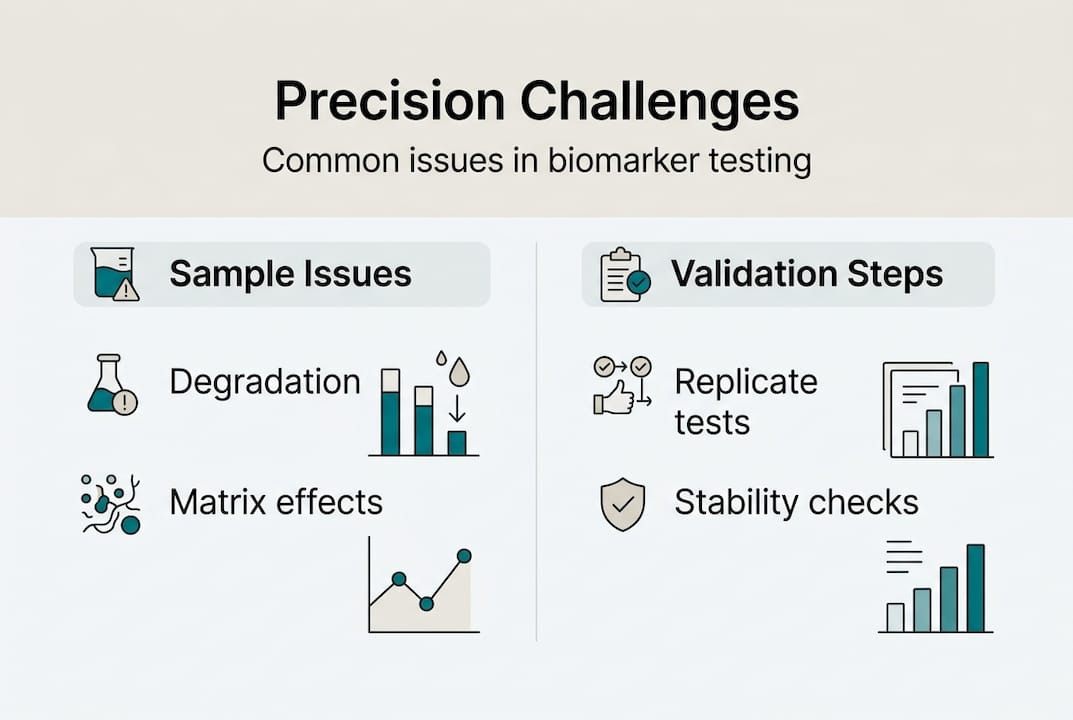
Sample stability adds another layer of complexity. Many biomarkers degrade over time or with temperature fluctuations. Vitamin C, for example, oxidizes rapidly after collection. If samples degrade inconsistently during storage or transport, precision suffers even if the assay itself performs flawlessly. At-home testing introduces additional stability considerations since samples travel through mail systems.
At-home DBS/finger-prick methods validated to precision <8% CV can approach lab-grade accuracy, while lab visit kits often exhibit less precision due to variability. This finding surprises many people who assume traditional lab draws always outperform at-home methods. The reality is more nuanced. Dried blood spot technology, when properly validated, offers remarkable stability and precision.
Key factors affecting at-home test precision:
- Sample collection technique consistency across users
- Blood spot drying time and environmental humidity
- Card storage conditions before and during shipping
- Transit time from collection to laboratory analysis
- Extraction efficiency from dried blood matrix
| Testing Method | Typical CV Range | Key Advantages | Main Challenges |
|---|---|---|---|
| Venous lab draw | 8-12% | Large sample volume | Phlebotomy variability, transport issues |
| At-home DBS (validated) | <8% | Sample stability, convenience | Collection technique variation |
| At-home liquid blood | 10-15% | Familiar format | Stability concerns, shipping restrictions |
| Saliva/urine at-home | 12-18% | Non-invasive | Matrix complexity, limited biomarkers |
The superior precision of validated DBS methods stems from sample stability. Once blood dries on the collection card, most biomarkers remain remarkably stable for days or weeks. This eliminates the degradation issues that plague liquid samples during transport. Additionally, the small sample volume required reduces collection variability compared to filling multiple vials.
Athletes benefit tremendously from the convenience of frequent at-home testing, but must verify precision validation. A test you can take weekly provides far more actionable data than quarterly lab visits, assuming precision remains comparable. The wellness testing process guide health insights emphasizes this balance between convenience and analytical quality.
Pro Tip: When comparing at-home tests, specifically ask about precision validation using the actual collection method you’ll use. Some companies validate their assays using venous blood but sell finger-prick kits. The precision data won’t transfer unless they’ve specifically validated the DBS collection method.
Practical tips for interpreting and using precision test results
Check if your test reports key precision metrics and follows recognized protocols like CLSI or FDA guidelines. Reputable providers publish validation data showing coefficient of variation values for each biomarker. If this information isn’t readily available on their website or in test documentation, request it directly. Companies confident in their precision openly share these details.
Understand that variability affects how you interpret changes over time. If a test has 10% CV and your vitamin D increases from 30 to 33 ng/mL, that 10% change falls within measurement variability. You can’t confidently say your levels improved. However, an increase from 30 to 45 ng/mL clearly exceeds variability and represents real biological change. This principle guides meaningful interpretation.
Prioritize tests with validation data on the specific sample type you’ll provide. Generic precision claims mean little without method-specific validation. A company might tout excellent precision for their laboratory assays while offering at-home kits that haven’t undergone equivalent validation. Insist on seeing precision data for finger-prick DBS if that’s how you’ll collect samples.
Critical evaluation factors:
- Published CV values for each biomarker at relevant concentration ranges
- Validation using authentic biological samples, not just spiked controls
- Sample size and diversity in validation studies
- Independent third-party verification when possible
- Transparent methodology documentation
The sports biomarker testing market grows rapidly but lacks evidence that routine testing improves performance beyond addressing deficiencies such as iron levels in endurance athletes. This sobering reality check matters for interpretation. Use biomarker results as one tool among many, not a crystal ball. Precision testing ensures your data is reliable, but reliability doesn’t automatically translate to performance gains.
Extreme values or clear deficiencies provide the most actionable insights. If your ferritin drops to 15 ng/mL, you have an iron storage problem worth addressing regardless of minor measurement variability. Conversely, obsessing over whether your testosterone is 520 or 580 ng/dL when both fall in healthy ranges wastes mental energy. Precision matters most when results guide specific interventions.
Frequent testing with precise methods enables better long-term monitoring. Monthly or quarterly measurements reveal trends that single snapshots miss. You can track whether your vitamin D supplementation strategy works or if training stress depletes your magnesium stores. Precision ensures these trends reflect biology, not measurement noise.
The athlete blood testing performance framework emphasizes using validated tests to establish individual baselines, then monitoring deviations. Your optimal biomarker ranges might differ from population averages. Precise testing lets you identify your personal targets through consistent measurement over time.
Pro Tip: Create a simple spreadsheet tracking your biomarker results over time. Include the test’s reported CV for each marker. When values change, calculate whether the change exceeds 2-3 times the CV. This quick check separates meaningful shifts from random variation, helping you make smarter intervention decisions.
Don’t ignore the broader health context when interpreting precise biomarker data. A precise test showing low vitamin D means little if you never consider sun exposure, dietary intake, or supplementation. Biomarkers provide one data stream. Combine them with symptoms, performance metrics, and lifestyle factors for comprehensive health optimization. The biomarker interpretation health insights resource helps integrate laboratory data with real-world application.
Explore reliable biomarker testing with Biostarks
Now that you understand precision testing’s critical role in biomarker analysis, you need a provider that delivers validated, trustworthy results. Biostarks offers at-home tests validated for accuracy and precision using protocols aligned with CLSI and FDA guidelines. Our easy-to-use kits provide lab-grade biomarker data from dried blood spot samples, combining convenience with analytical rigor.
Personalized insights help athletes and health-conscious individuals optimize wellness and performance through actionable data you can trust. Our Swiss mass spectrometry techniques deliver the precision you need for confident decision making. Visit Biostarks to learn more about our validated testing approach and order your precision biomarker testing kit today. Take control of your health optimization journey with measurements that matter.
Frequently asked questions
What exactly are precision tests in biomarker analysis?
Precision tests are standardized laboratory protocols that verify how consistently a biomarker assay produces the same result when measuring identical samples repeatedly. They quantify measurement variability using statistical metrics like coefficient of variation, ensuring test results reflect true biology rather than random fluctuations.
How do endogenous samples differ from spiked samples in precision validation?
Endogenous samples contain biomarkers naturally present in real blood, including all the complex matrix effects from proteins and lipids that affect measurements. Spiked samples artificially add known amounts of a biomarker to clean matrix, potentially missing real-world interference patterns. Authentic biological samples provide more realistic precision validation.
Why does precision matter more at some concentration levels?
At very low concentrations near detection limits, measuring tiny amounts inherently involves more variability, so 15-20% CV is acceptable. At higher concentrations, technical factors dominate and precision should improve to 5-10% CV or better. This reflects both analytical capabilities and practical needs for clinical decisions.
How does at-home test precision compare with traditional lab testing?
Validated at-home dried blood spot methods can achieve precision under 8% CV, often matching or exceeding traditional venous draws that show 8-12% CV. The key difference is sample stability; dried blood remains stable during shipping while liquid samples may degrade, introducing variability. Collection technique training matters for both methods.
What precision metrics should I look for when choosing a biomarker test?
Look for published coefficient of variation values under 10% for most biomarkers, with documentation showing validation using the actual sample collection method you’ll use. Verify the company tested authentic biological samples across relevant concentration ranges and followed recognized protocols like CLSI EP15-A3 or FDA biomarker guidance.


