

Feeling great after a workout doesn’t mean your body is performing optimally at the cellular level. Many health-conscious individuals track steps, sleep scores, and body composition, but these external signals only tell part of the story. Your internal health status, measured through specific blood biomarkers, reveals what no mirror or fitness tracker can show: inflammation levels, hormonal balance, metabolic efficiency, and nutrient deficiencies that silently limit your performance and longevity. This guide breaks down what internal health status actually measures, which biomarkers matter most, how scores are built from raw data, and how you can apply this knowledge to make smarter decisions about your health.
Table of Contents
- Understanding internal health status: More than meets the eye
- Key biomarkers for internal health: What to track and why
- The science behind health scores: Grouping, tracking, and improvement
- Understanding biomarker fluctuations and advanced testing limitations
- Why internal health status is the true foundation of performance
- Ready to unlock your internal health status?
- Frequently asked questions
Key Takeaways
| Point | Details |
|---|---|
| Internal health status matters | Knowing your internal biomarkers gives a clearer, more actionable picture of health than relying on how you feel. |
| Track optimal—not just normal—values | For athletes and health enthusiasts, tracking optimal biomarker ranges is better for performance and longevity than standard norms. |
| Scores and trends guide improvement | Grouped biomarker scores and retesting reveal true progress and help you target the right habits for lasting change. |
| Retesting is critical | Individual biomarker levels fluctuate, so repeat testing helps you interpret trends and act confidently. |
| Expert review enhances value | General guidance helps, but clinical interpretation of your results ensures you avoid pitfalls and get the best outcomes. |
Understanding internal health status: More than meets the eye
Internal health status is the measurable state of your body’s biological systems, captured through laboratory analysis of blood, urine, or other biological samples. It’s not about how you look or how energetic you feel on a given Tuesday morning. It’s about what your blood biomarkers are actually doing, from iron stores to inflammatory proteins to hormone levels.
The role of biomarkers in health assessment has grown significantly as testing technology has become more accessible. A comprehensive panel typically includes 40 or more markers spanning nutrients, hormones, metabolic indicators, and cardiovascular risk factors. Each one provides a data point that, in isolation, tells a small story. Together, they paint a detailed picture of where your body is thriving and where it’s quietly struggling.
Here’s why this distinction matters so much for fitness and wellness goals:
- External indicators (weight, appearance, energy levels) are lagging signals. By the time they change noticeably, internal imbalances may have been building for months.
- Internal biomarkers are leading signals. They shift before symptoms appear, giving you the opportunity to intervene early.
- Subjective feelings are unreliable for precision optimization. Two athletes with identical training loads can have dramatically different ferritin levels, recovery capacity, and hormonal profiles.
- Biomarker data is objective, repeatable, and comparable over time, making it the foundation for real performance optimization.
Tracking 40+ biomarkers is key for performance, recovery, and longevity, giving athletes and health-focused individuals the data they need to move beyond guesswork.
This is the core shift that separates reactive health management from proactive optimization. You stop waiting to feel bad before making changes. Instead, you use data to stay ahead.
Key biomarkers for internal health: What to track and why
With internal health defined, let’s get specific about the key data points that matter most and how to interpret them.
Not all biomarkers carry equal weight. Some are foundational for everyone; others become especially critical depending on training intensity, age, or health goals. The important nuance here is that optimal biomarker ranges differ from standard “normal” lab values and can be tailored specifically for athletes and high performers.
| Biomarker | What it measures | Standard normal range | Optimal for performance |
|---|---|---|---|
| Ferritin | Iron storage | 15+ ng/mL | 50 to 100 ng/mL |
| Vitamin D | Immune, bone, muscle function | 20+ ng/mL | 40 to 60 ng/mL |
| hsCRP | Systemic inflammation | Below 3 mg/L | Below 1 mg/L |
| Testosterone | Hormonal balance, recovery | Age-dependent | Upper third of range |
| Fasting glucose | Metabolic health | Below 100 mg/dL | 70 to 85 mg/dL |
| ApoB | Cardiovascular risk | Below 130 mg/dL | Below 90 mg/dL |
The categories worth tracking regularly include:
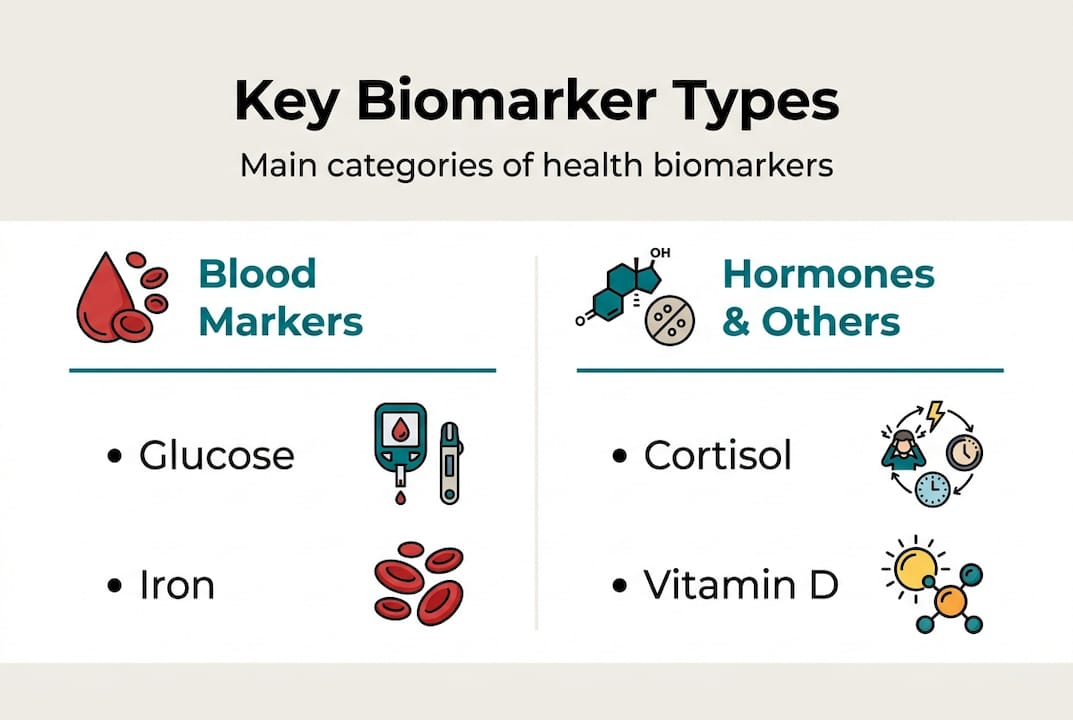
- Iron and ferritin: Low ferritin is one of the most common and overlooked causes of fatigue and poor endurance in athletes, even when hemoglobin looks normal.
- Vitamin D: Affects muscle function, immune response, and mood. Deficiency is widespread even in active individuals who spend time outdoors.
- hsCRP: High-sensitivity C-reactive protein is a sensitive marker of low-grade inflammation that can blunt recovery and accelerate aging.
- Hormones: Testosterone, cortisol, and thyroid markers reflect stress load, recovery capacity, and metabolic rate.
- Glucose and insulin: Fasting glucose and insulin resistance markers reveal how efficiently your body manages energy, which directly impacts body composition and endurance.
- Lipids (ApoB and LDL): ApoB is a more precise cardiovascular risk marker than standard LDL cholesterol alone.
Exploring the full range of types of biomarkers used in personal health assessment helps you understand which panels are worth prioritizing based on your specific goals, whether that’s endurance performance, body composition, or longevity.
Pro Tip: A single test is a snapshot, not a story. Retest every three to four months to identify trends, because biomarkers fluctuate naturally and trends reveal far more than any single reading.
The science behind health scores: Grouping, tracking, and improvement
Once you know which biomarkers to track, it’s crucial to understand how this data becomes actionable through health scoring and progress tracking.

Raw numbers from a lab report are hard to act on without context. Health scoring systems translate biomarker data into structured categories that show you where you stand and what to prioritize. Platforms like InsideTracker, for example, categorize biomarkers into 10 healthspan groups, with data showing that 80% of users improve at least one biomarker after receiving personalized recommendations.
| Healthspan category | Key biomarkers tracked |
|---|---|
| Metabolism | Glucose, insulin, HbA1c |
| Heart health | ApoB, LDL, triglycerides, blood pressure |
| Inflammation | hsCRP, white blood cell count |
| Hormones | Testosterone, cortisol, DHEA |
| Cognition and mood | Vitamin B12, folate, omega-3 index |
Here’s how raw data becomes a score you can actually use:
- Sample collection: Blood or urine is collected, ideally under standardized conditions (fasted, same time of day).
- Lab analysis: Biomarkers are measured using validated methods, such as mass spectrometry for precision markers.
- Range comparison: Each result is compared against both standard reference ranges and optimized ranges for your age, sex, and activity level.
- Category scoring: Results are grouped into health domains (metabolism, inflammation, hormones, etc.) and scored based on how many markers fall within optimal zones.
- Trend analysis: Scores are tracked over time, showing whether interventions like dietary changes or supplementation are actually moving the needle.
- Personalized recommendations: Specific actions are suggested based on which markers are out of range and by how much.
The using biomarker insights framework is what turns a lab report into a health strategy. You stop guessing which supplement to take or which training adjustment to make. The data tells you directly. Platforms built to track metabolic health through biomarkers make this process repeatable and measurable over months and years.
Understanding biomarker fluctuations and advanced testing limitations
As you apply these insights, it’s vital to understand the nuances and limitations, because what can affect your numbers is something most people miss entirely.
Biomarkers are not static. They respond to everything your body experiences, from a hard training session to a poor night’s sleep. Biomarker trends matter more than one-off readings, and results should always complement, not replace, a doctor’s evaluation.
Common causes of biomarker fluctuation include:
- Intense exercise: Can temporarily elevate hsCRP, creatine kinase, and white blood cell count, making inflammation markers look worse than they are.
- Poor sleep: Raises cortisol and disrupts glucose regulation, skewing metabolic markers.
- Stress: Chronically elevated cortisol suppresses testosterone and immune function markers.
- Menstrual cycle phase: Estrogen and progesterone shift significantly across the cycle, affecting iron, ferritin, and inflammatory markers.
- Hydration status: Affects blood concentration and can artificially alter values for several markers.
- Time of day: Cortisol peaks in the morning and drops by afternoon. Testosterone follows a similar pattern.
Understanding biomarker testing benefits means also understanding when your results might not reflect your true baseline. Proper biomarker interpretation always accounts for context, not just numbers.
Pro Tip: Always test at the same time of day, in a fasted state when required, and avoid testing within 48 hours of a hard workout. For women, note where you are in your cycle to ensure consistent comparisons across retests.
Biomarker testing is a powerful tool, but it is not a diagnostic service. It does not replace clinical evaluation, and outlier results should always be reviewed with a qualified healthcare provider who can factor in your full medical history.
Why internal health status is the true foundation of performance
Most mainstream fitness content focuses on training variables: volume, intensity, recovery protocols. These matter. But they all operate on top of a biological substrate that most people never actually measure. That’s the gap internal health status fills.
The uncomfortable truth is that external optimization has a ceiling when internal health is compromised. You can follow the perfect program and eat a clean diet, but if your ferritin is at 18 ng/mL, your vitamin D is at 22 ng/mL, and your hsCRP is quietly elevated, your results will plateau in ways that no training tweak can fix.
Services like InsideTracker use proprietary optimal ranges drawn from large research databases, which is a significant step forward. But clinician review remains vital for outliers, because optimal ranges are population-level starting points, not personalized prescriptions. The data empowers you; the expert helps you act on it correctly.
Democratized testing tools have made internal health data accessible to anyone, not just elite athletes with team physicians. That’s genuinely transformative. But accessibility doesn’t mean interpretation becomes automatic. The value of unlocking health data comes from pairing it with context, consistency, and qualified guidance.
Pro Tip: Treat your first biomarker panel as a baseline, not a verdict. The real value builds over multiple tests as you identify your personal patterns and response to interventions.
Ready to unlock your internal health status?
Understanding your internal health status is one thing. Actually measuring it is where real change begins. Biostarks offers advanced biomarker testing designed for health-conscious individuals and athletes who want precise, actionable data about their internal biology, using Swiss mass spectrometry for the highest analytical accuracy available.
Whether you’re optimizing performance, tracking longevity markers, or simply want to understand what’s happening beneath the surface, Biostarks provides the panel depth and reporting clarity to make that possible. If you want to go deeper before testing, explore the role of biomarkers for athletes to understand exactly how this data translates into performance gains. Your biology is already generating the data. Now it’s time to read it.
Frequently asked questions
What is internal health status?
Internal health status is a measure of your wellness based on laboratory biomarkers like hormones, vitamins, and inflammation markers, rather than how you feel or look. It provides objective, measurable data about your body’s biological systems.
Which biomarkers are most important for athletes?
Athletes should prioritize iron (ferritin), vitamin D, hsCRP, hormones, fasting glucose, and lipids like ApoB for performance and recovery. Tracking 40+ biomarkers gives a complete picture of where training adaptations are supported or limited.
How often should you test biomarkers?
Testing every three to four months is ideal for identifying meaningful trends, since results fluctuate based on exercise, sleep, stress, and other lifestyle factors. Single snapshots rarely tell the full story.
Can internal health status testing replace doctor visits?
No. Biomarker testing is not diagnostic and should complement, not replace, regular medical checkups. Biomarker testing adds precision data to your health picture, but clinical evaluation remains essential for proper interpretation and diagnosis.


