

TL;DR:
- Preventative health involves proactively implementing screenings, vaccinations, and lifestyle changes tailored to individual risk profiles to reduce disease onset. It encompasses clinical measures like blood pressure checks, cancer screenings, mental health assessments, and expanding biomarker monitoring for comprehensive internal health insights. Practicing prevention effectively requires continuous management, risk level awareness, and personalized strategies beyond annual checkups, supported by insurance coverage and informed clinical decisions.
Preventative health is defined as the practice of blocking, delaying, or reducing illness before symptoms appear, using screenings, vaccinations, counseling, and lifestyle management tailored to an individual’s risk profile. The term “preventive healthcare” is the standard clinical designation, though “preventative health” is widely used interchangeably. According to the Merck Manual, preventive care differs from traditional medical care by focusing on early diagnosis and risk reduction rather than treating existing disease. This distinction matters because catching a problem at stage one is categorically different from managing it at stage four. Understanding what preventative health means, and how to practice it, is the most direct path to a longer, healthier life.
What is preventative health and what does it include?
Preventative health encompasses every medical and lifestyle activity designed to stop disease before it takes hold. The CMS defines preventive services as including blood pressure checks, cholesterol panels, diabetes testing, cancer screenings, vaccinations, depression screening, and counseling on diet and physical activity. This is a broader category than most people realize. A flu shot is preventive care. So is a conversation with your doctor about quitting smoking or managing work-related stress.
The core components fall into four practical categories:
- Clinical screenings: Blood pressure measurement, fasting glucose, lipid panels, colonoscopy, mammography, Pap smears, and skin cancer checks
- Vaccinations: Influenza, pneumococcal, shingles (Shingrix), HPV, and COVID-19 boosters based on age and risk
- Mental health assessments: Depression and anxiety screenings, cognitive function evaluations, and substance use risk assessments
- Lifestyle counseling: Structured guidance on nutrition, physical activity, sleep hygiene, and stress reduction
Beyond these clinical touchpoints, precision health tools are expanding what preventive monitoring looks like. Biomarker testing, which measures internal indicators like lipids, hormones, amino acids, and metabolic markers, provides a layer of data that annual check-ups rarely capture. Proactive health monitoring gives you a real-time picture of your internal health status, not just a snapshot taken once a year.
Pro Tip: Schedule your annual wellness visit and your biomarker panel at the same time each year. Pairing clinical screenings with metabolic data gives you a complete picture rather than two separate, disconnected snapshots.

What are the five levels of preventive health?
Prevention is not a single action. It operates across five distinct levels, each targeting a different stage in the disease process. StatPearls outlines these levels to help clinicians and individuals time interventions for maximum effect.
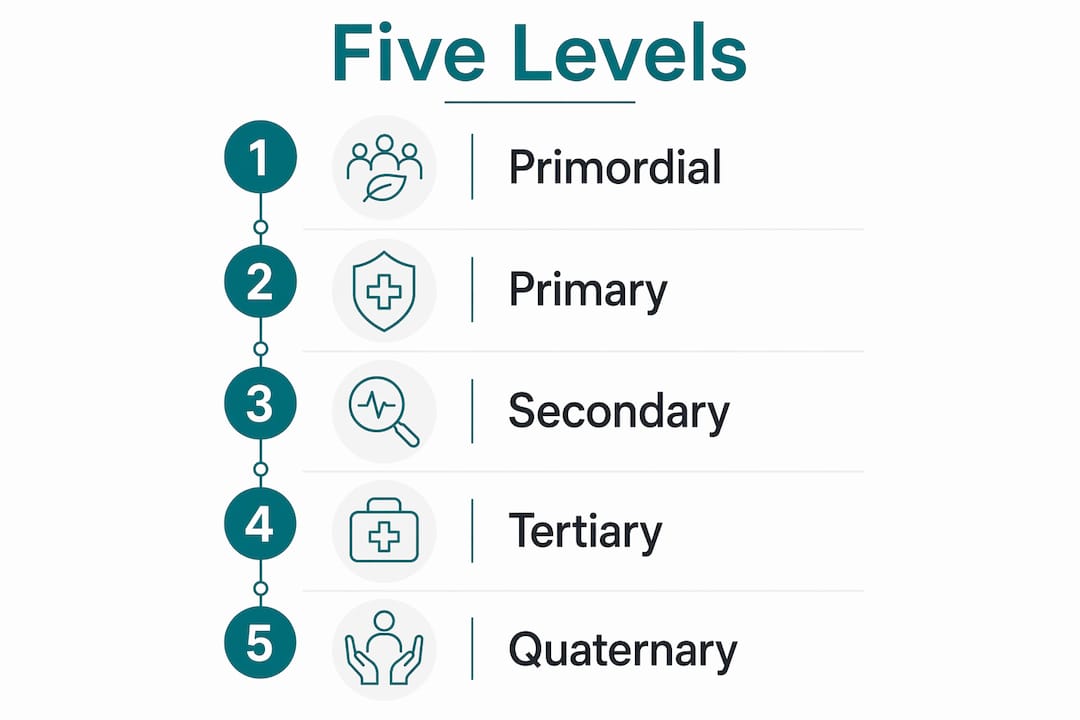
| Level | Target | Clinical example |
|---|---|---|
| Primordial | Social and environmental risk factors before they develop | Reducing air pollution exposure, improving food access in communities |
| Primary | Preventing disease onset by modifying personal risk factors | Vaccination, smoking cessation, regular exercise |
| Secondary | Early detection to reduce complications | Mammography, colonoscopy, fasting glucose screening |
| Tertiary | Managing existing disease to prevent further damage | Cardiac rehabilitation after a heart attack |
| Quaternary | Protecting against harm from overmedication or unnecessary procedures | Avoiding unnecessary antibiotics or redundant imaging |
Most people think of prevention as primary prevention: don’t smoke, exercise regularly, eat well. That is correct but incomplete. Secondary prevention, catching hypertension or pre-diabetes before it becomes a crisis, is where clinical screenings earn their value. Tertiary prevention is where chronic disease management programs like cardiac rehab or diabetes education classes operate. Quaternary prevention is the least discussed but increasingly relevant, as matching interventions to disease stage prevents the harm that comes from overtreating low-risk findings.
Understanding these levels also corrects a common misconception: a colonoscopy does not prevent colon cancer in the primary sense. It detects it early (secondary prevention) or removes precancerous polyps (primary prevention at a cellular level). Knowing which level you are operating at helps you set realistic expectations for any given intervention.
Pro Tip: Ask your doctor which level of prevention each recommended test addresses. This one question transforms a routine check-up into a strategic conversation about your actual risk profile.
How does U.S. insurance cover preventive services?
The Affordable Care Act (ACA) requires most health insurance plans to cover recommended preventive services at no cost to the patient, meaning no deductible, no copay, and no coinsurance. The AMA has documented that this first-dollar coverage is a direct driver of early diagnosis and reduced long-term healthcare costs. When patients pay nothing out of pocket, they use these services. When even a small cost is introduced, utilization drops, particularly among lower-income groups.
Services covered under ACA preventive mandates include:
- Blood pressure screening for adults
- Cholesterol screening for adults at elevated risk
- Colorectal cancer screening (colonoscopy, stool DNA tests) starting at age 45
- Mammography every one to two years for women 40 and older
- Annual flu vaccination for everyone six months and older
- Depression screening for adults and adolescents
- Diabetes screening for adults with elevated blood pressure
- Tobacco use counseling and cessation interventions
The Health Care Cost Institute confirms that even modest cost-sharing reduces preventive visits, which means the zero-cost structure is not just a policy benefit. It is a public health mechanism. One critical distinction: a service billed as “diagnostic” rather than “preventive” may carry a cost-share. If you arrive at a colonoscopy appointment with a prior symptom on record, your insurer may reclassify it. Always confirm the billing code with your provider before the appointment.
How to practice preventative health strategies every day
Effective prevention is individualized by age, genetics, lifestyle, and environment, not a one-size-fits-all checklist. The most effective preventive strategies precisely align interventions to your current risk profile and disease stage. Here is how to build that alignment in practice:
-
Know your baseline numbers. Fasting glucose, LDL cholesterol, blood pressure, and body mass index are the four metrics most directly linked to cardiovascular disease and type 2 diabetes risk. If you do not know your current values, you cannot set a meaningful target.
-
Prioritize lifestyle over screenings alone. Outcomes depend on ongoing management of blood pressure, cholesterol, tobacco use, weight, and mental health between visits, not just on completing an annual exam. A normal colonoscopy does not offset a diet that drives chronic inflammation.
-
Add biomarker monitoring to your routine. Standard blood panels miss dozens of metabolic signals. Tracking hormones, amino acids, micronutrients, and inflammatory markers through validated testing reveals patterns that clinical visits rarely surface. Biostarks’ metabolic health biomarker analysis is designed specifically for this purpose.
-
Address mental health as a physical risk factor. Chronic stress elevates cortisol, disrupts sleep, and drives inflammatory pathways linked to cardiovascular disease and metabolic dysfunction. Depression screening is a covered preventive service for a reason.
-
Schedule prevention like a recurring appointment, not a reaction. Build a personalized wellness monitoring plan that maps your screenings, lifestyle goals, and biomarker checks to a 12-month calendar. Consistency is the mechanism through which prevention actually works.
The most common mistake people make is treating a clean screening result as permission to stop paying attention. A normal mammogram or A1C does not mean your risk has disappeared. It means your risk has not yet materialized into detectable disease. Diet, exercise, and hormonal balance remain active variables regardless of what any single test shows.
Pro Tip: When reviewing your annual labs, ask for your trend data, not just this year’s values. A fasting glucose of 98 mg/dL is normal in isolation, but if it was 82 three years ago, that trajectory matters.
Key takeaways
Preventative health works when screenings, lifestyle management, and personalized biomarker monitoring are integrated into a consistent, risk-aligned strategy rather than treated as isolated annual events.
| Point | Details |
|---|---|
| Prevention has five distinct levels | From primordial (social risk factors) to quaternary (avoiding overtreatment), each level requires a different intervention. |
| ACA covers most preventive services at zero cost | No deductible or copay applies to recommended screenings, vaccines, and counseling under most U.S. insurance plans. |
| Screenings alone are not enough | Ongoing management of blood pressure, cholesterol, weight, and mental health between visits drives actual outcomes. |
| Biomarker monitoring fills the gaps | Standard clinical panels miss metabolic signals that at-home biomarker testing can detect between annual visits. |
| Individualization is the key variable | Prevention goals must be tailored to age, genetics, lifestyle, and current disease stage to be effective. |
Why I think most people are practicing prevention backwards
Most people treat preventive health as a once-a-year obligation: show up, get the bloodwork done, hear “everything looks fine,” and move on. That is not prevention. That is documentation. Real prevention happens in the 364 days between appointments, in the choices that either push your biomarkers toward disease or pull them away from it.
What I find consistently underappreciated is the quaternary level of prevention. The medical system has a structural incentive to screen and treat, and sometimes that incentive produces harm. Unnecessary imaging leads to incidental findings. Incidental findings lead to biopsies. Biopsies lead to anxiety, complications, and sometimes overtreatment of conditions that would never have caused symptoms. Knowing when not to intervene is as sophisticated a clinical skill as knowing when to act.
The other shift I believe is genuinely transformative is moving from reactive biomarker testing to continuous monitoring. When you only check your lipid panel once a year, you get a single data point with no context. When you track it quarterly alongside dietary changes or a new exercise program, you get a feedback loop. That feedback loop is what turns health data into health behavior. Biostarks was built around exactly this principle: precision data, delivered with enough frequency and clarity to actually change what you do.
Prevention is not passive. It is not a clean bill of health filed away in a folder. It is an active, data-informed relationship with your own biology. The people who age well are not the ones who avoided doctors. They are the ones who paid attention consistently, adjusted early, and never confused the absence of symptoms with the presence of health.
— Romain
Take your preventive health further with Biostarks
Biostarks, an AMR Labs SA company, offers at-home biomarker testing that analyzes vitamins, hormones, amino acids, lipids, minerals, and metabolic markers using Swiss mass spectrometry. Standard clinical visits capture a fraction of the data your body generates. Biostarks fills that gap with high-resolution panels that translate complex lab results into clear, personalized insights you can act on.

Whether you are building a prevention strategy from scratch or looking to deepen an existing one, Biostarks gives you the internal data that annual check-ups miss. Pair it with your clinical screenings and lifestyle goals for a genuinely complete picture of your health. Visit Biostarks to explore personalized biomarker monitoring plans designed for health-conscious individuals who want more than a once-a-year snapshot.
FAQ
What is the difference between preventive and preventative health?
“Preventive” and “preventative” are used interchangeably in clinical and everyday contexts. Both refer to healthcare activities designed to block or delay illness before symptoms appear.
What are the most important preventative health measures for adults?
The most impactful measures are blood pressure monitoring, cholesterol and glucose screening, cancer screenings (colonoscopy, mammography), annual vaccinations, and ongoing lifestyle management covering diet, exercise, and stress. The CMS lists these as core preventive services.
Are preventive health services free with insurance?
Under the ACA, most recommended preventive services are covered at no cost to the patient, with no deductible or copay. However, if a service is billed as diagnostic rather than preventive, cost-sharing may apply, so always confirm the billing classification in advance.
What is preventative health monitoring?
Preventative health monitoring is the ongoing tracking of biological markers, vital signs, and health metrics to detect risk factors before they develop into disease. Tools range from blood pressure cuffs and wearables to advanced biomarker panels that measure hormones, metabolic markers, and nutrient levels.
How often should I schedule preventive health screenings?
Frequency depends on age, sex, and individual risk factors. Most adults benefit from an annual wellness visit, with specific screenings (colonoscopy, mammography) on schedules recommended by the U.S. Preventive Services Task Force based on age and risk profile.
This content is for educational purposes only and does not constitute medical advice. Always consult with a healthcare professional before making changes to your health regimen.


