

TL;DR:
- Advanced biomarker testing delivers personalized health insights by measuring specific molecules in your body. It reveals hidden deficiencies and imbalances that can limit performance and longevity. Regular retesting allows for targeted adjustments and long-term health optimization.
Most people trying to optimize their health are essentially flying blind. They follow generic supplement stacks, copy elite athletes’ training plans, and hope for the best. But what works for someone else may actively work against your unique biology. Advanced biomarker testing now uses modern technology and AI-powered interpretation to deliver highly individualized health insights that were once reserved for professional sports labs and research institutions. This article breaks down exactly how that technology works, what it can do for your performance and longevity, and how to use the data without falling into common traps.
Table of Contents
- How advanced testing technology works
- Benefits for athletes and health-conscious individuals
- Limitations and nuances of advanced testing technology
- Applying insights for personalized wellness and longevity
- Our perspective: What most guides miss about advanced testing
- Ready to optimize with advanced testing?
- Frequently asked questions
Key Takeaways
| Point | Details |
|---|---|
| Personalized insights | Advanced at-home testing delivers individualized health data far beyond generic advice. |
| Optimized performance | Biomarker tracking helps detect imbalances, guide training, and improve recovery for athletes. |
| Truth about limitations | Not all tests are equally accurate, and trends matter more than snapshot results. |
| Real-world application | Translating test results into sustained action is key for long-term wellness and longevity. |
How advanced testing technology works
At its core, advanced biomarker testing is about measuring specific molecules in your body to understand what’s happening beneath the surface. The process starts with sample collection, which is far more accessible than most people expect. Depending on the panel, you might provide a finger-prick blood sample, a venous blood draw, saliva, urine, or a stool sample. Each sample type captures different biological signals, and many advanced panels combine more than one.
The at-home testing process is designed to be straightforward: you collect your sample using a kit, ship it to a certified lab, and receive results through a digital platform. Mobile phlebotomy services are also available for those who prefer a professional to handle the blood draw at home.
Once samples reach the lab, the real science begins. The technologies behind these panels include:
- Mass spectrometry: Identifies and quantifies molecules with exceptional precision, used heavily for amino acids, hormones, and metabolic markers
- ELISA (enzyme-linked immunosorbent assay): A standard method for detecting proteins, hormones, and antibodies
- Next-generation sequencing: Used for gut microbiome and genetic panels
- Dried blood spot analysis: Enables convenient at-home collection while still delivering reliable results for many markers
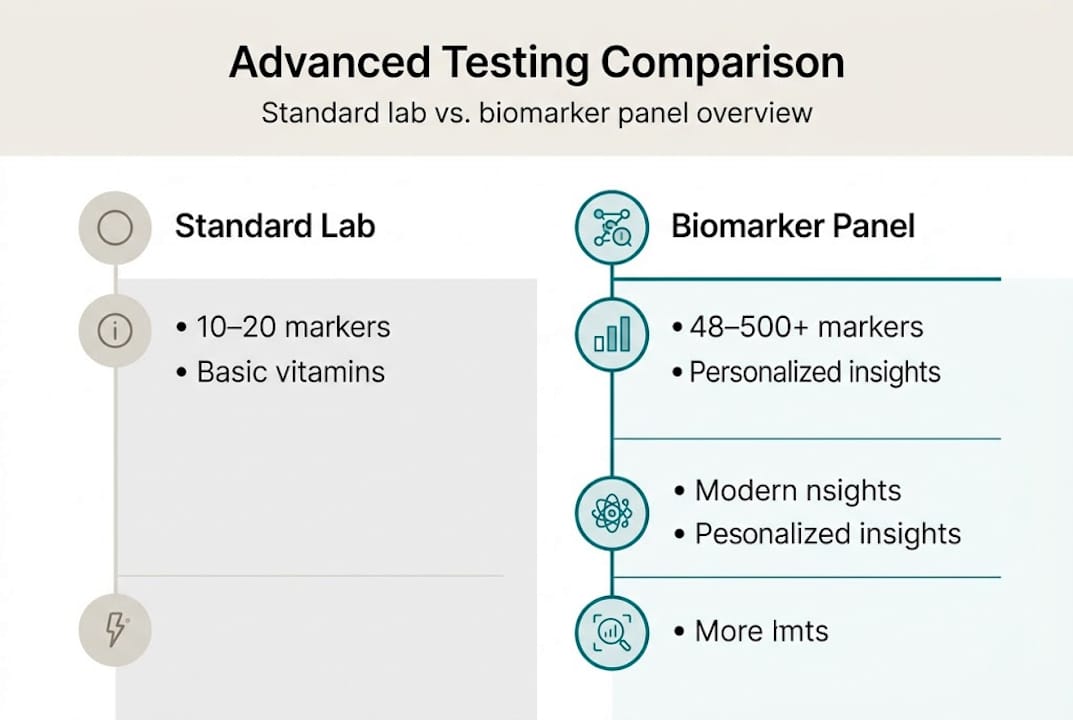
Advanced panels analyze anywhere from 48 to 500+ biomarkers in a single test, covering vitamins, hormones, lipids, amino acids, minerals, and inflammatory markers. That breadth is what separates these tests from a basic annual checkup.
What truly elevates modern testing is the interpretation layer. Standard clinical labs flag results as “normal” or “abnormal” based on population averages. Advanced platforms compare your results against optimal ranges, not just clinical cutoffs. This distinction matters enormously. You can be technically “normal” for ferritin and still be running on empty as an athlete.
Pro Tip: When reviewing your results, always ask whether the platform uses optimal ranges or clinical reference ranges. Optimal ranges are calibrated for performance and longevity, not just disease prevention.
| Feature | Standard lab test | Advanced biomarker panel |
|---|---|---|
| Number of markers | 10 to 20 | 48 to 500+ |
| Sample types | Venous blood only | Blood, saliva, urine, stool |
| Reference ranges | Clinical (disease-based) | Optimal (performance-based) |
| Interpretation | Basic flag system | AI and expert analysis |
| Collection method | Clinic or hospital | At-home or mobile phlebotomy |
Understanding at-home health testing at this level helps you choose the right panel and get more from your results.
Benefits for athletes and health-conscious individuals
Knowing your biomarkers isn’t just an interesting data exercise. For athletes and health-focused individuals, it can be the difference between plateauing and actually progressing.
One of the most impactful uses is identifying nutritional deficiencies that silently drain performance. Iron deficiency, low ferritin, suboptimal vitamin D, and B12 insufficiency are common limiters that standard checkups often miss until they become clinical problems. Catching them early means you can correct them before they affect your training.
Here’s a practical breakdown of what advanced panels reveal and why it matters:
- Iron and ferritin: Low ferritin tanks endurance capacity long before anemia appears on a standard blood count
- Vitamin D: Affects muscle function, immune response, and bone density; most athletes are deficient without knowing it
- hsCRP (high-sensitivity C-reactive protein): A sensitive inflammation marker that signals whether your body is recovering or silently inflamed
- Cortisol and testosterone: The ratio between these two hormones tells you whether you’re in an anabolic (building) or catabolic (breaking down) state
- Creatine kinase (CK): Measures muscle damage after training, helping you time recovery intelligently
Beyond recovery, advanced testing supports longevity planning. Early detection of metabolic risk factors like elevated triglycerides, insulin resistance markers, or homocysteine gives you a years-long head start on prevention.

| Biomarker | What it reveals | Why athletes care |
|---|---|---|
| Ferritin | Iron storage | Endurance and oxygen delivery |
| Vitamin D | Immune and muscle function | Injury prevention, recovery |
| hsCRP | Systemic inflammation | Overtraining detection |
| Testosterone/Cortisol | Hormonal balance | Training adaptation |
| Homocysteine | Cardiovascular risk | Long-term heart health |
The numbers back this up. 80% of users who track biomarkers improve at least one key marker over time. That’s not a coincidence. It’s the result of targeted, informed action.
Explore the full picture of biomarker benefits for athletes and how personalized biomarker interpretation translates data into real performance gains. The biomarker role in performance goes well beyond what most training guides acknowledge.
Limitations and nuances of advanced testing technology
Advanced testing is powerful, but it’s not infallible. Understanding where the technology has limits protects you from making poor decisions based on incomplete data.
First, sample type matters. Dried blood spots are convenient and valid for many markers, but less accurate than venous draws for certain measurements. Hormones and some lipid fractions, in particular, can show slight variations depending on collection method. This doesn’t make dried blood spot testing unreliable, but it does mean you should interpret borderline results with extra caution.
Second, there’s a real risk of over-interpretation. Seeing a result slightly outside an optimal range doesn’t automatically mean something is wrong. Single readings are snapshots, not verdicts. Trends across multiple tests are far more meaningful.
“No strong evidence exists that routine biomarker testing improves race performance unless it’s correcting an actual deficiency or imbalance.”
This is a critical point. Testing is most valuable when it identifies something fixable. If all your markers look solid, the data confirms you’re on the right track. That’s also useful, but it won’t magically make you faster.
Other limitations worth knowing:
- Timing of collection affects results (cortisol is highest in the morning; testing post-workout skews inflammation markers)
- Hydration status influences blood concentration of several markers
- Reference range heterogeneity across labs makes direct comparisons tricky
- Data validation across diverse populations is still an evolving area of research
Pro Tip: Always test under consistent conditions: same time of day, same hydration level, and ideally the same phase of your training cycle. This makes trend tracking far more reliable.
For those tracking hormonal health, consistency in testing protocol is especially important. Understanding the essential biomarker types also helps you prioritize which panels are worth repeating versus which are one-time baselines.
Applying insights for personalized wellness and longevity
Data without action is just noise. The real value of advanced testing comes from building a feedback loop between your results, your habits, and your goals.
Here’s a practical four-step process for turning test results into meaningful change:
- Review your results with context: Don’t just look at flagged markers. Read your full panel and note which values are trending toward optimal and which are moving away
- Consult an expert or AI-guided platform: Interpretation against optimal ranges requires nuance. A qualified practitioner or well-designed AI tool can help you prioritize what to address first
- Adjust one or two variables at a time: Changing your diet, supplementation, and training simultaneously makes it impossible to know what’s working. Isolate your interventions
- Retest in 3 to 6 months: This timeline gives most interventions enough time to show measurable impact in your bloodwork
Biomarkers offer the best value as baselines and for ruling out limiting factors. Broad panels are especially useful for longevity tracking, where early signals in metabolic or cardiovascular markers can guide preventive action years before symptoms appear.
A concrete example: if your ferritin comes back at 18 ng/mL (low for an endurance athlete), you supplement with iron, adjust your diet to include more heme iron sources, and retest after 12 weeks. If ferritin climbs to 45 ng/mL and your perceived energy improves, you’ve closed a real performance gap with data, not guesswork.
Pro Tip: Use your first test as a baseline, not a judgment. The goal isn’t to have perfect numbers immediately. It’s to understand where you are so you can track meaningful progress over time.
Learn more about using biomarker insights strategically and how athlete blood testing fits into a broader performance plan.
Our perspective: What most guides miss about advanced testing
Most articles on biomarker testing focus on which markers to track. We think that misses the bigger picture entirely.
The athletes and health-focused individuals who get the most out of advanced testing aren’t the ones obsessing over every data point. They’re the ones who use testing to build a clearer narrative about their health over time. Chasing a “perfect” vitamin D level while ignoring sleep quality, chronic stress, and training load is like tuning one instrument in a broken orchestra.
Advanced testing works best when it’s integrated into a broader health story. Your cortisol result means more when you also know you’ve been sleeping six hours a night for three weeks. Your hsCRP reading carries more weight when you can connect it to a period of unusually high training volume.
The other trap we see constantly is treating a single panel as a magic answer. One test gives you a snapshot. Consistent retesting, as outlined in the step-by-step testing process, builds the longitudinal picture that actually drives lasting change. Data alone doesn’t transform health. Consistent, informed action does.
Ready to optimize with advanced testing?
If this guide has sparked your interest in using advanced testing for better health, the next step is simpler than you might think. At-home biomarker testing removes the friction of clinic visits and long waits, putting precision health data directly in your hands.
Biostarks home testing solutions offer panels built around Swiss mass spectrometry, covering vitamins, hormones, amino acids, lipids, and metabolic markers with optimal range interpretation. Whether you’re an athlete looking to close performance gaps or someone focused on long-term longevity, you can explore the full at-home biomarker process and find the panel that fits your goals. Your data is waiting.
Frequently asked questions
Which biomarkers should athletes prioritize in testing?
Athletes should prioritize iron/ferritin, vitamin D, B12, hsCRP, thyroid hormones, and testosterone/cortisol ratio for recovery and performance optimization.
How accurate are dried blood spot tests compared to traditional lab draws?
Dried blood spots are valid for most biomarkers but may be slightly less accurate than venous draws for certain hormones and lipid fractions.
How often should I repeat advanced biomarker testing?
Repeat testing every 3 to 6 months is recommended, since trends over time are far more actionable than any single reading.
Can advanced testing guarantee better race performance or only health improvement?
Testing helps identify and fix deficiencies that limit performance, but routine testing alone does not guarantee improved race times without targeted intervention.
Do I need expert interpretation of my biomarker results?
Yes. AI or expert interpretation against optimal ranges is essential to avoid misreading results and to prioritize safe, effective actions.


