

TL;DR:
- Proactive internal health assessment combines lifestyle signals, biometric measurements, and advanced biomarkers to identify early dysfunctions. Tracking trends over several weeks with proper tools and professional guidance enables meaningful insights beyond standard checkups. Most individuals evaluate health reactively; shifting to a long-term, data-driven approach improves early detection and metabolic health.
Internal health assessment is the process of evaluating your body’s vital functions and metabolic status through a combination of biomarker testing and lifestyle monitoring. Most people wait for symptoms before investigating what’s happening inside, but by then, dysfunction has often been building for years. Knowing how to assess internal health means shifting from reactive checkups to proactive, data-driven evaluation. This guide covers the key indicators to track, the tools and tests that generate reliable data, a step-by-step interpretation process, and the most common obstacles you’ll face along the way.
How to assess internal health: key indicators to track
A thorough internal health evaluation covers three distinct layers: lifestyle signals you observe daily, biometric measurements you can take at home, and biomarkers revealed through lab testing. Each layer adds resolution to the picture.
Lifestyle and physical signals
Tracking seven lifestyle indicators over two to four weeks reveals meaningful trends that single snapshots miss entirely. Those indicators are sleep quality, energy levels, stress load, mood stability, gut function, physical activity, and perceived inflammation. A consistent pattern of poor sleep and low energy, for example, often precedes measurable hormonal or metabolic changes by months.

Several physical signs also indicate healthy internal function without any equipment. Hunger cycles every three to four hours, clear to light yellow urine, and good skin elasticity all point to stable blood sugar regulation, adequate hydration, and tissue health. These are signs of good internal health that require no lab work to notice.
Biometric measurements
A 10-minute home baseline using four measurements gives you a functional starting point for assessing health status. Blood pressure below 120/80 mmHg, waist circumference under 40 inches for men and 35 inches for women, a sleep quality self-rating from one to five, and a stress rating from one to five form a simple but meaningful snapshot. These numbers matter because they correlate directly with cardiovascular and metabolic risk.
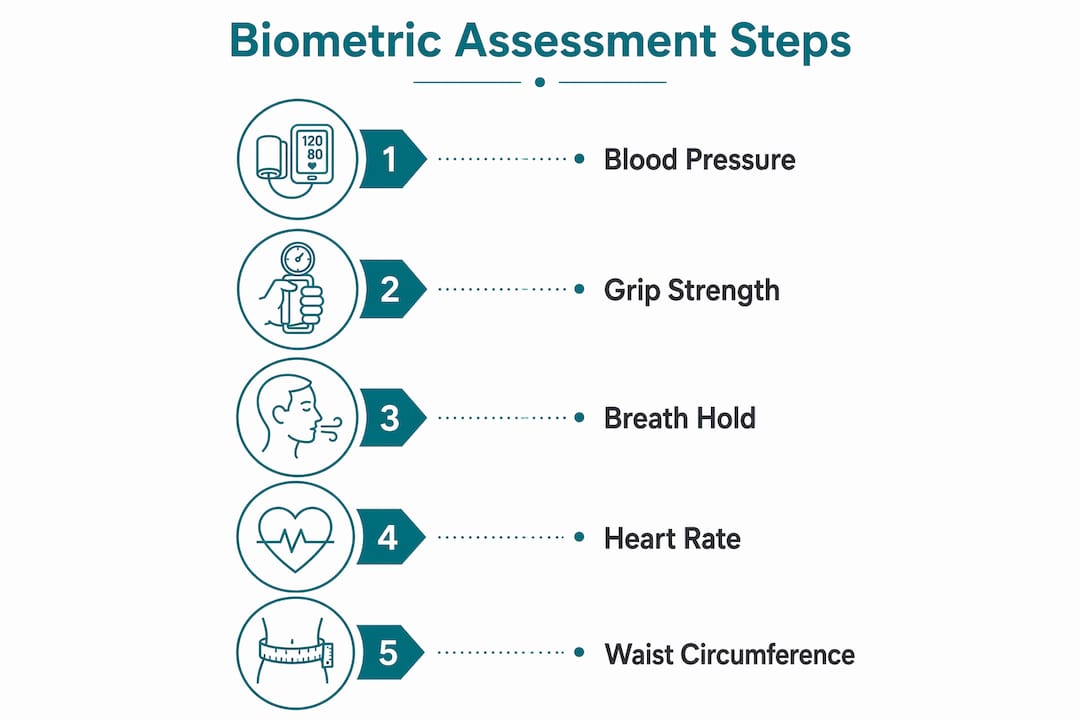
Grip strength and breath-hold capacity are two underused physical tests that correlate strongly with longevity-related metrics. Men under 40 should aim for grip strength above 45 kg; women above 30 kg. Holding your breath for 30 seconds or more is a validated proxy for cardiovascular fitness. Both tests take under two minutes and require no equipment beyond a grip dynamometer.
Biomarkers from lab testing
Standard cholesterol panels and fasting glucose are a starting point, not a finish line. Advanced markers like ApoB and fasting insulin detect cardiovascular and metabolic risk years before traditional tests flag anything abnormal. Optimal fasting insulin sits between 2 and 5 μIU/mL; an ApoB below 80 mg/dL is the current target for low cardiovascular risk. Most standard physicals never order these.
Pro Tip: Add heart rate variability (HRV) tracking to your wearable data. HRV correlates with metabolic markers including blood glucose control, stress response, and sleep recovery, making it one of the most information-dense signals available without a blood draw.
What tools and tests give you accurate data?
Reliable internal health evaluation depends on using the right instruments at each layer of assessment. The table below maps the tool category to what it measures and its primary use case.
| Tool | What it measures | Best use case |
|---|---|---|
| Blood pressure cuff | Systolic/diastolic pressure | Daily cardiovascular baseline |
| Tape measure | Waist circumference | Metabolic and visceral fat risk |
| Glucometer | Fasting and postprandial glucose | Metabolic function screening |
| Grip dynamometer | Muscle strength | Functional fitness and longevity proxy |
| Wearable (e.g., Garmin, Oura Ring, WHOOP) | HRV, sleep stages, resting heart rate | Autonomic and recovery monitoring |
| At-home biomarker test | Hormones, lipids, vitamins, metabolic markers | Comprehensive internal health snapshot |
| Advanced lab panel | ApoB, fasting insulin, HOMA-IR, VO2 max | Early risk detection beyond standard tests |
For lab testing, executive-level health exams now include coronary calcium scoring, advanced lipid markers, body composition analysis, and VO2 max testing. These go far beyond what a standard annual physical covers. A standard annual physical lasts 30 to 60 minutes and returns lab results within one week, but it rarely includes the advanced markers that catch early dysfunction.
Preparation matters for accurate results. For fasting-based tests including insulin, glucose, and lipid panels, fast for 10 to 12 hours beforehand and avoid intense exercise the day prior. Some medications affect thyroid and hormone readings, so flag any prescriptions with your provider before testing. At-home biomarker testing through platforms like Biostarks uses Swiss mass spectrometry to analyze vitamins, hormones, amino acids, lipids, and metabolic markers from a single sample collected at home. The at-home testing process is designed to match clinical-grade accuracy without requiring a clinic visit.
Pro Tip: Don’t rely on a single wearable metric in isolation. Combine HRV trends from a device like Oura Ring or WHOOP with your sleep efficiency score (target above 85%) and resting heart rate to build a more complete picture of autonomic health.
How to evaluate and interpret your internal health data
Collecting data is only useful if you know what to do with it. Follow this process to move from raw numbers to meaningful conclusions.
-
Establish your baseline. Record all biometric and lifestyle indicators daily for two to four weeks before drawing any conclusions. Single isolated measurements are often misleading due to natural variability. A blood pressure reading of 135/85 on one stressful morning means far less than a two-week average of 128/82.
-
Organize data by domain. Group your readings into cardiovascular, metabolic, hormonal, and lifestyle categories. A personal health dashboard in a spreadsheet or an app like Apple Health or Cronometer works well for this. Seeing all domains together reveals patterns that individual readings hide.
-
Compare against validated benchmarks. Use established reference ranges as your first filter. Fasting insulin above 10 μIU/mL signals early insulin resistance even when fasting glucose looks normal. HOMA-IR calculated from fasting insulin and glucose provides earlier metabolic risk detection than glucose alone. A HOMA-IR above 2.0 warrants attention.
-
Prioritize trends over thresholds. A biomarker moving consistently in the wrong direction over three months is more significant than a value sitting just outside the reference range. Track direction, not just position.
-
Flag results that need professional review. Borderline or abnormal findings in cardiovascular markers, hormones, or inflammatory indicators require physician follow-up, not self-management. A comprehensive internal health evaluation is most effective when paired with professional interpretation for complex results.
The table below shows benchmark targets for the most clinically significant internal wellness indicators.
| Marker | Optimal range | What it signals |
|---|---|---|
| Blood pressure | Below 120/80 mmHg | Cardiovascular health |
| Fasting insulin | 2 to 5 μIU/mL | Metabolic sensitivity |
| ApoB | Below 80 mg/dL | Cardiovascular risk |
| Sleep efficiency | Above 85% | Recovery and CNS health |
| HRV (personal baseline) | Stable or rising trend | Autonomic balance |
| Waist circumference | Under 40" (men), 35" (women) | Visceral fat and metabolic risk |
Common challenges in internal health evaluation
Even motivated individuals run into predictable obstacles when building a health monitoring practice. Knowing them in advance reduces the chance they derail your progress.
-
Interpreting borderline results. A result that sits just outside the reference range is not a diagnosis. Focus on context: your age, sex, lifestyle, and trend direction all affect interpretation. Bodily signals should be evaluated against your personal baseline, not just population averages.
-
Inconsistent tracking. The most common failure mode is measuring intensively for two weeks, then stopping. Set a fixed weekly check-in time for biometrics and schedule lab retesting every three to six months. Consistency beats precision.
-
Health anxiety from data overload. Tracking too many markers simultaneously creates noise and anxiety. Start with five to seven core indicators and add complexity only after you understand your baseline. A holistic health approach that maps health across multiple domains encourages sustainable progress rather than obsessive monitoring.
-
Misinformation about normal ranges. Standard lab reference ranges are built from population averages that include unhealthy individuals. Optimal ranges for markers like fasting insulin and ApoB are significantly tighter than what most labs flag as abnormal. Work with a provider who understands functional and precision medicine benchmarks.
-
Neglecting emotional and metabolic domains together. Stress and mood directly affect cortisol, insulin sensitivity, and HRV. Treating physical biomarkers in isolation while ignoring chronic stress produces incomplete and sometimes misleading health assessments. The role of advanced lab testing is most powerful when combined with lifestyle data, not used as a standalone snapshot.
Key takeaways
Accurate internal health assessment requires combining biomarker lab data, biometric self-monitoring, and consistent lifestyle tracking over at least two to four weeks to identify meaningful trends.
| Point | Details |
|---|---|
| Layer your data sources | Combine lifestyle signals, biometrics, and lab biomarkers for a complete picture. |
| Track trends, not snapshots | Monitor indicators over two to four weeks before drawing conclusions about your health status. |
| Use advanced markers | ApoB and fasting insulin detect risk years before standard cholesterol and glucose panels flag problems. |
| Benchmark against optimal ranges | Standard lab reference ranges are often too broad; use precision medicine targets for fasting insulin and ApoB. |
| Pair data with professional review | Borderline or declining biomarker trends require physician interpretation, not self-management alone. |
Why I think most people are assessing their health backwards
Most people treat a health checkup as a pass-or-fail test. You go in, the doctor says your numbers are “normal,” and you leave reassured for another year. That model is built for sick care, not health optimization. What I’ve found, working in precision health, is that the most important information almost never appears in a standard panel.
Fasting insulin is the clearest example. A value of 9 μIU/mL sits comfortably within most lab reference ranges. But it signals years of progressive insulin resistance before fasting glucose ever moves. By the time glucose rises, the metabolic damage is already significant. The same logic applies to ApoB, HOMA-IR, and HRV trends. These markers tell you where you’re heading, not just where you are today.
The shift I’d encourage is from asking “Am I sick?” to asking “What direction am I moving in?” That reframe changes everything about how you use data. A single biomarker reading is a photograph. A series of readings over months is a film. The film is where the real story lives.
Patience is also underrated here. Most people want a one-week fix after seeing a concerning result. Meaningful metabolic change takes three to six months of consistent lifestyle adjustment to show up in biomarkers. That timeline isn’t a failure. It’s how physiology works. The individuals who get the most value from internal health monitoring are the ones who treat it as a long-term practice, not a one-time audit.
— Romain
Start your internal health assessment with Biostarks

Biostarks, an AMR Labs SA company, offers at-home biomarker testing that analyzes vitamins, hormones, amino acids, lipids, minerals, and metabolic markers using advanced Swiss mass spectrometry. You collect your sample at home and receive a personalized report with precision benchmarks and clear guidance on what your results mean. For anyone serious about monitoring metabolic health from home, Biostarks provides clinical-grade data without a clinic visit. The platform also offers resources on best practices for biomarker analysis to help you interpret and act on your results with confidence. Explore the full testing catalog and take the first data-driven step toward understanding your internal health at Biostarks.
FAQ
What does internal health assessment actually measure?
Internal health assessment evaluates biomarkers, biometrics, and lifestyle indicators that reflect how your organs, metabolism, hormones, and cardiovascular system are functioning. It goes beyond symptom checks to detect early dysfunction before clinical disease develops.
How often should you reassess your internal health?
Biometric measurements like blood pressure and waist circumference are worth tracking weekly, while comprehensive biomarker panels are best repeated every three to six months to capture meaningful trends. Single readings are rarely sufficient for accurate health evaluation.
What are the most important biomarkers for internal health?
Fasting insulin, ApoB, HOMA-IR, and HRV are among the most sensitive early indicators of metabolic and cardiovascular health. Standard panels that measure only total cholesterol and fasting glucose miss the majority of early-stage dysfunction.
Can you assess internal health at home without a doctor?
Yes, a meaningful baseline is achievable at home using a blood pressure cuff, tape measure, grip dynamometer, and an at-home biomarker test. However, borderline or abnormal results always require professional interpretation before making significant changes to your health regimen.
What are the signs of good internal health?
Consistent hunger cycles every three to four hours, clear to light yellow urine, stable energy throughout the day, sleep efficiency above 85%, and a rising or stable HRV trend are all reliable internal wellness indicators that require no lab work to observe.
This content is for educational purposes only and does not constitute medical advice. Always consult with a healthcare professional before making changes to your health regimen.


