

TL;DR:
- Many seemingly healthy adults carry undetected genetic risks that traditional screening overlooks.
- Precision health personalizes prevention and treatment by analyzing genes, biomarkers, environment, and lifestyle.
- Reliable at-home testing, validated methods, and professional guidance are essential for effective health optimization.
You could be perfectly healthy by every standard measure your doctor checks and still carry a serious undetected risk. A Mayo Clinic study found that about 13% of seemingly healthy adults carry significant genetic risks that routine care never flags. That is what makes precision health so fundamentally different from the medical system most of us grew up with. Instead of comparing you to a statistical average, it maps your biology specifically: your genes, your biomarkers, your environment, and how they interact. For anyone using at-home biomarker testing to understand their metabolic health, this framework is not just interesting theory. It is the reason your test results mean something real.
Table of Contents
- What is precision health and how does it differ from traditional medicine?
- The role of biomarkers and genetic insights in precision health
- How at-home biomarker testing fits into precision health
- Comparing traditional health assessments with precision health approaches
- Applying precision health: How to optimize your wellness with personalized insights
- Why validated clinical utility and expert guidance are critical for precision health success
- Explore Biostarks’ at-home biomarker testing for precision health insights
- Frequently asked questions
What is precision health and how does it differ from traditional medicine?
Precision health replaces one-size-fits-all medicine with care shaped around an individual’s genes, lifestyle, and environment. The goal is better prevention, earlier detection, and more effective treatment because the recommendations are built around you, not a population average.
Traditional medicine works on a logic that made sense before we had the tools to do better. A doctor measures your cholesterol, compares it to a reference range derived from large population studies, and prescribes accordingly. That reference range reflects millions of people, not you. Your body might process fats differently than the average patient. Your stress response, sleep quality, and nutritional status all alter how any given biomarker behaves in your bloodstream. Traditional medicine is often based on average patient response, while precision medicine accounts for individual differences to optimize treatment.
The data streams that precision health draws from include:
- Genetic data: Your DNA sequence, including variants that raise or lower risk for specific conditions
- Biomarker panels: Blood and tissue measurements of metabolic, hormonal, and inflammatory markers
- Environmental exposures: Toxins, pathogens, and lifestyle stressors that affect gene expression
- Lifestyle factors: Sleep, nutrition, physical activity, and stress levels that constantly shift your biology
If you have already explored at-home health testing, you have taken a direct step into this framework. The data you collect at home feeds the same logic that precision health operates on: specific, personal, and actionable.
The role of biomarkers and genetic insights in precision health
Biomarkers are measurable biological signals. Think of them as your body’s instrument panel, each reading telling you something about what is happening beneath the surface right now. Blood glucose reflects insulin sensitivity. Ferritin tells you about stored iron. Cortisol patterns reveal stress axis function. None of these readings exist in isolation, and none of them mean exactly the same thing in every person.
Precision health commonly uses genetics and biomarkers together to identify risk factors early, guide effective interventions, and reduce side effects from unnecessary or mismatched treatments. The combination is powerful because genetics tells you what you are predisposed to, and biomarkers tell you what is actually happening right now.
Biomarker tests fall into three functional categories, and understanding the difference helps you evaluate the quality of any test you consider:
- Diagnostic biomarkers: Confirm whether a condition is present (example: HbA1c confirming type 2 diabetes)
- Prognostic biomarkers: Predict how a condition is likely to progress over time
- Predictive biomarkers: Indicate how likely a person is to respond to a specific intervention or therapy
For a test to genuinely serve your precision health goals, it needs to meet three standards. According to testing validation criteria, biomarker tests must be analytically valid (the measurement is accurate and reproducible), clinically valid (the marker genuinely correlates with the health outcome it claims to), and clinically useful (the result changes what you or your clinician will do). A test that fails on clinical utility is just expensive data noise.
Understanding biomarker testing insights and the role of biomarkers in health optimization gives you a foundation for reading your own results with real context rather than anxiety.
Pro Tip: When evaluating any biomarker test, ask specifically whether the lab uses mass spectrometry for quantification. It is far more sensitive and specific than antibody-based immunoassays, which means fewer false positives and more reliable trend data over time.
How at-home biomarker testing fits into precision health
At-home testing removes the single biggest barrier to precision health: access. Most people will not schedule a specialist appointment to check their vitamin D, amino acid profile, or hormonal balance unless they already have symptoms. By that point, the gap between optimal and deficient has often been open for months. At-home testing moves the measurement earlier, when course correction is far easier.

But convenience alone does not make a test useful. At-home biomarker tests must provide reliable, clinically useful data with clear guidance on next steps to support precision health goals. A result that shows a number with no reference to what it means for your specific health goals is not precision health. It is just a number.
Precision health extends well beyond genetics to include lifestyle and environment, and at-home tests serve you best when integrated with clinical context. The value multiplies when you understand not just what your level is, but why it matters for your metabolic function, and what to do next.
Key qualities to look for in at-home biomarker testing:
- Validated methodology: The analysis method should have published accuracy data
- Reference ranges relevant to optimal health, not just disease thresholds
- Actionable interpretation: Results explained in terms of what to do, not just what was measured
- Professional support access: A clear path to discuss results with a qualified clinician
Once you have your results, a clear process helps you extract real value. Here is how to move from data to outcome:
- Read the full report, including context for each biomarker, not just the flagged values
- Identify patterns across related markers rather than reacting to isolated numbers
- Consult a healthcare professional to interpret findings within your full medical history
- Build a targeted intervention, whether nutritional, lifestyle-based, or clinical
- Retest after 8 to 12 weeks to confirm whether your intervention is working
You can find practical context for using biomarker insights and a walkthrough of the wellness testing process to map your own next steps.
Pro Tip: Do not retest too quickly. Most biomarkers require 8 to 12 weeks to reflect meaningful physiological change from a dietary or lifestyle intervention. Testing sooner produces noise, not signal.
Comparing traditional health assessments with precision health approaches
The difference between these two approaches is not just philosophical. It shows up in concrete outcomes.
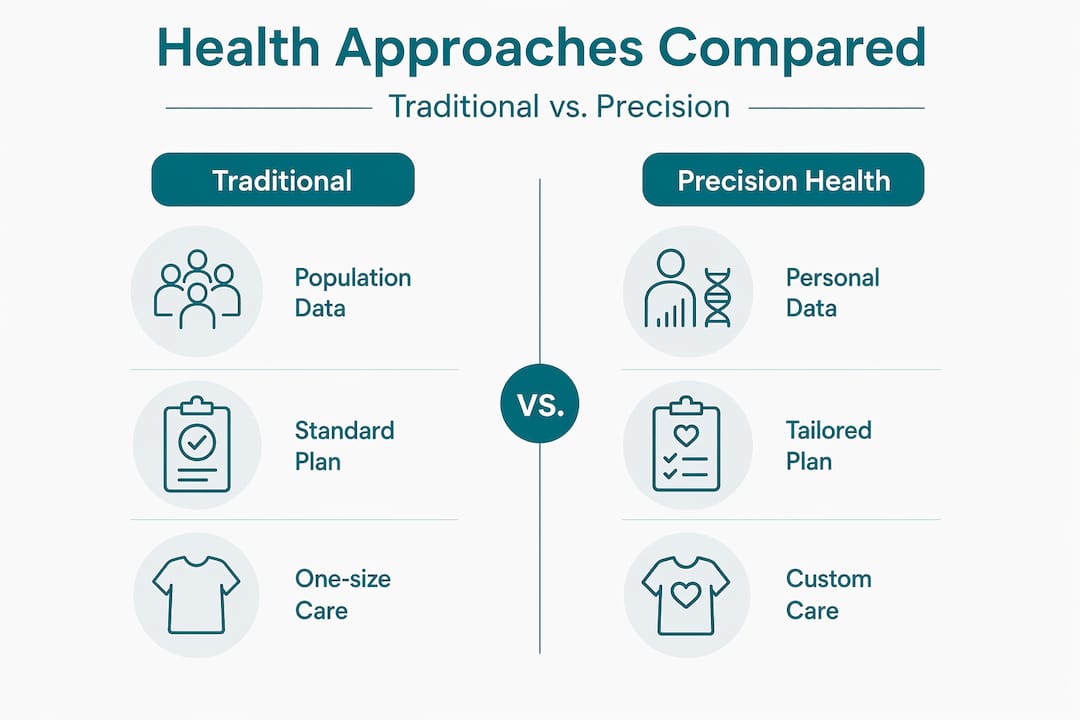
| Feature | Traditional health assessment | Precision health approach |
|---|---|---|
| Data basis | Population averages | Individual genetics, biomarkers, lifestyle |
| Focus | Diagnosing existing disease | Prevention, early detection, optimization |
| Treatment logic | Standard protocols by condition | Tailored to individual response patterns |
| Biomarker use | Basic panels at threshold levels | Broad panels with trend tracking |
| Risk identification | Symptom-driven | Data-driven, pre-symptomatic |
| Lifestyle guidance | Generic recommendations | Personalized to your unique biology |
Precision health improves early detection, reduces medication side effects, and delivers lifestyle recommendations that actually fit your biology rather than a generic population profile. The practical implication: two people with the same LDL cholesterol reading may need completely different interventions based on their genetic lipid metabolism, inflammation markers, and insulin sensitivity.
Precision medicine moves beyond the “average patient” to select the right treatment at the right dose for each individual. That logic extends naturally to prevention. When you know your personal cardiovascular risk profile from biomarkers for disease prevention, you are not guessing at what lifestyle changes matter most. You are working from your own data.
Key advantages of the precision health model:
- Earlier identification of metabolic dysfunction before symptoms appear
- Reduced trial-and-error in treatment and supplementation
- Better long-term adherence because recommendations are specific and verifiable
- Clearer ROI on health interventions when you can track blood biomarker changes over time
Applying precision health: How to optimize your wellness with personalized insights
Having the data is step one. Knowing what to do with it is where most people stall. Precision health promotes long-term wellness by identifying personalized lifestyle, nutrition, and medical interventions aligned with your unique biological profile. The key word is personalized. Generic advice based on your data still misses the mark.
Here is a practical sequence for building a precision health routine:
- Establish your baseline with a broad biomarker panel covering metabolic, hormonal, nutritional, and inflammatory markers
- Identify your priority areas based on results that fall outside optimal ranges, not just clinical thresholds
- Consult a qualified professional who can contextualize your results within your full health history
- Target specific interventions: dietary changes, movement patterns, sleep optimization, or supplementation tied directly to your data
- Retest to verify: your follow-up panel should show measurable shifts in the markers your intervention targeted
- Build a monitoring rhythm that keeps you ahead of drift in key biomarkers over months and years
Effective precision health programs rely on clinical interpretation, communication, and follow-up to translate data into better health outcomes. Without that loop, even excellent data can sit unused.
Tracking metabolic health biomarkers over time gives you something no single test can: a trend line. A fasting glucose of 92 mg/dL looks fine in isolation. If it was 84 six months ago and 88 three months before that, that trajectory tells a very different story. Following biomarker analysis best practices ensures you capture that kind of signal before it becomes a clinical problem.
Pro Tip: Build your biomarker calendar around your intervention cycles, not arbitrary dates. Test before you start a new protocol and again 10 to 12 weeks after. That structure makes your data genuinely comparative.
Why validated clinical utility and expert guidance are critical for precision health success
Here is the uncomfortable truth that most precision health content skips: data without context is not insight. It is anxiety with a scientific veneer.
The consumer health space has produced an enormous volume of biomarker tests, genetic reports, and wellness dashboards. Some of them are built on rigorous clinical validation. Others measure things accurately but have no clear link to a health decision you should actually make. Clinical utility is what separates the two: real value comes from biomarkers that directly inform prevention, diagnosis, or treatment decisions. If a test result cannot change what you or your clinician will do, it has no clinical utility regardless of how sophisticated the technology behind it sounds.
The same principle applies to genetic findings. Genomic results require counseling, clinical interpretation, and coordinated follow-up to translate into beneficial care. A raw variant report without professional interpretation can leave you overreacting to low-penetrance risks or underreacting to genuinely actionable findings.
What this means in practice: the most valuable thing you can do as someone building a precision health routine is to be selective about which data you collect and rigorous about how you interpret it. Choose tests built on validated methodology. Seek platforms that connect test results to clear clinical guidance. And treat professional consultation not as an optional add-on, but as a required step in the process.
Precision health is not about collecting the most data. It is about collecting the right data and doing something specific with it. That distinction matters enormously when you are making real decisions about your nutrition, supplementation, and long-term health strategy. Resources like biomarker insights help bridge the gap between what your results say and what they mean for your specific health goals.
Explore Biostarks’ at-home biomarker testing for precision health insights
Knowing what precision health requires is one thing. Having access to testing that actually delivers on that standard is another.

Biostarks offers at-home biomarker testing built on Swiss mass spectrometry, analyzing vitamins, hormones, amino acids, lipids, minerals, and metabolic markers with clinical-grade accuracy. Every report is designed to move past raw numbers and into clear, personalized interpretation so you know exactly where your biology stands and what to do next. Whether you are tracking metabolic function, optimizing athletic performance, or building a long-term longevity strategy, Biostarks gives you the validated, decision-ready data that precision health demands. Explore the full range of testing options and take your first data-driven step toward a health strategy that is genuinely yours.
Frequently asked questions
What distinguishes precision health from precision medicine?
Precision medicine is a component within precision health that focuses on treating specific diseases based on genetics, while precision health takes a broader view, using personalized data to support prevention, wellness, and long-term optimization before disease develops.
Are at-home biomarker tests reliable for precision health insights?
Yes, when they are built on validated methodology. Analytically and clinically valid tests that produce actionable, professionally interpreted results can deliver genuine precision health value from the convenience of home collection.
How does precision health detect hidden genetic risks?
By analyzing genetic variants alongside lifestyle and environmental data, precision health identifies risks that standard screening misses entirely. About 13% of healthy adults carry serious undetected genetic risks found only through this kind of targeted genomic analysis.
What role do healthcare professionals play in precision health?
They are essential, not optional. Expert interpretation and coordinated follow-up are what turn biomarker and genetic findings into personalized care plans with real health outcomes rather than uncontextualized data sitting in a dashboard.


