

TL;DR:
- Focusing on 3–5 key health metrics helps prevent overload and ensures meaningful analysis. Regular weekly reviews and controlled testing over three weeks enable accurate trend detection and validated lifestyle adjustments. Simplified, consistent tracking combined with biochemical insights leads to better personal health understanding and results.
Using health data for wellness means transforming raw biometric readings and clinical results into personal insights that drive real behavior change. Platforms like Apple Health, Microsoft Copilot Health, and Fitbit now make it possible to aggregate wearables, lab results, and lifestyle logs in one place. The challenge is not collecting data. The challenge is knowing which numbers matter, how to read them over time, and how to act on what you find. This guide gives you a structured method for doing exactly that.
How to use health data for wellness: start with the right metrics
The first mistake most people make is tracking everything. Collecting only 3–5 primary KPIs initially prevents data overload and keeps your attention on metrics that actually move the needle. More data does not mean better decisions. It usually means more confusion.
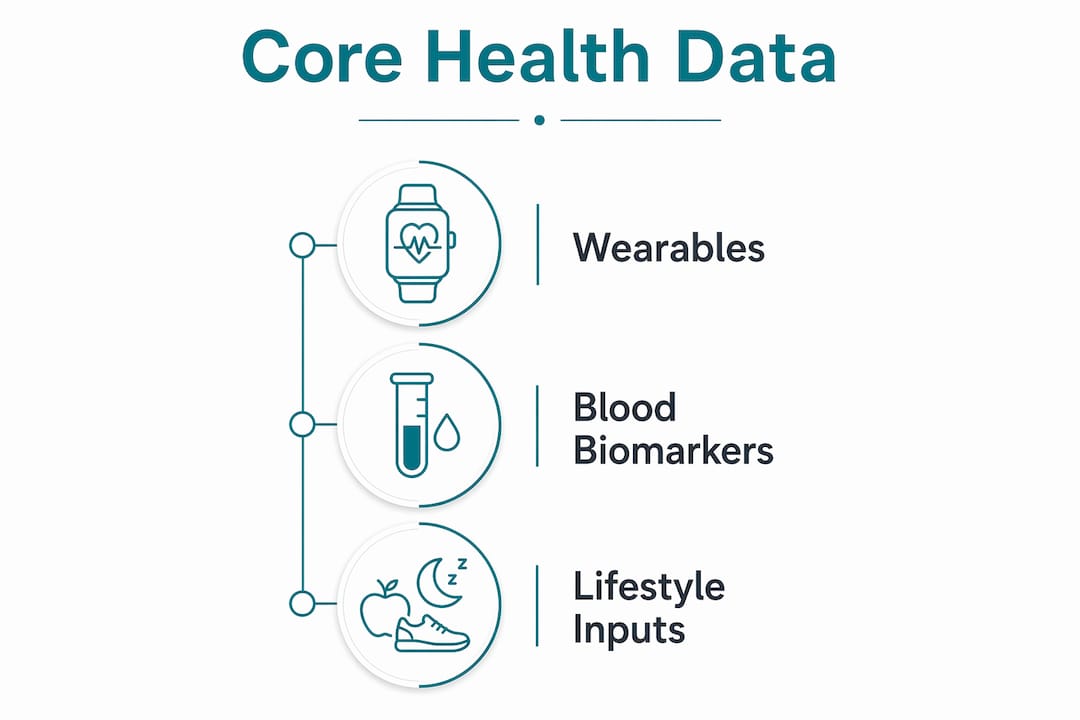
The three core data categories
Build your tracking stack around three layers:
- Wearable biometrics: Heart rate variability (HRV), resting heart rate, sleep duration and quality, daily step count, and blood oxygen saturation. These update continuously and reveal how your body responds to stress, recovery, and activity.
- Blood biomarkers: Vitamins (D, B12), hormones (cortisol, testosterone, thyroid), lipids, metabolic markers (glucose, insulin), and amino acids. These tell you what is happening inside your cells, not just on the surface.
- Contextual lifestyle data: Nutrition logs, stress ratings, alcohol intake, and subjective energy scores. These provide the “why” behind the numbers your devices capture.
| Data Source | Key Metrics | Strengths | Limitations |
|---|---|---|---|
| Wearables (e.g., Garmin, Oura Ring) | HRV, sleep, heart rate | Continuous, passive collection | Surface-level; no biochemical data |
| At-home blood tests (e.g., Biostarks) | Vitamins, hormones, lipids | Deep biochemical insight | Point-in-time snapshots |
| Nutrition apps (e.g., Cronometer) | Macros, micronutrients | Detailed dietary context | Requires manual input |
| Clinical records (EHR) | History, labs, diagnoses | Comprehensive medical context | Fragmented across providers |
Pro Tip: Pick one metric from each category as your primary KPI. For most people, that means HRV from a wearable, one or two blood biomarkers relevant to your goals, and a daily energy score logged manually.
Personalized health data only becomes useful when you know which signals to prioritize. Start narrow, then expand once your review routine is solid.
How do you consolidate health data from multiple sources?
Fragmented data is the enemy of good analysis. When your sleep data lives in one app, your blood results in another, and your nutrition logs in a third, you cannot see the connections that matter. Integration is the fix.
Automatic syncing vs. manual logging
Automatic syncing is preferred for physiological data like heart rate and sleep, while manual logs add the contextual detail that sensors cannot capture, such as mood ratings or perceived stress. A hybrid workflow gives you the richest dataset.
The major aggregation platforms each take a different approach:
| Platform | Data Sources Supported | Key Feature | Privacy Model |
|---|---|---|---|
| Apple Health | 300+ apps, wearables, EHR | On-device storage | User-controlled, local |
| Google Health | Android wearables, apps | Cross-device sync | Cloud-based |
| Microsoft Copilot Health | 50,000+ U.S. providers, wearables | AI-assisted health summaries | Federated, provider-linked |
Microsoft Copilot Health’s scale is significant. Connecting clinical records from that many providers means your wearable data can be read alongside your actual medical history, not just your step count.
Data ownership and privacy are foundational concerns. Decentralized architectures, like Apple Health’s on-device model, keep your sensitive data under your control rather than on a third-party server. Before connecting any app, check whether it sells or shares your data with advertisers.
Pro Tip: Do a quarterly app permission audit. Revoke access for any app you no longer actively use. Stale connections are a privacy risk and a source of data noise that skews your analysis.
How to analyze health metrics and spot meaningful trends
Raw numbers are not insights. A single low HRV reading on a Monday morning tells you almost nothing. A three-week downward trend in HRV, coinciding with rising resting heart rate and poor sleep scores, tells you your body is under sustained stress.
Trends and moving averages over weeks or months matter far more than individual daily data points, especially for variable metrics like HRV or sleep. Establish a baseline of at least two weeks for daily metrics and one month for more variable markers before testing any intervention. Without a baseline, you have no reference point for what “normal” looks like for your body.
The weekly review ritual
A 20–30 minute weekly review is the highest-ROI habit in health data management. It takes less time than a gym session and produces clearer direction for the week ahead. Here is how to run it:
- Pull your 7-day averages for each primary KPI.
- Compare this week’s averages to your 4-week baseline.
- Flag any metric that moved more than 10% in either direction.
- Cross-reference flagged metrics with your lifestyle log. Did your sleep drop the same week you traveled? Did HRV fall after adding a new supplement?
- Write one sentence summarizing the most important pattern you see.
- Decide on one behavior to test or maintain in the coming week.
Cross-correlating metrics is where the real insight lives. Combining clinical history with biometric data improves the relevance and personalization of wellness guidance significantly. An HRV drop paired with elevated inflammatory markers from a recent blood test points toward a recovery problem, not just a bad night’s sleep.
The most common mistake is reacting to single daily readings instead of analyzing trends across multiple metrics. Reacting to noise wastes effort and creates anxiety. Reacting to trends creates results.
Pro Tip: Use a simple spreadsheet or a notes app to log your weekly summary sentence. After 12 weeks, you will have a personal health narrative that no app can generate for you.
How to test lifestyle changes using your health data
Data without experimentation is just surveillance. The goal is to use your metrics to test whether a specific change, such as an earlier bedtime, a dietary shift, or a new stress management practice, actually improves your body’s response.
Test each lifestyle change for about three weeks before drawing conclusions. Biological systems are noisy. A one-week test cannot separate a real signal from natural fluctuation. Three weeks filters out most of the noise.
A simple intervention protocol
Follow this sequence for every change you test:
- Define your hypothesis. “If I shift my bedtime 45 minutes earlier, my average HRV will increase within three weeks.”
- Choose one primary KPI. Track one main outcome metric. Secondary metrics can be observed but should not drive your conclusion.
- Log contextual notes daily. Record anything that could confound your results: travel, illness, alcohol, unusual stress.
- Run the intervention for 21 days. Do not change anything else during this window.
- Compare moving averages. Compare your 3-week intervention average to your pre-intervention baseline.
- Document the outcome. Record what changed, what did not, and what you will test next.
| Step | Action | Tool |
|---|---|---|
| 1. Baseline | Record 2–4 weeks of pre-intervention data | Wearable + blood test |
| 2. Hypothesis | Write one clear prediction | Notes app |
| 3. Intervention | Apply one change for 21 days | Lifestyle log |
| 4. Analysis | Compare moving averages | Spreadsheet or health app |
| 5. Decision | Continue, modify, or discard the change | Weekly review ritual |
Pro Tip: Never test two interventions at the same time. If you change your diet and your sleep schedule simultaneously, you cannot know which one drove the result. One change at a time is the rule.
Good health tracking practices treat your body like a system worth understanding, not a problem to fix overnight.
What are the biggest challenges in wellness tracking using data?
Even disciplined trackers run into problems. Knowing the common failure points in advance lets you avoid them.
“Data collection without a focused hypothesis leads to overwhelm. Focus on small, actionable KPIs and build from consistent reviews.” — From Chaos to Clarity
The most frequent obstacles and their fixes:
- Data overwhelm: You added too many metrics. Cut back to your 3–5 primary KPIs and pause everything else for 30 days.
- Inconsistent syncing: Gaps in wearable data skew your averages. Set a daily charging routine so your device never misses a night.
- Platform changes: Apps update, discontinue features, or change data-sharing policies. Export your data quarterly as a CSV backup.
- Premature reactions: You changed your supplement stack after one bad blood result. Wait for a trend across at least two data points before acting.
- Motivation drop-off: Tracking feels like a chore after 6 weeks. Tie your weekly review to an existing habit, such as Sunday morning coffee, to keep it automatic.
- Privacy exposure: Connecting too many third-party apps creates unnecessary risk. User-centric data control is not optional. Audit your permissions every quarter.
The fix for most of these problems is the same: simplify your system, stay consistent, and review on a schedule.
Key takeaways
Data-driven wellness works when you track fewer metrics with more discipline, integrate sources into one system, and review trends weekly before testing one change at a time.
| Point | Details |
|---|---|
| Start with 3–5 KPIs | Limiting your metrics prevents overwhelm and keeps analysis focused on what matters. |
| Use a hybrid data approach | Combine automatic wearable syncing with manual lifestyle logs for the richest dataset. |
| Establish a baseline first | Collect 2–4 weeks of data before testing any intervention to have a valid reference point. |
| Run a weekly review ritual | A 20–30 minute weekly review is the single highest-ROI habit for health data users. |
| Test one change at a time | Run each lifestyle intervention for 21 days in isolation to get a clean, readable result. |
Why simple beats sophisticated every time
I have worked with a lot of health data, and the pattern I keep seeing is this: the people who get the best results are not the ones with the most sensors. They are the ones with the most consistent review habits.
Early on, I made the classic mistake of tracking everything. I had HRV, sleep stages, glucose, cortisol, VO2 max estimates, and a nutrition log running simultaneously. The data was rich. The insight was zero. I was spending more time managing apps than understanding my body.
What changed things was cutting down to three metrics and committing to a Sunday review. Within eight weeks, I spotted a clear pattern: my HRV dropped reliably three days after high-stress work periods, not the day after. That lag was invisible when I was reacting to daily numbers. It only appeared in the trend.
The emerging AI tools, including Microsoft Copilot Health and Fitbit’s coaching features, are genuinely useful for surfacing patterns you might miss. But they work best when your data is clean, consistent, and focused. Feed a noisy, fragmented dataset into an AI assistant and you get noisy, fragmented advice.
My honest recommendation: pick your three metrics, build your weekly review habit, and run your first 21-day experiment before you add anything else. The data-driven approach to health rewards patience and structure far more than it rewards volume.
— Romain
Take your health data further with Biostarks
Wearables give you the surface layer. Blood biomarkers give you the full picture.

Biostarks, an AMR Labs SA company, uses advanced Swiss mass spectrometry to analyze over 100 biomarkers from a single at-home sample, covering vitamins, hormones, amino acids, lipids, and metabolic markers. The results integrate directly into your wellness tracking workflow, giving you the clinical depth that no wearable can provide. If you are serious about optimizing your health with data, Biostarks is the logical next layer to add to your stack. Pair your wearable trends with validated biochemical data and you will finally understand not just what your body is doing, but why. You can also explore wellness tracking strategies to complement your biomarker results with structured progress monitoring.
FAQ
What is the best way to start using health data for wellness?
Start by selecting 3–5 key metrics across wearables, blood biomarkers, and lifestyle inputs. Establish a 2–4 week baseline before making any changes, then run a weekly review to identify trends.
How long should i track data before testing a lifestyle change?
Collect at least two weeks of baseline data for daily metrics and one month for more variable markers like HRV or hormones. This gives you a reliable reference point before any intervention.
How do i avoid being overwhelmed by too much health data?
Limit your active tracking to 3–5 primary KPIs and ignore everything else for the first 30 days. A focused dataset is easier to review and produces clearer patterns than a broad one.
Is my health data private when using aggregation platforms?
Privacy depends on the platform’s architecture. Apple Health stores data on-device, which limits third-party exposure. Always audit app permissions quarterly and export your data regularly as a backup.
How do i know if a lifestyle change is actually working?
Compare your 3-week intervention moving average to your pre-intervention baseline using the same primary KPI. A meaningful change shows up in the trend, not in a single day’s reading.
This content is for educational purposes only and does not constitute medical advice. Always consult with a healthcare professional before making changes to your health regimen.


