

Feeling good is not the same as being healthy. Many people assume that energy levels, sleep quality, and general mood are reliable signals of what’s happening inside their bodies. They’re not. Subclinical deficiencies, early metabolic dysfunction, and silent inflammation can develop for years before you notice a single symptom. Biomarkers enable early detection of health risks and shift care from reactive to proactive, giving health-conscious individuals a real edge in optimizing wellness and longevity. This guide breaks down what health insights actually are, how to use them strategically, and where most people go wrong.
Table of Contents
- What are health insights and why do they matter?
- Types of health insights: From classical to advanced biomarkers
- From information to action: How health insights drive real change
- Common pitfalls and controversies in health insights
- Best practices for harnessing health insights
- The real value of health insights: What most people miss
- Ready to leverage your health insights?
- Frequently asked questions
Key Takeaways
| Point | Details |
|---|---|
| Early detection advantage | Health insights from biomarkers allow you to address issues before symptoms appear. |
| Personalized wellness optimization | Actionable data helps you tailor lifestyle and intervention strategies unique to your body. |
| Go beyond one-time tests | Long-term health improvements come from consistent tracking and expert interpretation. |
| Beware of pitfalls | Not all health insights are equally reliable; prioritize validated, context-driven approaches. |
What are health insights and why do they matter?
Health insights are actionable conclusions drawn from objective biological data, typically biomarkers measured through blood, urine, saliva, or stool. A biomarker is any measurable indicator of a biological state. Think blood glucose, ferritin, cortisol, or triglycerides. These numbers tell a story your symptoms can’t.
The traditional healthcare model is reactive. You feel sick, you see a doctor, you get treated. That system works for acute illness. It fails spectacularly at prevention. Data-driven wellness flips this model. Instead of waiting for problems to surface, you track key markers over time and intervene early, before dysfunction becomes disease.
The role of biomarkers in health extends far beyond diagnosing illness. They reveal trends, highlight imbalances, and help you personalize nutrition, exercise, sleep, and supplementation with precision that generic advice simply cannot match. That’s the core value of why use biomarker insights: they replace guesswork with evidence.
Here’s what biomarker-driven health insights can help you do:
- Detect nutrient deficiencies before they affect energy or cognition
- Identify early metabolic risk factors like insulin resistance
- Monitor inflammation linked to cardiovascular and autoimmune conditions
- Personalize supplementation and dietary choices based on your actual biology
- Track the effectiveness of lifestyle interventions over time
“The shift from reactive to proactive care is not just a trend. It’s the foundation of modern longevity medicine.”
Pro Tip: A single test gives you a snapshot. Real insight comes from tracking the same markers over months and years. Context and consistency are what turn raw numbers into meaningful health intelligence.
Types of health insights: From classical to advanced biomarkers
Not all biomarkers carry equal weight. Standard blood panels, the kind your doctor orders at an annual physical, measure markers like cholesterol, fasting glucose, and basic thyroid function. These are valuable but limited. They were designed to catch disease, not optimize health.
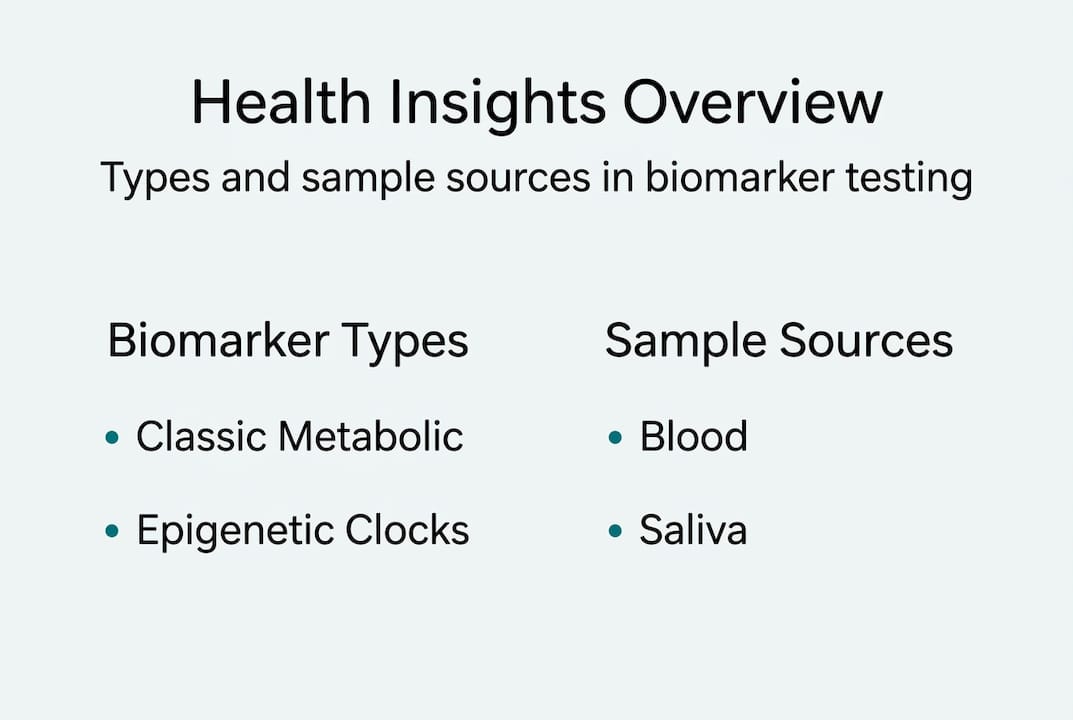
Advanced biomarker panels go further. Types of biomarkers for personal health insight now include epigenetic clocks that estimate biological age, proteomic healthy aging scores (PHAS), VO2 max as a cardiovascular fitness predictor, and gut microbiota composition. Advanced predictive biomarkers like VO2 max and epigenetic clocks have emerged as some of the strongest predictors of healthspan and lifespan.

Methodologies have also expanded dramatically. Blood biomarkers for personal health insights now sit alongside urine, saliva, and stool testing, imaging, performance assessments, mass spectrometry-based proteomics, and AI-powered analysis frameworks validated through fit-for-purpose methodologies.
| Biomarker type | Examples | Primary use |
|---|---|---|
| Classic metabolic | Glucose, HbA1c, LDL | Disease screening |
| Nutritional | Vitamin D, B12, ferritin | Deficiency detection |
| Hormonal | Cortisol, testosterone, insulin | Performance and stress |
| Inflammatory | CRP, IL-6, homocysteine | Cardiovascular and immune risk |
| Advanced aging | Epigenetic clock, PHAS, VO2 max | Longevity and healthspan |
| Microbiome | Gut diversity, short-chain fatty acids | Metabolic and immune function |
Emerging tools like AI-assisted pattern recognition and multi-omic panels are making it possible to see connections across dozens of markers simultaneously. That’s a level of resolution that was unavailable to most individuals just five years ago.
Pro Tip: Select your testing panel based on your specific goals. If longevity is your priority, focus on epigenetic age and PHAS. If performance is the goal, prioritize VO2 max, amino acids, and hormonal balance.
From information to action: How health insights drive real change
Data without action is just noise. The real power of health insights comes from what you do with them. Health insights drive personalized optimization and shift care from guesswork to precision, but only when paired with a structured response framework.
Here’s a practical action sequence:
- Test strategically. Choose a panel aligned with your goals, whether that’s metabolic health, hormonal balance, or longevity markers.
- Review with an expert. Raw numbers need clinical context. A practitioner can distinguish a clinically significant result from normal variation.
- Build a personalized plan. Adjust nutrition, supplementation, sleep, and exercise based on your specific data, not population averages.
- Implement and monitor. Make targeted changes and track how your markers respond over 3 to 6 months.
- Repeat and refine. Longitudinal tracking and multi-biomarker panels dramatically increase predictive accuracy and the value of each subsequent test.
This is how you track metabolic health biomarkers effectively: not as a one-time event, but as an ongoing practice. The difference between someone who tests once and someone who tracks consistently is the difference between a photograph and a film. One shows a moment. The other reveals a pattern.
The case for data-driven wellness is not theoretical. Predictive biomarkers have been shown to identify disease risk years before clinical symptoms appear, giving individuals a meaningful window for early correction and optimization.
Common pitfalls and controversies in health insights
The accessibility of biomarker testing is exciting. It’s also where things can go wrong. More data does not automatically mean better decisions.
One of the biggest risks is overdiagnosis. When you test broadly, you will find values outside reference ranges. Not all of them are clinically meaningful. Risks include overdiagnosis, poor reproducibility, and unreliable prediction when biomarkers are applied without proper validation or context.
| Biomarker | Validation level | Common misuse |
|---|---|---|
| Vitamin D | High | Over-supplementation without retesting |
| Cortisol (single point) | Moderate | Misread as chronic stress without pattern |
| Epigenetic age | Emerging | Treated as definitive without clinical context |
| Gut microbiome diversity | Emerging | Acted on without dietary baseline |
Standardization and cohort validation are critical for clinical utility. Many commercially available panels include markers that lack robust validation in diverse populations, which means results can mislead as easily as they inform.
“Biomarkers bridge science to practice, but they demand large cohorts and rigorous standardization before they can be trusted as clinical decision tools.”
How to avoid the most common pitfalls:
- Focus on validated biomarkers with strong evidence bases
- Never act on a single abnormal result without retesting
- Work with a qualified practitioner to interpret results in context
- Prioritize top longevity biomarkers with established predictive value
- Avoid chasing marginal optimizations before addressing foundational markers
Best practices for harnessing health insights
Knowing the pitfalls is half the battle. The other half is building a sustainable, evidence-based approach to biomarker tracking that actually improves your health over time.
- Start with a comprehensive baseline. Test a broad panel first to identify any significant gaps or risks before narrowing your focus.
- Track longitudinally. Longitudinal multi-biomarker analysis consistently outperforms single-point testing in predictive accuracy. Commit to retesting at regular intervals.
- Pair data with expert interpretation. Numbers need context. A practitioner who understands your history, goals, and lifestyle can translate data into a genuinely personalized plan.
- Use insights for prevention first. The highest return on biomarker investment comes from catching risk early, not from fine-tuning an already healthy system.
- Approach emerging tools with informed caution. AI analysis and wearable integration are powerful additions, but they work best when layered onto a foundation of validated blood and metabolic markers.
- Align testing with your goals. Athletes optimizing performance need different panels than someone focused on disease prevention through biomarkers. Specificity matters.
The benefits of biomarker testing for athletes and biohackers are well documented, but the same principles apply to anyone serious about their long-term health. Precision, consistency, and expert partnership are the three pillars that make biomarker insights genuinely transformative.
Pro Tip: Schedule a formal review with your healthcare provider every 6 to 12 months to revisit your data together. Patterns that seem insignificant in isolation often become meaningful when reviewed alongside your lifestyle changes and previous results.
The real value of health insights: What most people miss
Here’s a perspective most articles won’t give you. People get excited about biomarker testing, run a comprehensive panel, receive a detailed report, and then… nothing changes. The data sits in an app. The insights feel abstract. Life continues as before.
The uncomfortable truth is that data alone does not create health. It creates potential. The gap between a person who transforms their health through biomarker insights and one who doesn’t is rarely about the quality of the test. It’s about what happens after.
We’ve seen this pattern repeatedly. Someone discovers their hs-CRP is elevated, their vitamin D is low, and their fasting insulin is trending upward. All three are actionable. But without a clear plan, a practitioner partnership, and a commitment to follow-up testing, those numbers just generate anxiety rather than change.
The real value of why use biomarker insights is not the data itself. It’s the behavioral and physiological change that data makes possible when paired with curiosity, discipline, and expert guidance. A single test is a conversation starter. Consistent, context-driven tracking over time is where genuine health optimization lives.
Ready to leverage your health insights?
If you’ve been tracking your health by feel alone, the gap between where you are and where you could be is likely larger than you think. Biostarks makes it straightforward to close that gap.
At Biostarks, we use advanced Swiss mass spectrometry to analyze dozens of biomarkers from a simple at-home sample. You get a clear, actionable report covering vitamins, hormones, amino acids, lipids, minerals, and metabolic markers, all interpreted with precision and context. Your data is handled with full transparency, and you can review our health data privacy policy at any time. The next step toward evidence-based wellness is one test away.
Frequently asked questions
How do health insights impact longevity?
Health insights identify risks early and enable personalized changes that can meaningfully extend lifespan. High VO2 max and PHAS panels are among the strongest predictors of longer, healthier life currently available.
What are the safest ways to interpret biomarker data?
Always consult a health professional and focus on multiple validated markers tracked over time. Fit-for-purpose validation approaches and expert guidance are essential for accurate, safe interpretation.
Are all health insights equally reliable?
No. Some biomarkers have strong scientific backing while others are still emerging. Not all biomarkers predict outcomes reliably, so validation level and clinical context matter significantly.
How often should I re-test my biomarkers?
Most experts recommend retesting every 6 to 12 months, though frequency can vary depending on the specific marker and your health goals. High-priority markers like metabolic and inflammatory panels may warrant more frequent review during active intervention periods.


