

TL;DR:
- Hormones are chemical messengers regulating nearly every organ system and biological process.
- Understanding hormone fluctuations and biomarkers helps optimize physical and mental health proactively.
- Personalized hormone testing and timing improve treatment efficacy beyond standard reference ranges.
Hormones are not just the culprits behind teenage mood swings or the reason menopause feels disruptive. They are the body’s master control system, quietly running the show from the moment you wake up to the moment you fall asleep. Every heartbeat, every hunger signal, every stress response, and every moment of calm is orchestrated by these chemical messengers circulating through your bloodstream. If you want to genuinely optimize your health, understanding how hormones work is not optional. It is the foundation of everything else.
Table of Contents
- What are hormones and why they matter
- Core ways hormones shape physical and mental health
- Hormone regulation: feedback, rhythms, and why details matter
- Personalizing health: hormone testing and using biomarker insights
- What most people get wrong about hormones and health
- Next steps to optimize your hormonal health
- Frequently asked questions
Key Takeaways
| Point | Details |
|---|---|
| Hormones touch all health | Hormones influence body systems from mood to metabolism and immunity. |
| Balance is dynamic | Hormone regulation is more complex than just aiming for textbook ‘normal’ ranges. |
| Timing matters | Aligning interventions and tests with biological rhythms improves accuracy and results. |
| Personalization is key | Tracking biomarkers and understanding optimal ranges enables tailored, proactive health care. |
What are hormones and why they matter
Hormones are chemical messengers produced by glands throughout your body, including the thyroid, adrenal glands, pancreas, ovaries, and testes. Once released into the bloodstream, they travel to target cells and trigger specific biological responses. Think of them as texts sent from one part of your body to another, with instructions your cells cannot ignore.
The major hormone systems each govern a distinct territory. The thyroid system controls metabolism and energy. The adrenal system manages stress and electrolyte balance. The reproductive system regulates development and fertility. Growth hormone coordinates tissue repair and body composition. Together, these systems do not work in isolation. They are deeply interconnected, which is exactly why a disruption in one can ripple across your entire physiology.
Key functions regulated by hormones include:
- Growth and development across every life stage, not just puberty
- Metabolism including how efficiently your body burns fuel and stores fat
- Mood and cognition, with direct links to serotonin and dopamine pathways
- Stress response, via cortisol and adrenaline signaling
- Immune function and inflammatory regulation
- Sleep and circadian rhythms, driven in part by melatonin and cortisol timing
- Reproduction and sexual health, influenced by estrogen, progesterone, and testosterone
The mental health connection deserves particular attention. Sex hormones like estrogen modulate serotonin, affecting mood, with declines during menopause closely linked to depression. Prolactin, often associated with lactation, also acts as a stress hormone and is elevated in several psychiatric conditions, making it a clinically significant marker even outside reproductive health contexts.
One of the most common misconceptions is that “hormone balance” means keeping every hormone at a fixed midpoint. In reality, hormones are designed to fluctuate. Cortisol spikes in the morning and drops at night. Insulin rises after meals. The goal is not flatness. It is appropriate, context-driven fluctuation. Learning the difference between healthy variability and true imbalance is central to good hormone balance and your health.
Pro Tip: A seemingly small shift in thyroid hormone can alter metabolic rate, cognition, and mood in ways that feel enormous day to day. Do not dismiss subtle symptoms just because a single test value looks “normal.”
Core ways hormones shape physical and mental health
Hormones touch virtually every organ system. Their influence extends far beyond reproduction, and understanding the breadth of that influence is what separates reactive health management from proactive optimization.
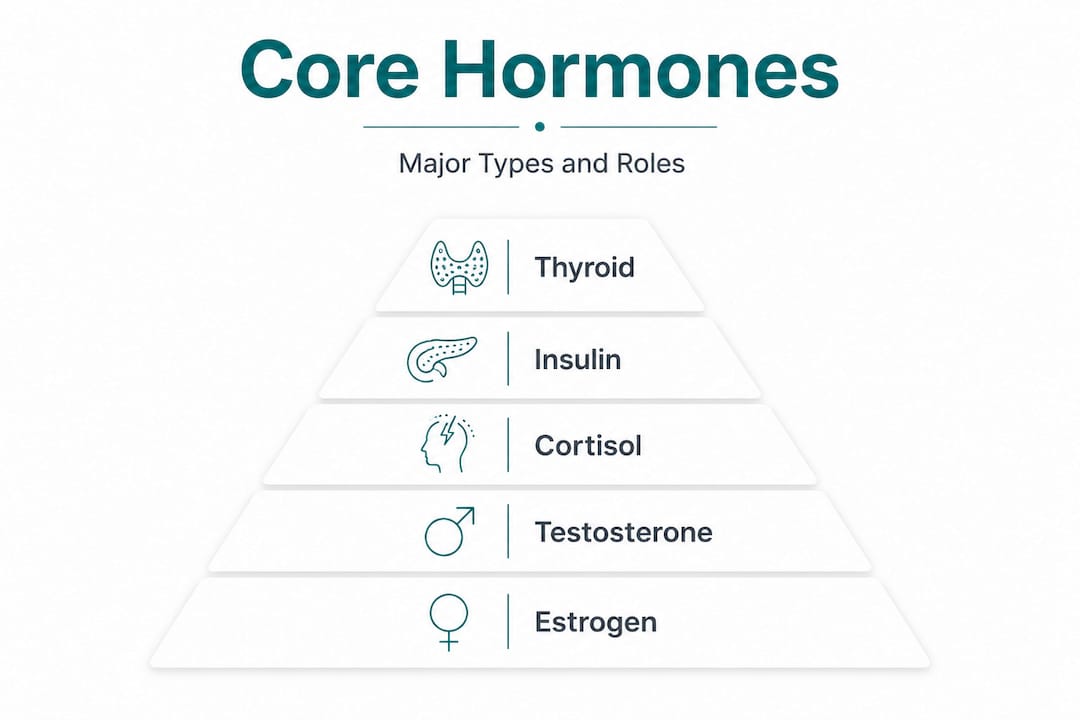
Here are the major hormones and the health functions they govern:
- Insulin regulates blood sugar and fat storage; chronic excess drives insulin resistance and type 2 diabetes
- Thyroid hormones (T3, T4) control metabolic rate, body temperature, and cognitive clarity
- Cortisol coordinates the stress response, immune suppression, and energy mobilization
- Estrogen governs reproductive health, bone density, cardiovascular protection, and mood
- Testosterone drives muscle mass, libido, energy, and red blood cell production in both men and women
- Growth hormone (GH) repairs tissues, regulates body composition, and supports fat metabolism
The range of what can go wrong is wide. Consider this overview of common imbalances:
| Hormone | Excess symptoms | Deficiency symptoms | Health impact |
|---|---|---|---|
| Thyroid (T3/T4) | Rapid heartbeat, anxiety, weight loss | Fatigue, weight gain, depression | Metabolic and cardiovascular risk |
| Cortisol | Visceral fat, high blood pressure, insomnia | Fatigue, low immunity, hypotension | Stress system dysregulation |
| Insulin | Fat gain, inflammation, cognitive fog | Low blood sugar, muscle wasting | Metabolic disease risk |
| Testosterone | Aggression, acne (in excess use) | Low libido, muscle loss, mood drops | Body composition and vitality |
| Growth hormone | Gigantism, acromegaly, joint pain | Growth defects, low muscle, fatigue | Development and tissue health |
| Estrogen | Bloating, mood swings, clot risk | Hot flashes, bone loss, depression | Reproductive and bone health |
Some edge cases reveal just how powerful these signals are. GH excess causes gigantism in children and acromegaly in adults, while deficiency leads to measurable growth defects. Women are also 5 to 8 times more prone to thyroid disorders than men, a disparity that underscores how sex biology shapes hormone vulnerability. Even stress, by elevating prolactin to pathological levels, can mimic clinical conditions.
Thyroid disorders affect up to 20 million Americans, with the majority undiagnosed or undertreated, according to the American Thyroid Association. Most cases are entirely manageable when caught early through targeted testing.
The mental health dimension runs equally deep. Estrogen modulates serotonin signaling in the brain, which is why mood often tracks hormonal cycles so predictably. This is not just relevant to women. Testosterone decline in men correlates with depression, reduced motivation, and cognitive slowing in ways that are frequently misattributed to aging or burnout. Knowing which essential hormone markers to track helps you distinguish between these possibilities with data rather than guesswork.
Hormone regulation: feedback, rhythms, and why details matter
Hormones do not operate on a simple on/off switch. They are governed by elegant regulatory systems that involve feedback loops, gland communication, and timing synchronized to your body’s internal clock.

Negative feedback is the most common regulatory mechanism. When a hormone reaches a sufficient level, the gland producing it receives a signal to slow down. Think of a thermostat: when the room hits the target temperature, the heating turns off. The hypothalamic-pituitary-thyroid axis is a classic example. The hypothalamus signals the pituitary, which signals the thyroid to produce T3 and T4. When those levels rise high enough, the hypothalamus and pituitary reduce their signaling.
Positive feedback is far rarer and more intense. Rather than shutting off production, it amplifies it. Oxytocin during labor/07%3A_Endocrine_Physiology/7.10%3A_Regulation_of_Hormone_Secretion) is the clearest example: uterine contractions trigger more oxytocin, which drives stronger contractions, until delivery ends the cycle. There is also a slower-acting mechanism called integral feedback, where glands physically change in mass over weeks to sustain the right output level. This explains why thyroid glands enlarge under chronic iodine deficiency.
| Feedback type | Mechanism | Example | Effect |
|---|---|---|---|
| Negative feedback | Rising hormone suppresses its own production | Cortisol suppressing ACTH | Maintains homeostasis |
| Positive feedback | Rising hormone stimulates more production | Oxytocin during labor | Amplifies to a threshold event |
| Integral feedback | Gland mass adapts over weeks | Thyroid enlargement in iodine deficiency | Long-term regulatory resilience |
Timing is equally critical. Hormone therapy timed to circadian rhythms maximizes benefits and minimizes side effects in treatments ranging from osteoporosis to adrenal hyperplasia. This field is called chronotherapeutics, and it is changing how clinicians think about when, not just what, to prescribe. Administering cortisol replacement in the morning mimics the natural peak and avoids disrupting sleep. Ignoring this timing can undermine even a correctly dosed therapy.
Pro Tip: If you are on any form of hormone therapy, ask your prescriber specifically about timing. Even a few hours of difference in when you take a medication can meaningfully shift how your body responds. For evidence-based guidance, explore hormone analysis best practices before your next conversation with a healthcare provider.
Personalizing health: hormone testing and using biomarker insights
Knowing that hormones matter is useful. Knowing your hormone levels is transformative. The shift from general awareness to personalized data is where real health optimization begins.
Hormone testing has expanded significantly. Comprehensive panels now cover thyroid function, adrenal output, sex hormones, growth hormone, insulin, and more. But here is the critical nuance: reference ranges versus optimal ranges are not the same thing. Reference ranges describe where 95% of a general population falls. Optimal ranges describe where people tend to feel and function best. For example, total testosterone in men spans 264 to 916 ng/dL as a reference range. That is a massive window. A man at 270 ng/dL is technically “normal,” but may experience profound fatigue, low motivation, and muscle loss compared to a man at 650 ng/dL.
| Hormone | Reference range | Functional optimal | Why it matters |
|---|---|---|---|
| Total testosterone (men) | 264 to 916 ng/dL | 500 to 800 ng/dL | Vitality, muscle, mood |
| Free T4 (thyroid) | 0.8 to 1.8 ng/dL | 1.1 to 1.6 ng/dL | Metabolic efficiency |
| Fasting insulin | 2.6 to 24.9 µIU/mL | 2 to 8 µIU/mL | Insulin sensitivity |
| Cortisol (morning) | 6 to 23 µg/dL | 15 to 20 µg/dL | Energy and immune readiness |
| Estradiol (women, follicular) | 19 to 144 pg/mL | 40 to 100 pg/mL | Mood, bone, cardiovascular |
Here is a practical framework for using hormone testing to drive real results:
- Establish a baseline. Test broadly before you have symptoms. This gives you a personal reference point, not just a population-level one.
- Interpret with context. Age, sex, lifestyle, stress load, and health goals all change what an optimal result looks like for you specifically.
- Track trends over time. A single value is a snapshot. A series of values over months is a story. Rising cortisol across three tests tells you something meaningful.
- Act early on outliers. Catching a thyroid marker drifting out of optimal range before symptoms appear gives you the widest window for lifestyle or therapeutic intervention.
- Retest after changes. Whether you adjust sleep, nutrition, supplementation, or medication, follow-up testing tells you whether it worked.
For a detailed walkthrough of interpreting your results, a step-by-step hormone analysis guide can help you move from raw data to clear action. Understanding the fundamentals of biomarker interpretation is equally important to ensure you read your results in proper context.
What most people get wrong about hormones and health
Here is the uncomfortable reality: most people who get a hormone panel done look at the result, see “normal,” and move on. That is exactly the wrong approach.
The word “normal” in medicine describes a statistical distribution. It does not describe you. It does not account for your age, your goals, your sleep quality, your stress load, or your family history. Two people with identical testosterone values can have wildly different lived experiences based on differences in receptor sensitivity, cortisol levels, and body composition. The number alone does not tell the whole story.
What we consistently observe is that single-point testing without trend analysis creates a false sense of security. Someone who tests cortisol once at 14 µg/dL looks fine. But if six months earlier it was 8 µg/dL, and six months later it is 21 µg/dL, that trajectory matters far more than any individual reading. Hormones move. Health moves with them.
The other pitfall is chasing symptoms without identifying root causes. Brain fog prompts people to reach for adaptogens. Fatigue drives supplement stacking. Low libido sparks testosterone enthusiasm. None of these are inherently wrong, but treating the symptom without knowing the driver is like fixing a warning light by covering it with tape. The real leverage comes from understanding why a hormone is out of range.
Context, not textbook ranges, is the actual tool. Your lifestyle, age, biological sex, training volume, sleep, and health goals all inform what optimal looks like for you personally. Tracking your hormonal health over time, with an eye toward trends and personal baselines, is the practice that actually moves the needle. The most actionable thing you can do is stop comparing your results to a population and start comparing them to your own history.
Next steps to optimize your hormonal health
Understanding the science of hormones is only the beginning. The real shift happens when you translate that knowledge into data about your own biology. Every person’s hormonal landscape is unique, shaped by genetics, lifestyle, environment, and goals. Generic advice can only take you so far.

Biostarks makes it possible to go further. With comprehensive biomarker testing powered by advanced Swiss mass spectrometry, you get precise, high-resolution hormone data from a simple at-home sample. No clinic visit required, no generic lab printout to decipher. You receive a clear, personalized report that shows where your markers sit relative to optimal ranges and what your trends reveal about your health trajectory. Explore the Biostarks advanced collection to find the right panel for your goals, whether you are optimizing performance, managing fatigue, or simply taking proactive control of your long-term wellness.
Frequently asked questions
What are the most important hormones to test for overall health?
The most important hormones to test typically include thyroid hormones, insulin, cortisol, testosterone or estrogen, and growth hormone, as top hormone markers collectively reflect metabolic, reproductive, and stress system function across many body systems.
How does stress influence hormone levels?
Stress significantly increases cortisol and prolactin, and elevated prolactin can disrupt other hormone systems and even mimic disease states if levels remain chronically high without an obvious reproductive cause.
Why is hormone timing important for therapy?
Timing hormone therapies to align with your body’s circadian rhythms often significantly boosts their effectiveness and reduces unwanted side effects, making when you take a therapy nearly as important as what you take.
What is the difference between reference and optimal hormone ranges?
Reference ranges reflect population averages, but optimal ranges are narrower and targeted at functional health, allowing for more precise interventions that address how you actually feel and perform rather than how you compare statistically.
Recommended
- Why track hormonal health for personalized we… | Biostarks
- What is hormone profiling: a guide to wellnes… | Biostarks
- Top hormone markers: essential examples for h… | Biostarks
- How to analyze hormone balance: at-home guide | Biostarks
- Comprehensive Wellness: Transforming Whole-Body Health
- How Genetic Testing Drives Better Wellness, Health, and Prevention


