

TL;DR:
- Hormone imbalance symptoms often overlap, making at-home testing crucial for accurate diagnosis.
- Blood tests analyzed by accredited labs using LC-MS/MS provide the most reliable hormone data.
- Long-term trends from repeated testing help identify meaningful health patterns over time.
You wake up tired despite eight hours of sleep. Your mood shifts without warning. The scale creeps up even though nothing in your diet has changed. These are not random complaints. They are often signals that your hormones are out of sync, and most people spend years chasing symptoms without ever looking at the underlying data. This guide walks you through how to analyze your hormone balance at home, from choosing the right test to reading your results and knowing when to act. If you have ever wanted to move from guessing to knowing, this is where that shift begins.
Table of Contents
- Understanding hormone balance and its role in your health
- Tools and requirements for at-home hormone analysis
- Step-by-step guide: How to collect and submit your samples
- Interpreting your hormone test results: What the numbers mean
- What most guides get wrong about analyzing hormones at home
- Analyze your hormone balance with easy, science-backed tools
- Frequently asked questions
Key Takeaways
| Point | Details |
|---|---|
| Hormone balance impacts health | Understanding your hormone levels helps optimize mood, energy, and metabolism. |
| Choose the right test | Blood tests are most accurate, but saliva and urine reveal additional patterns. |
| Follow careful steps | Proper prepping and sample collection ensures your at-home results are reliable. |
| Interpret with context | Don’t focus on a single number—look for trends and consult with a professional when in doubt. |
Understanding hormone balance and its role in your health
Hormones are chemical messengers that regulate nearly every system in your body. Sleep, metabolism, mood, libido, muscle repair, immune function — all of it runs on hormonal signals. When those signals are off, even slightly, the downstream effects can feel enormous and frustratingly vague.
The importance of hormone balance goes well beyond reproductive health. Cortisol governs your stress response and blood sugar. Thyroid hormones control your metabolic rate. Insulin determines how your cells use fuel. Testosterone and estrogen shape body composition, cognition, and energy in both men and women. When any of these fall out of range, the effects ripple outward.
Common signs of hormonal imbalance include:
- Persistent fatigue that does not improve with rest
- Unexplained weight gain or difficulty losing fat
- Brain fog or difficulty concentrating
- Disrupted sleep patterns or insomnia
- Mood swings, anxiety, or low motivation
- Reduced libido or reproductive changes
- Skin issues, hair thinning, or brittle nails
The challenge is that these symptoms overlap with dozens of other conditions. That is exactly why testing matters. Without data, you are guessing. With data, you have a starting point for real intervention.
Not all testing methods are equal. Hormone profiling for wellness can be done through blood, saliva, or urine, and each fluid tells a slightly different story. Blood is the most established method for clinical diagnosis. Saliva and urine can reveal free hormone levels and metabolite patterns that blood sometimes misses.
“Blood tests are the most validated for diagnosis, but saliva and urine provide other insights” — particularly around free hormone fractions and daily fluctuation patterns.
Understanding which method fits your goals is the first step toward a smarter, more targeted approach to your hormonal health.
Tools and requirements for at-home hormone analysis
With an understanding of what hormone balance is, the next step is knowing what you will need to start your own analysis at home. The good news is that at-home hormone testing has become significantly more accessible and more accurate over the past few years.
Here is a quick comparison of the three main sample types used in at-home hormone testing:
| Sample type | Best for | Accuracy | Ease of collection | Standardization |
|---|---|---|---|---|
| Blood (dried spot) | Broad hormone panel | High | Moderate | High |
| Saliva | Free cortisol, DHEA | Moderate | Easy | Moderate |
| Urine (dried) | Metabolites, estrogen breakdown | Moderate | Easy | Lower |
As research confirms, saliva and urine tests are better for free hormones and metabolites, but less standardized compared to blood. For most people starting out, a blood-based panel analyzed by an accredited lab gives you the most reliable baseline.
A typical at-home hormone kit includes:
- Collection device (lancet, swab, or collection cup)
- Sample storage card or tube with stabilizing agent
- Biohazard bag for safe transport
- Pre-paid return shipping label
- Digital instructions and access to your results portal
When choosing a kit, look at which specific hormones are measured. A basic panel might cover testosterone and estradiol. A more detailed step-by-step hormone analysis will include cortisol, DHEA-S, thyroid markers, insulin, and sex hormone binding globulin (SHBG). The more context you have, the more useful the results.
For at-home biomarker testing to be meaningful, the lab processing your sample needs to be accredited. Look for ISO 15189 certification or equivalent national accreditation. This is not a minor detail. It is the difference between actionable data and noise.
Pro Tip: Before ordering any kit, download the sample instructions and read them fully. Timing errors and improper storage are the most common reasons for invalid results — and they are entirely preventable.
Step-by-step guide: How to collect and submit your samples
Once you have selected your testing method and kit, it is essential to follow proper sample collection and submission steps for accurate results. Sloppy collection is the single biggest source of error in at-home testing. Here is how to do it right.
Before you collect:
- Schedule your collection for the morning, ideally between 7 and 9 a.m. Many hormones, especially cortisol, follow a diurnal rhythm and peak in the early morning.
- Fast for at least 8 hours if your kit requires it. Some panels need a fasted state for accurate insulin and glucose-related markers.
- Avoid intense exercise for 24 hours before collection. Strenuous activity can spike cortisol and testosterone temporarily.
- Stay well hydrated the night before, especially for blood spot tests.
- Avoid alcohol, caffeine, and supplements that could interfere with specific markers unless your kit explicitly allows them.
During collection:
- Wash your hands thoroughly with soap and warm water. Dry completely.
- Follow your kit’s specific protocol for blood (fingerprick), saliva (passive drool or swab), or urine (midstream catch or first morning void).
- Fill the collection device to the indicated line. Underfilling is a common mistake.
- Label your sample clearly with your name, date, and time of collection.
- Seal the sample in the provided biohazard bag immediately.
After collection:
- Allow blood spot cards to air-dry fully before sealing, usually 30 minutes.
- Store samples at room temperature or as directed. Do not refrigerate unless instructed.
- Ship the same day or the next morning using the pre-paid label.
The lab’s analytical method matters here too. LC-MS/MS is more precise than immunoassay methods for hormone measurement, particularly at low concentrations. Choosing a service that uses liquid chromatography-mass spectrometry (LC-MS/MS) means your results carry more clinical weight.
Timing is everything in hormone testing. A cortisol sample collected at noon instead of 8 a.m. can look like adrenal insufficiency when everything is actually normal.
For a smoother process, review the optimizing hormone analysis workflow guide before your first collection. And if you want to assess metabolic health naturally alongside your hormone data, plan both tests around the same collection window.

Pro Tip: Photograph your completed sample card before sealing and shipping. If there is ever a question about fill level or sample quality, you have a visual record.
Interpreting your hormone test results: What the numbers mean
After sending your samples, you will receive your results. Here is how to break them down and what you should look for.
Your report will list each hormone alongside a measured value and a reference range. That range represents the typical spread seen in a healthy population. Being outside that range does not automatically mean something is wrong, but it is a signal worth investigating.
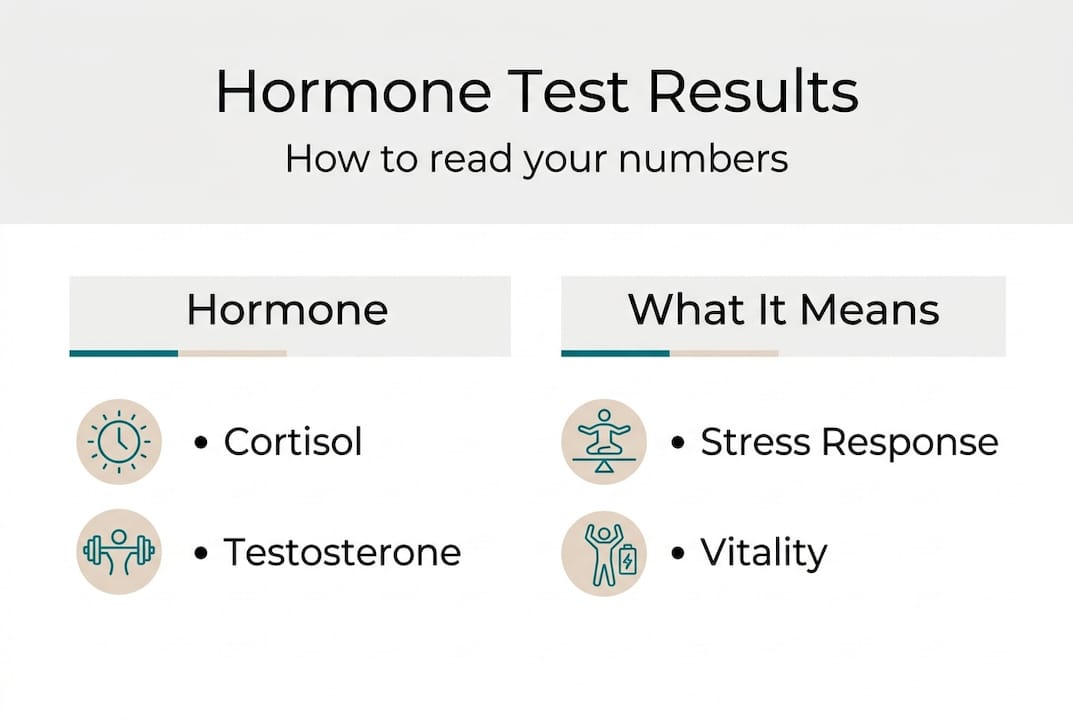
Here is a quick reference for common hormones and what elevated or low results might suggest:
| Hormone | Low result may indicate | High result may indicate |
|---|---|---|
| Cortisol | Adrenal fatigue, HPA axis dysregulation | Chronic stress, Cushing’s syndrome |
| Testosterone | Low energy, reduced muscle mass | PCOS (women), anabolic use |
| Estradiol | Menopause, low bone density | Estrogen dominance, poor metabolism |
| DHEA-S | Adrenal insufficiency, aging | Adrenal overactivity |
| TSH (thyroid) | Hyperthyroidism | Hypothyroidism |
For tracking hormonal health over time, context matters as much as the number itself. A testosterone level at the low end of normal means something very different for a 28-year-old athlete than for a 55-year-old managing fatigue.
Key things to look for in your results:
- Values that fall consistently near the edge of a reference range
- Patterns across multiple related hormones (cortisol and DHEA together, for example)
- Changes from a previous test that shift the trend in one direction
Research confirms that blood tests remain the gold standard for diagnosis, while saliva and urine elucidate broader patterns and metabolites that add important context. Using both over time gives you a richer picture.
Knowing the ways to track metabolic health alongside your hormones helps you connect the dots between energy, body composition, and endocrine function.
If any result falls significantly outside the reference range, or if you notice a strong trend across multiple markers, consult a healthcare provider before making changes to supplementation, medication, or diet.
What most guides get wrong about analyzing hormones at home
Here is something most how-to guides overlook: a single hormone test is almost never enough to act on. The wellness space loves to treat one lab result as a diagnosis. It is not.
Hormone levels fluctuate based on sleep quality the night before, what you ate, how stressed you were, and even the time of day you collected your sample. A one-time cortisol result that looks low might just mean you slept unusually well that week. A testosterone reading that looks high might reflect a temporary spike from a hard training block.
The real value of at-home testing comes from wellness hormone profiling done repeatedly over months. Trends are where the signal lives. Three tests over six months showing a consistent downward trend in DHEA-S tells you something meaningful. One test does not.
Lifestyle factors shift hormone levels more than most people expect. A week of poor sleep can suppress testosterone by 10 to 15 percent. Chronic caloric restriction tanks estrogen. High psychological stress keeps cortisol elevated for weeks. These are not edge cases. They are the norm for most busy, high-performing individuals.
The smarter approach is to treat each test as a data point in a longer story, not a verdict. Collect, interpret, adjust your lifestyle or protocol, and test again. That longitudinal loop is where real optimization happens.
Analyze your hormone balance with easy, science-backed tools
If you are ready to move from symptom-guessing to data-driven decisions, Biostarks makes that transition straightforward. Our at-home hormone panels use advanced Swiss mass spectrometry to deliver the kind of precision that used to require a clinic visit.
From the moment your kit arrives, the process is designed to be simple. Clear collection instructions, secure pre-paid shipping, and accredited lab processing mean your results are both easy to obtain and clinically meaningful. Once your report is ready, you get actionable insights, not just numbers on a page. Whether you are tracking cortisol patterns, assessing sex hormone balance, or monitoring thyroid function, Biostarks gives you the full picture. Explore our hormone panels at biostarks.com and start building your personal health baseline today.
Frequently asked questions
What is the most reliable way to test hormone balance at home?
Blood tests analyzed with LC-MS/MS are the gold standard for accuracy, while saliva and urine may reveal free hormones and patterns but are less standardized overall.
How often should I analyze my hormone balance?
For meaningful trend insights, test every 3 to 6 months, or follow your healthcare provider’s guidance based on your specific symptoms and health goals.
Can lifestyle changes be tracked through at-home hormone testing?
Yes. Serial testing can reveal hormone trends related to lifestyle shifts in diet, exercise, sleep, and stress management over time.
What should I do if my hormone levels are out of the normal range?
Always consult a healthcare provider to interpret out-of-range results and determine a safe, evidence-based action plan before making any significant changes.


