

TL;DR:
- Micronutrient deficiencies are common globally and can undermine energy, immunity, and health without obvious symptoms.
- Personalized biomarker testing enables precise assessment of vitamin levels, guiding targeted dietary or supplement interventions.
- A food-first approach complemented by data-driven supplementation offers the most effective strategy for optimizing long-term health.
Eating well feels like enough. You load your plate with vegetables, choose whole grains, and skip the junk food. Yet one third of the global population still has micronutrient deficiencies, many of them undetected and quietly undermining energy, immunity, and metabolic performance. A balanced diet is a strong foundation, but it is not a guarantee. Genetics, gut health, lifestyle, and life stage all shape how your body absorbs and uses vitamins. The good news is that personalized biomarker testing now makes it possible to move from guessing to knowing, and from generic advice to a strategy built around your actual biology.
Table of Contents
- What vitamins do for energy, metabolism, and wellness
- How much do you need? RDAs, AIs, and upper limits explained
- Personalizing vitamin status: The science of at-home biomarker testing
- Leveraging data: How to optimize your vitamin plan
- An expert perspective: Food first, testing always, supplements only when needed
- Ready to upgrade your vitamin wellness?
- Frequently asked questions
Key Takeaways
| Point | Details |
|---|---|
| Vitamins drive wellness | Vitamins are essential for energy, metabolism, immune health, and cognitive function. |
| Personalize with testing | At-home biomarker testing accurately reveals your vitamin status to guide smarter choices. |
| Balance is critical | Meeting vitamin needs is vital, but more is not always better—follow expert intake guidance. |
| Food trumps supplements | Prioritize a diverse, vitamin-rich diet and use supplements only to correct specific deficiencies. |
| Track and adapt | Monitor your levels and tailor your vitamin approach as your health and lifestyle evolve. |
What vitamins do for energy, metabolism, and wellness
Vitamins are not optional extras. They are essential micronutrients your body cannot produce in sufficient quantities on its own, which means every cell depends on what you eat and absorb. Without them, core physiological systems start to slow down in ways that are easy to miss until the effects become hard to ignore.
The B-complex vitamins are where the metabolic story gets most interesting. B vitamins act as coenzymes in energy metabolism, driving the breakdown of glucose, fatty acids, and amino acids into usable fuel. Think of them as the spark plugs in your metabolic engine. Thiamin (B1), riboflavin (B2), niacin (B3), and B12 are each involved in distinct steps of the Krebs cycle and electron transport chain. Remove any one of them and energy output drops.
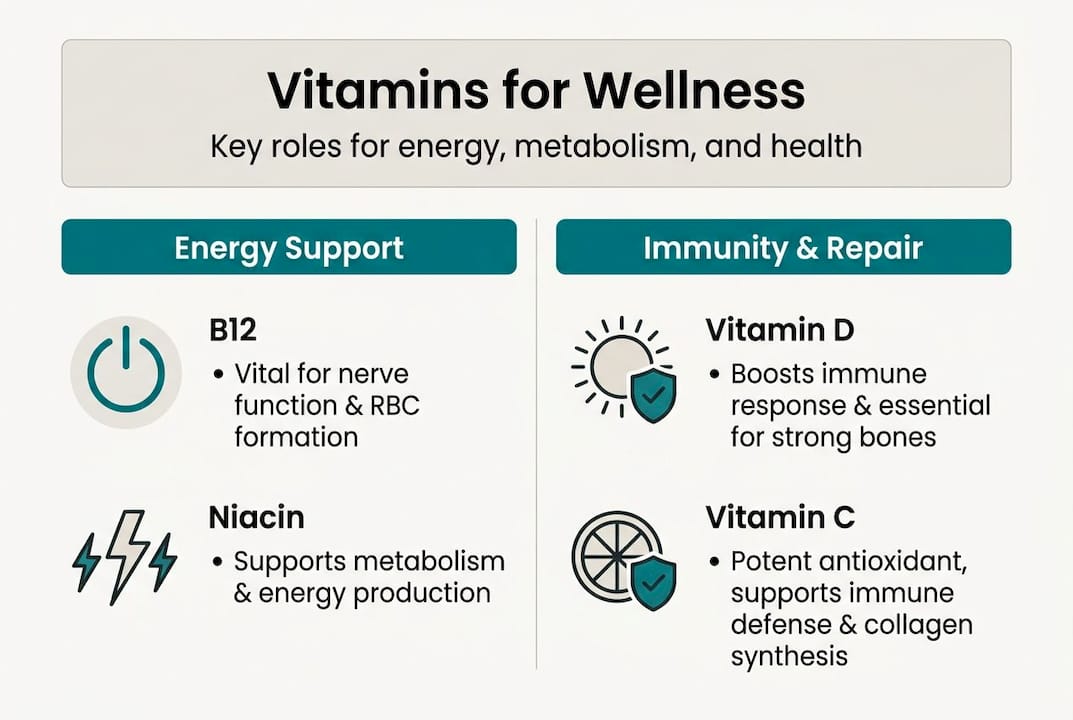
Vitamin C plays a different but equally critical role. As a potent antioxidant, it neutralizes free radicals generated during intense exercise and normal cellular activity, protecting tissue from oxidative damage. It also supports collagen synthesis, immune cell function, and iron absorption from plant foods. Vitamin D, meanwhile, acts more like a hormone than a classic vitamin. It regulates calcium metabolism for bone density, modulates immune responses, and influences gene expression in hundreds of tissues.
Common consequences of vitamin deficiency include:
- Persistent fatigue and low motivation (B12, iron, vitamin D)
- Frequent infections and slow recovery (vitamins C and D)
- Brain fog and difficulty concentrating (B12, folate)
- Muscle weakness and bone pain (vitamin D)
- Poor skin and wound healing (vitamins A and C)
“Micronutrient deficiencies affect cognitive performance, immune resilience, and physical endurance long before clinical symptoms appear.”
Pro Tip: If you have been struggling with unexplained fatigue, B12 and vitamin D are the first biomarkers worth checking. Many people see a measurable lift in energy and mental clarity within weeks of correcting a deficiency. Explore wellness optimization strategies to see how biomarker data connects to real performance gains.
For a practical overview of which vitamins for energy matter most, Harvard Health provides a useful breakdown by function.
How much do you need? RDAs, AIs, and upper limits explained
Knowing that vitamins matter is one thing. Knowing exactly how much you need is where most people get stuck. The science here is more nuanced than the label on a supplement bottle suggests.
The Institute of Medicine and NIH establish RDAs and upper limits to define both adequate intake and toxicity thresholds. The Recommended Dietary Allowance (RDA) is the daily amount sufficient to meet the needs of roughly 97% of healthy adults. The Adequate Intake (AI) is used when evidence is not strong enough to set a firm RDA. The Upper Tolerable Limit (UL) is the maximum daily intake unlikely to cause harm.
| Vitamin | RDA (adults) | Upper limit (UL) | Risk of excess |
|---|---|---|---|
| Vitamin D | 600 IU | 4,000 IU | Hypercalcemia, kidney damage |
| Vitamin A | 700-900 mcg | 3,000 mcg | Liver toxicity, birth defects |
| Vitamin C | 75-90 mg | 2,000 mg | GI distress, kidney stones |
| Folate | 400 mcg | 1,000 mcg | May mask B12 deficiency |
| Vitamin B12 | 2.4 mcg | Not established | Generally well tolerated |
For vitamin RDA guidance tailored to specific health goals, Harvard’s reference guide is worth bookmarking.
Life stages and situations that shift your needs:
- Pregnancy increases folate, iron, and vitamin D requirements significantly
- Adults over 65 absorb B12 less efficiently due to reduced stomach acid
- Vegans and vegetarians are at higher risk for B12, D, and zinc gaps
- Athletes with high training loads deplete B vitamins and antioxidants faster
- People with digestive conditions like Crohn’s or celiac disease often have impaired absorption
Pro Tip: Chasing the highest dose is not the goal. Optimal is not the same as maximal. Fat-soluble vitamins (A, D, E, K) accumulate in tissue and can reach toxic levels over time. More is not better unless your data says you are deficient.
Personalizing vitamin status: The science of at-home biomarker testing
Standard dietary advice gives you population averages. Your body is not average. This is where at-home biomarker testing changes the game entirely.
At-home biomarker testing uses finger-prick blood samples to measure key vitamin markers including 25-OH vitamin D, B12, folate, and more. Dried blood spot technology has advanced significantly, and modern assays now deliver lab-grade accuracy from a small sample collected at home. No clinic visit, no waiting room, no disrupted schedule.

| Feature | At-home testing | Traditional lab testing |
|---|---|---|
| Sample type | Finger-prick dried blood spot | Venous blood draw |
| Convenience | Home, any time | Clinic appointment required |
| Turnaround | 3 to 5 days | 1 to 7 days |
| Accuracy | High (validated assays) | High |
| Cost | Typically lower | Variable, often higher |
| Data access | Digital report with insights | Paper or portal results |
Steps for self-sampling and using your results:
- Order your testing kit and review the instructions before starting
- Collect your sample first thing in the morning before eating or drinking
- Allow the dried blood spot card to dry fully before sealing and mailing
- Receive your digital report and review each biomarker against reference ranges
- Identify any values outside optimal zones and flag them for action
- Share results with your nutritionist or healthcare provider if needed
For a detailed walkthrough, the at-home testing guide covers every step from collection to interpretation. To understand why catching deficiencies early matters, the personal health impact of testing article makes the case clearly.
Pro Tip: Retest every 3 to 6 months when actively adjusting your diet or supplementation. A single data point tells you where you are. A trend tells you whether your strategy is actually working.
Leveraging data: How to optimize your vitamin plan
Data without action is just numbers. Once you have your biomarker results, the next step is translating them into a practical, sustainable plan.
If your results show a deficiency, the first move is food. Supplements are a tool, not a replacement for nutritional variety. Prioritize food sources for vitamins first, and use testing to identify the specific gaps where supplementation is genuinely warranted.
Best food sources by vitamin group:
- B12: Meat, fish, eggs, dairy, and fortified plant milks
- Vitamin D: Fatty fish, egg yolks, fortified foods, and sun exposure
- Folate: Dark leafy greens, legumes, avocado, and citrus
- Vitamin C: Bell peppers, kiwi, strawberries, and broccoli
- Vitamin A: Liver, sweet potato, carrots, and leafy greens
The food matrix effect is real. Nutrients in whole foods come packaged with fiber, phytonutrients, and cofactors that improve absorption and synergy. A supplement delivers an isolated compound. The understanding vitamin synergy framework explains why this distinction matters for long-term outcomes.
For older adults, the evidence does support supplementation in specific cases. The COSMOS trial showed that multivitamin supplementation improved global cognition over two years in adults over 60, a finding that has reshaped how clinicians think about supplements for aging populations.
Ongoing tracking and adjustment steps:
- Establish your baseline with a full vitamin panel
- Adjust diet based on identified gaps before adding supplements
- If supplementing, choose bioavailable forms (methylcobalamin for B12, D3 for vitamin D)
- Retest after 90 days to measure response
- Use data-driven wellness strategies to refine your approach over time
- Track trends across seasons, especially vitamin D in winter months
“The goal is not a perfect number on a lab report. It is sustained, measurable improvement in how you feel and function.”
Pro Tip: One of the most common mistakes when starting a new vitamin routine is adding multiple supplements at once. If something helps or hurts, you will not know which one caused it. Introduce changes one at a time and use tracking vitamin levels to build a clear picture.
An expert perspective: Food first, testing always, supplements only when needed
Supplement culture has a convincing pitch: take this pill and fix that problem. It is clean, simple, and mostly wrong. The reality is that diets rich in vitamins lower chronic disease risk in ways that isolated supplements rarely replicate unless a true deficiency exists. Food delivers context. A pill delivers a compound.
What most wellness conversations still miss is that the real risk is not just deficiency. It is also excess. Over-supplementing fat-soluble vitamins without testing is a slow, invisible problem that builds over months. Routine testing is not about anxiety. It is about precision. You would not manage your finances without checking your account balance. Your biology deserves the same discipline.
We believe the future of vitamin wellness is not a better multivitamin. It is a personalized protocol built on real data, adjusted over time, and grounded in food quality first. Supplements earn their place in specific, documented situations. Testing, guided by biomarkers for personal health, is what separates strategy from guesswork.
Ready to upgrade your vitamin wellness?
You now have a clear picture of how vitamins drive your energy, metabolism, and long-term health. The next logical step is finding out exactly where you stand. Generic advice can only take you so far.
Biostarks makes it easy to test your key vitamin biomarkers from home using advanced Swiss mass spectrometry. With a simple finger-prick sample, you get a detailed digital report showing exactly which levels need attention and which are already optimized. No clinic visits, no guesswork. Start with personalized vitamin testing and use the insights to build a plan that actually fits your biology. Learn more about how at-home biomarker testing works and take the first step today.
Frequently asked questions
Which vitamins impact energy and metabolism most?
B vitamins act as coenzymes in energy and metabolic pathways, making B12, thiamin, and niacin the most critical for sustained energy production and efficient fuel conversion.
How do I know if I need a vitamin supplement?
At-home biomarker testing measures your actual vitamin D, B12, folate, and other levels from a finger-prick sample, giving you evidence-based clarity instead of relying on symptoms alone.
Are there risks to getting too many vitamins?
Yes. Upper limits prevent vitamin toxicity for fat-soluble vitamins like A, D, E, and K, which accumulate in body tissue and can cause serious health issues when consistently exceeded.
Is diet or supplementation better for meeting vitamin needs?
Food sources offer better synergy through the food matrix effect, making a varied whole-food diet the first choice, with supplements reserved for documented deficiencies or specific life-stage needs.
Recommended
- How to improve vitamin levels for optimal health | Biostarks
- Wellness optimization strategies for personal… | Biostarks
- Wellness optimization checklist: 25% better m… | Biostarks
- Optimize metabolic function for peak health i… | Biostarks
- Healthy Cookware Explained: Essential Guide to Safe Choices – Brass & Steel


